Crystal structure prediction using graph neural combinatorial optimization
Pith reviewed 2026-05-08 04:46 UTC · model grok-4.3
The pith
Graph neural networks allocate atoms on discrete positions to predict crystal structures, outperforming heuristics and competing with commercial solvers.
A machine-rendered reading of the paper's core claim, the machinery that carries it, and where it could break.
Core claim
We demonstrate a neural combinatorial optimization method for crystal structure prediction using graph neural networks to sample feasible atomic structures unsupervised. Leveraging expander graphs over discrete positions to model short- and long-range interactions and the Gumbel-Sinkhorn approach to enforce stoichiometry, the technique produces structures that outperform classical heuristic approaches and compete with a commercial optimization solver across different chemical compositions.
What carries the argument
Graph neural network operating on expander graphs of discrete atomic positions, with a Gumbel-Sinkhorn layer to enforce stoichiometry.
If this is right
- Scaling crystal structure prediction to larger and more complex systems becomes feasible by utilizing expanding GPU resources.
- Computational costs for CSP decrease compared to exact optimization methods for large instances.
- Exploration of atomic configuration space is possible without symmetry constraints or labeled data.
- Integration into broader materials discovery pipelines accelerates the identification of new functional materials.
Where Pith is reading between the lines
- This method might extend to optimizing other discrete placement problems in chemistry, such as molecular packing.
- Combining the GNN sampler with more accurate energy models could improve the reliability of predicted structures.
- Testing on periodic systems with defects or interfaces could reveal limitations in the current graph construction.
- The competitive performance suggests potential for hybrid approaches with traditional solvers for even better results.
Load-bearing premise
The expander graphs over discrete positions capture the essential short- and long-range atomic interactions needed for the neural network to distinguish low-energy structures.
What would settle it
If the method is applied to a set of well-known crystal compositions and consistently fails to find structures with energies matching or better than known ground states within the solver's time frame, the performance claim would be falsified.
Figures



read the original abstract
Crystalline materials are widely used in technological applications, yet their discovery remains a significant challenge. As their properties are driven by structure, crystal structure prediction (CSP) methods play a central role in computational approaches aiming to accelerate this process. Previously, CSP has been approached from a combinatorial optimization perspective, with the core challenge of allocating atoms on a fine grid of predefined discrete positions within a unit cell while minimizing their interaction energy. Exact mathematical optimization methods provide guaranteed solutions, but they become computationally expensive for large-scale instances, where the atomic configuration space grows rapidly, particularly in the absence of additional symmetry constraints. In this work, we introduce a neural combinatorial optimization approach to the atom allocation challenge and, subsequently, CSP, based on graph neural networks (GNNs), which can effectively sample from the distribution of feasible structures in an unsupervised manner. We leverage expander graphs to construct computational graphs over discrete positions that capture both short- and long-range interactions between atoms, and employ the Gumbel-Sinkhorn approach to enforce the desired stoichiometry of the generated structures. We demonstrate that our method outperforms classical heuristic approaches and is competitive with a commercial optimization solver across a range of chemical compositions. This enables the use of ever-expanding GPU infrastructure to tackle the inherent combinatorial challenges of CSP, paving the way for scaling beyond current capabilities.
Editorial analysis
A structured set of objections, weighed in public.
Referee Report
Summary. The paper introduces a neural combinatorial optimization method for crystal structure prediction (CSP) by framing atom allocation on a discrete grid as a combinatorial problem. It constructs expander graphs over positions to model short- and long-range interactions, employs Gumbel-Sinkhorn layers to enforce stoichiometry, and uses a GNN to sample feasible low-energy structures in an unsupervised manner. The central claim is that this approach outperforms classical heuristics and is competitive with a commercial solver across chemical compositions, enabling GPU scaling for larger CSP instances.
Significance. If the benchmarks hold, the work offers a meaningful advance by integrating GNN message passing with combinatorial techniques (expander graphs and Gumbel-Sinkhorn) to address the exponential growth of configuration space in CSP. The unsupervised sampling and explicit motivation for long-range encoding via expanders are strengths that could complement existing ML-CSP pipelines and leverage expanding GPU resources.
major comments (2)
- [§3.1] §3.1 (expander graph construction): The claim that expander graphs capture both short- and long-range interactions sufficiently for feasible low-energy sampling is load-bearing for the outperformance result; the manuscript should include a controlled comparison (e.g., against k-nearest-neighbor graphs or full-interaction baselines on small cells) to quantify the contribution of the expansion property.
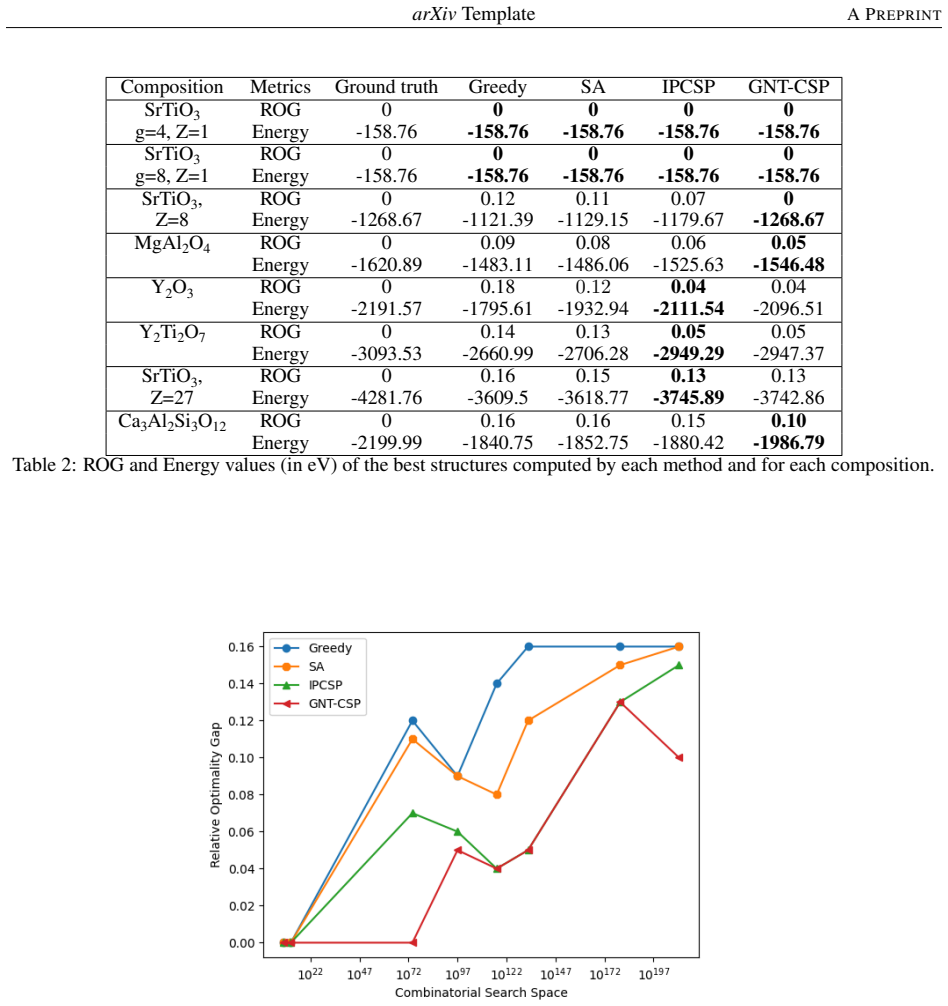
- [Results section] Results section, benchmark tables: The competitiveness with the commercial solver is central to the main claim, yet the manuscript must report exact solver time limits, hardware, and whether the GNN sampling budget was matched to the solver's; without these controls the comparison risks being non-equivalent.
minor comments (3)
- [Abstract] Abstract: Add at least one quantitative metric (e.g., success rate or energy difference) and mention of error bars or number of compositions to make the outperformance claim verifiable from the summary.
- [Notation] Notation: Define the discrete position set and stoichiometry vector consistently across equations; the current presentation occasionally overloads symbols for grid points and atom types.
- [Figure 2] Figure 2 (or equivalent): The diagram of the GNN + Gumbel-Sinkhorn pipeline would benefit from an explicit legend distinguishing message-passing edges from the Sinkhorn projection step.
Simulated Author's Rebuttal
We thank the referee for the constructive feedback and for recognizing the potential of integrating GNNs with combinatorial optimization techniques for crystal structure prediction. We address each major comment below and have prepared revisions to enhance the manuscript's rigor and transparency.
read point-by-point responses
-
Referee: [§3.1] §3.1 (expander graph construction): The claim that expander graphs capture both short- and long-range interactions sufficiently for feasible low-energy sampling is load-bearing for the outperformance result; the manuscript should include a controlled comparison (e.g., against k-nearest-neighbor graphs or full-interaction baselines on small cells) to quantify the contribution of the expansion property.
Authors: We agree that an explicit ablation would better substantiate the role of the expansion property. In the revised manuscript we will add a controlled comparison on small cells, evaluating expander graphs against k-nearest-neighbor graphs and dense (full-interaction) baselines. The new experiments will report sampling success rates and achieved energies, thereby quantifying the contribution of long-range connectivity provided by the expander construction. revision: yes
-
Referee: Results section, benchmark tables: The competitiveness with the commercial solver is central to the main claim, yet the manuscript must report exact solver time limits, hardware, and whether the GNN sampling budget was matched to the solver's; without these controls the comparison risks being non-equivalent.
Authors: We acknowledge that precise experimental controls are necessary for a fair comparison. We will revise the results section and benchmark tables to state the exact wall-clock time limits and hardware platform used for the commercial solver. We will also document the GNN sampling budget (number of forward passes and temperature schedule) and confirm that it was calibrated to be comparable in total compute to the solver's allotted time, thereby ensuring equivalence of the reported performance. revision: yes
Circularity Check
No significant circularity in derivation chain
full rationale
The paper introduces a new unsupervised neural combinatorial optimization procedure for CSP: GNN message passing on expander graphs over discrete positions, combined with Gumbel-Sinkhorn for stoichiometry enforcement. Performance is evaluated empirically against classical heuristics and a commercial solver on multiple compositions. No load-bearing step reduces by construction to a fitted parameter, self-definition, or self-citation chain; the expander-graph construction and training objective are explicitly specified as independent design choices motivated by interaction range, and the reported outperformance is not claimed as a first-principles derivation but as algorithmic benchmarking. The method is self-contained against external benchmarks.
Axiom & Free-Parameter Ledger
free parameters (1)
- GNN architecture hyperparameters
axioms (1)
- domain assumption Expander graphs adequately encode short- and long-range atomic interactions for the purpose of structure sampling
Reference graph
Works this paper leans on
-
[1]
doi:10.1021/cr2003272. Stefano Curtarolo, Gus L. W. Hart, Marco Buongiorno Nardelli, Natalio Mingo, Stefano Sanvito, and Ohad Levy. The high-throughput highway to computational materials design.Nature Materials, 12(3):191–201, 2013. ISSN 1476-4660. doi:10.1038/nmat3568. URLhttps://doi.org/10.1038/nmat3568. Anubhav Jain, Shyue Ping Ong, Geoffroy Hautier, W...
-
[2]
doi:10.4230/LIPIcs.MFCS.2022.8. Vladimir V Gusev, Duncan Adamson, Argyrios Deligkas, Dmytro Antypov, Christopher M Collins, Piotr Krysta, Igor Potapov, George R Darling, Matthew S Dyer, Paul Spirakis, et al. Optimality guarantees for crystal structure prediction.Nature, 619(7968):68–72, 2023. OI Pulkkinen, P Gautam, V Mustonen, and T Aittokallio. Multiobj...
-
[3]
Naval Re- search Logistics Quarterly2(1-2), 83–97 (1955).https://doi.org/https://doi
doi:https://doi.org/10.1002/nav.3800020109. URL https://onlinelibrary.wiley.com/doi/abs/10. 1002/nav.3800020109. Gurobi Optimization, LLC. Gurobi Optimizer Reference Manual, 2024. URLhttps://www.gurobi.com. Vijay V . Vazirani.Approximation Algorithms. Springer Publishing Company, Incorporated, 2010. ISBN 3642084699. Ilhem Quenel Boussaid, Julien Lepagnot,...
-
[4]
PoseNet: A convolutional network for real-time 6-dof camera relocalization,
Curran Associates Inc. Diederik P. Kingma and Max Welling. Auto-Encoding Variational Bayes. In2nd International Conference on Learning Representations, 2014. George Papandreou and Alan L. Yuille. Perturb-and-map random fields: Using discrete optimization to learn and sample from energy models. InProceedings of the 2011 International Conference on Computer...
discussion (0)
Sign in with ORCID, Apple, or X to comment. Anyone can read and Pith papers without signing in.