Synchronized molecular dynamics method for thin-layer flows of complex fluids
Pith reviewed 2026-05-08 01:36 UTC · model grok-4.3
The pith
The synchronized molecular dynamics method lets sparse local molecular simulations reproduce thin-layer flows of complex fluids by linking them only through overall conservation laws.
A machine-rendered reading of the paper's core claim, the machinery that carries it, and where it could break.
Core claim
By sparsely distributing MD cells along the channel and iteratively adjusting the external force on each cell to enforce the macroscopic continuity equation, the method obtains consistent cross-sectional velocity profiles and streamwise pressure distributions for thin-layer flows. Validation against a modified Reynolds equation with slip for Lennard-Jones fluids in wedge channels confirms accuracy, while application to Kremer-Grest polymer flows shows that shear-thinning and conformation changes emerge naturally from the molecular dynamics without any prescribed model.
What carries the argument
The synchronized molecular dynamics (SMD) method, which sparsely places local MD cells along the channel and couples them by iteratively updating external forces to satisfy the macroscopic continuity equation.
If this is right
- Pressure-driven and wall-driven flows of simple fluids match a slip-corrected Reynolds equation without any fitted parameters.
- Polymeric flows at high pressure differences exhibit shear-thinning and chain conformation changes that arise directly from the molecular model.
- No constitutive relation or boundary condition needs to be supplied in advance for either Newtonian or non-Newtonian cases.
- The computational cost scales with the number of sparse cells rather than the full domain length.
Where Pith is reading between the lines
- The same synchronization idea could be tested in non-wedge geometries or unsteady flows where interfacial effects dominate.
- Coupling the SMD cells to a coarser continuum solver at larger scales might extend the method to engineering-length lubrication problems.
- Direct comparison against full MD in longer channels would quantify how far the separation-of-scales assumption holds.
Load-bearing premise
The flow can be split into local cross-sectional molecular motion and overall streamwise transport that can be linked using only global conservation rules.
What would settle it
Running a full-domain molecular dynamics simulation of the entire thin-layer geometry and comparing the resulting velocity profiles and pressure distribution with those from the SMD method; any statistically significant mismatch would show the synchronization step fails to capture the physics.
Figures




read the original abstract
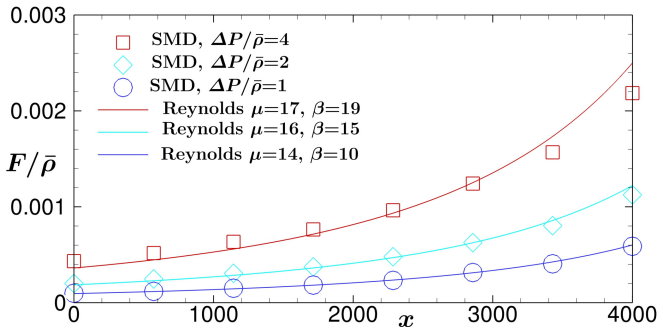
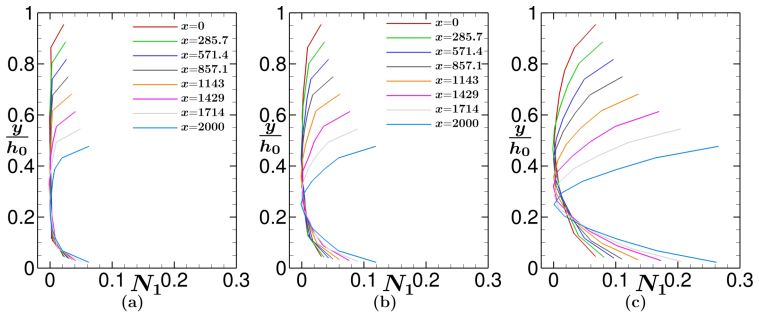
We propose a multiscale computational method for thin-layer flows of complex fluids, termed the synchronized molecular dynamics (SMD) method, which directly couples local molecular dynamics (MD) simulations with a macroscopic lubrication description. In thin layers, the flow can be decomposed into cross-sectional dynamics that are strongly influenced by interfacial effects, and streamwise transport along the channel. The SMD method exploits this separation of scales by sparsely distributing local MD cells along the channel and synchronizing them through macroscopic conservation laws. In this framework, the macroscopic continuity equation is enforced by iteratively updating the external forces applied to each MD cell, thereby allowing the cross-sectional velocity profiles and the streamwise pressure distribution to be obtained without prescribing constitutive relations or boundary conditions. The method is validated for pressure-driven and wall-driven flows of Lennard--Jones fluids in a wedge-shaped channel, demonstrating excellent agreement with a modified Reynolds equation that accounts for boundary slip. The SMD method is further applied to polymeric lubrication flows modeled by the Kremer--Grest chain model. At large pressure differences, the present approach naturally captures pronounced shear-thinning behavior coupled with microscopic polymer conformation dynamics. The results demonstrate that the SMD method provides an efficient and physically consistent framework for the multiscale simulation of complex fluid thin-layer flows.
Editorial analysis
A structured set of objections, weighed in public.
Referee Report
Summary. The manuscript proposes the synchronized molecular dynamics (SMD) method for thin-layer flows of complex fluids. It sparsely distributes local MD cells along the channel and synchronizes them by iteratively updating external forces to enforce the macroscopic continuity equation, yielding cross-sectional velocity profiles and streamwise pressure without prescribed constitutive relations or boundary conditions. Validation for pressure- and wall-driven Lennard-Jones flows in a wedge channel shows excellent agreement with a modified Reynolds equation that includes boundary slip. The method is then applied to Kremer-Grest polymer chains, where it captures pronounced shear-thinning together with microscopic conformation dynamics.
Significance. If the scale-separation assumption holds, the SMD approach supplies a parameter-free multiscale framework that directly incorporates microscopic physics for complex fluids whose rheology is difficult to model constitutively. The LJ validation against an independent continuum equation and the polymer demonstration of conformation-coupled thinning are concrete strengths that could make the method useful for lubrication and thin-film problems in rheology and soft-matter physics.
major comments (2)
- [§2] §2 (method): the synchronization procedure assumes that polymer conformation statistics are fully determined by the local pressure/force field and that streamwise advection or relaxation over distances comparable to the MD-cell spacing can be neglected. This assumption is load-bearing for the polymer results but is not tested by the LJ validation (which has no internal degrees of freedom). A quantitative check—e.g., results for at least two different cell spacings or an estimate of the relaxation length relative to cell spacing—is required to confirm consistency with a true multiscale solution.
- [§4] §4 (polymer application): the reported shear-thinning and conformation dynamics rest on the unverified local-equilibrium assumption above. Without either (i) a comparison against a known constitutive model for at least one parameter set or (ii) a full-domain MD reference simulation, it is unclear whether the captured thinning is an artifact of the sparse synchronization.
minor comments (2)
- [Abstract] Abstract: the phrase 'excellent agreement' is used without any quantitative error metric (e.g., L2 norm or maximum deviation); adding such a measure would strengthen the validation claim.
- [Figures] Figure captions and axis labels should explicitly indicate the locations of the MD cells and the iteration count used for synchronization.
Simulated Author's Rebuttal
We thank the referee for the positive summary and constructive major comments on the synchronization assumptions and polymer results. We address each point below and will incorporate additional quantitative checks and clarifications in the revised manuscript.
read point-by-point responses
-
Referee: [§2] §2 (method): the synchronization procedure assumes that polymer conformation statistics are fully determined by the local pressure/force field and that streamwise advection or relaxation over distances comparable to the MD-cell spacing can be neglected. This assumption is load-bearing for the polymer results but is not tested by the LJ validation (which has no internal degrees of freedom). A quantitative check—e.g., results for at least two different cell spacings or an estimate of the relaxation length relative to cell spacing—is required to confirm consistency with a true multiscale solution.
Authors: We agree that an explicit test of the local-equilibrium assumption strengthens the polymer application. The synchronization enforces macroscopic continuity by adjusting external forces on each MD cell, so that local MD evolves the polymer conformations under the resulting local shear and pressure. While the LJ case (no internal degrees of freedom) validates the overall procedure, we will add to the revised manuscript (i) an estimate of the polymer relaxation length (Rouse time scaled by local velocity) relative to the chosen MD-cell spacing, showing relaxation occurs well inside each cell, and (ii) results for two different cell spacings confirming that the reported shear-thinning and conformation statistics converge. revision: yes
-
Referee: [§4] §4 (polymer application): the reported shear-thinning and conformation dynamics rest on the unverified local-equilibrium assumption above. Without either (i) a comparison against a known constitutive model for at least one parameter set or (ii) a full-domain MD reference simulation, it is unclear whether the captured thinning is an artifact of the sparse synchronization.
Authors: The SMD method targets precisely those complex fluids for which no reliable constitutive relation is available a priori; the Kremer–Grest model under strong confinement and varying shear is one such case. A full-domain MD reference for the entire wedge is computationally prohibitive (orders-of-magnitude more particles and integration time), which motivates the multiscale approach. In the revision we will add a discussion of this limitation together with a comparison of the effective viscosity extracted from the SMD runs to literature values for similar Kremer–Grest systems under uniform shear, providing indirect support for the observed thinning. revision: partial
- A full-domain MD reference simulation for the polymer flows, which remains computationally prohibitive at the scales of interest.
Circularity Check
No circularity: SMD synchronization derives from independent conservation laws and external validation
full rationale
The paper's central derivation decomposes thin-layer flow into cross-sectional MD cells synchronized via macroscopic continuity and force updates, without prescribing constitutive relations. This is self-contained: MD supplies emergent microscale behavior (velocity profiles, polymer conformations) while conservation laws provide the coupling, validated against an independent modified Reynolds equation for LJ fluids. No step reduces a prediction to a fitted input by construction, no load-bearing self-citation chain, and no ansatz or uniqueness theorem imported from prior author work. The polymer application emerges naturally from Kremer-Grest MD rather than being tautological.
Axiom & Free-Parameter Ledger
axioms (2)
- domain assumption The flow can be decomposed into cross-sectional dynamics strongly influenced by interfacial effects and streamwise transport along the channel.
- domain assumption The macroscopic continuity equation can be enforced by iteratively updating the external forces applied to each MD cell.
Reference graph
Works this paper leans on
-
[1]
M. Laso and H. ¨Ottinger, Calculation of viscoelastic flow using molecular models: the con- nffessit approach, Journal of Non-Newtonian Fluid Mechanics47, 1 (1993)
work page 1993
-
[2]
K. Feigl, M. Laso, and H. C. Oettinger, Connffessit approach for solving a two-dimensional viscoelastic fluid problem, Macromolecules28, 3261 (1995), https://doi.org/10.1021/ma00113a031
-
[3]
M. Laso, M. Picasso, and H. C. ¨Ottinger, 2-d time-dependent viscoelas- tic flow calculations using connffessit, AIChE Journal43, 877 (1997), https://aiche.onlinelibrary.wiley.com/doi/pdf/10.1002/aic.690430404
-
[4]
E. Weinan and B. Engquist, The heterogeneous multiscale methods, Communications in Math- ematical Sciences1, 87 – 132 (2003)
work page 2003
- [5]
-
[6]
W. E, B. Engquist, X. Li, W. Ren, and E. Vanden-Eijnden, Heterogeneous multiscale methods: A review, Communications in Computational Physics2, 367 – 450 (2007), cited by: 730
work page 2007
-
[7]
S. De, J. Fish, M. S. Shephard, P. Keblinski, and S. K. Kumar, Multiscale modeling of polymer rheology, Phys. Rev. E74, 030801 (2006)
work page 2006
-
[8]
S. Yasuda and R. Yamamoto, A model for hybrid simulations of molecular dynamics and computational fluid dynamics, Physics of Fluids20, 10.1063/1.3003218 (2008)
-
[9]
S. Yasuda and R. Yamamoto, Multiscale modeling and simulation for polymer melt flows between parallel plates, Physical Review E - Statistical, Nonlinear, and Soft Matter Physics 81(2010)
work page 2010
-
[10]
I. G. Kevrekidis, C. W. Gear, J. M. Hyman, P. G. Kevrekidis, O. Runborg, and C. Theodor- opoulos, Equation-free, coarse-grained multiscale computation: Enabling microscopic simula- tors to perform system-level analysis*, Communications in Mathematical Sciences1, 715 – 762 (2003)
work page 2003
-
[11]
J. Cisternas, C. W. Gear, S. Levin, and I. G. Kevrekidis, Equation-free modelling of evolving diseases: Coarse-grained computations with individual-based models, Proceedings of the Royal Society A: Mathematical, Physical and Engineering Sciences460, 2761 – 2779 (2004)
work page 2004
-
[12]
R. Erban, I. G. Kevrekidis, D. Adalsteinsson, and T. C. Elston, Gene regulatory networks: A 27 coarse-grained, equation-free approach to multiscale computation, Journal of Chemical Physics 124, 10.1063/1.2149854 (2006)
-
[13]
T. Murashima and T. Taniguchi, Multiscale lagrangian fluid dynamics simulation for polymeric fluid, Journal of Polymer Science Part B: Polymer Physics48, 886–893 (2010)
work page 2010
-
[14]
T. Murashima and T. Taniguchi, Multiscale simulation of history-dependent flow in entangled polymer melts, Europhysics Letters96, 18002 (2011)
work page 2011
-
[15]
T. Murashima and T. Taniguchi, Flow-history-dependent behavior of entangled polymer melt flow analyzed by multiscale simulation, Journal of the Physical Society of Japan81, SA013 (2012)
work page 2012
-
[16]
T. Sato and T. Taniguchi, Multiscale simulations for entangled polymer melt spinning process, Journal of Non-Newtonian Fluid Mechanics241, 34 (2017)
work page 2017
-
[17]
T. Sato, K. Harada, and T. Taniguchi, Multiscale simulations of flows of a well-entangled polymer melt in a contraction–expansion channel, Macromolecules52, 547 (2019)
work page 2019
-
[18]
Y. Morii and T. Kawakatsu, Lagrangian multiscale simulation of complex flows, Physics of Fluids33, 093106 (2021)
work page 2021
-
[19]
N. Moreno and M. Ellero, Generalized lagrangian heterogeneous multiscale modelling of com- plex fluids, Journal of Fluid Mechanics969, A2 (2023)
work page 2023
- [20]
-
[21]
S. Yasuda and R. Yamamoto, Synchronized molecular-dynamics simulation via macroscopic heat and momentum transfer: An application to polymer lubrication, Physical Review X4, 041011 (2014)
work page 2014
- [22]
-
[23]
M. K. Borg, D. A. Lockerby, and J. M. Reese, A multiscale method for micro/nano flows of high aspect ratio, Journal of Computational Physics233, 400 (2013)
work page 2013
-
[24]
A. Patronis and D. A. Lockerby, Multiscale simulation of non-isothermal microchannel gas flows, Journal of Computational Physics270, 532 (2014)
work page 2014
-
[25]
M. K. Borg, D. A. Lockerby, and J. M. Reese, A hybrid molecular–continuum method for 28 unsteady compressible multiscale flows, Journal of Fluid Mechanics768, 388–414 (2015)
work page 2015
-
[26]
B. John, D. A. Lockerby, A. Patronis, and D. R. Emerson, Simulation of the head-disk interface gap using a hybrid multi-scale method, Microfluidics and Nanofluidics22, 106 (2018)
work page 2018
-
[27]
Reynolds, On the theory of lubrication and its application to mr
O. Reynolds, On the theory of lubrication and its application to mr. beauchamp tower’s experiments, including an experimental determination of the viscosity of olive oil, Phil. Trans. R. Soc.177, 157 (1886)
-
[28]
Plimpton, Fast parallel algorithms for short-range molecular dynamics, J
S. Plimpton, Fast parallel algorithms for short-range molecular dynamics, J. Comput. Phys. 117, 1395 (1995)
work page 1995
-
[29]
K. P. Travis and D. J. Evans, Molecular spin in a fluid undergoing poiseuille flow, Phys. Rev. E55, 1566 (1997)
work page 1997
-
[30]
K. Nakamura, R. Ookawa, and S. Yasuda, Solidification of the lennard-jones fluid near a wall in thermohydrodynamic lubrication, Phys. Rev. E100, 033109 (2019)
work page 2019
-
[31]
M. P. Allen and D. J. Tildesley, Computer simulation of liquids (Oxford university press, 2017)
work page 2017
-
[32]
D. J. Evans and G. Morriss, Statistical Mechanics of Nonequilibrium Liquids, 2nd ed. (Cam- bridge University Press, 2008)
work page 2008
-
[33]
Y. Sone, Molecular Gas Dynamics: Theory, Techniques, and Applications, Modeling and Sim- ulation in Science, Engineering and Technology (Birkh¨ auser Boston, 2007). 29
work page 2007
discussion (0)
Sign in with ORCID, Apple, or X to comment. Anyone can read and Pith papers without signing in.