A Comparative Analysis on the Performance of Upper Confidence Bound Algorithms in Adaptive Deep Neural Networks
Pith reviewed 2026-05-25 06:47 UTC · model grok-4.3
The pith
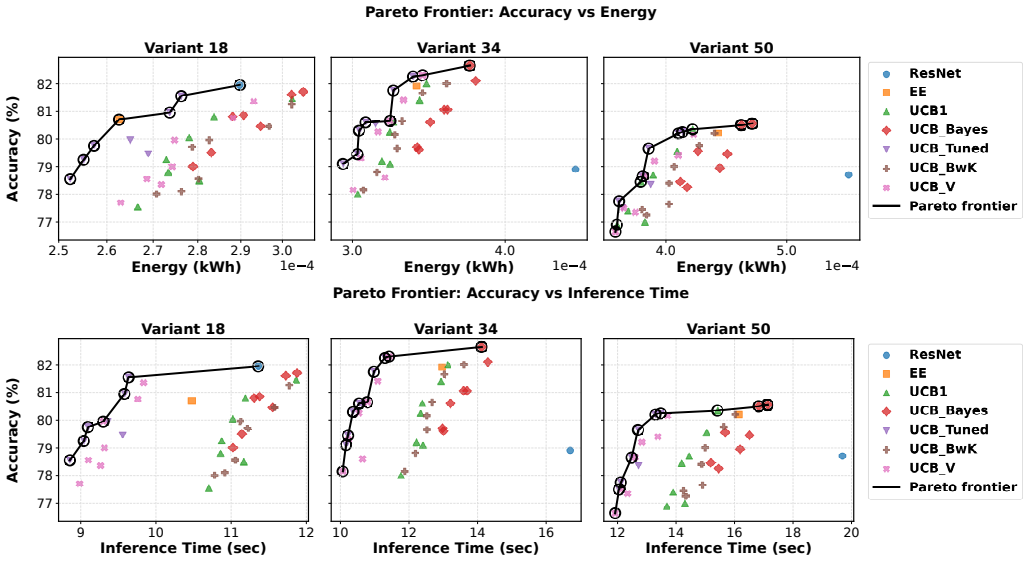
UCB-Bayes converges fastest among tested strategies in adaptive deep neural networks for edge inference, while UCB-V and UCB-Tuned dominate accuracy-energy and accuracy-latency trade-offs.
A machine-rendered reading of the paper's core claim, the machinery that carries it, and where it could break.
Core claim
By embedding UCB-V, UCB-Tuned, UCB-Bayes, and UCB-BwK alongside UCB1 inside the Multi-Armed Bandit controller of Adaptive Deep Neural Networks, the authors show on ResNet and MobileViT that every strategy attains sub-linear cumulative regret, that UCB-Bayes converges to low regret values ahead of UCB-Tuned and UCB-V, and that UCB-V and UCB-Tuned alone occupy the leading positions on the accuracy-latency and accuracy-energy Pareto frontiers across the three CIFAR datasets.
What carries the argument
Upper Confidence Bound (UCB) algorithms inside the Multi-Armed Bandit controller that dynamically choose confidence thresholds to trigger early exits in Adaptive Deep Neural Networks.
If this is right
- Every UCB variant tested yields sub-linear cumulative regret on the evaluated tasks.
- UCB-Bayes reaches low regret values faster than UCB-Tuned, UCB-V, or the baseline.
- UCB-V and UCB-Tuned produce the strongest accuracy-latency and accuracy-energy fronts.
- The same ordering appears on both ResNet and MobileViT architectures.
- The pattern holds across CIFAR-10, CIFAR-10.1, and CIFAR-100.
Where Pith is reading between the lines
- Deployments that switch to UCB-Bayes could shorten the period of high-regret early-exit decisions during online adaptation.
- Networks using UCB-V or UCB-Tuned may run at measurably lower average energy or latency for any target accuracy level.
- The approach could be checked on additional vision models or on actual edge hardware to see whether the regret and Pareto advantages persist outside the reported CIFAR setting.
Load-bearing premise
Observed differences in regret curves and Pareto performance arise mainly from the choice of UCB variant rather than from details of the early-exit implementation, hyper-parameter choices, or the particular CIFAR data splits.
What would settle it
Re-running the experiments on the same networks and datasets but with altered hyper-parameter values or fresh random train-validation splits, then finding that the ranking of UCB variants on regret speed or Pareto dominance reverses, would show the differences are not driven by the UCB choice itself.
Figures



read the original abstract
Edge computing environments impose strict constraints on energy consumption and latency, making the deployment of deep neural networks a significant challenge. Therefore, smart and adaptive inference strategies that dynamically balance computational cost or latency with predictive accuracy are critical in edge computing scenarios. In this work, we build on Adaptive Deep Neural Networks (ADNNs) that employ the Multi-Armed Bandit (MAB) framework. Current literature leverages the first version of the Upper Confidence Bound (UCB1) strategy to dynamically select the optimal confidence threshold, enabling efficient early exits without sacrificing accuracy. However, we introduce four additional Upper Confidence Bound strategies in ADNNs, namely UCB-V, UCB-Tuned, UCB-Bayes, and UCB-BwK, and perform, for the first time, a comparative study of these strategies with respect to trade-offs between accuracy, energy consumption, and latency. The proposed UCB strategies are employed on the ResNet and MobileViT neural networks, and are evaluated on the benchmark datasets of CIFAR-10, CIFAR-10.1, and CIFAR-100. Experimental results demonstrate that all strategies achieve sub-linear cumulative regret, with UCB-Bayes converging the fastest, followed by UCB-Tuned and UCB-V. Finally, UCB-V and UCB-Tuned dominate the Pareto Frontiers of accuracy-latency and accuracy-energy trade-offs. The implementation code is available here: https://github.com/gr3gor1/MAB_UCB
Editorial analysis
A structured set of objections, weighed in public.
Referee Report
Summary. The paper empirically compares five Upper Confidence Bound (UCB) variants (UCB1, UCB-V, UCB-Tuned, UCB-Bayes, UCB-BwK) as the multi-armed bandit policy for selecting early-exit thresholds in Adaptive Deep Neural Networks (ADNNs). It evaluates ResNet and MobileViT models on CIFAR-10, CIFAR-10.1 and CIFAR-100, claiming that all variants exhibit sub-linear cumulative regret, that UCB-Bayes converges fastest, and that UCB-V and UCB-Tuned dominate the accuracy-latency and accuracy-energy Pareto fronts. Code is released.
Significance. If the reported performance ordering and Pareto dominance can be shown to be robust to implementation details and statistically reliable, the work would supply concrete, actionable guidance on UCB selection for resource-constrained adaptive inference. The public code release is a clear strength for reproducibility.
major comments (2)
- [Abstract / Experimental Results] Abstract and experimental results section: the headline claims of convergence ordering ('UCB-Bayes converging the fastest, followed by UCB-Tuned and UCB-V') and Pareto dominance are presented without any report of the number of independent runs, error bars, or statistical significance tests. This directly undermines the ability to attribute observed differences to the choice of UCB variant.
- [Experimental Results] Experimental protocol: no description is given of whether hyper-parameter tuning, early-exit threshold logic, or train/test splits were held identical across the five UCB variants. Without such controls or ablations, the central attribution of regret and Pareto differences to the UCB strategy itself cannot be isolated from confounding implementation factors.
minor comments (1)
- [Abstract] The abstract states that four additional strategies are introduced, yet UCB1 is described as already present in the literature; clarify the exact novelty contribution of each variant.
Simulated Author's Rebuttal
We thank the referee for the detailed and constructive feedback. The comments highlight important aspects of statistical reporting and experimental controls that will improve the clarity and credibility of our comparative study. We will revise the manuscript accordingly to address these points.
read point-by-point responses
-
Referee: [Abstract / Experimental Results] Abstract and experimental results section: the headline claims of convergence ordering ('UCB-Bayes converging the fastest, followed by UCB-Tuned and UCB-V') and Pareto dominance are presented without any report of the number of independent runs, error bars, or statistical significance tests. This directly undermines the ability to attribute observed differences to the choice of UCB variant.
Authors: We agree that the absence of these details weakens the claims. The original experiments were performed with 5 independent runs per configuration using different random seeds, but this information, along with error bars and significance tests, was not included. In the revised manuscript we will report the number of runs, add error bars (standard deviation) to all plots, and include statistical significance tests (paired t-tests) to support the reported ordering and Pareto dominance. These additions will be made to both the abstract and the experimental results section. revision: yes
-
Referee: [Experimental Results] Experimental protocol: no description is given of whether hyper-parameter tuning, early-exit threshold logic, or train/test splits were held identical across the five UCB variants. Without such controls or ablations, the central attribution of regret and Pareto differences to the UCB strategy itself cannot be isolated from confounding implementation factors.
Authors: The experimental design kept all non-policy elements fixed across variants: identical model weights, identical early-exit threshold selection logic (only the UCB policy changed), identical hyper-parameters, and identical train/test splits. However, we acknowledge that this was not explicitly stated. In the revision we will add a dedicated experimental protocol subsection that documents these controls and states that differences are attributable to the UCB variant. If space allows, we will also include a brief ablation confirming the isolation of the policy effect. revision: yes
Circularity Check
No circularity: empirical head-to-head comparison of published UCB variants on benchmarks
full rationale
The paper conducts an experimental comparison of UCB1, UCB-V, UCB-Tuned, UCB-Bayes and UCB-BwK inside ADNN early-exit logic on CIFAR-10/10.1/100 with ResNet and MobileViT. All central claims (sub-linear regret, convergence ordering, Pareto dominance) are direct outputs of measured regret curves and accuracy-latency/energy fronts. No equations, fitted parameters, or predictions are defined inside the paper and then re-used as outputs. Background citations to prior ADNN/MAB work are not load-bearing for any derivation; the results stand on the reported runs. This matches the default non-circular case for benchmark-driven algorithm comparisons.
Axiom & Free-Parameter Ledger
axioms (1)
- domain assumption The multi-armed bandit formulation accurately models the problem of selecting a confidence threshold for early exits in ADNNs.
Reference graph
Works this paper leans on
-
[1]
Perfor- mance analysis of filter pruning methods for edge classificat ion tasks,
A. Stefanidou, I. Kontopoulos, K. Tserpes, and I. V arlam is, “Perfor- mance analysis of filter pruning methods for edge classificat ion tasks,” in 2025 IEEE Intelligent Mobile Computing (MobileCloud) , 2025, pp. 51–58
work page 2025
-
[2]
Conditional computation in neural networks: P rinciples and research trends,
S. Scardapane, A. Baiocchi, A. Devoto, V . Marsocci, P . Mi nervini, and J. Pomponi, “Conditional computation in neural networks: P rinciples and research trends,” Intelligenza Artificiale , vol. 18, no. 1, pp. 175– 190, 2024
work page 2024
-
[3]
A. Q. Jiang, A. Sablayrolles, A. Roux, A. Mensch, B. Savar y, C. Bam- ford, D. S. Chaplot, D. d. l. Casas, E. B. Hanna, F. Bressand et al. , “Mixtral of experts,” arXiv preprint arXiv:2401.04088 , 2024
work page internal anchor Pith review Pith/arXiv arXiv 2024
-
[4]
Early-exi t deep neural networks for distorted images: providing an efficient edge o ffloading,
R. G. Pacheco, F. D. Oliveira, and R. S. Couto, “Early-exi t deep neural networks for distorted images: providing an efficient edge o ffloading,” in 2021 IEEE Global Communications Conference (GLOBECOM) , 2021, pp. 1–6
work page 2021
-
[5]
Dynexit: A dynam ic early- exit strategy for deep residual networks,
M. Wang, J. Mo, J. Lin, Z. Wang, and L. Du, “Dynexit: A dynam ic early- exit strategy for deep residual networks,” in 2019 IEEE International W orkshop on Signal Processing Systems (SiPS) , 2019, pp. 178–183
work page 2019
-
[6]
CeeBERT: Cross-Domain In ference in Early Exit BERT,
D. J. Bajpai and M. K. Hanawal, “CeeBERT: Cross-Domain In ference in Early Exit BERT,” in Findings of the Association for Computational Linguistics: ACL 2024 , L.-W. Ku, A. Martins, and V . Srikumar, Eds. Bangkok, Thailand: Association for Computational Linguis tics, Dec. 2024, pp. 1736–1748
work page 2024
-
[7]
Beyond greedy exits: Improved early exit decisions for risk control and reliability,
——, “Beyond greedy exits: Improved early exit decisions for risk control and reliability,” arXiv preprint arXiv:2509.23666 , 2025
-
[8]
Adaee: Adaptive early-exit dnn inference through multi-armed bandits,
R. G. Pacheco, M. Shifrin, R. S. Couto, D. S. Menasch´ e, M. K. Hanawal, and M. E. M. Campista, “Adaee: Adaptive early-exit dnn inference through multi-armed bandits,” in ICC 2023-IEEE International Conference on Communications . IEEE, 2023, pp. 3726–3731
work page 2023
-
[9]
W. Ju, W. Bao, D. Y uan, L. Ge, and B. B. Zhou, “Learning earl y exit for deep neural network inference on mobile devices through mul ti-armed bandits,” in 2021 IEEE/ACM 21st International Symposium on Cluster , Cloud and Internet Computing (CCGrid) , 2021, pp. 11–20
work page 2021
-
[10]
Dynamic early exit sche duling for deep neural network inference through contextual bandi ts,
W. Ju, W. Bao, L. Ge, and D. Y uan, “Dynamic early exit sche duling for deep neural network inference through contextual bandi ts,” in Proceedings of the 30th ACM International Conference on Inf ormation & Knowledge Management , 2021, pp. 823–832
work page 2021
-
[11]
Unsupervised early exit in dnns with multiple exits,
M. K. Hanawal, A. Bhardwaj et al. , “Unsupervised early exit in dnns with multiple exits,” arXiv preprint arXiv:2209.09480 , 2022
-
[12]
SplitEE: Early Exit in Deep Neural Networks with Split Computing
D. J. Bajpai, V . K. Trivedi, S. L. Y adav, and M. K. Hanawal , “SplitEE: Early Exit in Deep Neural Networks with Split Computing.” [O nline]. Available: https://dl.acm.org/doi/epdf/10.1145/3639856.3639873
-
[13]
Branch yNet: Fast Inference via Early Exiting from Deep Neural Networks,
S. Teerapittayanon, B. McDanel, and H. T. Kung, “Branch yNet: Fast Inference via Early Exiting from Deep Neural Networks,” arXiv.org, Sep. 2017
work page 2017
-
[14]
Early-Exit Deep Neural Network - A Comprehensive Survey,
R. PHaseena, SrivastavaVishal, ChaurasiaKuldeep, P . G, and C. S, “Early-Exit Deep Neural Network - A Comprehensive Survey,” ACM Computing Surveys , Nov. 2024, publisher: ACMPUB27New Y ork, NY
work page 2024
-
[15]
LECO: Improving Ear ly Exiting via Learned Exits and Comparison-based Exiting Mec hanism,
J. Zhang, M. Tan, P . Dai, and W. Zhu, “LECO: Improving Ear ly Exiting via Learned Exits and Comparison-based Exiting Mec hanism,” in Proceedings of the 61st Annual Meeting of the Association fo r Computational Linguistics (V olume 4: Student Research W or kshop), V . Padmakumar, G. V allejo, and Y . Fu, Eds. Toronto, Canada: Association for Computational...
work page 2023
-
[16]
BERT L oses Patience: Fast and Robust Inference with Early Exit,
W. Zhou, C. Xu, T. Ge, J. McAuley, K. Xu, and F. Wei, “BERT L oses Patience: Fast and Robust Inference with Early Exit,” in Advances in Neural Information Processing Systems , vol. 33. Curran Associates, Inc., 2020, pp. 18 330–18 341
work page 2020
-
[17]
Distillation-Based Trainin g for Multi-Exit Architectures,
M. Phuong and C. Lampert, “Distillation-Based Trainin g for Multi-Exit Architectures,” in 2019 IEEE/CVF International Conference on Computer Vision (ICCV) . Seoul, Korea (South): IEEE, Oct. 2019, pp. 1355–1364. [Online]. Availab le: https://ieeexplore.ieee.org/document/9009834/
-
[18]
Fast BERT: a Self-distilling BERT with Adaptive Inference Time,
W. Liu, P . Zhou, Z. Wang, Z. Zhao, H. Deng, and Q. Ju, “Fast BERT: a Self-distilling BERT with Adaptive Inference Time,” in Proceedings of the 58th Annual Meeting of the Association for Computatio nal Linguistics, D. Jurafsky, J. Chai, N. Schluter, and J. Tetreault, Eds. Online: Association for Computational Linguistics, A pr. 2020, pp. 6035–6044. [Onlin...
work page 2020
-
[19]
DeeBERT: Dynam ic Early Exiting for Accelerating BERT Inference,
J. Xin, R. Tang, J. Lee, Y . Y u, and J. Lin, “DeeBERT: Dynam ic Early Exiting for Accelerating BERT Inference,” Apr. 2020. [Online]. Available: https://arxiv.org/abs/2004.12993v1
-
[20]
L gvit: Dynamic early exiting for accelerating vision transformer ,
G. Xu, J. Hao, L. Shen, H. Hu, Y . Luo, H. Lin, and J. Shen, “L gvit: Dynamic early exiting for accelerating vision transformer ,” in Proceed- ings of the 31st ACM International Conference on Multimedia , 2023, pp. 9103–9114
work page 2023
-
[21]
How to Train Y our Multi-Exi t Model? Analyzing the Impact of Training Strategies,
P . Kubaty, B. W´ ojcik, B. Krzepkowski, M. Michaluk, T. T rzci´ nski, J. Pomponi, and K. Adamczewski, “How to Train Y our Multi-Exi t Model? Analyzing the Impact of Training Strategies,” Jul. 2 024
-
[22]
Fast yet Safe: Early-Exiting w ith Risk Control,
M. Jazbec, A. Timans, T. H. V eljkovi´ c, K. Sakmann, D. Zh ang, C. A. Naesseth, and E. Nalisnick, “Fast yet Safe: Early-Exiting w ith Risk Control,” Advances in Neural Information Processing Systems , vol. 37, pp. 129 825–129 854, Dec. 2024
work page 2024
-
[23]
F ixing overconfidence in dynamic neural networks,
L. Meronen, M. Trapp, A. Pilzer, L. Y ang, and A. Solin, “F ixing overconfidence in dynamic neural networks,” in Proceedings of the IEEE/CVF winter conference on applications of computer vis ion, 2024, pp. 2680–2690
work page 2024
-
[24]
On bayesian upp er confidence bounds for bandit problems,
E. Kaufmann, O. Cappe, and A. Garivier, “On bayesian upp er confidence bounds for bandit problems,” in Proceedings of the Fifteenth Interna- tional Conference on Artificial Intelligence and Statistic s, ser. Proceed- ings of Machine Learning Research, N. D. Lawrence and M. Giro lami, Eds., vol. 22. La Palma, Canary Islands: PMLR, 21–23 Apr 2012 , pp. 592–600
work page 2012
-
[25]
Finite-time Analysis of the Multiarmed Bandit Problem,
P . Auer, N. Cesa-Bianchi, and P . Fischer, “Finite-time Analysis of the Multiarmed Bandit Problem,” Machine Learning, vol. 47, no. 2, pp. 235– 256, May 2002, company: Springer Distributor: Springer Ins titution: Springer Label: Springer Publisher: Kluwer Academic Publi shers
work page 2002
-
[26]
A. Badanidiyuru, R. Kleinberg, and A. Slivkins, “Bandi ts with knap- sacks,” Journal of the ACM (JACM) , vol. 65, no. 3, pp. 1–55, 2018
work page 2018
-
[27]
Resour ceful contextual bandits,
A. Badanidiyuru, J. Langford, and A. Slivkins, “Resour ceful contextual bandits,” in Conference on Learning Theory . PMLR, 2014, pp. 1109– 1134
work page 2014
-
[28]
MobileViT: Light-weight, General-purpose, and Mobile-friendly Vision Transformer
S. Mehta and M. Rastegari, “Mobilevit: light-weight, g eneral- purpose, and mobile-friendly vision transformer,” arXiv preprint arXiv:2110.02178, 2021
work page internal anchor Pith review Pith/arXiv arXiv 2021
-
[29]
Learning multiple layers of features from tiny images,
A. Krizhevsky, G. Hinton et al. , “Learning multiple layers of features from tiny images,” 2009
work page 2009
-
[30]
Do CIFAR-10 Classifiers Generalize to CIFAR-10?
B. Recht, R. Roelofs, L. Schmidt, and V . Shankar, “Do cif ar-10 classi- fiers generalize to cifar-10?” 2018, https://arxiv.org/ab s/1806.00451
work page internal anchor Pith review Pith/arXiv arXiv 2018
-
[31]
Deep residual learni ng for image recognition,
K. He, X. Zhang, S. Ren, and J. Sun, “Deep residual learni ng for image recognition,” in Proceedings of the IEEE conference on computer vision and pattern recognition , 2016, pp. 770–778
work page 2016
discussion (0)
Sign in with ORCID, Apple, or X to comment. Anyone can read and Pith papers without signing in.