Molecular Dynamics Force Field Genetic Optimization for Tri-n-butyl Phosphate Liquid
Pith reviewed 2026-05-10 09:14 UTC · model grok-4.3
The pith
Genetic optimization with a neural network surrogate tunes Lennard-Jones parameters for tri-n-butyl phosphate liquid to 23 percent overall experimental deviation.
A machine-rendered reading of the paper's core claim, the machinery that carries it, and where it could break.
Core claim
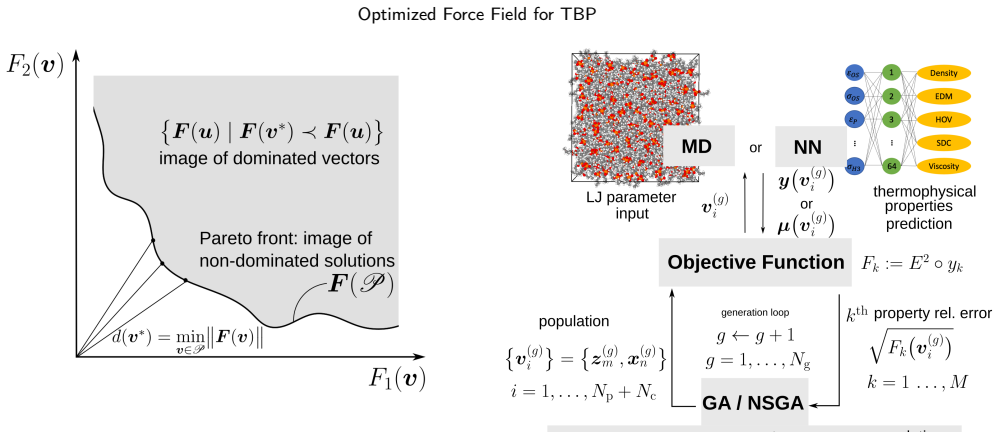
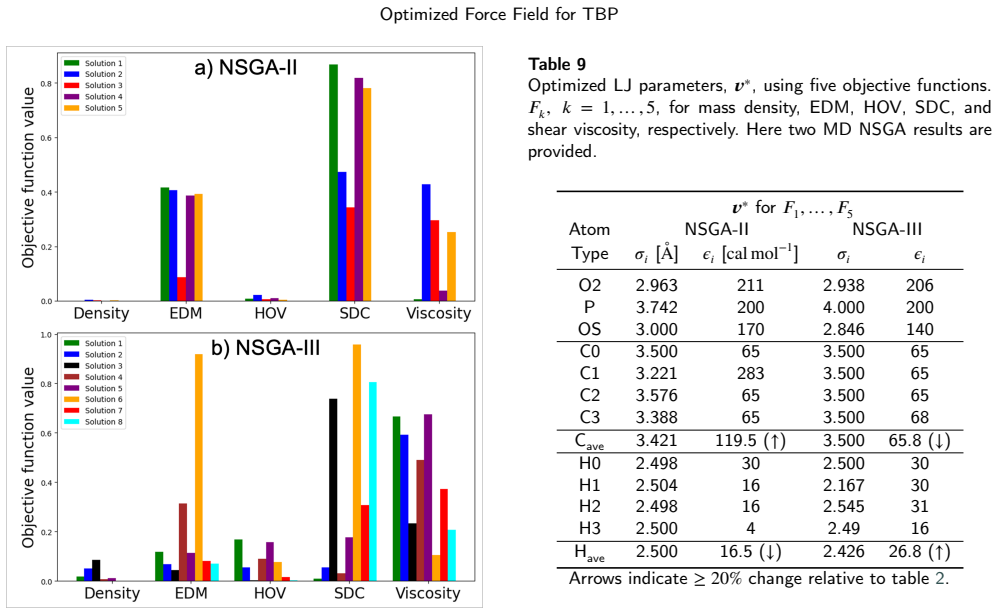
Embedding molecular dynamics inside a multi-objective genetic algorithm and accelerating evaluations with a neural network property model produces Lennard-Jones parameters for tri-n-butyl phosphate that reduce the aggregate relative deviation across density, dipole moment, vaporization heat, self-diffusion, and shear viscosity to 23 percent of experimental values.
What carries the argument
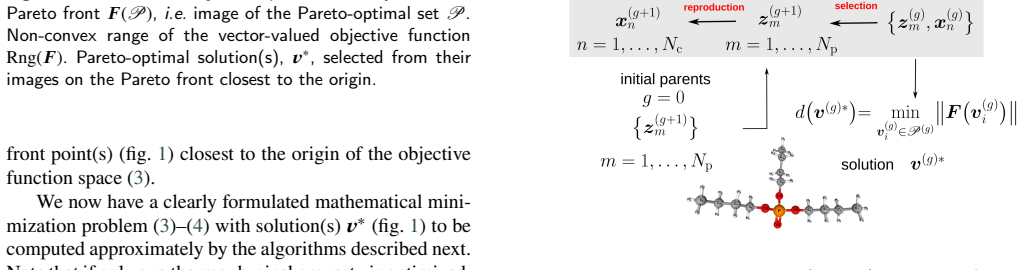
The NN NSGA-III loop, a non-dominated sorting genetic algorithm that uses a neural network surrogate to predict molecular dynamics properties and thereby evaluate candidate Lennard-Jones parameter sets.
If this is right
- The optimized Lennard-Jones parameters improve thermophysical property predictions in molecular dynamics simulations of TBP liquid.
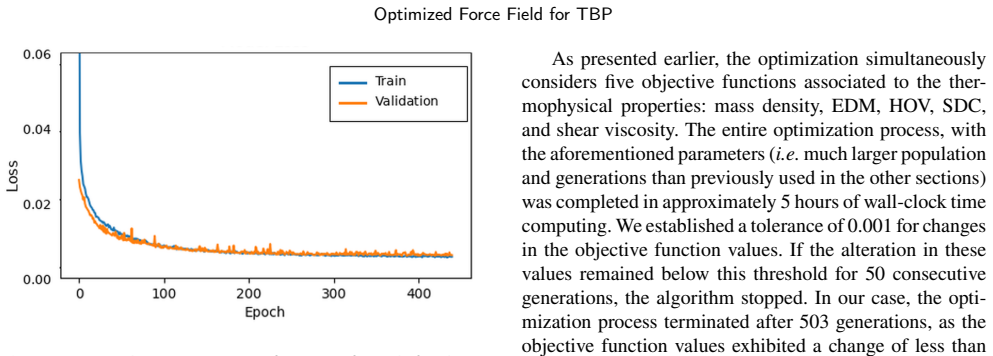
- The neural network surrogate reduces the computational cost of the optimization loop, permitting larger populations and additional generations.
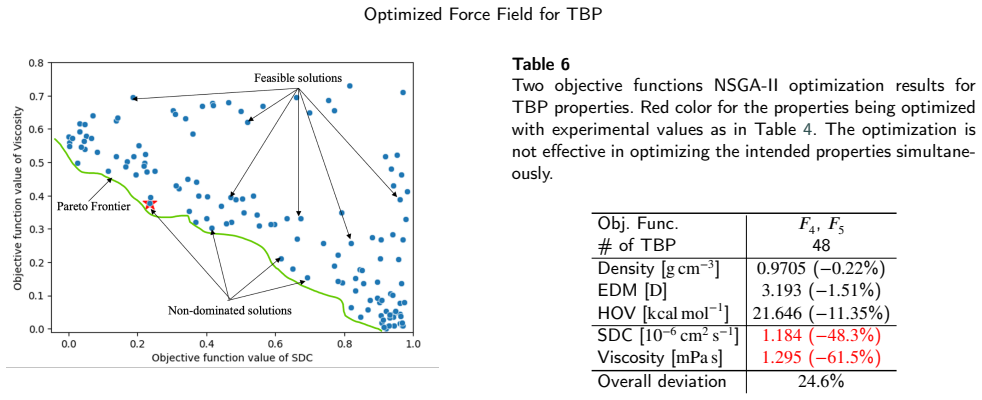
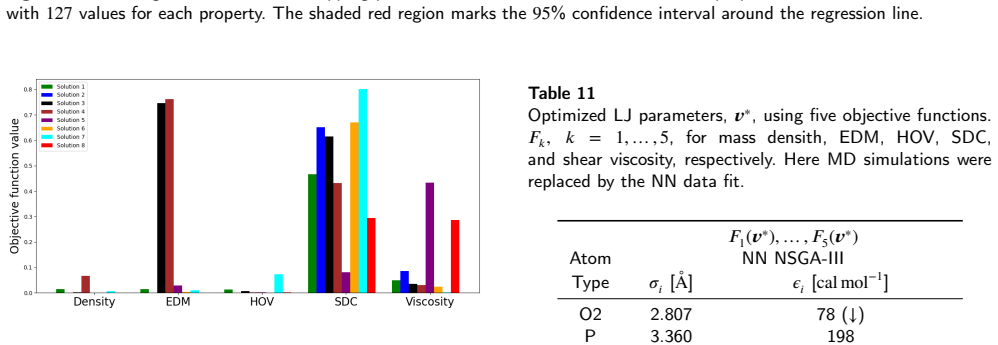
- Multi-objective optimization reveals trade-offs that make simultaneous improvement of self-diffusion coefficient and shear viscosity difficult.
- Systematic single-objective versus multi-objective comparisons establish a general framework for atomistic force field tuning of TBP.
Where Pith is reading between the lines
- The refined parameters may improve accuracy in simulations of TBP used as a solvent in nuclear fuel reprocessing.
- The surrogate-assisted genetic method could be applied to parameter optimization for other phosphate esters or similar organic liquids.
- Validation against experimental properties not included in the original multi-objective function would provide an independent check on transferability.
Load-bearing premise
The neural network surrogate accurately predicts the molecular dynamics properties across the explored Lennard-Jones parameter space without introducing systematic bias.
What would settle it
Run independent molecular dynamics simulations with the reported optimized Lennard-Jones parameters and directly compute the relative deviations for density, heat of vaporization, self-diffusion coefficient, and shear viscosity to test whether their combined error equals or falls below 23 percent.
Figures
read the original abstract
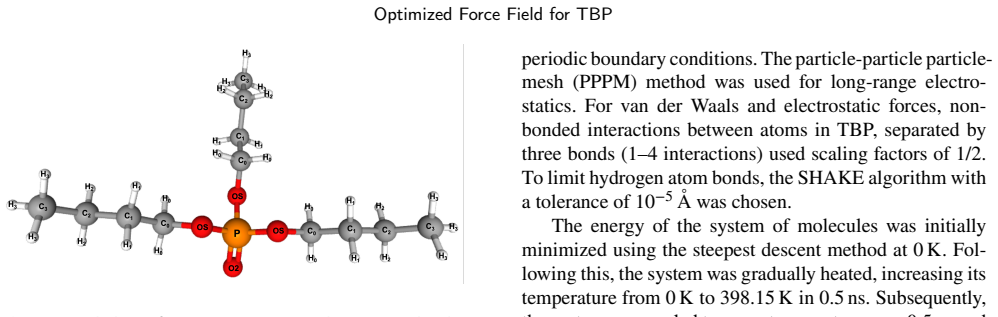
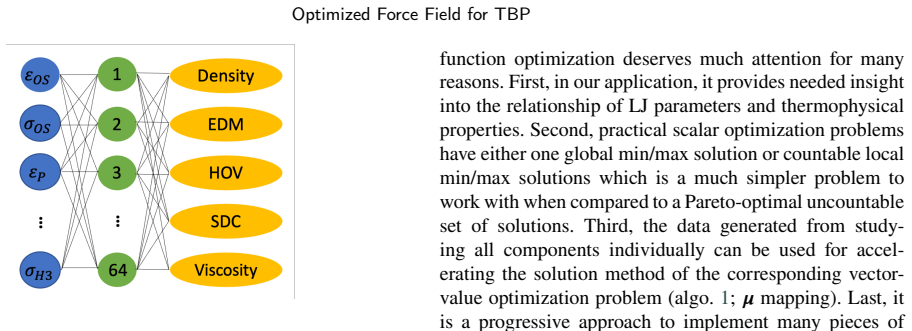
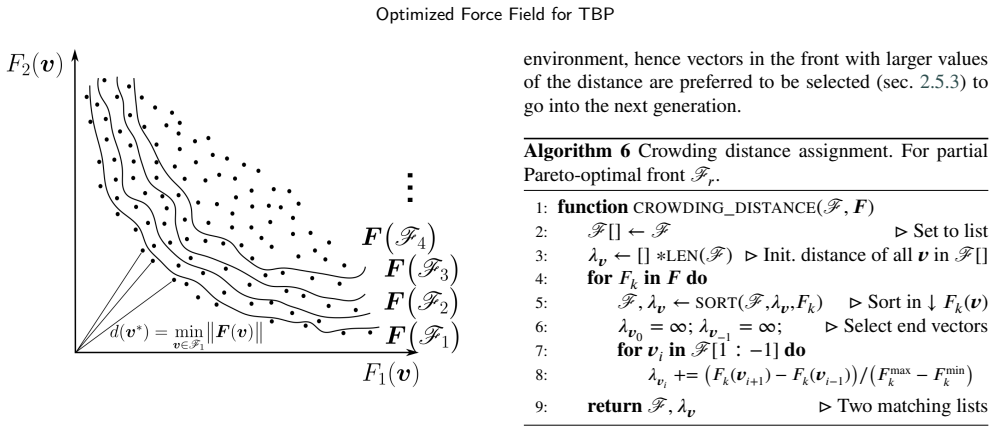
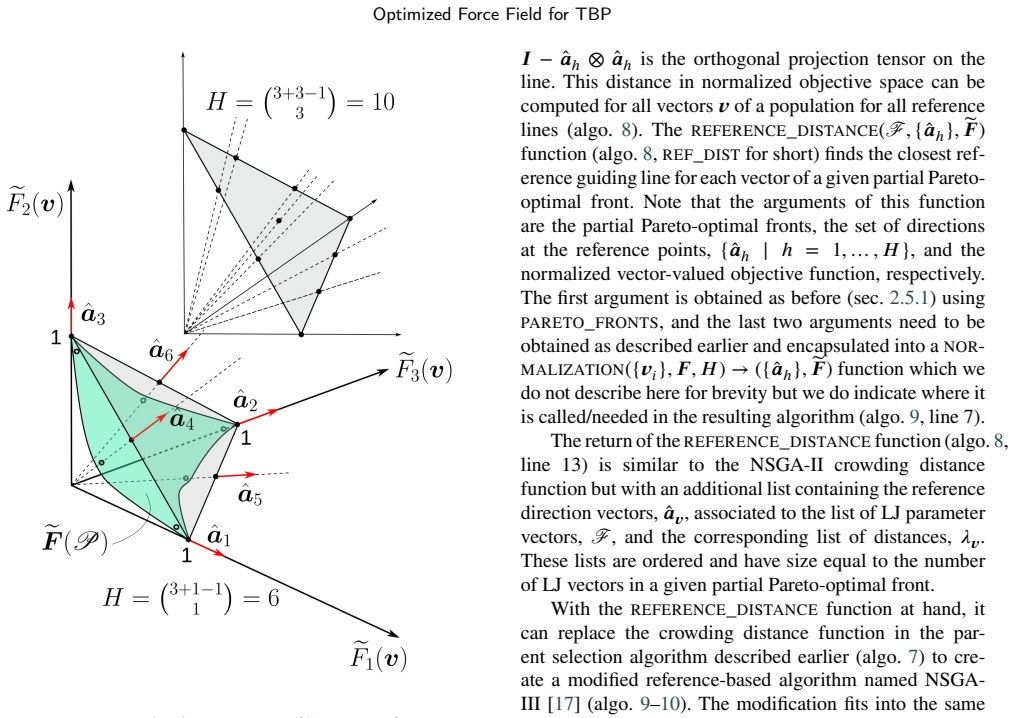
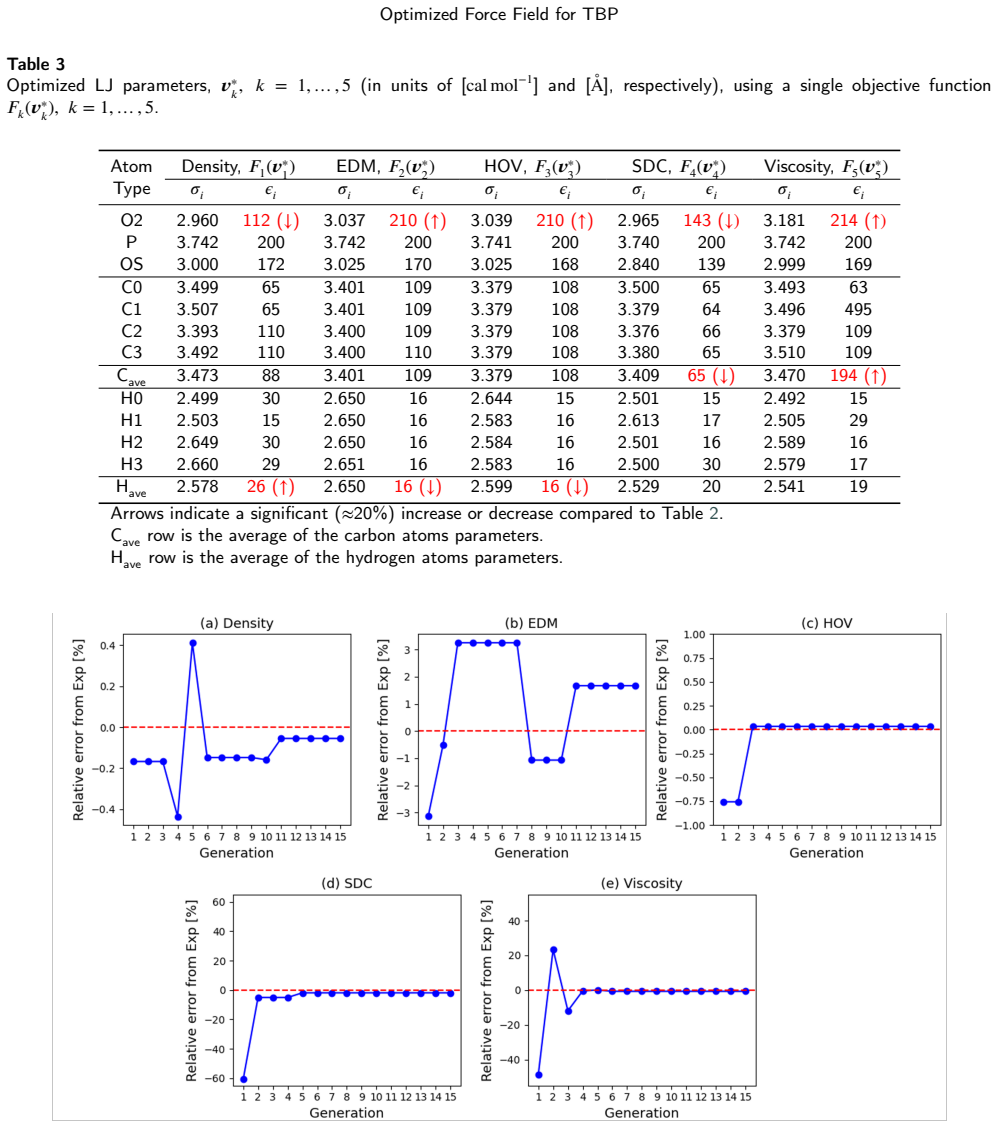
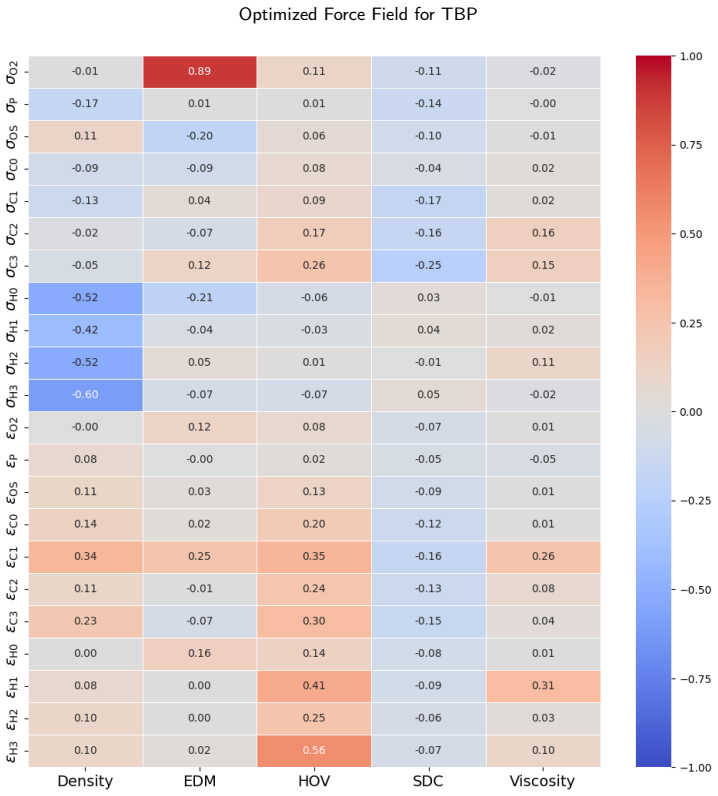
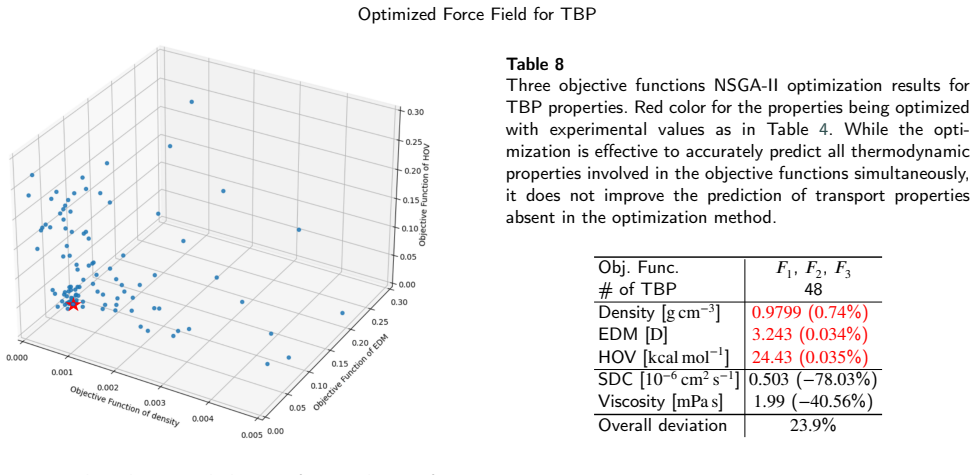
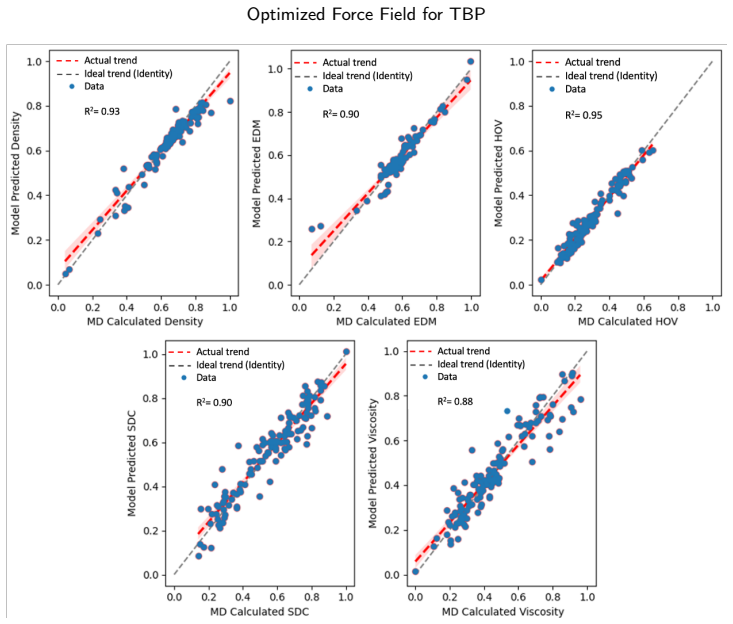
An iterative optimization algorithm with MD simulations in the loop is developed and applied to optimize Lennard-Jones (LJ) parameters specific for liquid tri-n-butyl phosphate (TBP). The optimization loop uses non-dominated sorting genetic algorithms to obtain LJ parameters that reproduce key properties such as mass density, electric dipole moment, heat of vaporization, self-diffusion coefficient (SDC), and shear viscosity. Errors relative to experimentally measured properties lead to a multi-objective function optimization problem stated in terms of a Pareto-optimal set. A systematic application of the optimization algorithm to cases involving single- and multi-objective functions was carried out in this work, establishing a framework for atomistic TBP property predictions. We demonstrate the use of a neural network property model to amortize the high cost of MD simulations in the optimization loop and to allow for large populations and more generations to be used in the genetic algorithms. In our previous study of finding the best force field for TBP property predictions as judged by the aforementioned thermophysical properties, we found the Polarized AMBER-MNDO force field to be the best overall showing a \num{74}\% relative deviation from experimental values. However, in this study, we show optimized values of the LJ parameters that improve the overall deviation from experimental data to \num{23}\% when using the NN NSGA-III algorithm. Despite this large improvement, the accurate prediction of the transport properties, SDC and shear viscosity, remains difficult since improvements in one of them worsen the other, and vice versa.
Editorial analysis
A structured set of objections, weighed in public.
Referee Report
Summary. The manuscript develops an iterative optimization framework that couples molecular dynamics simulations with non-dominated sorting genetic algorithms (NSGA-II/III) to refine Lennard-Jones epsilon and sigma parameters for tri-n-butyl phosphate. A neural-network surrogate is trained to predict five target properties (mass density, electric dipole moment, heat of vaporization, self-diffusion coefficient, and shear viscosity) and thereby amortize the cost of MD evaluations inside the genetic algorithm. The central quantitative claim is that the resulting optimized LJ parameters reduce the overall relative deviation from experimental data from 74 % (prior Polarized AMBER-MNDO force field) to 23 % when the NN-augmented NSGA-III is used, while acknowledging a persistent trade-off between SDC and viscosity.
Significance. If the NN surrogate is demonstrated to be accurate throughout the explored parameter region, the work supplies a reusable, automated pipeline for multi-objective force-field parameterization of complex organic liquids. The explicit use of NSGA-III to generate a Pareto front, together with the honest reporting of the SDC-viscosity trade-off, constitutes a practical advance for solvent-extraction chemistry. The NN amortization technique itself is a reusable engineering contribution that could be adopted by other groups performing expensive MD-based fitting.
major comments (3)
- [§4 and §5] §4 (NN surrogate model) and §5 (optimization results): the reported drop from 74 % to 23 % overall deviation rests on the assumption that the neural-network property predictor reproduces MD-computed values for LJ parameter combinations visited by NSGA-III. No cross-validation error, test-set MAE, or extrapolation diagnostics are supplied for parameter vectors distant from the training distribution; without these, the genetic algorithm may converge to surrogate minima that do not correspond to true MD minima.
- [§5.2] §5.2 (Pareto-front analysis): the manuscript states that NN NSGA-III yields a 23 % overall deviation but does not define the aggregation rule used to compute this scalar (simple average, weighted sum, or maximum deviation) nor the selection criterion applied to the final Pareto set. Because the five objectives are incommensurate and exhibit a documented trade-off, the numerical improvement cannot be evaluated without this information.
- [Methods] Methods (MD protocol and objective function): finite-sampling uncertainties in the MD-derived properties and their propagation into the multi-objective fitness function are not quantified. This omission affects both the baseline 74 % figure and the claimed 23 % improvement, rendering the statistical significance of the optimization result unclear.
minor comments (2)
- [Abstract] Abstract: the phrase 'a systematic application … to cases involving single- and multi-objective functions' is not expanded in the results; a brief comparison of single-objective versus multi-objective outcomes would clarify the added value of the Pareto approach.
- [Figures] Figure captions and axis labels should explicitly state whether plotted properties are NN predictions or direct MD values, especially on the Pareto-front plots.
Simulated Author's Rebuttal
We thank the referee for the constructive and detailed comments, which help clarify key aspects of our optimization framework and surrogate model. We address each major comment point by point below, indicating where revisions will be made to the manuscript.
read point-by-point responses
-
Referee: [§4 and §5] §4 (NN surrogate model) and §5 (optimization results): the reported drop from 74 % to 23 % overall deviation rests on the assumption that the neural-network property predictor reproduces MD-computed values for LJ parameter combinations visited by NSGA-III. No cross-validation error, test-set MAE, or extrapolation diagnostics are supplied for parameter vectors distant from the training distribution; without these, the genetic algorithm may converge to surrogate minima that do not correspond to true MD minima.
Authors: We acknowledge the referee's concern regarding surrogate validation. The NN was trained on MD data from a Latin-hypercube sampled grid of LJ parameters centered on literature values for TBP, with a 20% hold-out test set used during hyperparameter tuning. To strengthen the manuscript, we will add explicit reporting of 5-fold cross-validation MAE for each property, the test-set MAE (which was below 4% relative error for density and heat of vaporization), and a supplementary figure showing the parameter-space coverage of NSGA-III generations relative to the training distribution. For the final Pareto solutions, we will also report direct MD validation runs to confirm surrogate predictions. These additions will demonstrate that the visited points remained within well-sampled regions. revision: yes
-
Referee: [§5.2] §5.2 (Pareto-front analysis): the manuscript states that NN NSGA-III yields a 23 % overall deviation but does not define the aggregation rule used to compute this scalar (simple average, weighted sum, or maximum deviation) nor the selection criterion applied to the final Pareto set. Because the five objectives are incommensurate and exhibit a documented trade-off, the numerical improvement cannot be evaluated without this information.
Authors: The 23% value is the unweighted arithmetic mean of the five individual relative deviations from experiment, consistent with our prior work on the Polarized AMBER-MNDO baseline. We will explicitly define this aggregation rule in the revised §5.2. From the Pareto front, we selected the non-dominated solution that minimizes this mean deviation subject to no property exceeding 50% error, thereby respecting the documented SDC-viscosity trade-off. The full set of Pareto solutions and the selection logic will be described in the text, with the complete front data provided in the Supporting Information for reproducibility. revision: yes
-
Referee: [Methods] Methods (MD protocol and objective function): finite-sampling uncertainties in the MD-derived properties and their propagation into the multi-objective fitness function are not quantified. This omission affects both the baseline 74 % figure and the claimed 23 % improvement, rendering the statistical significance of the optimization result unclear.
Authors: We agree that sampling uncertainties should be quantified. Our MD protocol used 10 ns production runs (after 5 ns equilibration) with properties averaged over three independent replicas; block-averaging standard errors were typically 1-2% for density, 3-5% for heat of vaporization, and 8-12% for SDC and viscosity. These values will be added to the Methods section and to the property tables. While we did not propagate the uncertainties into the GA fitness function (which would have required a stochastic optimization formulation), the magnitude of the reported improvement (74% to 23%) substantially exceeds the sampling errors, supporting the significance of the result. We will discuss this comparison explicitly in the revision. revision: partial
Circularity Check
Minor self-citation for baseline comparison; no load-bearing circularity
full rationale
The paper optimizes LJ parameters via NSGA-III genetic algorithms (with NN surrogate for MD) to minimize deviation from independent experimental targets (density, dipole moment, heat of vaporization, SDC, viscosity). The 74% baseline is referenced from the authors' prior work, but the 23% result is generated independently by the current optimization loop against external data. No self-definitional equations, fitted inputs renamed as predictions, or ansatz smuggling occur; the NN amortizes cost without redefining objectives or creating self-referential loops. The derivation chain remains self-contained against external benchmarks.
Axiom & Free-Parameter Ledger
free parameters (1)
- Lennard-Jones epsilon and sigma for TBP atom types
axioms (2)
- domain assumption Lennard-Jones form adequately captures non-bonded interactions in TBP liquid
- domain assumption The five chosen properties (density, dipole moment, heat of vaporization, SDC, viscosity) sufficiently represent force field quality
Reference graph
Works this paper leans on
-
[1]
AlShalabi,L.,Shaaban,Z.,2006. Normalizationasapreprocessing engine for data mining and the approach of preference matrix, in: 2006 International conference on dependability of computer systems, IEEE. pp. 207–214
work page 2006
-
[2]
Basu, M.A., Samanta, T., Das, D., 2013. Volumetric and acous- tic properties of binary mixtures of tri-n-butyl phosphate with n- hexane, cyclohexane, and n-heptane from T=(298.15 to 323.15) K. J. Chem. Thermodyn. 57, 335–343
work page 2013
-
[3]
Generalized neural-network repre- sentationofhigh-dimensionalpotential-energysurfaces
Behler, J., Parrinello, M., 2007. Generalized neural-network repre- sentationofhigh-dimensionalpotential-energysurfaces. Phys.Rev. Lett. 98, 146401
work page 2007
-
[4]
Benay, G., Wipff, G., 2014. Liquid–liquid extraction of uranyl by TBP: The TBP and ions models and related interfacial features revisitedbyMDandPMFsimulations.J.Phys.Chem.B.118,3133– 3149
work page 2014
-
[5]
Electrochemistry of purex: R is for reduction and ion transfer
Bertelsen, E.R., Antonio, M.R., Jensen, M.P., Shafer, J.C., 2022. Electrochemistry of purex: R is for reduction and ion transfer. Solvent Extr. Ion Exch. 40, 64–85
work page 2022
-
[6]
Beudaert, P., Lamare, V., Dozol, J.F., Troxler, L., Wipff, G., 1998. Theoretical studies on tri-n-butyl phosphate: MD simulations in vacuo, in water, in chloroform, and at a water/chloroform interface. Solvent Extr. Ion Exch. 16, 597–618
work page 1998
-
[7]
Billah, M.M., Rocky, M.M.H., Hossen, I., Hossain, I., Hossain, M.N.,Akhtar,S.,2018. Densities,viscosities,andrefractiveindices for the binary mixtures of tri-n-butyl phosphate (TBP) with toluene andethylbenzenebetween(303.15and323.15)K. J.Mol.Liq.265, 611–620
work page 2018
-
[8]
Transformations, means, and confidence intervals
Bland, J.M., Altman, D.G., 1996. Transformations, means, and confidence intervals. Br. Med. J. 312, 1079
work page 1996
-
[9]
Pymoo: Multi-objective optimization in python
Blank, J., Deb, K., 2020. Pymoo: Multi-objective optimization in python. IEEE Access 8, 89497–89509
work page 2020
-
[10]
Boothroyd, S., Wang, L.P., Mobley, D.L., Chodera, J.D., Shirts, M.R.,2022. Openforcefieldevaluator:Anautomated,efficient,and scalable framework for the estimation of physical properties from molecular simulation. J. Chem. Theory Comput. 18, 3566–3576
work page 2022
-
[11]
Bourasseau, E., Haboudou, M., Boutin, A., Fuchs, A.H., Ungerer, P., 2003. New optimization method for intermolecular potentials: Optimizationofanewanisotropicunitedatomspotentialforolefins: Prediction of equilibrium properties. J. Chem. Phys. 118, 3020– 3034
work page 2003
-
[12]
The log-dynamic brain: how skeweddistributionsaffectnetworkoperations
Buzsáki, G., Mizuseki, K., 2014. The log-dynamic brain: how skeweddistributionsaffectnetworkoperations. Nat.Rev.Neurosci. 15, 264–278
work page 2014
-
[13]
Third phase formation revisited: the U (VI), HNO3–TBP,n-dodecanesystem
Chiarizia, R., Jensen, M., Borkowski, M., Ferraro, J., Thiyagarajan, P., Littrell, K., 2003. Third phase formation revisited: the U (VI), HNO3–TBP,n-dodecanesystem. SolventExtr.IonExch.21,1–27
work page 2003
-
[14]
Chiarizia, R., Jensen, M.P., Rickert, P.G., Kolarik, Z., Borkowski, M., Thiyagarajan, P., 2004. Extraction of zirconium nitrate by TBP in n-octane: Influence of cation type on third phase formation according to the “sticky spheres” model. Langmuir 20, 10798– 10808
work page 2004
-
[15]
Molecular dynamics simulation of tri-n-butyl-phosphate liquid: a force field comparative study
Cui, S., de Almeida, V.F., Hay, B.P., Ye, X., Khomami, B., 2012. Molecular dynamics simulation of tri-n-butyl-phosphate liquid: a force field comparative study. J. Phys. Chem. B. 116, 305–313
work page 2012
-
[16]
Cui,S.,deAlmeida,V.F.,Khomami,B.,2014. Moleculardynamics simulations of tri-n-butyl-phosphate/n-dodecane mixture: Thermo- physical properties and molecular structure. J. Chem. Phys. B 118, 10750–10760
work page 2014
-
[17]
Deb, K., Jain, H., 2014. An evolutionary many-objective optimiza- tion algorithm using reference-point-based nondominated sorting approach,PartI:solvingproblemswithboxconstraints.IEEETrans. Evol. Comput. 18, 577–601
work page 2014
-
[18]
A fast and elitist multiobjective genetic algorithm: NSGA-II
Deb, K., Pratap, A., Agarwal, S., Meyarivan, T., 2002. A fast and elitist multiobjective genetic algorithm: NSGA-II. IEEE Trans. Evol. Comput. 6, 182–97
work page 2002
-
[19]
Deb, K., Sindhya, K., Okabe, T., 2007. Self-adaptive simulated binarycrossoverforreal-parameteroptimization,in:Proceedingsof the9thannualconferenceongeneticandevolutionarycomputation, pp. 1187–1194
work page 2007
-
[20]
Deublein, S., Metzler, P., Vrabec, J., Hasse, H., 2013. Automated development of force fields for the calculation of thermodynamic properties: acetonitrile as a case study. Molecular Simulation 39, 109–118
work page 2013
-
[21]
Automatic parameterization of force fields for liquids by simplex optimization
Faller, R., Schmitz, H., Biermann, O., Müller-Plathe, F., 1999. Automatic parameterization of force fields for liquids by simplex optimization. J. Comput. Chem. 20, 1009–1017
work page 1999
-
[22]
Fang, S., Zhao, C.X., He, C.H., 2008. Densities and viscosities of binarymixturesoftri-n-butylphosphate+cyclohexane,+n-heptane atT=(288.15,293.15,298.15,303.15,and308.15)K.J.Chem.Eng. Data 53, 2244–2246
work page 2008
-
[23]
Data mining: concepts and techniques
Han, J., Pei, J., Tong, H., 2022. Data mining: concepts and techniques. Morgan Kaufmann
work page 2022
-
[24]
Hatami, F., de Almeida, V.F., 2025. Status of classical molecular dynamics force fields for liquid tri-n-butyl phosphate with and without polarization. Chem. Eng. Sci. 318, 122086
work page 2025
-
[25]
Grow: Agradient-basedoptimizationworkflowfortheautomateddevelop- mentofmolecularmodels
Hülsmann,M.,Köddermann,T.,Vrabec,J.,Reith,D.,2010a. Grow: Agradient-basedoptimizationworkflowfortheautomateddevelop- mentofmolecularmodels. Comput.Phys.Commun.181,499–513
-
[26]
Assessment ofnumericaloptimizationalgorithmsforthedevelopmentofmolec- ular models
Hülsmann, M., Vrabec, J., Maaß, A., Reith, D., 2010b. Assessment ofnumericaloptimizationalgorithmsforthedevelopmentofmolec- ular models. Comput. Phys. Commun. 181, 887–905
-
[27]
Jain, H., Deb, K., 2014. An evolutionary many-objective optimiza- tion algorithm using reference-point-based nondominated sorting approach,PartII:handlingconstraintsandextendingtoanadaptive approach. IEEE Trans. Evol. Comput. 18, 602–22
work page 2014
-
[28]
Adam: A Method for Stochastic Optimization
Kingma, D.P., Ba, J., 2014. Adam: A method for stochastic optimization. arXiv preprint arXiv:1412.6980
work page internal anchor Pith review Pith/arXiv arXiv 2014
-
[29]
Moyer, B.A., 2008. Proceedings of ISEC 2008, International Solvent Extraction Conference-Solvent Extraction: Fundamentals to Industrial Applications. Technical Report. Chemical Sciences Division, Oak Ridge National Laboratory (United States)
work page 2008
-
[30]
Mu, J., Motokawa, R., Williams, C.D., Akutsu, K., Nishitsuji, S., Masters, A.J., 2016. Comparative molecular dynamics study on tri-n-butyl phosphate in organic and aqueous environments and its relevance to nuclear extraction processes. J. Phys. Chem. B 120, 5183–5193
work page 2016
-
[31]
Plaue, J., Gelis, A., Czerwinski, K., Thiyagarajan, P., Chiarizia, R.,
- [32]
-
[33]
Fast parallel algorithms for short-range molec- ular dynamics
Plimpton, S., 1995. Fast parallel algorithms for short-range molec- ular dynamics. J. Comput. Phys. 117, 1–19
work page 1995
-
[34]
Schulz, W.W., Bender, K., Burger, L.L., Navratil, J. (Eds.), 1990. Applications of Tributyl Phosphate in Nuclear Fuel Processing. volume 3. CRC Press, Boca Raton FL
work page 1990
-
[35]
Grappa–a machine learned molecular mechanics force field
Seute, L., Hartmann, E., Stühmer, J., Gräter, F., 2025. Grappa–a machine learned molecular mechanics force field. Chem. Sci. 16, 2907–2930
work page 2025
-
[36]
Tian,Q.,Liu,H.,2007. Densitiesandviscositiesofbinarymixtures of tributyl phosphate with hexane and dodecane from (298.15 to 328.15) K. J. Chem. Eng. Data. 52, 892–897
work page 2007
-
[37]
Physnet: A neural network for predicting energies, forces, dipole moments, and partial charges
Unke, O.T., Meuwly, M., 2019. Physnet: A neural network for predicting energies, forces, dipole moments, and partial charges. J. Chem. Theory Comput. 15, 3678–3693
work page 2019
-
[38]
Vo, Q.N., Dang, L.X., Nguyen, H.D., Nilsson, M., 2018. Micro- scopic behaviors of tri-n-butyl phosphate, n-dodecane, and their mixtures at air/liquid and liquid/liquid interfaces: An amber polar- izable force field study. J. Phys. Chem. B. 123, 655–665. Hatami and de Almeida:Preprint submitted to ElsevierPage 26 of 27 Optimized Force Field for TBP
work page 2018
-
[39]
Vo, Q.N., Hawkins, C.A., Dang, L.X., Nilsson, M., Nguyen, H.D.,
-
[40]
Computational study of molecular structure and self- associationoftri-n-butylphosphatesinn-dodecane. J.Phys.Chem. B. 119, 1588–1597
-
[41]
Automaticparameterizationofforce fieldbysystematicsearchandgeneticalgorithms
Wang,J.,Kollman,P.A.,2001. Automaticparameterizationofforce fieldbysystematicsearchandgeneticalgorithms. J.Comput.Chem. 22, 1219–1228
work page 2001
-
[42]
Systematic parametrization of polarizable force fields from quantum chemistry data
Wang, L.P., Chen, J., Van Voorhis, T., 2013. Systematic parametrization of polarizable force fields from quantum chemistry data. J. Phys. Chem. Lett. 9, 452–460
work page 2013
-
[43]
Buildingforcefields: An automatic, systematic, and reproducible approach
Wang,L.P.,Martinez,T.J.,Pande,V.S.,2014. Buildingforcefields: An automatic, systematic, and reproducible approach. J. Phys. Chem. Lett. 5, 1885–1891
work page 2014
-
[44]
Washington University in St. Louis, 2023. Amber99 parameter file. URL:https://dasher.wustl.edu/tinker/distribution/params/ amber99.prm
work page 2023
-
[45]
Uranyl nitrate complex extraction into TBP/dodecane organic solu- tions: A molecular dynamics study
Ye, X., Cui, S., de Almeida, V.F., Hay, B.P., Khomami, B., 2010. Uranyl nitrate complex extraction into TBP/dodecane organic solu- tions: A molecular dynamics study. Phys. Chem. Chem. Phys. 12, 15406–409
work page 2010
-
[46]
Ye, X., Cui, S., de Almeida, V.F., Khomami, B., 2009. Interfacial complex formation in uranyl extraction by tributyl phosphate in dodecane diluent: A molecular dynamics study. J. Chem. Phys. B 113, 9852–62
work page 2009
-
[47]
Molec- ular simulation of water extraction into tri-n-butyl-phosphate/n- dodecane solution
Ye, X., Cui, S., de Almeida, V.F., Khomami, B., 2013. Molec- ular simulation of water extraction into tri-n-butyl-phosphate/n- dodecane solution. J. Chem. Phys. B 117, 14835–841
work page 2013
-
[48]
Deep potential molecular dynamics: a scalable model with the accuracy of quantum mechanics
Zhang, L., Han, J., Wang, H., Car, R., Weinan, E., 2018. Deep potential molecular dynamics: a scalable model with the accuracy of quantum mechanics. Phys. Rev. Lett. 120, 143001
work page 2018
-
[49]
Zhang, Y., Hu, C., Jiang, B., 2019. Embedded atom neural network potentials:Efficientandaccuratemachinelearningwithaphysically inspired representation. J. Phys. Chem. Lett. 10, 4962–4967
work page 2019
-
[50]
Zilberman, B.Y., Fedorov, Y.S., Kopyrin, A., Arkhipov, S., Blazheva, I., Glekov, R., 2001. Extraction of U (IV) and U (VI) with 30% tributyl phosphate under conditions of formation of the second organic phase. Radiochemistry 43, 172–176. Hatami and de Almeida:Preprint submitted to ElsevierPage 27 of 27
work page 2001
discussion (0)
Sign in with ORCID, Apple, or X to comment. Anyone can read and Pith papers without signing in.