Parameterized Quantum Circuits as Feature Maps: Representation Quality and Readout Effects in Multispectral Land-Cover Classification
Pith reviewed 2026-05-07 13:30 UTC · model grok-4.3
The pith
Quantum feature maps improve land-cover classification only when reused inside classical kernel SVMs
A machine-rendered reading of the paper's core claim, the machinery that carries it, and where it could break.
Core claim
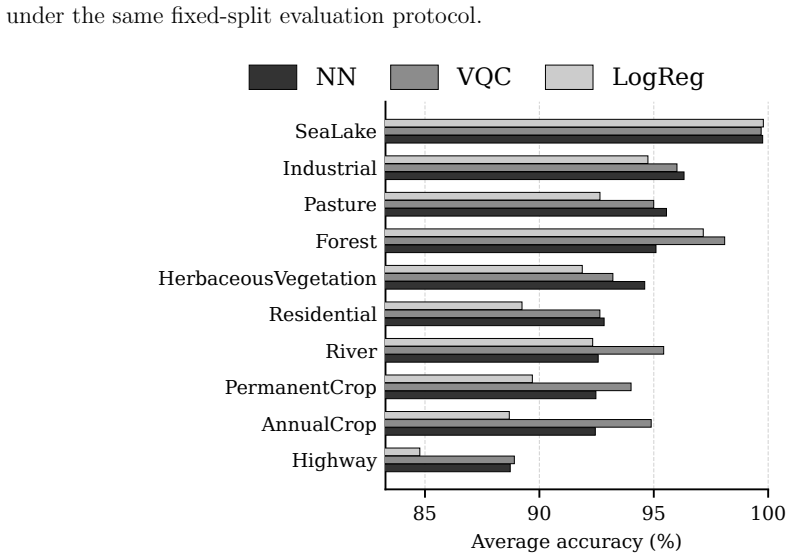
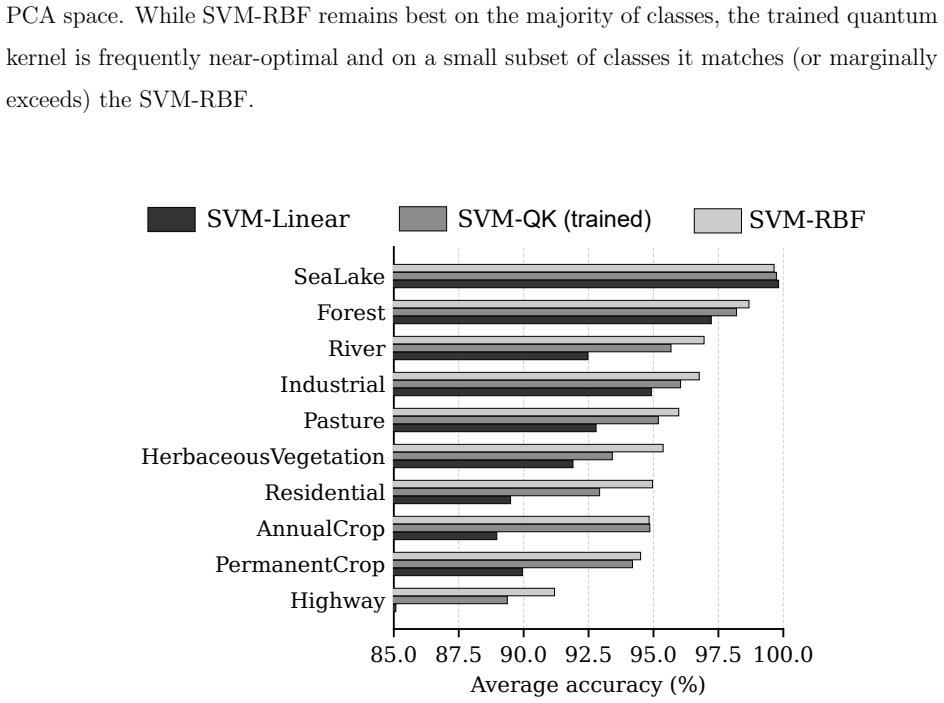
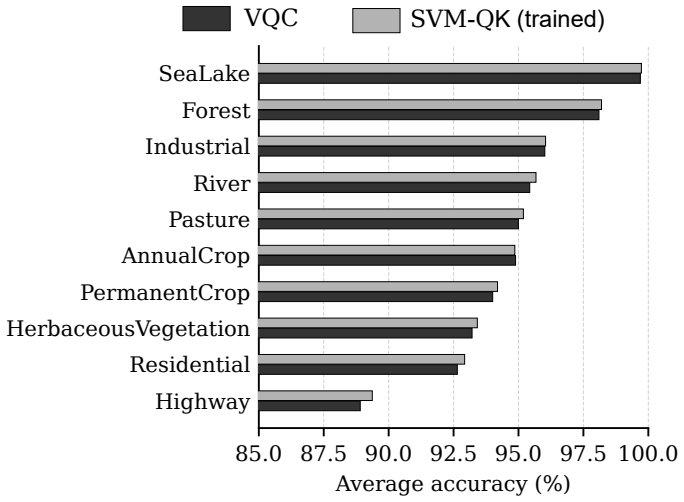
Parameterized quantum circuits trained as variational classifiers do not surpass RBF-SVM accuracy when their expectation values are read out linearly. The identical trained circuit nevertheless supplies a feature map that, when inserted into a kernel-based SVM, yields higher accuracy than either the linear quantum readout or the classical baselines alone.
What carries the argument
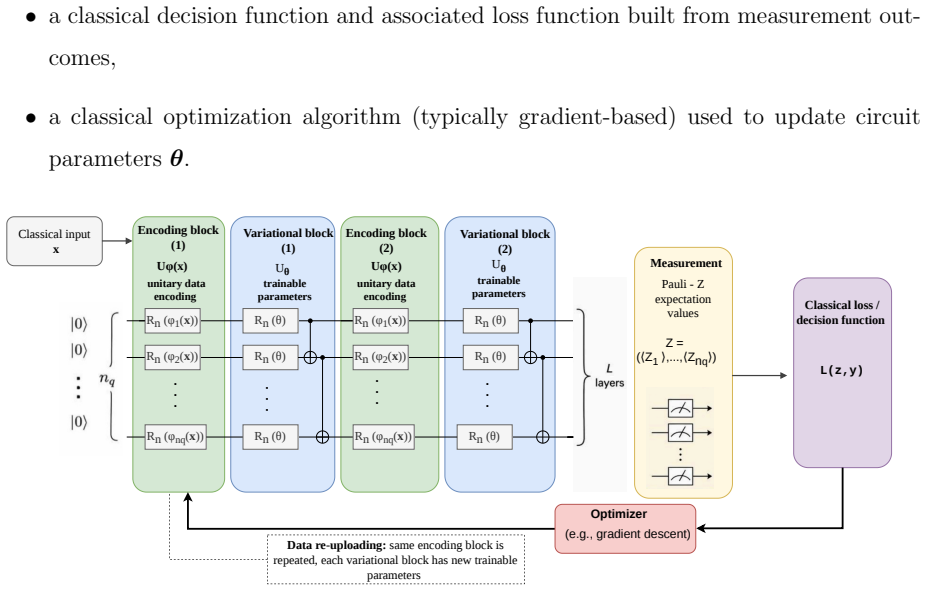
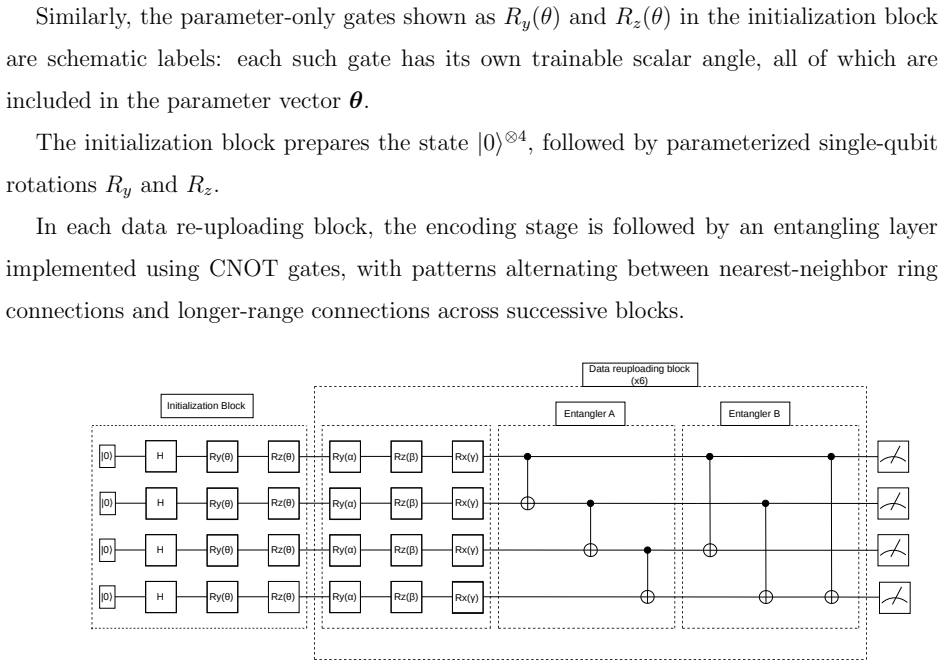
Variational quantum circuits serving as trainable nonlinear feature maps, contrasted under linear readout versus quantum-kernel SVM readout.
If this is right
- Direct linear readout from a trained VQC is outperformed by classical RBF-SVM on this task.
- Reusing the learned quantum feature map inside a kernel SVM produces measurable accuracy gains over both linear quantum and classical baselines.
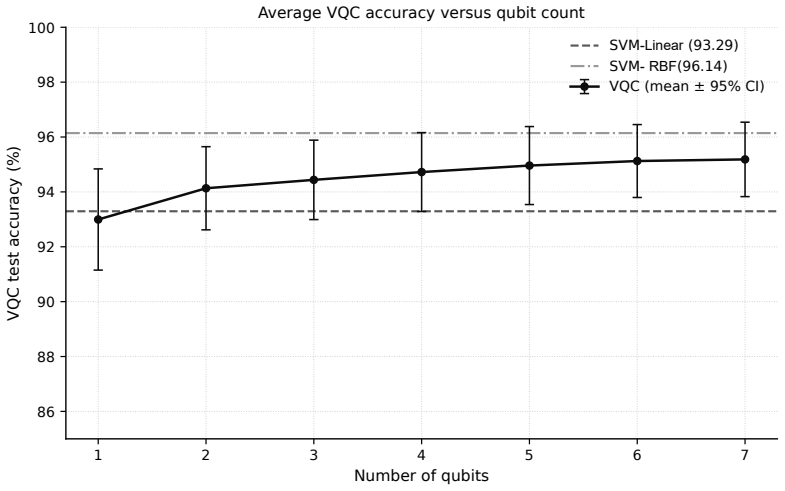
- Performance saturates with added qubits because Hilbert-space dimension grows exponentially while parameters grow only linearly.
- Quantum representations can add value when paired with classical decision mechanisms rather than used for end-to-end replacement.
Where Pith is reading between the lines
- The same transfer of a learned quantum map into kernel methods may be worth testing on other remote-sensing or high-dimensional classification problems.
- Future experiments could check whether the feature map remains effective across different satellite datasets or requires dataset-specific retraining.
- The results suggest that near-term quantum advantage, if any, is more likely to appear in the representation stage than in the full classification pipeline.
Load-bearing premise
The feature map produced by the trained variational quantum circuit stays stable and useful when extracted and inserted directly into a classical kernel SVM without retraining or extra regularization.
What would settle it
If classification accuracy on the EuroSAT-MS dataset shows no gain when the quantum feature map is used inside the kernel SVM relative to the linear VQC or to RBF-SVM, the central claim is falsified.
Figures
read the original abstract
We investigate variational quantum classifiers (VQCs) for land-cover classification from multispectral satellite imagery, adopting a feature-map perspective in which the quantum circuit defines a nonlinear data embedding while the readout determines how this representation is exploited. Using the EuroSAT-MS dataset, we perform a systematic one-vs-one evaluation across all class pairs under a controlled experimental protocol, comparing classical baselines (logistic regression, SVMs, neural networks) with VQCs employing both linear readout and quantum-kernel SVM strategies. Our results show that, while VQCs with linear readout do not outperform strong classical baselines such as RBF-SVM, the same trained quantum feature map can significantly improve performance when reused within a kernel-based decision framework. A qubit-count sweep further reveals saturation effects consistent with the mismatch between exponential Hilbert space dimension and linear parameter scaling. Overall, our findings highlight that the effectiveness of quantum models depends critically on the interplay between representation and readout, and that meaningful gains may arise from combining learned quantum feature maps with classical decision mechanisms rather than seeking direct replacement of classical models.
Editorial analysis
A structured set of objections, weighed in public.
Referee Report
Summary. The manuscript empirically investigates parameterized quantum circuits (PQCs) as nonlinear feature maps for multispectral land-cover classification on the EuroSAT-MS dataset. It conducts a systematic one-vs-one comparison of variational quantum classifiers (VQCs) using linear readout against classical baselines including logistic regression, SVMs, and neural networks. The central finding is that linear-readout VQCs do not surpass strong classical models such as RBF-SVM, but the same trained quantum feature map yields significant performance gains when inserted unchanged into a quantum-kernel SVM framework. A qubit-count sweep is included to illustrate saturation effects arising from the mismatch between Hilbert-space dimension and parameter scaling.
Significance. If the empirical results hold under proper controls, the work usefully separates the roles of representation and readout in quantum machine learning. It supplies concrete evidence that hybrid strategies—learned quantum embeddings paired with classical kernel decision surfaces—can be more effective than direct VQC replacement for a real-world remote-sensing task. The controlled one-vs-one protocol and qubit-scaling analysis add value to the literature on practical quantum feature maps.
major comments (1)
- [Results / Experimental protocol] The central claim that the trained quantum feature map drives statistically significant gains when reused in the kernel SVM (abstract and Results) is load-bearing yet unsupported by the required ablations. No comparison is reported to the identical circuit with random or untrained parameters, nor to classical nonlinear embeddings of comparable expressivity. Without these controls it remains possible that the observed improvement is an artifact of the kernel decision surface rather than a property of the learned quantum representation.
minor comments (2)
- [Abstract] The abstract states comparative outcomes but supplies no numerical accuracies, error bars, hyperparameter tables, or data-split details; these should be summarized even at the abstract level for immediate assessment of effect size.
- [Methods] The precise extraction step for the quantum feature map (circuit parameters only, or the full unitary) and the kernel evaluation protocol (exact simulation versus shot noise) are not described; this information is necessary for reproducibility.
Simulated Author's Rebuttal
We thank the referee for their constructive feedback and the opportunity to improve the manuscript. The major comment raises a valid point about strengthening the evidence for the role of the trained quantum feature map. We address it below and will revise the paper to incorporate the requested controls.
read point-by-point responses
-
Referee: The central claim that the trained quantum feature map drives statistically significant gains when reused in the kernel SVM (abstract and Results) is load-bearing yet unsupported by the required ablations. No comparison is reported to the identical circuit with random or untrained parameters, nor to classical nonlinear embeddings of comparable expressivity. Without these controls it remains possible that the observed improvement is an artifact of the kernel decision surface rather than a property of the learned quantum representation.
Authors: We agree that direct ablations are needed to isolate the contribution of the trained representation. In the revised manuscript we will add a comparison of the quantum-kernel SVM performance using the trained feature map versus the identical circuit with random (untrained) parameters. This will demonstrate that the performance gains arise from the learned embedding rather than the kernel framework alone. Regarding classical nonlinear embeddings of comparable expressivity, our protocol already includes RBF-SVM as a strong nonlinear classical baseline; however, we will also include a comparison against a classical nonlinear embedding (e.g., a trained autoencoder of similar parameter count) followed by an SVM to further address this concern. These additions will be reported with the same one-vs-one protocol and statistical tests used elsewhere in the paper. revision: yes
Circularity Check
No circularity: purely empirical evaluation on held-out data
full rationale
The paper reports experimental results from training VQCs and classical baselines on the EuroSAT-MS dataset and measuring accuracy on held-out test sets. No mathematical derivation, uniqueness theorem, or ansatz is invoked whose output reduces to its own fitted inputs by construction. Claims about the utility of reusing a trained quantum feature map inside a kernel SVM are supported solely by direct performance comparisons rather than any self-referential prediction or self-citation load-bearing step.
Axiom & Free-Parameter Ledger
Reference graph
Works this paper leans on
-
[1]
L. Ma, Y. Liu, X. Zhang, Y. Ye, G. Yin, and B. A. Johnson, ISPRS Journal of Photogrammetry and Remote Sensing152, 166 (2019)
work page 2019
- [2]
- [3]
- [4]
-
[5]
V. Havl´ ıˇ cek, A. D. C´ orcoles, K. Temme, A. W. Harrow, A. Kandala, J. M. Chow, and J. M. Gambetta, Nature567, 209 (2019)
work page 2019
-
[6]
Schuld (2021), arXiv:2101.11020 [quant-ph]
M. Schuld, Supervised quantum machine learning models are kernel methods (2021), arXiv:2101.11020 [quant-ph]
- [7]
- [8]
- [9]
- [10]
-
[11]
M. Khan, A. Hanan, M. Kenzhebay, M. Gazzea, and R. Arghandeh, Scientific Reports14, 16744 (2024)
work page 2024
-
[12]
Y. Cong, S. Khanna, C. Meng, P. Liu, E. Rozi, Y. He, M. Burke, D. B. Lobell, and S. Ermon, inAdvances in Neural Information Processing Systems, Vol. 35 (2022) pp. 197–211
work page 2022
-
[13]
D. Szwarcman, S. Roy, P. Fraccaro, O. E. G´ ıslason, B. Blumenstiel, R. Ghosal, P. H. De Oliveira, J. L. de Sousa Almeida, R. Sedona, Y. Kang,et al., IEEE Transactions on Geoscience and Remote Sensing 10.1109/TGRS.2025.3642610 (2025)
-
[14]
A. Delilbasic, G. Cavallaro, M. Willsch, F. Melgani, M. Riedel, and K. Michielsen, in2021 IEEE International Geoscience and Remote Sensing Symposium (IGARSS)(2021) pp. 2608– 2611. 23
work page 2021
-
[15]
A. Delilbasic, B. Le Saux, M. Riedel, K. Michielsen, and G. Cavallaro, IEEE Journal of Selected Topics in Applied Earth Observations and Remote Sensing17, 1434 (2024)
work page 2024
-
[16]
J. M. Zollner, inProceedings of the 30th International Conference on Advances in Geographic Information Systems(2022)
work page 2022
-
[17]
A. Miroszewski, J. Mielczarek, G. Czelusta, F. Szczepanek, B. Grabowski, B. Le Saux, and J. Nalepa, IEEE Journal of Selected Topics in Applied Earth Observations and Remote Sensing 16, 7601 (2023)
work page 2023
-
[18]
A. Sebastianelli, D. A. Zaidenberg, D. Spiller, B. Le Saux, and S. L. Ullo, IEEE Journal of Selected Topics in Applied Earth Observations and Remote Sensing15, 565 (2022)
work page 2022
-
[19]
F. Fan, Y. Shi, T. Guggemos, and X. X. Zhu, IEEE Transactions on Neural Networks and Learning Systems35, 18145 (2024)
work page 2024
-
[20]
F. Fan, Y. Shi, and X. X. Zhu, IEEE Journal of Selected Topics in Applied Earth Observations and Remote Sensing17, 12477 (2024)
work page 2024
-
[21]
I. Liliopoulos, G. D. Varsamis, K. Milchanowski, R. Martin-Cuevas, K. Safouri, P. Dimitrakis, and I. G. Karafyllidis, Quantum Machine Intelligence7, 10.1007/s42484-024-00230-8 (2025)
-
[22]
A. Sebastianelli, F. Mauro, G. Ciabatti, D. Spiller, B. Le Saux, P. Gamba, and S. L. Ullo, IEEE Transactions on Geoscience and Remote Sensing63, 1 (2025)
work page 2025
-
[23]
D. A. Zaidenberg, A. Sebastianelli, D. Spiller, and S. L. Ullo, in2021 IEEE International Geoscience and Remote Sensing Symposium (IGARSS)(2021) pp. 5680–5683
work page 2021
-
[24]
A. Sebastianelli, M. P. Di Rosso, S. L. Ullo, and P. Gamba, IEEE Geoscience and Remote Sensing Letters20, 1 (2023)
work page 2023
-
[25]
S. Otgonbaatar and D. Kranzlm¨ uller, IEEE Transactions on Quantum Engineering5, 1 (2024)
work page 2024
-
[26]
Y. Liu, W. Wang, H. Wang, and B. Alidaee, Journal of Engineering Research and Sciences 10.55708/js0212004 (2023)
- [27]
-
[28]
G. Maragkopoulos, A. Mandilara, R. Komini, and D. Syvridis, arXiv preprint arXiv:2603.15522 (2026)
-
[29]
M. Benedetti, E. Lloyd, S. Sack, and M. Fiorentini, Quantum Science and Technology4, 043001 (2019)
work page 2019
- [30]
-
[31]
T. Hubregtsen, D. Wierichs, E. Gil-Fuster, P.-J. H. S. Derks, P. K. Faehrmann, and J. J. Meyer, Phys. Rev. A106, 042431 (2022)
work page 2022
-
[32]
A. Mandilara, A. Papadopoulos, and D. Syvridis, arXiv preprint arXiv:2509.12072 (2025)
-
[33]
A. P´ erez-Salinas, A. Cervera-Lierta, E. Gil-Fuster, and J. I. Latorre, Quantum4, 226 (2020)
work page 2020
-
[34]
S. Sim, P. D. Johnson, and A. Aspuru-Guzik, Advanced Quantum Technologies2, 1900070 (2019)
work page 2019
-
[35]
J. R. McClean, S. Boixo, V. N. Smelyanskiy, R. Babbush, and H. Neven, Nature Communi- cations9, 4812 (2018). 25
work page 2018
discussion (0)
Sign in with ORCID, Apple, or X to comment. Anyone can read and Pith papers without signing in.