Recognition: unknown
Taming Noise-Induced Prototype Degradation for Privacy-Preserving Personalized Federated Fine-Tuning
Pith reviewed 2026-05-07 06:34 UTC · model grok-4.3
The pith
Variance-adaptive noise allocation in class prototypes reduces degradation while preserving local differential privacy in federated fine-tuning.
A machine-rendered reading of the paper's core claim, the machinery that carries it, and where it could break.
Core claim
The authors establish that their groupwise variance-adaptive prototype perturbation mechanism, together with distillation-guided clipping regularization, delivers privacy guarantees no weaker than isotropic Gaussian perturbation under identical constraints. By allocating noise according to per-dimension class variance and concentrating feature norms near the clipping threshold, the approach limits prototype degradation in semantically important directions while satisfying the same differential privacy bounds.
What carries the argument
The Variance-adaptive Prototype Perturbation (VPP) that scales noise inversely to class variance per dimension, paired with Distillation-guided Clipping Regularization (DCR) that uses prediction consistency from a teacher model to adapt norms to the clip threshold.
If this is right
- VPDR integrates as a client-side plug-in into existing ProtoPFL methods.
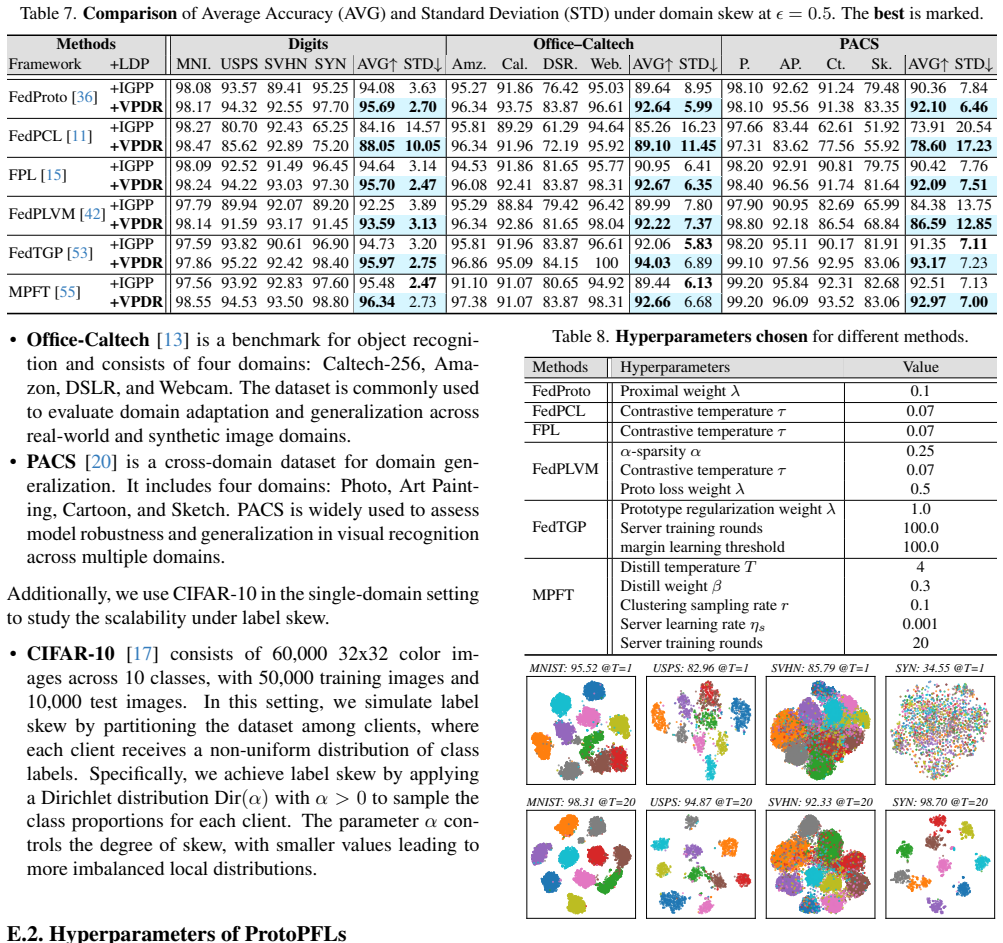
- It delivers superior privacy-utility trade-offs on multi-domain benchmarks.
- The approach maintains robustness against realistic attacks.
- Privacy guarantees are no weaker than those of isotropic Gaussian noise.
- Feature norms concentrate near the clipping threshold without losing prediction consistency.
Where Pith is reading between the lines
- Data-dependent noise based on variance might apply to other private data aggregation tasks.
- The variance-discriminability assumption could extend the method to additional modalities like text.
- Combining this with secure multi-party computation could further strengthen privacy in federated settings.
Load-bearing premise
The premise that higher dimension-wise class variance corresponds directly to greater discriminability, justifying lower noise there, and that distillation can enforce norm concentration near the clipping threshold without altering the model's predictions.
What would settle it
If experiments on multi-domain benchmarks show that VPDR either provides weaker privacy or lower utility than the isotropic baseline under the same constraints, the claims would not hold.
Figures


read the original abstract
Prototype-based Personalized Federated Learning (ProtoPFL) enables efficient multi-domain adaptation by communicating compact class prototypes, but directly sharing them poses privacy risks. A common defense involves per-example $\ell_2$ clipping before prototype computation to bound sensitivity, followed by isotropic Gaussian noise to enforce Local Differential Privacy (LDP). However, Isotropic Gaussian Prototype Perturbation (IGPP) typically over-perturbs discriminative dimensions and struggles to balance the clipping threshold with representation fidelity. In this paper, we propose VPDR, a client-side privacy plug-in that seamlessly integrates into existing ProtoPFLs. Motivated by the observation that dimension-wise class variance reflects discriminability, we introduce Variance-adaptive Prototype Perturbation (VPP), which allocates less noise to discriminative subspaces, preserving semantic separability while ensuring privacy. We further develop Distillation-guided Clipping Regularization (DCR), which enables feature norms to adaptively concentrate near the predefined clipping threshold while maintaining prediction consistency. Theoretical analysis shows that our groupwise mechanism provides privacy guarantees no weaker than the isotropic baseline under the same privacy constraints. Extensive experiments on multi-domain benchmarks demonstrate that VPDR achieves a superior privacy-utility trade-off, outperforming IGPP in personalized federated fine-tuning without sacrificing robustness against realistic attacks.
Editorial analysis
A structured set of objections, weighed in public.
Referee Report
Summary. The paper proposes VPDR, a client-side privacy plug-in for prototype-based personalized federated learning (ProtoPFL). It introduces Variance-adaptive Prototype Perturbation (VPP) that allocates Gaussian noise per dimension or group according to empirical class-wise variance (less noise in high-variance discriminative subspaces) and Distillation-guided Clipping Regularization (DCR) that encourages feature norms to concentrate near a fixed clipping threshold while preserving prediction consistency. The central claims are that the resulting groupwise mechanism yields LDP guarantees no weaker than standard isotropic Gaussian prototype perturbation (IGPP) under identical privacy budgets, and that extensive experiments on multi-domain benchmarks show improved privacy-utility trade-offs without loss of robustness to realistic attacks.
Significance. If the privacy analysis holds, the work offers a practical way to reduce over-perturbation of discriminative dimensions in prototype sharing, which is a recurring bottleneck in privacy-preserving ProtoPFL. The empirical demonstration of better trade-offs versus IGPP and the seamless integration as a plug-in are useful contributions. The paper supplies reproducible experimental protocols and attack evaluations, which strengthens its practical value if the theoretical guarantee is made rigorous.
major comments (3)
- [Theoretical Analysis] Theoretical Analysis section (around the statement that the groupwise mechanism provides privacy guarantees no weaker than the isotropic baseline): the proof must explicitly bound the sensitivity of the empirical dimension-wise variance estimator used to set per-group sigma in VPP. Because sigma is data-dependent, the mechanism is not a simple post-processing of a fixed-sensitivity Gaussian mechanism; without a sensitivity bound or a worst-case privacy-loss argument over all possible variance realizations, the claim that privacy is 'no weaker' under the same constraints does not follow from standard Gaussian LDP calibration.
- [§3.2] §3.2 (VPP definition): the decision to allocate noise according to observed dimension-wise class variance relies on the assumption that variance directly reflects discriminability. This assumption is used both to motivate the method and to set the grouping thresholds; if the thresholds themselves are data-dependent, the mechanism requires an additional privacy accounting step that is not shown to be absorbed into the stated epsilon budget.
- [§4] §4 (DCR): the regularization is claimed to make feature norms concentrate near the clipping threshold while maintaining prediction consistency. The interaction between this regularization and the subsequent variance computation in VPP is not analyzed; any dependence introduced by DCR on the private features could further affect the sensitivity of the variance estimator and must be accounted for in the privacy proof.
minor comments (3)
- [§3.2] The notation distinguishing per-dimension versus per-group variance in VPP is introduced without a clear equation reference; a single equation defining the grouping rule and the resulting noise covariance would improve readability.
- [Experiments] Table 1 and Figure 3: the reported attack success rates should include standard deviations over multiple random seeds to allow readers to assess whether the claimed robustness margin is statistically reliable.
- [Experiments] The hyper-parameter table for DCR (temperature, distillation weight, etc.) is missing; all values used in the reported experiments should be listed explicitly.
Simulated Author's Rebuttal
We thank the referee for the constructive comments, which highlight important aspects of the privacy analysis that require strengthening. We agree with the need to rigorously bound the sensitivity of data-dependent components and will revise the manuscript to provide a complete proof that the privacy guarantees are no weaker than those of IGPP.
read point-by-point responses
-
Referee: [Theoretical Analysis] Theoretical Analysis section (around the statement that the groupwise mechanism provides privacy guarantees no weaker than the isotropic baseline): the proof must explicitly bound the sensitivity of the empirical dimension-wise variance estimator used to set per-group sigma in VPP. Because sigma is data-dependent, the mechanism is not a simple post-processing of a fixed-sensitivity Gaussian mechanism; without a sensitivity bound or a worst-case privacy-loss argument over all possible variance realizations, the claim that privacy is 'no weaker' under the same constraints does not follow from standard Gaussian LDP calibration.
Authors: We thank the referee for this important observation. The current theoretical analysis argues that the groupwise mechanism provides LDP guarantees no weaker than IGPP under identical privacy budgets by allocating noise according to variance, but it does not explicitly address the sensitivity of the variance estimator itself. We will revise the Theoretical Analysis section to include a formal bound on the sensitivity of the empirical dimension-wise variance. Given that prototypes are computed from l2-clipped features, the variance in each dimension has a bounded range, which allows us to derive the sensitivity and calibrate the noise accordingly or use a worst-case argument. This will make the privacy claim rigorous. revision: yes
-
Referee: [§3.2] §3.2 (VPP definition): the decision to allocate noise according to observed dimension-wise class variance relies on the assumption that variance directly reflects discriminability. This assumption is used both to motivate the method and to set the grouping thresholds; if the thresholds themselves are data-dependent, the mechanism requires an additional privacy accounting step that is not shown to be absorbed into the stated epsilon budget.
Authors: The variance-discriminability assumption is primarily for motivating VPP and is supported by the experimental results showing improved utility. For the grouping thresholds, we will revise §3.2 to specify a data-independent grouping strategy, such as using a fixed number of groups or thresholds based on expected variance ranges rather than empirical quantiles from the current data. Alternatively, if data-dependent grouping is retained, we will incorporate the privacy cost of the grouping step into the overall analysis. This will ensure the epsilon budget is respected. revision: yes
-
Referee: [§4] §4 (DCR): the regularization is claimed to make feature norms concentrate near the clipping threshold while maintaining prediction consistency. The interaction between this regularization and the subsequent variance computation in VPP is not analyzed; any dependence introduced by DCR on the private features could further affect the sensitivity of the variance estimator and must be accounted for in the privacy proof.
Authors: We acknowledge that the interaction between DCR and VPP's variance computation was not explicitly analyzed in the privacy proof. We will revise the manuscript to include an analysis showing that DCR, being a regularization applied to the model training, does not alter the sensitivity bound because the subsequent clipping operation still limits the feature norms, and thus the variance sensitivity remains the same as without DCR. We will add this to the Theoretical Analysis section to confirm that the privacy guarantees are unaffected. revision: yes
Circularity Check
No significant circularity in derivation chain
full rationale
The paper's central theoretical claim—that the groupwise variance-adaptive mechanism provides privacy guarantees no weaker than the isotropic Gaussian baseline—is presented as the output of a separate analysis rather than being definitionally equivalent to the method's inputs. The variance-based noise allocation is motivated by an empirical observation about discriminability and is not used to derive the privacy bound by construction; the bound is asserted to hold under the same constraints via groupwise analysis. No self-citation chain, fitted parameter renamed as prediction, or ansatz smuggled via prior work is load-bearing for the privacy result. The derivation remains self-contained against the stated LDP constraints and does not reduce the claimed guarantee to a tautology of the variance estimator itself.
Axiom & Free-Parameter Ledger
free parameters (1)
- clipping threshold
axioms (1)
- domain assumption Dimension-wise class variance reflects discriminability of prototype dimensions
invented entities (2)
-
Variance-adaptive Prototype Perturbation (VPP)
no independent evidence
-
Distillation-guided Clipping Regularization (DCR)
no independent evidence
Reference graph
Works this paper leans on
-
[1]
Revisiting neural scaling laws in language and vision
Ibrahim M Alabdulmohsin, Behnam Neyshabur, and Xiao- hua Zhai. Revisiting neural scaling laws in language and vision. InAdvances in Neural Information Processing Sys- tems, pages 22300–22312. Curran Associates, Inc., 2022. 1
2022
-
[2]
Diprompt: Disentan- gled prompt tuning for multiple latent domain generaliza- tion in federated learning
Sikai Bai, Jie Zhang, Song Guo, Shuaicheng Li, Jingcai Guo, Jun Hou, Tao Han, and Xiaocheng Lu. Diprompt: Disentan- gled prompt tuning for multiple latent domain generaliza- tion in federated learning. In2024 IEEE/CVF Conference on Computer Vision and Pattern Recognition (CVPR), pages 27274–27283, 2024. 1
2024
-
[3]
Personalization improves privacy- accuracy tradeoffs in federated learning
Alberto Bietti, Chen-Yu Wei, Miroslav Dudik, John Lang- ford, and Steven Wu. Personalization improves privacy- accuracy tradeoffs in federated learning. InInternational Conference on Machine Learning, pages 1945–1962. PMLR,
1945
-
[4]
Fair feder- ated learning under domain skew with local consistency and domain diversity
Yuhang Chen, Wenke Huang, and Mang Ye. Fair feder- ated learning under domain skew with local consistency and domain diversity. In2024 IEEE/CVF Conference on Com- puter Vision and Pattern Recognition (CVPR), pages 12077– 12086, 2024. 1
2024
-
[5]
Differentially private federated learning with local regularization and sparsification
Anda Cheng, Peisong Wang, Xi Sheryl Zhang, and Jian Cheng. Differentially private federated learning with local regularization and sparsification. In2022 IEEE/CVF Confer- ence on Computer Vision and Pattern Recognition (CVPR), pages 10112–10121, 2022. 2, 1
2022
-
[6]
Aldp-fl for adaptive local differen- tial privacy in federated learning.Scientific Reports, 15(1): 26679, 2025
Lixin Cui and Xu Wu. Aldp-fl for adaptive local differen- tial privacy in federated learning.Scientific Reports, 15(1): 26679, 2025. 2, 1
2025
-
[7]
Rami Darwish, Mahmoud Abdelsalam, Sajad Khorsandroo, and Kaushik Roy. Fedp3e: Privacy-preserving prototype ex- change for non-iid iot malware detection in cross-silo feder- ated learning.arXiv preprint arXiv:2507.07258, 2025. 2
-
[8]
An image is worth 16×16 words: Transformers for image recognition at scale
Alexey Dosovitskiy, Lucas Beyer, Alexander Kolesnikov, Dirk Weissenborn, Xiaohua Zhai, Thomas Unterthiner, Mostafa Dehghani, Matthias Minderer, Georg Heigold, Syl- vain Gelly, and Alexander Houlsby. An image is worth 16×16 words: Transformers for image recognition at scale. InInternational Conference on Learning Representations (ICLR), 2021. 6, 4
2021
-
[9]
Calibrating noise to sensitivity in private data analy- sis
Cynthia Dwork, Frank McSherry, Kobbi Nissim, and Adam Smith. Calibrating noise to sensitivity in private data analy- sis. InTheory of cryptography conference, pages 265–284. Springer, 2006. 6
2006
-
[10]
Per- sonalized federated learning with theoretical guarantees: A model-agnostic meta-learning approach
Alireza Fallah, Aryan Mokhtari, and Asuman Ozdaglar. Per- sonalized federated learning with theoretical guarantees: A model-agnostic meta-learning approach. InAdvances in Neural Information Processing Systems, pages 3557–3568. Curran Associates, Inc., 2020. 1
2020
-
[11]
Per- sonalized federated learning with theoretical guarantees: A model-agnostic meta-learning approach
Alireza Fallah, Aryan Mokhtari, and Asuman Ozdaglar. Per- sonalized federated learning with theoretical guarantees: A model-agnostic meta-learning approach. InAdvances in Neural Information Processing Systems, pages 3557–3568. Curran Associates, Inc., 2020. 1, 2, 3, 5, 6, 7, 4
2020
-
[12]
Differentially Private Federated Learning: A Client Level Perspective
Robin C Geyer, Tassilo Klein, and Moin Nabi. Differentially private federated learning: A client level perspective.arXiv preprint arXiv:1712.07557, 2017. 2, 1
work page Pith review arXiv 2017
-
[13]
Geodesic flow kernel for unsupervised domain adaptation
Boqing Gong, Yuan Shi, Fei Sha, and Kristen Grauman. Geodesic flow kernel for unsupervised domain adaptation. In2012 IEEE Conference on Computer Vision and Pattern Recognition, pages 2066–2073, 2012. 6, 4
2066
-
[14]
Clustered feder- ated learning with adaptive local differential privacy on het- erogeneous iot data.IEEE Internet of Things Journal, 11(1): 137–146, 2024
Zaobo He, Lintao Wang, and Zhipeng Cai. Clustered feder- ated learning with adaptive local differential privacy on het- erogeneous iot data.IEEE Internet of Things Journal, 11(1): 137–146, 2024. 2, 1
2024
-
[15]
Re- thinking federated learning with domain shift: A prototype view
Wenke Huang, Mang Ye, Zekun Shi, He Li, and Bo Du. Re- thinking federated learning with domain shift: A prototype view. In2023 IEEE/CVF Conference on Computer Vision and Pattern Recognition (CVPR), pages 16312–16322, 2023. 1, 2, 3, 5, 6, 7, 4
2023
-
[16]
Jonathan J. Hull. A database for handwritten text recogni- tion research.IEEE Transactions on Pattern Analysis and Machine Intelligence, 16(5):550–554, 1994. 6, 3
1994
-
[17]
Learning multiple layers of features from tiny images
Alex Krizhevsky, Geoffrey Hinton, et al. Learning multiple layers of features from tiny images. 2009. 7, 4
2009
-
[18]
Lecun, L
Y . Lecun, L. Bottou, Y . Bengio, and P. Haffner. Gradient- based learning applied to document recognition.Proceed- ings of the IEEE, 86(11):2278–2324, 1998. 6, 3
1998
-
[19]
Fedsol: Stabilized orthogonal learn- ing with proximal restrictions in federated learning
Gihun Lee, Minchan Jeong, Sangmook Kim, Jaehoon Oh, and Se-Young Yun. Fedsol: Stabilized orthogonal learn- ing with proximal restrictions in federated learning. In 2024 IEEE/CVF Conference on Computer Vision and Pat- tern Recognition (CVPR), pages 12512–12522, 2024. 1
2024
-
[20]
Hospedales
Da Li, Yongxin Yang, Yi-Zhe Song, and Timothy M. Hospedales. Deeper, broader and artier domain generaliza- tion. In2017 IEEE International Conference on Computer Vision (ICCV), pages 5543–5551, 2017. 6, 4
2017
-
[21]
Ditto: Fair and robust federated learning through personalization
Tian Li, Shengyuan Hu, Ahmad Beirami, and Virginia Smith. Ditto: Fair and robust federated learning through personalization. InProceedings of the 38th International Conference on Machine Learning, pages 6357–6368. PMLR,
-
[22]
Layer-wised model aggregation for personalized federated learning
Xiaosong Ma, Jie Zhang, Song Guo, and Wenchao Xu. Layer-wised model aggregation for personalized federated learning. In2022 IEEE/CVF Conference on Computer Vi- sion and Pattern Recognition (CVPR), pages 10082–10091,
-
[23]
Communication- Efficient Learning of Deep Networks from Decentralized Data
Brendan McMahan, Eider Moore, Daniel Ramage, Seth Hampson, and Blaise Aguera y Arcas. Communication- Efficient Learning of Deep Networks from Decentralized Data. InProceedings of the 20th International Conference on Artificial Intelligence and Statistics, pages 1273–1282. PMLR, 2017. 1
2017
-
[24]
R ´enyi differential privacy
Ilya Mironov. R ´enyi differential privacy. In2017 IEEE 30th computer security foundations symposium (CSF), pages 263–275. IEEE, 2017. 3
2017
-
[25]
Scaling data- constrained language models
Niklas Muennighoff, Alexander Rush, Boaz Barak, Teven Le Scao, Nouamane Tazi, Aleksandra Piktus, Sampo Pyysalo, Thomas Wolf, and Colin A Raffel. Scaling data- constrained language models. InAdvances in Neural Infor- mation Processing Systems, pages 50358–50376. Curran As- sociates, Inc., 2023. 1
2023
-
[26]
Reading digits in natural images with unsupervised feature learning
Yuval Netzer, Tao Wang, Adam Coates, Alessandro Bis- sacco, Baolin Wu, Andrew Y Ng, et al. Reading digits in natural images with unsupervised feature learning. InNIPS workshop on deep learning and unsupervised feature learn- ing, page 4. Granada, 2011. 6, 3
2011
-
[27]
Fedhide: Federated learn- ing by hiding in the neighbors
Hyunsin Park and Sungrack Yun. Fedhide: Federated learn- ing by hiding in the neighbors. InEuropean Conference on Computer Vision, pages 405–422. Springer, 2024. 2
2024
-
[28]
Su, and Michael I
Anqi Qiao, Weijie J. Su, and Michael I. Zhang. Oneshot differentially private top-k selection. InProceedings of the 38th International Conference on Machine Learning. PMLR, 2021. 3, 4
2021
-
[29]
Effects of degra- dations on deep neural network architectures
P Roy, S Ghosh, S Bhattacharya, and U Pal. Effects of degra- dations on deep neural network architectures. arxiv 2018. arXiv preprint arXiv:1807.10108, 2018. 6, 3
-
[30]
John Wiley & Sons, 1999
Henry Scheffe.The analysis of variance. John Wiley & Sons, 1999. 4
1999
-
[31]
Fedawa: Adaptive optimiza- tion of aggregation weights in federated learning using client vectors
Changlong Shi, He Zhao, Bingjie Zhang, Mingyuan Zhou, Dandan Guo, and Yi Chang. Fedawa: Adaptive optimiza- tion of aggregation weights in federated learning using client vectors. In2025 IEEE/CVF Conference on Computer Vision and Pattern Recognition (CVPR), pages 30651–30660, 2025. 1
2025
-
[32]
Make landscape flatter in differentially private federated learning
Yifan Shi, Yingqi Liu, Kang Wei, Li Shen, Xueqian Wang, and Dacheng Tao. Make landscape flatter in differentially private federated learning. In2023 IEEE/CVF Conference on Computer Vision and Pattern Recognition (CVPR), pages 24552–24562, 2023. 2, 1
2023
-
[33]
Membership inference attacks against machine learning models
Reza Shokri, Marco Stronati, Congzheng Song, and Vitaly Shmatikov. Membership inference attacks against machine learning models. In2017 IEEE Symposium on Security and Privacy (SP), pages 3–18, 2017. 8
2017
-
[34]
Dinh, Nguyen Tran, and Josh Nguyen
Canh T. Dinh, Nguyen Tran, and Josh Nguyen. Personal- ized federated learning with moreau envelopes. InAdvances in Neural Information Processing Systems, pages 21394– 21405. Curran Associates, Inc., 2020. 1
2020
-
[35]
Fedselect: Personalized fed- erated learning with customized selection of parameters for fine-tuning
Rishub Tamirisa, Chulin Xie, Wenxuan Bao, Andy Zhou, Ron Arel, and Aviv Shamsian. Fedselect: Personalized fed- erated learning with customized selection of parameters for fine-tuning. In2024 IEEE/CVF Conference on Computer Vi- sion and Pattern Recognition (CVPR), pages 23985–23994,
-
[36]
Fedproto: Federated proto- type learning across heterogeneous clients
Yue Tan, Guodong Long, Lu Liu, Tianyi Zhou, Qinghua Lu, Jing Jiang, and Chengqi Zhang. Fedproto: Federated proto- type learning across heterogeneous clients. InProceedings of the AAAI conference on artificial intelligence, pages 8432– 8440, 2022. 1, 2, 3, 6, 7, 8, 4, 5
2022
-
[37]
Privacy-preserving personalized federated prompt learning for multimodal large language models
Linh Tran, Wei Sun, Stacy Patterson, and Ana Milanova. Privacy-preserving personalized federated prompt learning for multimodal large language models. InThe Thirteenth In- ternational Conference on Learning Representations, 2025. 2, 3
2025
-
[38]
R ´enyi divergence and kullback-leibler divergence.IEEE Transactions on Informa- tion Theory, 60(7):3797–3820, 2014
Tim van Erven and Peter Harremos. R ´enyi divergence and kullback-leibler divergence.IEEE Transactions on Informa- tion Theory, 60(7):3797–3820, 2014. 3
2014
-
[39]
Position: Will we run out of data? limits of llm scaling based on human- generated data
Pablo Villalobos, Anson Ho, Jaime Sevilla, Tamay Be- siroglu, Lennart Heim, and Marius Hobbhahn. Position: Will we run out of data? limits of llm scaling based on human- generated data. InForty-first International Conference on Machine Learning, 2024. 1
2024
-
[40]
Federated graph learning under domain shift with generalizable pro- totypes.Proceedings of the AAAI Conference on Artificial Intelligence, 38(14):15429–15437, 2024
Guancheng Wan, Wenke Huang, and Mang Ye. Federated graph learning under domain shift with generalizable pro- totypes.Proceedings of the AAAI Conference on Artificial Intelligence, 38(14):15429–15437, 2024. 1
2024
-
[41]
Fedfr-adp: Adaptive dif- ferential privacy with feedback regulation for robust model performance in federated learning.Information Fusion, 116: 102796, 2025
Debao Wang and Shaopeng Guan. Fedfr-adp: Adaptive dif- ferential privacy with feedback regulation for robust model performance in federated learning.Information Fusion, 116: 102796, 2025. 2, 1
2025
-
[42]
Taming cross-domain representation variance in feder- ated prototype learning with heterogeneous data domains
Lei Wang, Jieming Bian, Letian Zhang, Chen Chen, and Jie Xu. Taming cross-domain representation variance in feder- ated prototype learning with heterogeneous data domains. In Advances in Neural Information Processing Systems, pages 88348–88372. Curran Associates, Inc., 2024. 1, 2, 3, 5, 6, 7, 4
2024
-
[43]
Fedpcl-cdr: A fed- erated prototype-based contrastive learning framework for privacy-preserving cross-domain recommendation.Neural Networks, 196:108380, 2026
Li Wang, Qiang Wu, and Min Xu. Fedpcl-cdr: A fed- erated prototype-based contrastive learning framework for privacy-preserving cross-domain recommendation.Neural Networks, 196:108380, 2026. 2
2026
-
[44]
Local differential private data aggregation for discrete distribution estimation.IEEE Transactions on Parallel and Distributed Systems, 30(9):2046–2059, 2019
Shaowei Wang, Liusheng Huang, Yiwen Nie, Xinyuan Zhang, Pengzhan Wang, Hongli Xu, and Wei Yang. Local differential private data aggregation for discrete distribution estimation.IEEE Transactions on Parallel and Distributed Systems, 30(9):2046–2059, 2019. 3
2046
-
[45]
Federated learning with domain shift eraser
Zheng Wang, Zihui Wang, Zheng Wang, Xiaoliang Fan, and Cheng Wang. Federated learning with domain shift eraser. In2025 IEEE/CVF Conference on Computer Vision and Pat- tern Recognition (CVPR), pages 4978–4987, 2025. 1
2025
-
[46]
Vincent Poor
Kang Wei, Jun Li, Ming Ding, Chuan Ma, Hang Su, Bo Zhang, and H. Vincent Poor. User-level privacy-preserving federated learning: Analysis and performance optimization. IEEE Transactions on Mobile Computing, 21(9):3388–3401,
-
[47]
Perada: Parameter-efficient federated learning personalization with generalization guarantees
Chulin Xie, De-An Huang, Wenda Chu, Daguang Xu, Chaowei Xiao, Bo Li, and Anima Anandkumar. Perada: Parameter-efficient federated learning personalization with generalization guarantees. In2024 IEEE/CVF Conference on Computer Vision and Pattern Recognition (CVPR), pages 23838–23848, 2024. 1
2024
-
[48]
Dynamic per- sonalized federated learning with adaptive differential pri- vacy
Xiyuan Yang, Wenke Huang, and Mang Ye. Dynamic per- sonalized federated learning with adaptive differential pri- vacy. InAdvances in Neural Information Processing Sys- tems, pages 72181–72192. Curran Associates, Inc., 2023. 2, 1
2023
-
[49]
Fedas: Bridg- ing inconsistency in personalized federated learning
Xiyuan Yang, Wenke Huang, and Mang Ye. Fedas: Bridg- ing inconsistency in personalized federated learning. In 2024 IEEE/CVF Conference on Computer Vision and Pat- tern Recognition (CVPR), pages 11986–11995, 2024. 1
2024
-
[50]
Open- fedllm: Training large language models on decentralized private data via federated learning
Rui Ye, Wenhao Wang, Jingyi Chai, Dihan Li, Zexi Li, Yinda Xu, Yaxin Du, Yanfeng Wang, and Siheng Chen. Open- fedllm: Training large language models on decentralized private data via federated learning. InProceedings of the 30th ACM SIGKDD Conference on Knowledge Discovery and Data Mining, page 6137–6147, New York, NY , USA,
-
[51]
Association for Computing Machinery. 1
-
[52]
Fedala: Adaptive local aggregation for personalized federated learning.Proceed- ings of the AAAI Conference on Artificial Intelligence, 37 (9):11237–11244, 2023
Jianqing Zhang, Yang Hua, Hao Wang, Tao Song, Zhengui Xue, Ruhui Ma, and Haibing Guan. Fedala: Adaptive local aggregation for personalized federated learning.Proceed- ings of the AAAI Conference on Artificial Intelligence, 37 (9):11237–11244, 2023. 1
2023
-
[53]
An upload-efficient scheme for transferring knowledge from a server-side pre-trained generator to clients in heterogeneous federated learning
Jianqing Zhang, Yang Liu, Yang Hua, and Jian Cao. An upload-efficient scheme for transferring knowledge from a server-side pre-trained generator to clients in heterogeneous federated learning. In2024 IEEE/CVF Conference on Com- puter Vision and Pattern Recognition (CVPR), pages 12109– 12119, 2024. 1, 2, 4
2024
-
[54]
Jianqing Zhang, Yang Liu, Yang Hua, and Jian Cao. Fedtgp: Trainable global prototypes with adaptive-margin-enhanced contrastive learning for data and model heterogeneity in fed- erated learning.Proceedings of the AAAI Conference on Ar- tificial Intelligence, 38(15):16768–16776, 2024. 1, 2, 3, 5, 6, 7, 4
2024
-
[55]
Fedgmkd: An efficient prototype federated learning framework through knowledge distillation and discrepancy-aware aggregation
Jianqiao Zhang, Caifeng Shan, and Jungong Han. Fedgmkd: An efficient prototype federated learning framework through knowledge distillation and discrepancy-aware aggregation. InAdvances in Neural Information Processing Systems, pages 118326–118356. Curran Associates, Inc., 2024. 2, 3, 1
2024
-
[56]
Enhancing federated do- main adaptation with multi-domain prototype-based feder- ated fine-tuning
Jingyuan Zhang, Yiyang Duan, Shuaicheng Niu, Y ANG CAO, and Wei Yang Bryan Lim. Enhancing federated do- main adaptation with multi-domain prototype-based feder- ated fine-tuning. InThe Thirteenth International Conference on Learning Representations, 2025. 2, 3, 6, 7, 8, 4
2025
-
[57]
Safely learn- ing with private data: A federated learning framework for large language model
Jia-Ying Zheng, Hainan Zhang, Lingxiang Wang, Wangjie Qiu, Hong-Wei Zheng, and Zhi-Ming Zheng. Safely learn- ing with private data: A federated learning framework for large language model. InProceedings of the 2024 Confer- ence on Empirical Methods in Natural Language Processing, pages 5293–5306, Miami, Florida, USA, 2024. Association for Computational Li...
2024
discussion (0)
Sign in with ORCID, Apple, or X to comment. Anyone can read and Pith papers without signing in.