Investigation of nonlocal transport associated with the orbital Hall effect in Ti
Pith reviewed 2026-05-09 19:22 UTC · model grok-4.3
The pith
Nonlocal resistance in single-layer Ti Hall bars exceeds what Ohmic bypass simulations predict, suggesting orbital transport from the orbital Hall effect.
A machine-rendered reading of the paper's core claim, the machinery that carries it, and where it could break.
Core claim
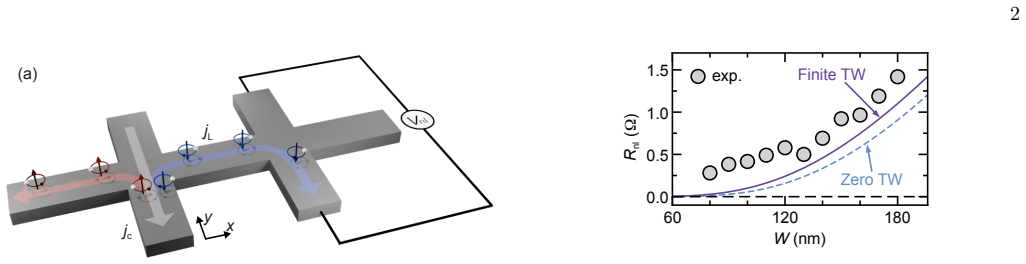
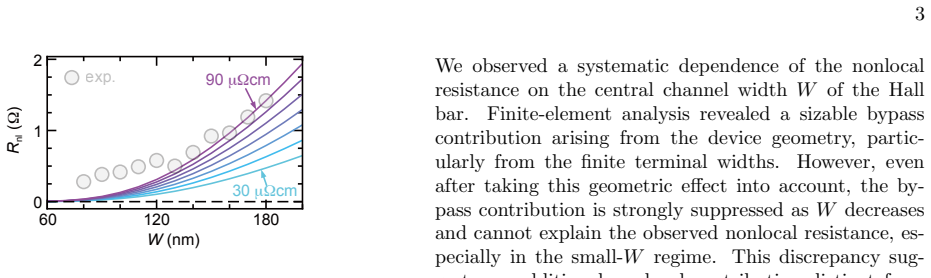
In single-layer Ti Hall bars a nonlocal resistance persists after the Ohmic bypass contribution estimated from finite-element simulations is subtracted, and the discrepancy survives even when spatial variations in Ti resistivity are included; the residual signal is therefore interpreted as orbital-current transport driven by the orbital Hall effect.
What carries the argument
The comparison of measured nonlocal resistance versus central channel width against finite-element simulations that calculate the Ohmic bypass current in the Hall-bar geometry.
If this is right
- Orbital currents could be generated and detected in light metals without heavy-element spin-orbit coupling layers.
- Channel-width scaling offers a practical method to separate orbital from charge transport contributions in a single device.
- The observed signal implies that orbital diffusion lengths in Ti are comparable to or longer than the smallest channel widths tested.
- Nonlocal geometries become a viable probe for orbital Hall conductivity in materials where spin Hall signals are absent.
Where Pith is reading between the lines
- The same width-scaling test could be applied to other light transition metals to map their orbital Hall angles without spin contamination.
- If orbital currents prove long-lived, they might enable nonlocal orbital-based interconnects or logic elements.
- A control experiment in a material known to lack orbital Hall response would cleanly isolate any remaining artifactual contributions.
Load-bearing premise
Finite-element simulations capture every possible Ohmic bypass path, and local resistivity fluctuations in the titanium film do not produce an unaccounted bypass signal at the widths used.
What would settle it
Repeat the nonlocal-resistance measurement at channel widths narrow enough that the simulated Ohmic bypass drops below the noise floor; if a finite signal remains, the orbital-transport interpretation is strengthened.
Figures

read the original abstract
We investigate nonlocal transport in single-layer Ti Hall bars to explore signatures of orbital-current transport driven by the orbital Hall effect. Despite the negligible spin Hall effect in Ti, we observe a finite nonlocal resistance in the single-layer Ti Hall bar and study its dependence on the central channel width. Finite-element simulations show that the measured signal contains a sizable Ohmic bypass contribution. However, the bypass contribution is strongly suppressed at small channel widths and cannot fully account for the observed nonlocal resistance even when variations in the Ti resistivity are taken into account. Our results therefore suggest an additional nonlocal contribution distinct from the Ohmic bypass background, which may be associated with orbital transport driven by the orbital Hall effect in Ti.
Editorial analysis
A structured set of objections, weighed in public.
Referee Report
Summary. The manuscript reports measurements of nonlocal resistance in single-layer Ti Hall bars as a function of central channel width. Finite-element simulations indicate that a sizable Ohmic bypass contribution is present but strongly suppressed at small widths; even after including Ti resistivity variations, the simulations cannot account for the full measured signal. The authors conclude that the residual nonlocal resistance suggests an additional contribution possibly arising from orbital-current transport driven by the orbital Hall effect in Ti.
Significance. If the residual signal is robustly shown to exceed all Ohmic contributions, the work would provide useful experimental evidence for orbital Hall effect in a material with negligible spin Hall angle, supporting the broader development of orbitronics. The geometric-variation approach combined with simulation subtraction is a reasonable strategy for isolating non-Ohmic nonlocal signals.
major comments (2)
- [finite-element simulations and resistivity-variation analysis] The central claim that the measured nonlocal resistance exceeds all Ohmic contributions rests on the finite-element simulations fully capturing bypass effects even after resistivity variations are included. However, the manuscript provides insufficient detail on the spatial distribution, correlation length, or amplitude spectrum of the resistivity inhomogeneities that were modeled; without explicit tests of grain-boundary-like or fabrication-induced gradients whose length scales match the smallest channel widths, it remains possible that additional Ohmic bypass is unaccounted for.
- [results and comparison to simulations] Quantitative comparison between data and simulations is load-bearing for the subtraction step, yet the manuscript does not report error bars on the simulated nonlocal resistances arising from resistivity uncertainty or mesh convergence, nor does it show the raw data tables or fitting residuals that would allow independent verification of the claimed residual at small widths.
minor comments (3)
- The abstract and introduction would benefit from a short statement of the expected magnitude of the orbital Hall effect in Ti relative to the observed residual to help readers gauge the scale of the claimed effect.
- All figures showing width dependence should include both measured data points with error bars and the corresponding simulated Ohmic curves on the same plot for direct visual comparison.
- A table listing all simulation parameters (resistivity range, contact resistances, mesh density, etc.) would improve reproducibility.
Simulated Author's Rebuttal
We thank the referee for the constructive feedback and for acknowledging the potential importance of our work in providing evidence for the orbital Hall effect in Ti. We address the major comments point by point below and will make the necessary revisions to the manuscript.
read point-by-point responses
-
Referee: The central claim that the measured nonlocal resistance exceeds all Ohmic contributions rests on the finite-element simulations fully capturing bypass effects even after resistivity variations are included. However, the manuscript provides insufficient detail on the spatial distribution, correlation length, or amplitude spectrum of the resistivity inhomogeneities that were modeled; without explicit tests of grain-boundary-like or fabrication-induced gradients whose length scales match the smallest channel widths, it remains possible that additional Ohmic bypass is unaccounted for.
Authors: We agree that more detailed information on the resistivity inhomogeneity modeling would strengthen the manuscript. Our simulations incorporated resistivity variations based on experimental measurements of Ti film resistivity, modeled as random fluctuations. To fully address this point, we will expand the methods section with explicit details on the spatial distribution (using correlated random fields with correlation lengths on the order of grain sizes in Ti), the amplitude spectrum, and additional simulations testing grain-boundary-like patterns and fabrication-induced gradients scaled to the smallest channel widths. These new results will demonstrate that the Ohmic bypass remains insufficient to account for the observed signal, supporting our conclusion. revision: yes
-
Referee: Quantitative comparison between data and simulations is load-bearing for the subtraction step, yet the manuscript does not report error bars on the simulated nonlocal resistances arising from resistivity uncertainty or mesh convergence, nor does it show the raw data tables or fitting residuals that would allow independent verification of the claimed residual at small widths.
Authors: We acknowledge the need for greater transparency in the quantitative comparison. In the revised manuscript, we will add error bars to the simulated nonlocal resistance values, accounting for uncertainties in the input resistivity and confirming mesh convergence through systematic tests. Furthermore, we will include the raw data tables for both experimental and simulated nonlocal resistances, as well as the fitting residuals, in the supplementary material. This will enable independent verification and clearly illustrate the residual signal at small widths that exceeds the Ohmic contributions. revision: yes
Circularity Check
No circularity: experimental comparison to independent simulations
full rationale
The paper is purely experimental, reporting measured nonlocal resistance in Ti Hall bars as a function of channel width and comparing it directly to separate finite-element simulations of Ohmic bypass (including resistivity variations). No derivation, ansatz, prediction, or uniqueness theorem is presented that reduces by construction to a parameter fitted from the same dataset or to a self-citation chain. The central suggestion of an additional orbital contribution rests on the empirical observation that simulations under-account for the signal at small widths, which is an external benchmark rather than a self-referential step. Any self-citations to prior orbital Hall work are not load-bearing for the reported data-simulation discrepancy.
Axiom & Free-Parameter Ledger
Reference graph
Works this paper leans on
-
[1]
Sinova, J., Valenzuela, S. O., Wunderlich, J., Back, C. H. & Jungwirth, T. Spin Hall effects.Rev. Mod. Phys.87, 1213–1260 (2015)
work page 2015
-
[2]
Manchon, A.et al.Current-induced spin-orbit torques in ferromagnetic and antiferromagnetic systems.Rev. Mod. Phys.91, 035004 (2019)
work page 2019
-
[3]
Bernevig, B. A., Hughes, T. L. & Zhang, S.-C. Orbi- tronics: The intrinsic orbital current inp-doped silicon. Phys. Rev. Lett.95, 066601 (2005)
work page 2005
-
[4]
Tanaka, T.et al.Intrinsic spin Hall effect and orbital Hall effect in 4dand 5dtransition metals.Phys. Rev. B 77, 165117 (2008)
work page 2008
-
[5]
Kontani, H., Tanaka, T., Hirashima, D. S., Yamada, K. & Inoue, J. Giant orbital Hall effect in transition metals: Origin of large spin and anomalous Hall effects.Phys. Rev. Lett.102, 016601 (2009)
work page 2009
-
[6]
Go, D., Jo, D., Kim, C. & Lee, H.-W. Intrinsic spin and orbital Hall effects from orbital texture.Phys. Rev. Lett. 121, 086602 (2018)
work page 2018
-
[7]
Jo, D., Go, D. & Lee, H.-W. Gigantic intrinsic orbital Hall effects in weakly spin-orbit coupled metals.Phys. Rev. B98, 214405 (2018)
work page 2018
-
[8]
Cysne, T. P.et al.Disentangling orbital and valley Hall effects in bilayers of transition metal dichalcogenides. Phys. Rev. Lett.126, 056601 (2021)
work page 2021
-
[9]
Salemi, L. & Oppeneer, P. M. First-principles theory of intrinsic spin and orbital Hall and Nernst effects in metallic monoatomic crystals.Phys. Rev. Materials6, 095001 (2022)
work page 2022
-
[10]
Lee, S.et al.Efficient conversion of orbital Hall current to spin current for spin-orbit torque switching.Commun. Phys.4, 234 (2021)
work page 2021
-
[11]
Lee, D.et al.Orbital torque in magnetic bilayers.Nat. Commun.12, 6710 (2021). 4
work page 2021
-
[12]
Sala, G. & Gambardella, P. Giant orbital Hall effect and orbital-to-spin conversion in 3d, 5d, and 4fmetallic heterostructures.Phys. Rev. Research4, 033037 (2022)
work page 2022
-
[13]
Hayashi, H.et al.Observation of long-range orbital trans- port and giant orbital torque.Commun. Phys.6, 32 (2023)
work page 2023
-
[14]
Choi, Y.-G.et al.Observation of the orbital Hall effect in a light metal Ti.Nature619, 52–56 (2023)
work page 2023
- [15]
-
[16]
Ding, S.et al.Harnessing orbital-to-spin conversion of interfacial orbital currents for efficient spin-orbit torques. Phys. Rev. Lett.125, 177201 (2020)
work page 2020
-
[17]
Ding, S.et al.Observation of the orbital Rashba- Edelstein magnetoresistance.Phys. Rev. Lett.128, 067201 (2022)
work page 2022
-
[18]
Lyalin, I., Alikhah, S., Berritta, M., Oppeneer, P. M. & Kawakami, R. K. Magneto-optical detection of the orbital Hall effect in chromium.Phys. Rev. Lett.131, 156702 (2023)
work page 2023
-
[19]
Marui, Y.et al.Spin and orbital Hall currents detected via current-induced magneto-optical Kerr effect in V and Pt.Phys. Rev. B108, 144436 (2023)
work page 2023
-
[20]
Moriya, H.et al.Observation of long-range current- induced torque in Ni/Pt bilayers.Nano Lett.24, 6459– 6464 (2024)
work page 2024
-
[21]
Santos, E. S.et al.Bulk and interface effects based on Rashba-like states in Ti and Ru nanoscale-thick films: Implications for orbital-charge conversion in spintronic devices.ACS Appl. Nano Mater.(2024)
work page 2024
-
[22]
Gao, T.et al.Control of dynamic orbital response in ferromagnets via crystal symmetry.Nat. Phys.20, 1896– 1903 (2024)
work page 1903
- [23]
- [24]
-
[25]
El Hamdi, A.et al.Observation of the orbital in- verse Rashba–Edelstein effect.Nat. Phys.19, 1855–1860 (2023)
work page 2023
-
[26]
Xu, Y.et al.Orbitronics: light-induced orbital currents in Ni studied by terahertz emission experiments.Nat. Commun.15, 2043 (2024)
work page 2043
-
[27]
Seifert, T. S.et al.Time-domain observation of ballis- tic orbital-angular-momentum currents with giant relax- ation length in tungsten.Nat. Nanotechnol.18, 1132– 1138 (2023)
work page 2023
- [28]
-
[29]
O.et al.Nonreciprocity in magnon mediated charge-spin-orbital current interconversion
Ledesma-Martin, J. O.et al.Nonreciprocity in magnon mediated charge-spin-orbital current interconversion. Nano Letters25, 3247–3252 (2025)
work page 2025
- [30]
-
[31]
Go, D., Jo, D., Lee, H.-W., Kl¨ aui, M. & Mokrousov, Y. Orbitronics: Orbital currents in solids.EPL135, 37001 (2021)
work page 2021
-
[32]
Kim, J. & Otani, Y. Orbital angular momentum for spintronics.J. Magn. Magn. Mater.563, 169974 (2022)
work page 2022
-
[33]
Jo, D., Go, D., Choi, G.-M. & Lee, H.-W. Spintronics meets orbitronics: Emergence of orbital angular momen- tum in solids.npj Spintronics2, 19 (2024)
work page 2024
-
[34]
Orbitronics: Harnessing orbital currents in solid-state devices.J
Ando, K. Orbitronics: Harnessing orbital currents in solid-state devices.J. Phys. Soc. Jpn.94, 092001 (2025)
work page 2025
-
[35]
Liao, L. & Otani, Y. Long-range transport versus local generation in orbitronics.Communi. Phys.9, 48 (2026)
work page 2026
-
[36]
Rang, M. & Kelly, P. J. Orbital relaxation length from first-principles scattering calculations.Phys. Rev. B109, 214427 (2024)
work page 2024
-
[37]
Go, D.et al.Long-range orbital torque by momentum- space hotspots.Phys. Rev. Lett.130, 246701 (2023)
work page 2023
-
[38]
Valet, T., Jaffr` es, H., Cros, V. & Raimondi, R. Quan- tum kinetic anatomy of electron angular momenta edge accumulation.Phys. Rev. Lett.135, 256301 (2025)
work page 2025
-
[39]
Gao, W.et al.Nonlocal electrical detection of reciprocal orbital Edelstein effect.Nat. Commun.16, 6380 (2025)
work page 2025
-
[40]
Mihajlovi´ c, G., Pearson, J., Garcia, M., Bader, S. & Hoff- mann, A. Negative Nonlocal Resistance in Mesoscopic Gold Hall Bars: Absence of the Giant Spin Hall Effect. Physical review letters103, 166601 (2009)
work page 2009
- [41]
-
[42]
Abanin, D.et al.Giant nonlocality near the Dirac point in graphene.Science332, 328–330 (2011)
work page 2011
-
[43]
Du, C., Wang, H., Yang, F. & Hammel, P. C. System- atic variation of spin-orbit coupling withd-orbital fill- ing: Large inverse spin Hall effect in 3dtransition metals. Phys. Rev. B90, 140407 (2014)
work page 2014
discussion (0)
Sign in with ORCID, Apple, or X to comment. Anyone can read and Pith papers without signing in.