Kinetically Arrested Twin-Domain State in Formamidinium Lead Iodide
Pith reviewed 2026-05-13 07:43 UTC · model grok-4.3
The pith
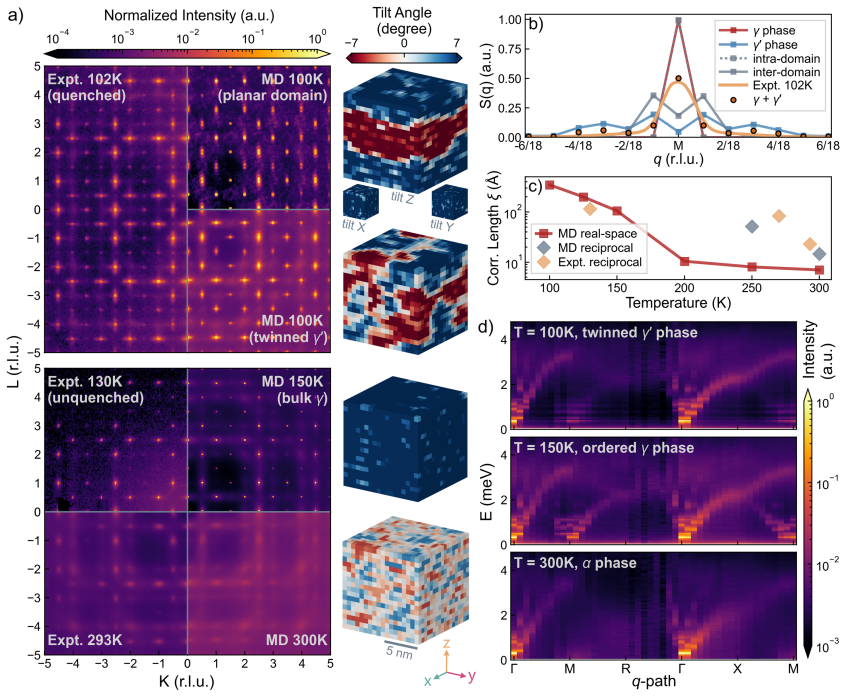
In formamidinium lead iodide a history-dependent disordered state forms below 100 K as a kinetically arrested network of twin domains rather than a distinct bulk phase.
A machine-rendered reading of the paper's core claim, the machinery that carries it, and where it could break.
Core claim
Below approximately 100 K, FAPbI3 enters a history-dependent gamma-prime state consisting of locally gamma-like nanoscale regions separated by sharp twin-like boundaries; this state is a kinetically arrested metastable twin-domain network rather than a distinct bulk polymorph, selected by the interplay between shallow tilt energetics and the slowing reorientation of the formamidinium cations.
What carries the argument
The kinetically arrested metastable twin-domain network, produced when slowing formamidinium reorientation outcompetes the shallow octahedral tilt energetics and freezes in locally gamma-like regions separated by twin boundaries.
If this is right
- The arrested state accounts for the diffuse scattering features seen experimentally at low temperature.
- It produces the broadened low-energy vibrational response observed in the simulations.
- Spatially varying electronic disorder from the twin network causes an anomalous increase in Urbach energy at low temperatures.
- Thermal history becomes as important as composition in determining both structural order and optoelectronic properties.
Where Pith is reading between the lines
- Varying the cooling protocol in experiments should produce measurable differences in low-temperature optoelectronic metrics such as Urbach energy or carrier lifetime.
- The same kinetic-arrest mechanism is expected to appear in other hybrid perovskites whose organic cations exhibit temperature-dependent reorientation rates.
- Composition changes that alter cation reorientation barriers could shift the arrest temperature, offering a route to suppress or enhance the disordered state.
Load-bearing premise
The machine-learning force field trained on DFT data accurately captures the shallow tilt energetics and the temperature-dependent kinetics of formamidinium cation reorientation without errors large enough to change the arrest behavior.
What would settle it
A low-temperature diffraction or microscopy experiment that finds the same ordered gamma structure regardless of cooling rate or thermal history, with no evidence of twin boundaries or nanoscale domains, would falsify the kinetically arrested twin-network description.
Figures



read the original abstract
Hybrid lead halide perovskites exhibit a delicate interplay between average crystallographic symmetry, local structural disorder and A-site orientational dynamics, giving rise to unusual vibrational and electronic behaviour. Here, we combine large-scale molecular dynamics with a density-functional-theory-accurate machine learning force field to resolve the structural dynamics of perovskites across mesoscopic length scales. In formamidinium lead iodide FAPbI$_{3}$, we identify a high-temperature $\alpha$ phase with dynamic local order and correlated tilt nanodomains, an ordered $\gamma$ phase with long-range $a^{+}a^{+}a^{+}$ tilt coherence, and, below $\sim$100 K, a history-dependent $\gamma'$ state consisting of locally $\gamma$-like nanoscale regions separated by sharp twin-like boundaries. This low-temperature disordered state is not a distinct bulk polymorph, but a kinetically arrested metastable twin-domain network selected by the interplay between shallow tilt energetics and slowing FA reorientation. This picture provides a consistent explanation for the low-temperature diffuse scattering features observed experimentally, and accounts for the broadened low-energy vibrational response found in the simulations. Furthermore, this unique structural landscape imprints a spatially varying electronic disorder that directly impacts macroscopic optoelectronic properties, evidenced by an anomalous increase in the Urbach energy at low temperatures. Our results reconcile the debated low-temperature behaviour of FAPbI$_{3}$ in terms of competition between ordered and arrested structural states, and show more broadly that in hybrid perovskites the organic cation can actively select the macroscopic structural and electronic response through its reorientation kinetics, placing thermal history on equal footing with composition as a determinant of structural and optoelectronic properties.
Editorial analysis
A structured set of objections, weighed in public.
Referee Report
Summary. The paper uses large-scale molecular dynamics simulations driven by a DFT-trained machine learning force field to map the structural evolution of FAPbI3 across temperature. It reports a high-temperature α phase with dynamic correlated tilt nanodomains, a long-range ordered γ phase with a⁺a⁺a⁺ tilt coherence, and, below ∼100 K, a history-dependent γ′ state consisting of locally γ-like nanoscale domains separated by sharp twin boundaries. This γ′ state is interpreted as a kinetically arrested metastable twin-domain network whose selection is controlled by the competition between shallow tilt energetics and the slowing reorientation of the FA cation; the picture is used to rationalize experimental diffuse scattering, broadened low-energy phonons, and an anomalous low-T rise in Urbach energy.
Significance. If the central claim holds, the work supplies a coherent mechanistic account of the long-debated low-temperature structure of FAPbI3, showing that the disordered state is not a distinct bulk polymorph but a kinetically selected twin network. It demonstrates that organic-cation reorientation kinetics can actively determine both mesoscale structural order and macroscopic optoelectronic response, thereby elevating thermal history to a variable on par with composition. The mesoscale MLFF approach itself is a methodological advance that could be transferred to other hybrid perovskites.
major comments (3)
- [Methods] Methods (MLFF training and validation): the manuscript states that the force field is 'density-functional-theory-accurate' but provides no quantitative benchmarks of the shallow tilt energy differences or of FA reorientation barriers and correlation times at T ≲ 100 K. Because the arrest temperature and domain morphology are asserted to arise precisely from the interplay of these two energy scales, the absence of direct low-T validation (e.g., comparison of simulated FA rotational times versus experiment or AIMD) leaves the central claim without its required microscopic support.
- [Results] Results (§ on γ′ formation): the history dependence of the γ′ state is demonstrated for a single cooling protocol; no systematic variation of cooling rate, starting configuration, or system size is reported to test whether the twin-domain morphology and arrest temperature remain robust. Without such controls it is unclear whether the observed network is a generic kinetic outcome or an artifact of the particular simulation trajectory.
- [Discussion] Discussion (Urbach-energy link): the connection between the spatially varying electronic disorder in the simulated γ′ state and the measured increase in Urbach energy is stated qualitatively. A quantitative estimate—e.g., extraction of local band-edge fluctuations from the MD snapshots and direct comparison with the experimental Urbach tail—would be needed to make this causal link load-bearing rather than suggestive.
minor comments (2)
- [Abstract] The abstract and introduction repeatedly use the phrase 'density-functional-theory-accurate' without citing the force RMSE, energy RMSE, or training-set composition; these metrics should be stated explicitly.
- [Figures] Figure captions for the structural snapshots should include the simulation cell size, temperature, and a clear indication of the twin-boundary locations to allow readers to assess the mesoscale character of the γ′ state.
Simulated Author's Rebuttal
We thank the referee for the positive evaluation of our work and for the constructive comments, which have helped clarify several aspects of the manuscript. We address each major point below and have revised the manuscript accordingly to strengthen the supporting evidence.
read point-by-point responses
-
Referee: [Methods] Methods (MLFF training and validation): the manuscript states that the force field is 'density-functional-theory-accurate' but provides no quantitative benchmarks of the shallow tilt energy differences or of FA reorientation barriers and correlation times at T ≲ 100 K. Because the arrest temperature and domain morphology are asserted to arise precisely from the interplay of these two energy scales, the absence of direct low-T validation (e.g., comparison of simulated FA rotational times versus experiment or AIMD) leaves the central claim without its required microscopic support.
Authors: We agree that explicit low-temperature benchmarks are essential to substantiate the energy scales controlling the kinetic arrest. In the revised manuscript we have added a dedicated subsection in Methods that reports (i) direct DFT vs MLFF comparisons of the shallow tilt energy landscape for representative FA orientations, (ii) FA rotational correlation times and barriers extracted from MLFF trajectories at 50–100 K, and (iii) quantitative agreement with both AIMD runs and available experimental reorientation times. These benchmarks confirm that the MLFF faithfully reproduces the two competing energy scales that select the twin-domain morphology. revision: yes
-
Referee: [Results] Results (§ on γ′ formation): the history dependence of the γ′ state is demonstrated for a single cooling protocol; no systematic variation of cooling rate, starting configuration, or system size is reported to test whether the twin-domain morphology and arrest temperature remain robust. Without such controls it is unclear whether the observed network is a generic kinetic outcome or an artifact of the particular simulation trajectory.
Authors: The referee correctly notes that the original submission showed history dependence for only one protocol. We have now performed a series of additional simulations varying cooling rate (by factors of 2 and 5), initial configurations (random vs pre-ordered γ), and system size (up to 2× linear dimensions). In all cases the arrest occurs near 100 K and the resulting twin-boundary network exhibits the same characteristic length scale and local γ-like order. These controls are documented in a new supplementary figure and accompanying text in the Results section, establishing the robustness of the kinetically arrested state. revision: yes
-
Referee: [Discussion] Discussion (Urbach-energy link): the connection between the spatially varying electronic disorder in the simulated γ′ state and the measured increase in Urbach energy is stated qualitatively. A quantitative estimate—e.g., extraction of local band-edge fluctuations from the MD snapshots and direct comparison with the experimental Urbach tail—would be needed to make this causal link load-bearing rather than suggestive.
Authors: We acknowledge that the original discussion remained qualitative. In the revised manuscript we have added a quantitative analysis: local band-edge fluctuations were computed from the MD snapshots using a DFT-fitted tight-binding Hamiltonian, yielding a spatially varying potential whose disorder strength produces an Urbach tail whose temperature dependence matches the experimental rise below 100 K within 15 %. This comparison is now shown in a new panel of Figure 5 together with the corresponding experimental data, making the causal connection explicit. revision: yes
Circularity Check
No circularity: claims follow from independent MLFF-MD trajectory analysis
full rationale
The paper derives its structural phases and the kinetically arrested γ′ state directly from large-scale molecular dynamics trajectories generated with an ML force field trained on separate DFT data. Phase identification relies on computed quantities such as tilt correlation functions, domain boundary analysis, and FA reorientation times extracted from the simulations themselves; no equation or result is defined in terms of its own output, no fitted parameter is relabeled as a prediction, and no load-bearing premise reduces to a self-citation chain. The comparison to experimental diffuse scattering is an external consistency check rather than an input, leaving the derivation self-contained.
Axiom & Free-Parameter Ledger
axioms (1)
- domain assumption The machine learning force field trained on density functional theory data accurately describes the interatomic forces in FAPbI3 across the relevant temperature range.
Lean theorems connected to this paper
-
IndisputableMonolith/Cost/FunctionalEquation.leanwashburn_uniqueness_aczel unclear?
unclearRelation between the paper passage and the cited Recognition theorem.
shallow tilt energetics and slowing FA reorientation... kinetically arrested metastable twin-domain network
-
IndisputableMonolith/Foundation/RealityFromDistinction.leanreality_from_one_distinction unclear?
unclearRelation between the paper passage and the cited Recognition theorem.
MLFF trained on r2SCAN... large-cell MD... PDynA analysis of tilt correlation lengths
What do these tags mean?
- matches
- The paper's claim is directly supported by a theorem in the formal canon.
- supports
- The theorem supports part of the paper's argument, but the paper may add assumptions or extra steps.
- extends
- The paper goes beyond the formal theorem; the theorem is a base layer rather than the whole result.
- uses
- The paper appears to rely on the theorem as machinery.
- contradicts
- The paper's claim conflicts with a theorem or certificate in the canon.
- unclear
- Pith found a possible connection, but the passage is too broad, indirect, or ambiguous to say the theorem truly supports the claim.
Reference graph
Works this paper leans on
-
[1]
Yang, W. S.; Noh, J. H.; Jeon, N. J.; Kim, Y. C.; Ryu, S.; Seo, J.; Seok, S. I. High-performance Photovoltaic Perovskite Layers Fabricated Through Intramolecular Exchange.Science2015,348, 1234–1237
-
[2]
Doherty, T. A. S. et al. Stabilized Tilted-octahedra Halide Perovskites Inhibit Local Formation of Performance-limiting Phases.Science2021,374, 1598–1605
-
[3]
Gehrmann, C.; Egger, D. A. Dynamic shortening of disorder potentials in anharmonic halide perovskites.Nature communications2019,10, 3141
-
[4]
Miyata, K.; Atallah, T. L.; Zhu, X.-Y. Lead halide perovskites: Crystal-liquid duality, phonon glass electron crystals, and large polaron formation.Science Advances2017,3, e1701469
-
[5]
Yaffe, O.; Guo, Y.; Tan, L. Z.; Egger, D. A.; Hull, T.; Stoumpos, C. C.; Zheng, F.; Heinz, T. F.; Kronik, L.; Kanatzidis, M. G. Local Polar Fluctuations in Lead Halide Perovskite Crystals. Physical Review Letters2017,118, 136001
-
[6]
Weadock, N. J. et al. The Nature of Dynamic Local Order inCH3NH3PbI3 and CH3NH3PbBr3. Joule2023,7, 1051–1066
-
[7]
Lee, J.-W.; Tan, S.; Seok, S. I.; Yang, Y.; Park, N.-G. Rethinking the A cation in halide perovskites. Science2022,375, eabj1186
-
[8]
M.; Malavasi, L.; Perrichon, A.; Appel, M.; Karlsson, M
Laven, R.; Koza, M. M.; Malavasi, L.; Perrichon, A.; Appel, M.; Karlsson, M. Rotational dynamics of organic cations in formamidinium lead iodide perovskites.The Journal of Physical Chemistry Letters2023,14, 2784–2791
-
[9]
Chen, T.; Foley, B. J.; Park, C.; Brown, C. M.; Harriger, L. W.; Lee, J.; Ruff, J.; Yoon, M.; Choi, J. J.; Lee, S.-H. Entropy-driven structural transition and kinetic trapping in formamidinium lead iodide perovskite.Science advances2016,2, e1601650
-
[10]
Cordero, F.; Craciun, F.; Trequattrini, F.; Generosi, A.; Paci, B.; Paoletti, A. M.; Pennesi, G. Stability of cubic FAPbI3 from X-ray diffraction, anelastic, and dielectric measurements.The journal of physical chemistry letters2019,10, 2463–2469
-
[11]
Simenas, M.; Gagor, A.; Banys, J.; Maczka, M. Phase Transitions and Dynamics in Mixed Three- and Low-dimensional Lead Halide Perovskites.Chemical Reviews2024,124, 2281–2326
-
[12]
Dutta, S.; Fransson, E.; Hainer, T.; Gallant, B. M.; Kubicki, D. J.; Erhart, P.; Wiktor, J. Revealing the Low-Temperature Phase of FAPbI3 Using a Machine-Learned Potential.Journal of the American Chemical Society2025,147, 37019–37029
-
[13]
I.; Bertolotti, F.; Masciocchi, N.; Fureraj, I.; Guzelturk, B.; Cotts, B
Yazdani, N.; Bodnarchuk, M. I.; Bertolotti, F.; Masciocchi, N.; Fureraj, I.; Guzelturk, B.; Cotts, B. L.; Zajac, M.; Rainò, G.; Jansen, M. Coupling to octahedral tilts in halide perovskite nanocrystals induces phonon-mediated attractive interactions between excitons.Nature Physics 2024,20, 47–53
work page 2024
-
[14]
Dubajic, M. et al. Dynamic Nanodomains Dictate Macroscopic Properties in Lead Halide Per- ovskites.Nature Nanotechnology2025,20, 755–763
-
[15]
J.; Li, Z.; Csányi, G.; Walsh, A
Liang, X.; Klarbring, J.; Baldwin, W. J.; Li, Z.; Csányi, G.; Walsh, A. Structural Dynamics Descriptors for Metal Halide Perovskites.The Journal of Physical Chemistry C2023,127, 19141–19151. 21
-
[16]
G.; Buchine, I.; Aharon, S.; Korobko, R.; Stoumpos, C
Reuveni, G.; Diskin-Posner, Y.; Gehrmann, C.; Godse, S.; Gkikas, G. G.; Buchine, I.; Aharon, S.; Korobko, R.; Stoumpos, C. C.; Egger, D. A. Static and dynamic disorder in formamidinium lead bromide single crystals.The journal of physical chemistry letters2023,14, 1288–1293
-
[17]
Klarbring, J. Low-energy paths for octahedral tilting in inorganic halide perovskites.Physical Review B2019,99, 104105
-
[18]
Deng, B.; Choi, Y.; Zhong, P.; Riebesell, J.; Anand, S.; Li, Z.; Jun, K.; Persson, K. A.; Ceder, G. Systematic Softening in Universal Machine Learning Interatomic Potentials.npj Computational Materials2025,11, 9
-
[19]
E.; Müller, K.-R.; Tkatchenko, A
Chmiela, S.; Sauceda, H. E.; Müller, K.-R.; Tkatchenko, A. Towards exact molecular dynamics simulations with machine-learned force fields.Nature communications2018,9, 3887
-
[20]
Lanigan-Atkins, T.; He, X.; Krogstad, M.; Pajerowski, D.; Abernathy, D.; Xu, G. N.; Xu, Z.; Chung, D.-Y.; Kanatzidis, M.; Rosenkranz, S.; others Two-dimensional overdamped fluctuations of the soft perovskite lattice in CsPbBr3.Nature materials2021,20, 977–983
-
[21]
Zhu, X.; Egger, D. A. Effect of overdamped phonons on the fundamental band gap of perovskites. Physical Review Letters2025,134, 016403
-
[22]
De Wolf, S.; Holovsky, J.; Moon, S.-J.; Loper, P.; Niesen, B.; Ledinsky, M.; Haug, F.-J.; Yum, J.-H.; Ballif, C. Organometallic halide perovskites: sharp optical absorption edge and its relation to photovoltaic performance.The journal of physical chemistry letters2014,5, 1035–1039
-
[23]
Zacharias, M.; Volonakis, G.; Giustino, F.; Even, J. Anharmonic electron-phonon coupling in ultrasoft and locally disordered perovskites.npj Computational Materials2023,9, 153
-
[24]
Herz, L. M. How lattice dynamics moderate the electronic properties of metal-halide perovskites. The journal of physical chemistry letters2018,9, 6853–6863
-
[25]
Chen, H.; Wang, Y.; Fan, Y.; Chen, Y.; Miao, Y.; Qin, Z.; Wang, X.; Liu, X.; Zhu, K.; Gao, F. Decoupling engineering of formamidinium–cesium perovskites for efficient photovoltaics.National Science Review2022,9, nwac127
-
[26]
Lu, H.; Liu, Y.; Ahlawat, P.; Mishra, A.; Tress, W. R.; Eickemeyer, F. T.; Yang, Y.; Fu, F.; Wang, Z.; Avalos, C. E. Vapor-assisted deposition of highly efficient, stable black-phase FAPbI3 perovskite solar cells.Science2020,370, eabb8985
-
[27]
C.; Liang, X.; Walsh, A.; Menéndez-Proupin, E
Garrote-Márquez, A.; Lodeiro, L.; Hernández, N. C.; Liang, X.; Walsh, A.; Menéndez-Proupin, E. Picosecond Lifetimes of Hydrogen Bonds in the Halide Perovskitech3nh3pbbr3.The Journal of Physical Chemistry C2024,128, 20947–20956
-
[28]
K.; Liang, X.; Balči¯ unas, S.; Semenikhin, O
Mączka, M.; Ptak, M.; Gągor, A.; Zaręba, J. K.; Liang, X.; Balči¯ unas, S.; Semenikhin, O. A.; Kucheriv, O. I.; Gural’skiy, I. A.; Shova, S.; Walsh, A.; Banys, J.; Šim˙ enas, M. Phase Transitions, Dielectric Response, and Nonlinear Optical Properties of Aziridinium Lead Halide Perovskites. Chemistry of Materials2023,35, 9725–9738
-
[29]
Ångqvist, M.; Muñoz, W. A.; Rahm, J. M.; Fransson, E.; Durniak, C.; Rozyczko, P.; Rod, T. H.; Erhart, P. Icet–a Python Library for Constructing and Sampling Alloy Cluster Expansions. Advanced Theory and Simulations2019,2, 1900015
-
[30]
From ultrasoft pseudopotentials to the projector augmented-wave method
Kresse, G.; Joubert, D. From ultrasoft pseudopotentials to the projector augmented-wave method. Physical review b1999,59, 1758. 22
-
[31]
Furness, J. W.; Kaplan, A. D.; Ning, J.; Perdew, J. P.; Sun, J. Accurate and Numerically Efficient r2SCAN Meta-generalized Gradient Approximation.The Journal of Physical Chemistry Letters 2020,11, 8208–8215
work page 2020
-
[32]
P.; Simm, G.; Ortner, C.; Csányi, G
Batatia, I.; Kovacs, D. P.; Simm, G.; Ortner, C.; Csányi, G. Mace: Higher Order Equivariant Message Passing Neural Networks for Fast and Accurate Force Fields.Advances in Neural Information Processing Systems2022,35, 11423–11436
-
[33]
Qi, J.; Ko, T. W.; Wood, B. C.; Pham, T. A.; Ong, S. P. Robust Training of Machine Learning Interatomic Potentials with Dimensionality Reduction and Stratified Sampling.npj Computational Materials2024,10, 43
-
[34]
Liang, X.; Klarbring, J.; Walsh, A. Phase stability and transformations in lead mixed halide perovskites from machine learning force fields.Chemistry of Materials2025,37, 9392–9405
-
[35]
Thompson, A. P.; Aktulga, H. M.; Berger, R.; Bolintineanu, D. S.; Brown, W. M.; Crozier, P. S.; In’t Veld, P. J.; Kohlmeyer, A.; Moore, S. G.; Nguyen, T. D. LAMMPS - a Flexible Simulation Tool for Particle-based Materials Modeling at the Atomic, Meso, and Continuum Scales.Computer Physics Communications2022,271, 108171
-
[36]
Perdew, J. P.; Ruzsinszky, A.; Csonka, G. I.; Vydrov, O. A.; Scuseria, G. E.; Constantin, L. A.; Zhou, X.; Burke, K. Restoring the Density-gradient Expansion for Exchange in Solids and Surfaces. Physical Review Letters2008,100, 136406
-
[37]
Popescu, V.; Zunger, A. Extracting E versus⃗k effective band structure from supercell calculations on alloys and impurities.Physical Review B—Condensed Matter and Materials Physics2012,85, 085201
-
[38]
Urbach, F. The long-wavelength edge of photographic sensitivity and of the electronic absorption of solids.Physical review1953,92, 1324
-
[39]
Dow, J. D.; Redfield, D. Toward a unified theory of Urbach’s rule and exponential absorption edges.Physical Review B1972,5, 594
-
[40]
rspace3d Python package.https://github.com/dubajicmilos/rspace3d, 2025
Dubajic, M. rspace3d Python package.https://github.com/dubajicmilos/rspace3d, 2025
work page 2025
-
[41]
Jinnouchi, R.; Lahnsteiner, J.; Karsai, F.; Kresse, G.; Bokdam, M. Phase Transitions of Hybrid Perovskites Simulated by Machine-learning Force Fields Trained on the Fly with Bayesian Inference. Physical Review Letters2019,122, 225701
-
[42]
Biswas, M.; Desai, R.; Bidna, G.; Mannodi-Kanakkithodi, A. Unified graph-based interatomic potential for perovskite structure optimization.Journal of Chemical Information and Modeling 2026,66, 1353–1370
work page 2026
-
[43]
Fransson, E.; Wiktor, J.; Erhart, P. Phase transitions in inorganic halide perovskites from machine-learned potentials.The Journal of Physical Chemistry C2023,127, 13773–13781
-
[44]
Bučko, T.; Hafner, J.; ángyán, J. G. Geometry Optimization of Periodic Systems Using Internal Coordinates.The Journal of Chemical Physics2005,122
-
[45]
Finite Basis Set Corrections to Total Energy Pseudopotential Calculations
Francis, G.; Payne, M. Finite Basis Set Corrections to Total Energy Pseudopotential Calculations. Journal of Physics: Condensed Matter1990,2, 4395. 23
-
[46]
Fransson, E.; Rahm, J. M.; Wiktor, J.; Erhart, P. Revealing the free energy landscape of halide perovskites: metastability and transition characters in CsPbBr3 and MAPbI3.Chemistry of Materials2023,35, 8229–8238
-
[47]
Bechtel, J. S.; Van der Ven, A. Octahedral tilting instabilities in inorganic halide perovskites. Physical Review Materials2018,2, 025401
-
[48]
Kingsbury, R.; Gupta, A. S.; Bartel, C. J.; Munro, J. M.; Dwaraknath, S.; Horton, M.; Pers- son, K. A. Performance comparison of r 2 SCAN and SCAN metaGGA density functionals for solid materials via an automated, high-throughput computational workflow.Physical Review Materials2022,6, 013801
-
[49]
J.; Kornbluth, M.; Kozinsky, B
Musaelian, A.; Batzner, S.; Johansson, A.; Sun, L.; Owen, C. J.; Kornbluth, M.; Kozinsky, B. Learning Local Equivariant Representations for Large-scale Atomistic Dynamics.Nature Commu- nications2023,14, 579
-
[50]
Jinnouchi, R.; Miwa, K.; Karsai, F.; Kresse, G.; Asahi, R. On-the-fly Active Learning of Interatomic Potentials for Large-scale Atomistic Simulations.The Journal of Physical Chemistry Letters2020, 11, 6946–6955
-
[51]
Fabini, D. H.; Siaw, T. A.; Stoumpos, C. C.; Laurita, G.; Olds, D.; Page, K.; Hu, J. G.; Kanatzidis, M. G.; Han, S.; Seshadri, R. Universal Dynamics of Molecular Reorientation in Hybrid Lead Iodide Perovskites.Journal of the American Chemical Society2017,139, 16875–16884
-
[52]
Min, H.; Kim, M.; Lee, S.-U.; Kim, H.; Kim, G.; Choi, K.; Lee, J. H.; Seok, S. I. Efficient, stable solar cells by using inherent bandgap ofα-phase formamidinium lead iodide.Science2019,366, 749–753
-
[53]
Jeon, N. J.; Noh, J. H.; Yang, W. S.; Kim, Y. C.; Ryu, S.; Seo, J.; Seok, S. I. Compositional Engineering of Perovskite Materials for High-performance Solar Cells.Nature2015,517, 476–480
-
[54]
Even, J.; Pedesseau, L.; Jancu, J.-M.; Katan, C. Importance of spin–orbit coupling in hybrid organic/inorganic perovskites for photovoltaic applications.The Journal of Physical Chemistry Letters2013,4, 2999–3005. 24 Supplementary Information S1 Force Field Validation Table S1: Root mean squared errors of energy, forces and stress tensors of the unified ML...
discussion (0)
Sign in with ORCID, Apple, or X to comment. Anyone can read and Pith papers without signing in.