Recognition: unknown
Metric-Normalized Posterior Leakage (mPL): Attacker-Aligned Privacy for Joint Consumption
Pith reviewed 2026-05-09 19:03 UTC · model grok-4.3
The pith
Metric differential privacy can leave high posterior leakage when machine learning models are observed jointly rather than one record at a time.
A machine-rendered reading of the paper's core claim, the machinery that carries it, and where it could break.
Core claim
Metric-normalized posterior leakage quantifies the distance-scaled change in an attacker's posterior odds after observing releases. Uniformly bounding this quantity is equivalent to metric differential privacy when releases are single or independent. Under joint observation, however, satisfying metric differential privacy can still permit high leakage because learned aggregators compound evidence across correlated items. The paper therefore introduces probabilistically bounded metric-normalized posterior leakage to limit the frequency of excessive shifts and realizes it through Adaptive metric-normalized posterior leakage, a framework that perturbs outputs, audits them with a learned neural-
What carries the argument
metric-normalized posterior leakage (mPL), a distance-calibrated measure of the shift in an attacker's posterior odds induced by one or more releases
If this is right
- For single or independent releases, any uniform bound on metric-normalized posterior leakage is exactly equivalent to metric differential privacy.
- Joint observation allows learned aggregators to compound evidence and produce high leakage even when per-record metric differential privacy holds.
- Probabilistically bounded metric-normalized posterior leakage limits the fraction of releases that may exceed a chosen leakage threshold.
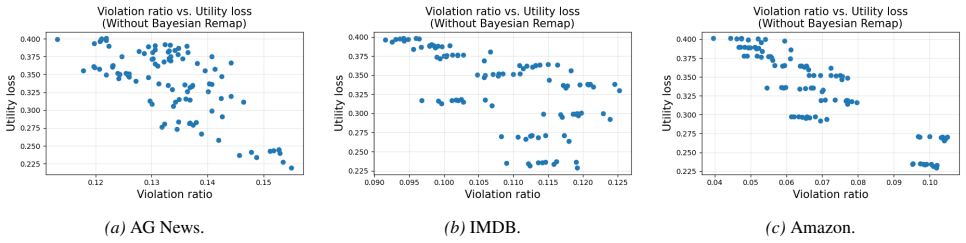
- Adaptive mPL reduces the frequency of high-leakage events in word-embedding tasks while incurring only low utility loss.
Where Pith is reading between the lines
- Privacy design for machine learning should start from joint-consumption threat models rather than per-record guarantees.
- Auditing with learned attackers creates an opening to update the auditor as new attack techniques appear.
- The same adaptive auditing loop could be tested on recommendation systems or graph learning where items are observed together.
Load-bearing premise
The learned attacker model used for auditing accurately captures real adversary capabilities and parameter adaptation does not create new leakage paths.
What would settle it
If a stronger neural adversary than the one used during auditing can still produce large posterior-odds shifts on jointly observed word embeddings after Adaptive mPL adaptation, the claim that the framework controls leakage would be contradicted.
Figures




read the original abstract
Metric differential privacy (mDP) strengthens local differential privacy (LDP) by scaling noise to semantic distance, but many machine learning (ML) systems are consumed under joint observation, where model-agnostic, per-record guarantees can miss leakage from evidence aggregation. We introduce metric-normalized posterior leakage (mPL), an attacker-aligned, distance-calibrated measure of posterior-odds shift induced by releases, and show that for single or independent releases, uniformly bounding mPL is equivalent to mDP. Under joint observation, however, satisfying mDP may still leave mPL high because learned aggregators compound evidence across correlated items. To make control practical, we formalize probabilistically bounded mPL (PBmPL), which limits how often mPL may exceed a target budget, and we operationalize it via Adaptive mPL (AmPL), a trust-and-verify framework that perturbs, audits with a learned attacker, and adapts parameters (with optional Bayesian remapping) to balance privacy and utility. In a word-embedding case study, neural adversaries violate mPL under joint consumption despite per-record mDP perturbations, whereas AmPL substantially lowers the frequency of such violations with low utility loss, indicating PBmPL as a practical, certifiable protection for joint-consumption settings.
Editorial analysis
A structured set of objections, weighed in public.
Referee Report
Summary. The paper introduces metric-normalized posterior leakage (mPL) as an attacker-aligned, distance-calibrated measure of posterior-odds shift from releases. It claims that for single or independent releases, uniformly bounding mPL is equivalent to metric differential privacy (mDP), but that mDP can leave mPL high under joint observation because learned aggregators compound evidence across correlated items. The paper formalizes probabilistically bounded mPL (PBmPL) to limit the frequency of high-mPL events and operationalizes control via Adaptive mPL (AmPL), a trust-and-verify framework that perturbs, audits with a learned attacker, and adapts parameters (with optional Bayesian remapping). A word-embedding case study shows neural adversaries can violate mPL despite per-record mDP, while AmPL reduces violation frequency with low utility loss.
Significance. If the equivalence and empirical results hold, the work provides a practical, certifiable approach to privacy in joint-consumption ML settings where standard per-record mDP guarantees are insufficient. The formalization of PBmPL and the adaptive auditing framework address a real gap between theoretical local guarantees and aggregated evidence leakage. Credit is due for the attacker-aligned formulation and the demonstration that mDP alone does not control mPL under joint observation.
major comments (2)
- [Abstract] Abstract: the claim that 'uniformly bounding mPL is equivalent to mDP' for single or independent releases is load-bearing for the paper's distinction between single-release and joint-consumption regimes, yet the abstract supplies no derivation or proof; the full theoretical section must explicitly derive the equivalence (including the precise definitions of mPL and the uniform bound) to confirm it is not tautological.
- [AmPL framework and case study] AmPL framework and case study: the central practical claim that AmPL achieves PBmPL control (limiting high-mPL frequency at low utility cost) depends on the learned neural adversary accurately identifying all relevant posterior-odds shifts under joint observation; the manuscript must supply evidence (e.g., ablation against alternative attacker architectures or correlation patterns) that the auditor is sufficiently complete, because incompleteness would allow undetected leakage paths to remain after parameter adaptation.
minor comments (2)
- [Abstract] Abstract: the acronym PBmPL is introduced without an immediate parenthetical gloss; adding '(probabilistically bounded mPL)' on first use would improve readability for readers unfamiliar with the new term.
- [Abstract] Abstract: the case-study claim of 'low utility loss' would be clearer if the precise utility metric (e.g., embedding similarity, downstream task accuracy) were named.
Simulated Author's Rebuttal
We thank the referee for their constructive feedback. We address each major comment below and have revised the manuscript to strengthen the presentation where appropriate.
read point-by-point responses
-
Referee: [Abstract] Abstract: the claim that 'uniformly bounding mPL is equivalent to mDP' for single or independent releases is load-bearing for the paper's distinction between single-release and joint-consumption regimes, yet the abstract supplies no derivation or proof; the full theoretical section must explicitly derive the equivalence (including the precise definitions of mPL and the uniform bound) to confirm it is not tautological.
Authors: We agree that an explicit derivation is necessary to support the load-bearing claim. In the revised manuscript we have added a dedicated subsection in the theoretical development that derives the equivalence in both directions: (i) mDP with parameter ε implies mPL ≤ ε for any single or independent release, and (ii) a uniform bound mPL ≤ ε implies the mDP guarantee. The derivation uses the precise definition of mPL as the supremum of the metric-normalized log posterior-odds ratio and shows that the normalization by semantic distance makes the uniform bound equivalent to the distance-scaled guarantee of mDP. This is not tautological, because mPL is an attacker-centric posterior measure while mDP is a mechanism property; the equivalence holds only under the single-release or independence assumption. The abstract has been updated to reference the derivation. revision: yes
-
Referee: [AmPL framework and case study] AmPL framework and case study: the central practical claim that AmPL achieves PBmPL control (limiting high-mPL frequency at low utility cost) depends on the learned neural adversary accurately identifying all relevant posterior-odds shifts under joint observation; the manuscript must supply evidence (e.g., ablation against alternative attacker architectures or correlation patterns) that the auditor is sufficiently complete, because incompleteness would allow undetected leakage paths to remain after parameter adaptation.
Authors: We recognize that the practical utility of AmPL rests on the auditor's completeness. The case study trains a neural adversary on joint observations to surface mPL violations that survive per-record mDP; the reported results show it detects such events. To strengthen the claim, the revised manuscript adds ablations that compare the neural auditor against simpler baselines (logistic regression on aggregated features) and across varied correlation strengths in the embedding space. These experiments confirm that the neural auditor identifies the dominant posterior shifts with higher or equal recall, and that AmPL's parameter adaptation still reduces violation frequency under the alternative auditors. We therefore maintain that the framework provides effective PBmPL control, while the new ablations address the completeness concern. revision: yes
Circularity Check
No significant circularity; derivation is self-contained
full rationale
The abstract presents mPL as a newly introduced measure of posterior-odds shift and states that uniformly bounding it is equivalent to mDP for single/independent releases, but this equivalence is described as a shown result rather than a definitional identity or fitted-parameter renaming. The joint-observation distinction, PBmPL formalization, and AmPL framework (perturb-audit-adapt with learned attacker and optional Bayesian remapping) are operationalized via empirical case study rather than reducing by construction to inputs. No equations, self-citations, or ansatzes are quoted that force the central claims back onto themselves. The paper is therefore self-contained against external benchmarks for the purposes of this circularity check.
Axiom & Free-Parameter Ledger
Reference graph
Works this paper leans on
-
[1]
Bayesian Theory , author =. 1994 , publisher =. doi:10.1002/9780470316870 , isbn =
-
[2]
Langley , title =
P. Langley , title =. Proceedings of the 17th International Conference on Machine Learning (ICML 2000) , address =. 2000 , pages =
2000
-
[3]
22nd International Conference on Extending Database Technology, EDBT 2019 , pages=
A utility-preserving and scalable technique for protecting location data with geo-indistinguishability , author=. 22nd International Conference on Extending Database Technology, EDBT 2019 , pages=. 2019 , organization=
2019
-
[4]
Proceedings of the 2013 ACM SIGSAC conference on Computer & communications security , pages=
Geo-indistinguishability: Differential privacy for location-based systems , author=. Proceedings of the 2013 ACM SIGSAC conference on Computer & communications security , pages=
2013
-
[5]
Advances in Neural Information Processing Systems , year=
Spectrally-Normalized Margin Bounds for Neural Networks , author=. Advances in Neural Information Processing Systems , year=
-
[6]
N. E. Bordenabe and K. Chatzikokolakis and C. Palamidessi , title =. Proc. of ACM CCS , year =
-
[7]
international symposium on privacy enhancing technologies symposium , pages=
Broadening the scope of differential privacy using metrics , author=. international symposium on privacy enhancing technologies symposium , pages=. 2013 , organization=
2013
-
[8]
Privacy Enhancing Technologies: 14th International Symposium, PETS 2014, Amsterdam, The Netherlands, July 16-18, 2014
A predictive differentially-private mechanism for mobility traces , author=. Privacy Enhancing Technologies: 14th International Symposium, PETS 2014, Amsterdam, The Netherlands, July 16-18, 2014. Proceedings 14 , pages=. 2014 , organization=
2014
-
[9]
URLhttps://doi.org/10.1109/FOCS.2013.53
John C. Duchi and Michael I. Jordan and Martin J. Wainwright , title =. 2013 IEEE 54th Annual Symposium on Foundations of Computer Science (FOCS) , year =. doi:10.1109/FOCS.2013.53 , note =
-
[10]
Theory of Cryptography: Third Theory of Cryptography Conference, TCC 2006, New York, NY, USA, March 4-7, 2006
Calibrating noise to sensitivity in private data analysis , author=. Theory of Cryptography: Third Theory of Cryptography Conference, TCC 2006, New York, NY, USA, March 4-7, 2006. Proceedings 3 , pages=. 2006 , organization=
2006
-
[11]
2019 IEEE International Conference on Data Mining (ICDM) , pages=
Leveraging hierarchical representations for preserving privacy and utility in text , author=. 2019 IEEE International Conference on Data Mining (ICDM) , pages=. 2019 , organization=
2019
-
[12]
Feyisetan and B
O. Feyisetan and B. Balle and T. Drake and T. Diethe , title =. Proceedings of the 13th International Conference on Web Search and Data Mining , pages =. 2020 , publisher =
2020
-
[13]
International conference on machine learning , pages=
On calibration of modern neural networks , author=. International conference on machine learning , pages=. 2017 , organization=
2017
-
[14]
2022 , booktitle =
Jacob Imola and Shiva Kasiviswanathan and Stephen White and Abhinav Aggarwal and Nathanael Teissier , title =. 2022 , booktitle =
2022
-
[15]
Kifer, Daniel and Machanavajjhala, Ashwin , title =. 2012 , isbn =. doi:10.1145/2213556.2213571 , booktitle =
-
[16]
PAnDA: Rethinking Metric Differential Privacy Optimization at Scale with Anchor-Based Approximation
Ruiyao Liu and Chenxi Qiu. PAnDA: Rethinking Metric Differential Privacy Optimization at Scale with Anchor-Based Approximation. Proceedings of The 32nd ACM Conference on Computer and Communications Security (CCS). 2025
2025
-
[17]
and Daly, Raymond E
Maas, Andrew L. and Daly, Raymond E. and Pham, Peter T. and Huang, Dan and Ng, Andrew Y. and Potts, Christopher , title =. Proceedings of the 49th Annual Meeting of the Association for Computational Linguistics: Human Language Technologies , month =. 2011 , address =
2011
-
[18]
Attention is All you Need , url =
Vaswani, Ashish and Shazeer, Noam and Parmar, Niki and Uszkoreit, Jakob and Jones, Llion and Gomez, Aidan N and Kaiser, ukasz and Polosukhin, Illia , booktitle =. Attention is All you Need , url =
-
[19]
Proceedings of the 10th ACM International Workshop on Security and Privacy Analytics , pages=
1-Diffractor: Efficient and Utility-Preserving Text Obfuscation Leveraging Word-Level Metric Differential Privacy , author=. Proceedings of the 10th ACM International Workshop on Security and Privacy Analytics , pages=
-
[20]
Kifer, Daniel and Machanavajjhala, Ashwin , title =. 2014 , issue_date =. doi:10.1145/2514689 , journal =
-
[21]
Proceedings of the 2014 conference on empirical methods in natural language processing (EMNLP) , pages=
Glove: Global vectors for word representation , author=. Proceedings of the 2014 conference on empirical methods in natural language processing (EMNLP) , pages=
2014
-
[22]
Proceedings of the 30th International Conference on Advances in Geographic Information Systems , pages=
TrafficAdaptor: an adaptive obfuscation strategy for vehicle location privacy against traffic flow aware attacks , author=. Proceedings of the 30th International Conference on Advances in Geographic Information Systems , pages=
-
[23]
Proceedings of the Thirty-Third International Joint Conference on Artificial Intelligence , pages=
Enhancing scalability of metric differential privacy via secret dataset partitioning and benders decomposition , author=. Proceedings of the Thirty-Third International Joint Conference on Artificial Intelligence , pages=
-
[24]
Proceedings of the 29th ACM International Conference on Information & Knowledge Management , pages=
Time-efficient geo-obfuscation to protect worker location privacy over road networks in spatial crowdsourcing , author=. Proceedings of the 29th ACM International Conference on Information & Knowledge Management , pages=
-
[25]
PETS , year=
Scalable Optimization for Locally Relevant Geo-Location Privacy , author=. PETS , year=
-
[26]
2016 IEEE 57th Annual Symposium on Foundations of Computer Science (FOCS) , pages=
Lipschitz extensions for node-private graph statistics and the generalized exponential mechanism , author=. 2016 IEEE 57th Annual Symposium on Foundations of Computer Science (FOCS) , pages=. 2016 , organization=
2016
-
[27]
The Twelfth International Conference on Learning Representations , year=
Beyond Memorization: Violating Privacy via Inference with Large Language Models , author=. The Twelfth International Conference on Learning Representations , year=
-
[28]
and Zhang, D
Wang, L. and Zhang, D. and Yang, D. and Lim, B. and Ma, X. , year =. Differential Location Privacy for Sparse Mobile Crowdsensing , doi =
-
[29]
and Yang, D
Wang, L. and Yang, D. and Han, X. and Wang, T. and Zhang, D. and Ma, X. , title =. Proc. of ACM WWW , year =
-
[30]
IEEE INFOCOM 2017-IEEE Conference on Computer Communications , pages=
Local private ordinal data distribution estimation , author=. IEEE INFOCOM 2017-IEEE Conference on Computer Communications , pages=. 2017 , organization=
2017
-
[31]
Yadav, Sourabh and Yu, Chenyang and Xie, Xinpeng and Huang, Yan and Qiu, Chenxi , title =. 2024 , isbn =. doi:10.1145/3678717.3691211 , pages =
-
[32]
, author=
Dynamic Differential Location Privacy with Personalized Error Bounds. , author=. NDSS , volume=
-
[33]
T. M. Mitchell. The Need for Biases in Learning Generalizations. 1980
1980
-
[34]
M. J. Kearns , title =
-
[35]
Machine Learning: An Artificial Intelligence Approach, Vol. I. 1983
1983
-
[36]
R. O. Duda and P. E. Hart and D. G. Stork. Pattern Classification. 2000
2000
-
[37]
Suppressed for Anonymity , author=
-
[38]
2017 , eprint=
Adam: A Method for Stochastic Optimization , author=. 2017 , eprint=
2017
-
[39]
2015 , eprint=
Optimality of the Laplace Mechanism in Differential Privacy , author=. 2015 , eprint=
2015
-
[40]
Newell and P
A. Newell and P. S. Rosenbloom. Mechanisms of Skill Acquisition and the Law of Practice. Cognitive Skills and Their Acquisition. 1981
1981
-
[41]
A. L. Samuel. Some Studies in Machine Learning Using the Game of Checkers. IBM Journal of Research and Development. 1959
1959
-
[42]
ArXiv , year=
TEM: High Utility Metric Differential Privacy on Text , author=. ArXiv , year=
-
[43]
Proceedings on Privacy Enhancing Technologies , year=
Constructing elastic distinguishability metrics for location privacy , author=. Proceedings on Privacy Enhancing Technologies , year=
-
[44]
Efficient Utility Improvement for Location Privacy , volume =
Chatzikokolakis, Kostas and Elsalamouny, Ehab and Palamidessi, Catuscia , year =. Efficient Utility Improvement for Location Privacy , volume =. Proceedings on Privacy Enhancing Technologies , doi =
-
[45]
IEEE Trans
Preserving geo-indistinguishability of the primary user in dynamic spectrum sharing , author=. IEEE Trans. on Vehicular Technology , year=
-
[46]
arXiv preprint arXiv:1805.08866 , year=
Author obfuscation using generalised differential privacy , author=. arXiv preprint arXiv:1805.08866 , year=
-
[47]
arXiv preprint arXiv:1905.09778 , year=
Privacy-preserving obfuscation of critical infrastructure networks , author=. arXiv preprint arXiv:1905.09778 , year=
-
[48]
IEEE Transactions on Dependable and Secure Computing , volume=
Secure and utility-aware data collection with condensed local differential privacy , author=. IEEE Transactions on Dependable and Secure Computing , volume=. 2019 , publisher=
2019
-
[49]
Utility-Preserving Privacy Protection of Textual Documents via Word Embeddings , year=
Hassan, Fadi and Sánchez, David and Domingo-Ferrer, Josep , journal=. Utility-Preserving Privacy Protection of Textual Documents via Word Embeddings , year=
-
[50]
TIFS , year=
A geo-indistinguishable location perturbation mechanism for location-based services supporting frequent queries , author=. TIFS , year=
-
[51]
Proceedings on Privacy Enhancing Technologies , year=
Not All Attributes are Created Equal: dX-Private Mechanisms for Linear Queries , author=. Proceedings on Privacy Enhancing Technologies , year=
-
[52]
IEEE Transactions on Dependable and Secure Computing , volume=
Personalized 3D location privacy protection with differential and distortion geo-perturbation , author=. IEEE Transactions on Dependable and Secure Computing , volume=. 2023 , publisher=
2023
-
[53]
IEEE Transactions on Mobile Computing , volume=
Eclipse: Preserving differential location privacy against long-term observation attacks , author=. IEEE Transactions on Mobile Computing , volume=. 2020 , publisher=
2020
-
[54]
IEEE Transactions on Mobile Computing , volume=
Distpreserv: Maintaining user distribution for privacy-preserving location-based services , author=. IEEE Transactions on Mobile Computing , volume=. 2022 , publisher=
2022
-
[55]
To and G
H. To and G. Ghinita and L. Fan and C. Shahabi , journal=. Differentially Private Location Protection for Worker Datasets in Spatial Crowdsourcing , year=
-
[56]
IEEE Transactions on Mobile Computing , volume=
Privacy-preserving location-based advertising via longitudinal geo-indistinguishability , author=. IEEE Transactions on Mobile Computing , volume=. 2023 , publisher=
2023
-
[57]
Advances in neural information processing systems , volume=
Character-level convolutional networks for text classification , author=. Advances in neural information processing systems , volume=
discussion (0)
Sign in with ORCID, Apple, or X to comment. Anyone can read and Pith papers without signing in.