Spin caloritronics: History and future prospects of experiments
Pith reviewed 2026-05-10 16:02 UTC · model grok-4.3
The pith
Spin caloritronics is transitioning from fundamental condensed matter physics to materials science and applied research.
A machine-rendered reading of the paper's core claim, the machinery that carries it, and where it could break.
Core claim
The authors establish that spin caloritronics combines spintronics with thermal transport and thermoelectric properties through the discovery of novel energy conversion and control principles based on heat-charge-spin interactions. After tracing the experimental history of these phenomena, the paper concludes that the field is now at a turning point, moving from fundamental condensed matter physics into materials science, with further development expected in measurement methods, underlying physics, material design, and engineering applications.
What carries the argument
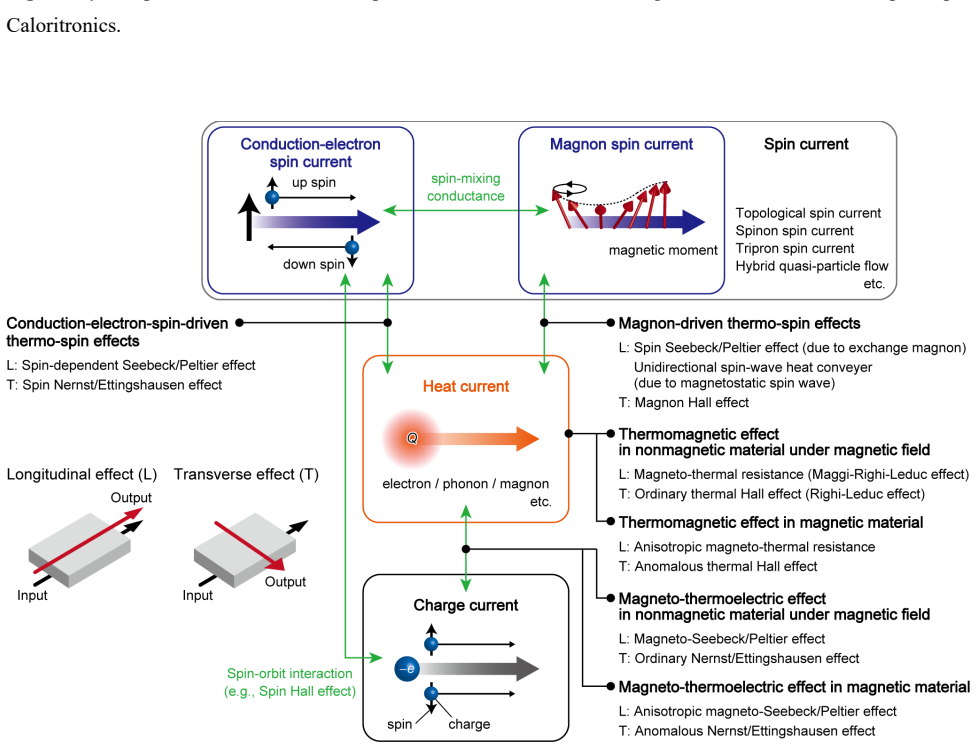
The coupling of spin, charge, and heat currents in magnetic and spintronic materials that produces observable transport effects such as the spin Seebeck effect.
If this is right
- Measurement techniques will be refined to characterize thermal spin transport more precisely.
- Physics research will identify additional mechanisms of heat-charge-spin coupling.
- Materials science will produce compounds engineered for stronger thermoelectric and spin responses.
- Engineering will develop devices that exploit these effects for energy conversion and control.
Where Pith is reading between the lines
- Integration with conventional thermoelectric materials could create hybrid systems for waste-heat recovery.
- Device-level testing of candidate materials would reveal whether the anticipated applications are realistic.
- Industry interest in low-power electronics might accelerate material development if the prospects section guides targeted experiments.
Load-bearing premise
The authors' reading of recent trends as evidence of a lasting shift from fundamental physics to materials science and applications, rather than a continuation of basic discoveries.
What would settle it
If the next five to ten years produce no measurable increase in papers or patents on optimized materials and device prototypes, with research remaining centered on new fundamental phenomena, the turning-point claim would not be supported.
Figures
read the original abstract
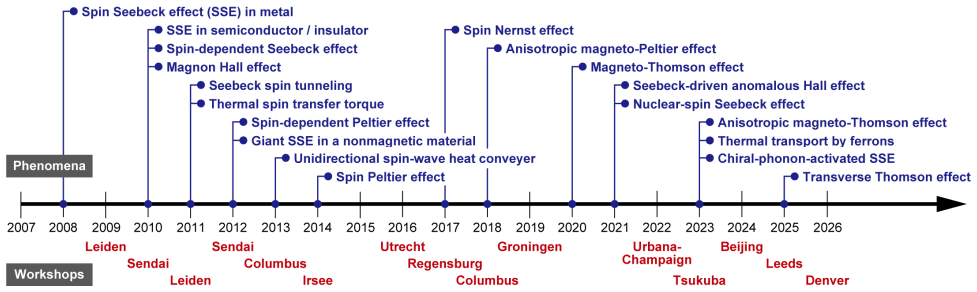
Since the beginning of the 21st century, novel energy conversion and control principles utilizing the spin degree of freedom have been discovered in the field of spin caloritronics, which integrates spintronics with thermal transport and thermoelectric properties. In this article, we review the history of development of spin caloritronics and experimental studies on various transport phenomena caused by heat-charge-spin interactions. We then discuss future prospects in spin caloritronics from the viewpoints of measurement techniques, physics, materials science, and engineering applications. Spin caloritronics is now at a turning point, transitioning from fundamental condensed matter physics to materials science, and further development is anticipated in both fundamental and applied research.
Editorial analysis
A structured set of objections, weighed in public.
Referee Report
Summary. The manuscript reviews the development of spin caloritronics since the early 21st century, summarizing experimental studies on transport phenomena arising from heat-charge-spin interactions. It then outlines future prospects from the perspectives of measurement techniques, fundamental physics, materials science, and engineering applications, concluding that the field is at a turning point transitioning from condensed matter physics to materials science with anticipated progress in both fundamental and applied directions.
Significance. As a review synthesizing prior experimental literature, the work could serve as a useful reference for consolidating the history of spin caloritronics and framing its potential directions. Its value is in providing an integrated overview rather than new quantitative results or derivations; the interpretive assessment of a 'turning point' would gain strength from explicit linkage to specific trends in the cited experiments.
major comments (1)
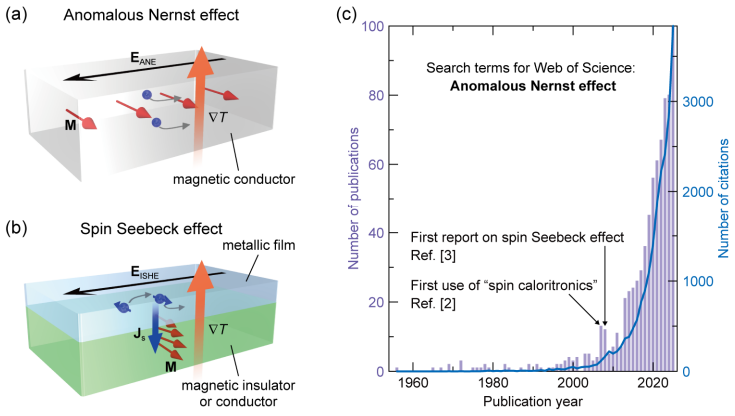
- [Abstract] Abstract (and likely the concluding section): The central claim that spin caloritronics 'is now at a turning point, transitioning from fundamental condensed matter physics to materials science' is presented as a synthesis of trends but lacks explicit quantitative support such as citation statistics, publication volume shifts, or concrete examples of the transition in the reviewed experiments. This interpretive statement is load-bearing for the forward-looking discussion and should be grounded with specific references to recent works.
minor comments (2)
- [Abstract] The abstract lists four viewpoints for future prospects (measurement techniques, physics, materials science, engineering) but does not preview which specific phenomena or materials will be highlighted; adding one or two concrete examples would improve clarity for readers.
- Ensure that all historical experimental milestones cited in the review are accompanied by precise references to the original papers, particularly for key discoveries in spin Seebeck effect or related phenomena, to allow verification.
Simulated Author's Rebuttal
We thank the referee for the constructive comment and the recommendation for minor revision. We address the point below and will revise the manuscript accordingly.
read point-by-point responses
-
Referee: [Abstract] Abstract (and likely the concluding section): The central claim that spin caloritronics 'is now at a turning point, transitioning from fundamental condensed matter physics to materials science' is presented as a synthesis of trends but lacks explicit quantitative support such as citation statistics, publication volume shifts, or concrete examples of the transition in the reviewed experiments. This interpretive statement is load-bearing for the forward-looking discussion and should be grounded with specific references to recent works.
Authors: We agree that adding concrete examples will strengthen the interpretive claim. In the revised manuscript, we will expand the abstract and concluding section with specific references to recent experimental works that illustrate the shift, including studies on optimized thermoelectric materials for spin Seebeck devices and integration of spin caloritronic phenomena into practical material platforms. These additions will provide explicit linkage to the reviewed literature without requiring new quantitative analyses such as citation counts. revision: yes
Circularity Check
No significant circularity; review of existing literature
full rationale
This paper is a historical review and forward-looking discussion of spin caloritronics experiments. It contains no mathematical derivations, equations, fitted parameters, or new quantitative predictions. The central claim that the field is at a turning point is an interpretive synthesis of published trends from external literature, not a result that reduces to any input defined within the paper. No self-citations are load-bearing for a derivation, no ansatzes are smuggled, and no known results are renamed as novel. The work is self-contained as a summary without an internal derivation chain.
Axiom & Free-Parameter Ledger
Reference graph
Works this paper leans on
- [1]
- [2]
- [3]
- [4]
-
[5]
K. F. Cuff, R. B. Horst, J. L. Weaver, S. R. Hawkins, C. F. Kooi, G. M. Enslow, Appl. Phys. Lett. 2 (1963) 145
work page 1963
- [6]
-
[7]
Y. Pan, B. He, T. Helm, D. Chen, W. Schnelle, C. Felser, Nat. Commun. 13 (2022) 3909
work page 2022
-
[8]
J. P. Jan, in Solid State Physics, Vol. 5 (eds., F. Seitz and D. Turnbull) (1957) 1-96
work page 1957
-
[9]
K. S. Das, F. K. Dejene, B. J. van Wees, I. J. Vera-Marun, Phys. Rev. B 94 (2016) 180403(R)
work page 2016
- [10]
- [11]
- [12]
-
[13]
T. Kikkawa, K. Uchida, Y. Shiomi, Z. Qiu, D. Hou, D. Tian, H. Nakayama, X.-F. Jin, E. Saitoh, Phys. Rev. Lett. 110 (2013) 067207
work page 2013
- [14]
- [15]
-
[16]
P. W. Bridgman, Phys. Rev. 24 (1924) 644
work page 1924
-
[17]
E. H. Hall, Phys. Rev. 26 (1925) 820
work page 1925
-
[18]
T. Seki, R. Iguchi, K. Takanashi, K. Uchida, Appl. Phys. Lett. 112 (2018) 152403
work page 2018
- [19]
-
[20]
F. Ando, T. Hirai, K. Uchida, APL Energy 2 (2024) 016103
work page 2024
-
[21]
W. Zhou, Y. Sakuraba, Appl. Phys. Express 13 (2020) 043001
work page 2020
- [22]
-
[23]
H. Nakayama, B. Xu, S. Iwamoto, K. Yamamoto, R. Iguchi, A. Miur a, T. Hirai, Y. Miura, Y. 18 Sakuraba, J. Shiomi, K. Uchida, Appl. Phys. Lett. 118 (2021) 042409
work page 2021
- [24]
-
[25]
X. Wu, Z. Liu, T. Luo, J. Appl. Phys. 123 (2018) 085109
work page 2018
-
[26]
M. R. Natale, D. J. Wesenberg, E. R. J. Edwards, H. T. Nembach, J. M. Shaw, B. L. Zink, Phys. Rev. Mater. 5 (2021) L111401
work page 2021
- [27]
- [28]
- [29]
- [30]
- [31]
-
[32]
Y. Kasahara, T. Ohnishi, Y. Mizukami, O. Tanaka, Sixiao Ma, K. Sugii, N. Kurita, H. Tanaka, J. Nasu, Y. Motome, T. Shibauchi, Y. Matsuda, Nature 559 (2018) 227
work page 2018
-
[33]
A. Slachter, F. L. Bakker, J-P. Adam, B. J. van Wees, Nat. Phys. 6 (2010) 879
work page 2010
-
[34]
J.-C. Le Breton, S. Sharma, H. Saito, S. Yuasa, R. Jansen, Nature 475 (2011) 82
work page 2011
- [35]
-
[36]
F. K. Dejene, J. Flipse, G. E. W. Bauer, B. J. van Wees, Nat. Phys. 9 (2013) 636
work page 2013
-
[37]
A. Azevedo, L. H. Vilela Leão, R. L. Rodriguez-Suarez, A. B. Oliveira, S. M. Rezende, J. Appl. Phys. 97 (2005) 10C715
work page 2005
- [38]
- [39]
- [40]
-
[41]
J. Xiao, G. E. W. Bauer, K. Uchida, E. Saitoh, S. Maekawa, Phys. Rev. B 81 (2010) 214418
work page 2010
- [42]
- [43]
- [44]
-
[45]
T. Kikkawa, K. Uchida, S. Daimon, Z. Qiu, Y. Shiomi, E. Saitoh, Phys. Rev. B 92 (2025) 064413. 19
work page 2025
-
[46]
H. Jin, S. R. Boona, Z. Yang, R. C. Myers, J. P. Heremans, Phys. Rev. B 92 (2015) 054436
work page 2015
-
[47]
S. M. Wu, J. E. Pearson, A. Bhattacharya, Phys. Rev. Lett. 114 (2015) 186602
work page 2015
-
[48]
S. Seki, T. Ideue, M. Kubota, Y. Kozuka, R. Takagi, M. Nakamura, Y. Kaneko, M. Kawasaki, Y. Tokura, Phys. Rev. Lett. 115 (2015) 266601
work page 2015
- [49]
- [50]
-
[51]
Y. Chen, M. Sato, Y. Tang, Y. Shiomi, K. Oyanagi, T. Masuda, Y. Nambu, M. Fujita, E. Saitoh, Nat. Commun. 12 (2021) 5199
work page 2021
-
[52]
T. Kikkawa, D. Reitz, H. Ito, T. Makiuchi, T. Sugimoto, K. Tsunekawa, S. Daimon, K. Oyanagi, R. Ramos, S. Takahashi, Y. Shiomi, Y. Tserkovnyak, E. Saitoh, Nat. Commun. 12 (2021) 4356
work page 2021
-
[53]
T. Kikkawa, K. Shen, B. Flebus, R. A. Duine, K. Uchida, Z. Qi u, G. E. W. Bauer, E. Saitoh, Phys. Rev. Lett. 117 (2016) 207203
work page 2016
-
[54]
T. An, V. I. Vasyuchka, K. Uchida, A. V. Chum ak, K. Yamaguchi, K. Harii, J. Ohe, M. B. Jungfleisch, Y. Kajiwara, H. Adachi, B. Hillebra nds, S. Maekawa, E. Sa itoh, Nat. Mater. 12 (2013) 549
work page 2013
-
[55]
Y. Kainuma, R. Iguchi, D. Prananto, V. I. Vasyuchka, B. Hillebrands, T. An, K. Uchida, Appl. Phys. Lett. 118 (2021) 222404
work page 2021
-
[56]
O. Breitenstein, W. Warta, M. Langenkam p, Lock-in Thermography: Basics and Use for Evaluating Electronic Devices and Materials 2nd edn, Springer, Berlin/Heidelberg, 2010
work page 2010
-
[57]
O. Wid, J. Bauer, A. Müller, O. Breitenstein, S. S. P. Parkin, G. Schmidt, Sci. Rep. 6 (2016) 28233
work page 2016
- [58]
- [59]
- [60]
-
[61]
A. Takahagi, T. Hirai, A. Alasli, S. J. Park, H. Nagano, K. Uchida, Nat. Phys. 21 (2025) 1283
work page 2025
-
[62]
T. Imamura, T. Hirai, K. Oyanagi, R. Iguchi, K. Takamori, S. Kobayashi, K. Uchida, Phys. Rev. Appl. 23 (2025) 024018
work page 2025
-
[63]
T. Yamazaki, R. Iguchi, T. Ohkubo, H. Nagano, K. Uchida, Phys. Rev. B 101 (2020) 020415(R)
work page 2020
- [64]
-
[65]
M. Razeghi, J. Spiece, V. Fonck, Y. Zhang, M. Rohde, R. Joris, P. S. Dobson, J. M. R. Weaver, L. M. C. Pereira, S. Granville, P. Gehring, ACS Nano 19 (2025) 39725
work page 2025
-
[66]
A. J. Schmidt, X. Chen, G. Chen, Rev. Sci. Instrum. 79 (2008) 114902
work page 2008
-
[67]
C. Chiritescu, D. G. Cahill, N. Nguyen, D. Johnson, A. Bodapati, P. Keblinski, P. Zschack, Science 315 (2007) 351. 20
work page 2007
-
[68]
S. E. Kim, F. Mujid, A. Rai, F. Eriksson, J. Suh, P. Poddar, A. Ray, C. Park, E. Fransson, Y. Zhong, D. A. Muller, P. Erhart, D. G. Cahill, J. Park, Nature 597 (2021) 660
work page 2021
-
[69]
P. Tang, K. Uchida, G. E. W. Bauer, Phys. Rev. B 111 (2025) L180407
work page 2025
-
[70]
S. Meyer, Y.-T. Chen, S. Wimmer, M. Althammer, T. Wimmer, R. Schlitz, S. Geprägs, H. Huebl, D. Ködderitzsch, H. Ebert, G. E. W. Bauer, R. Gross, S. T. B. Goennenwein, Nat. Mater. 16 (2017) 977
work page 2017
- [71]
- [72]
-
[73]
H. Arisawa, Y. Fujimoto, T. Kikkawa, E. Saitoh, Nat. Commun. 15 (2024) 6912
work page 2024
- [74]
-
[75]
G. E. W. Bauer, R. Iguchi, K. Uchida, Phys. Rev. Lett. 126 (2021) 187603
work page 2021
-
[76]
B. L. Wooten, R. Iguchi, P. Tang, J. S. Kang, K. Uchida, G. E. W. Bauer, J. P. Heremans, Sci. Adv. 9 (2023) add7194
work page 2023
- [77]
-
[78]
P. Tang, K. Uchida, G. E. W. Bauer, Phys. Rev. B 107 (2023) L121406
work page 2023
- [79]
- [80]
discussion (0)
Sign in with ORCID, Apple, or X to comment. Anyone can read and Pith papers without signing in.