Free-standing circular Bragg gratings enabling efficient GaAs quantum dot entangled photon pair sources
Pith reviewed 2026-05-08 19:15 UTC · model grok-4.3
The pith
Single-step etching creates free-standing Bragg gratings that boost GaAs quantum dot emission 700-fold and cut fine-structure splitting.
A machine-rendered reading of the paper's core claim, the machinery that carries it, and where it could break.
Core claim
Utilizing aspect-ratio-dependent etching in a single-step top-down process realizes free-standing circular Bragg grating cavities with deterministically positioned GaAs quantum dots; the geometry delivers free-space extraction efficiencies up to 68 percent and fiber coupling up to 40 percent, experimentally yielding photoluminescence enhancements up to 700 times, integrated count rates of 45 MHz, and a drop in average exciton fine-structure splitting from 7.3 to 1.3 micro-electronvolts while preserving 70-picosecond coherence times.
What carries the argument
The free-standing circular Bragg grating formed by single-step aspect-ratio-dependent etching, which simultaneously creates vertical asymmetry for directional emission and relaxes residual strain through the suspended membrane.
If this is right
- Photoluminescence intensity rises by up to 700 times relative to unprocessed planar quantum dots.
- Integrated count rates reach 45 MHz under the reported excitation conditions.
- Average exciton fine-structure splitting falls to 1.3 micro-electronvolts, improving suitability for entangled photon pair generation.
- Average coherence times remain 70 picoseconds, indicating the process does not degrade optical quality.
- The architecture supports coupling efficiencies of 40 percent into a NA-0.6 lensed fiber without bottom reflectors.
Where Pith is reading between the lines
- The same single-step suspension technique could be applied to other solid-state emitters to reduce fine-structure splitting without material-specific strain engineering.
- Arrays of such free-standing devices might enable on-chip multi-photon sources once deterministic positioning is extended to larger areas.
- The demonstrated fiber-coupling efficiency suggests these sources could be directly integrated into existing fiber-based quantum communication testbeds.
Load-bearing premise
The single-step aspect-ratio-dependent etching reliably produces the vertical asymmetry for directional emission, and the observed drop in fine-structure splitting is caused by strain relaxation in the suspended membrane rather than other fabrication side effects.
What would settle it
Fabricating and measuring identical GaAs quantum dots in both suspended CBGs and non-suspended planar reference regions; if the fine-structure splitting stays near 7 micro-electronvolts or the photoluminescence enhancement falls well below 100 times, the strain-relaxation and asymmetry claims would not hold.
Figures
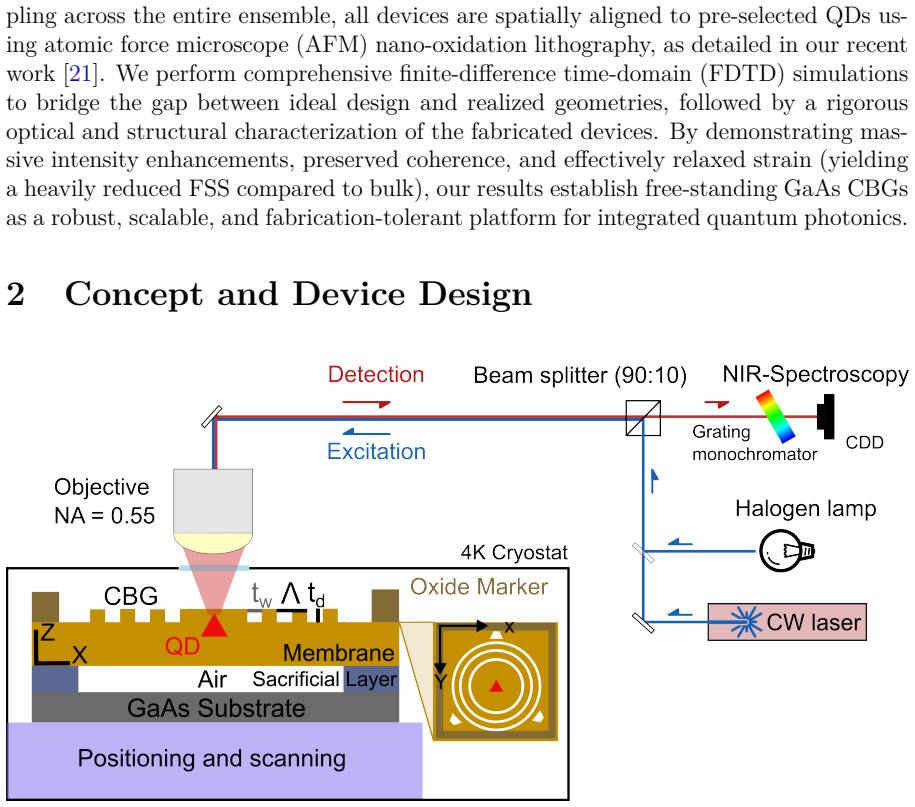


read the original abstract
Deterministic and bright quantum light sources based on scalable semiconductor technologies are a crucial building block for future quantum communication networks. While circular Bragg gratings (CBGs) are highly effective for extracting light from solid-state quantum emitters, conventional architectures rely on complex multi-layer processing or flip-chip bonding, which introduce detrimental strain and limit scalability. Here, we present a fabrication-minimal approach to realize monolithic, free-standing CBG cavities with deterministically positioned single GaAs quantum dots (QDs). By utilizing aspect-ratio-dependent etching (ARDE) in a single-step top-down process, we achieve the necessary vertical structural asymmetry for directional emission without requiring bottom reflectors. Finite-difference time-domain (FDTD) simulations validate this geometry, predicting free-space extraction efficiencies up to $68 \, \%$ and coupling efficiencies of $40 \, \%$ into a lensed single-mode fiber ($\text{NA} = 0.6$). Experimentally, the deterministically coupled QD-CBG devices yield a photoluminescence intensity enhancement of up to $\times 700$ compared to unprocessed planar QDs, reaching integrated count rates of $45 \, MHz$. Furthermore, the suspended membrane architecture effectively relaxes residual strain, significantly reducing the average exciton fine-structure splitting from $7.3 \, \mu eV$ in planar QDs to $1.3 \, \mu eV$ in the CBGs. Interferometric measurements confirm that the fabrication process preserves the optical quality of the emitters, with average coherence times of $70 \, ps$. By bridging optimized FDTD design with precise nanofabrication and robust optical performance, these results establish free-standing GaAs CBGs as a highly scalable platform for bright and coherent entangled photon pair sources.
Editorial analysis
A structured set of objections, weighed in public.
Referee Report
Summary. The manuscript presents a fabrication-minimal, single-step aspect-ratio-dependent etching (ARDE) process to realize monolithic free-standing circular Bragg grating (CBG) cavities with deterministically positioned GaAs quantum dots. FDTD simulations predict free-space extraction efficiencies up to 68% and 40% coupling into a NA=0.6 lensed fiber. Experiments report up to 700-fold photoluminescence intensity enhancement (45 MHz integrated count rates) relative to planar QDs, reduction of average exciton fine-structure splitting from 7.3 μeV to 1.3 μeV attributed to strain relaxation in the suspended membrane, and preserved optical quality with average coherence times of 70 ps.
Significance. If the central claims hold, the work provides a scalable route to bright, coherent GaAs QD-based entangled photon sources by eliminating multi-layer processing and flip-chip bonding while achieving both high extraction and reduced fine-structure splitting. The deterministic positioning, FDTD-validated geometry, and reported performance numbers represent clear strengths for quantum photonic integration.
major comments (2)
- [Abstract and Results] Abstract and Results: The attribution of the exciton fine-structure splitting reduction (7.3 μeV planar to 1.3 μeV in CBGs) specifically to strain relaxation by the suspended membrane lacks direct supporting evidence. No strain metrology (Raman, XRD), pre/post-suspension measurements on the same QDs, or control samples (identical ARDE but substrate-supported) are described to rule out alternative mechanisms such as etching-induced QD selection or local environment modification.
- [Experimental section] Experimental section: The reported photoluminescence enhancement factor of ×700 and 45 MHz count rates are presented without error bars, number of devices measured, or statistical distributions, and without explicit comparison to identically processed but non-suspended controls. This weakens verification of the extraction efficiency claims and the causal role of the free-standing architecture.
minor comments (1)
- The coherence time of ~70 ps is stated as an average but the measurement technique (e.g., Michelson interferometer visibility decay) and fitting procedure are not detailed, reducing clarity on how optical quality is quantified.
Simulated Author's Rebuttal
We thank the referee for the constructive comments and positive assessment of the work. We address each major point below and indicate the changes planned for the revised manuscript.
read point-by-point responses
-
Referee: [Abstract and Results] Abstract and Results: The attribution of the exciton fine-structure splitting reduction (7.3 μeV planar to 1.3 μeV in CBGs) specifically to strain relaxation by the suspended membrane lacks direct supporting evidence. No strain metrology (Raman, XRD), pre/post-suspension measurements on the same QDs, or control samples (identical ARDE but substrate-supported) are described to rule out alternative mechanisms such as etching-induced QD selection or local environment modification.
Authors: We agree that the manuscript does not include direct strain metrology such as Raman or XRD data, nor pre/post-suspension measurements on identical QDs or substrate-supported ARDE controls. The attribution relies on the established mechanism of strain relaxation in suspended GaAs membranes reported in prior literature. In the revision we will expand the discussion to cite this literature, explicitly state the absence of direct metrology, and note that alternative mechanisms cannot be fully excluded. We will also add a sentence acknowledging this as a limitation of the present study. revision: partial
-
Referee: [Experimental section] Experimental section: The reported photoluminescence enhancement factor of ×700 and 45 MHz count rates are presented without error bars, number of devices measured, or statistical distributions, and without explicit comparison to identically processed but non-suspended controls. This weakens verification of the extraction efficiency claims and the causal role of the free-standing architecture.
Authors: The referee correctly identifies that the current text lacks error bars, device counts, statistical distributions, and non-suspended control comparisons. In the revised manuscript we will add error bars, specify the number of devices measured, include statistical distributions of the enhancement factors, and provide data from identically processed but non-suspended control structures to better isolate the contribution of the free-standing geometry. revision: yes
Circularity Check
No significant circularity; simulations and experiments remain independent
full rationale
The paper reports FDTD simulations that predict extraction efficiencies from the described free-standing CBG geometry, followed by separate experimental results on fabricated devices showing PL enhancement and FSS reduction. No equations reduce to fitted parameters defined by the target quantities, no self-definitional loops exist, and no load-bearing self-citations or ansatzes are invoked to justify the central claims. The FSS reduction is stated as an observed experimental outcome attributed to membrane suspension, without any derivation that collapses to its own inputs.
Axiom & Free-Parameter Ledger
axioms (1)
- domain assumption Finite-difference time-domain simulations accurately predict extraction and coupling efficiencies for the described nanostructure geometry.
Forward citations
Cited by 1 Pith paper
-
Deterministic positioning of circular Bragg gratings using atomic force lithography for high-performance quantum dot light sources
AFM nano-oxidation lithography positions GaAs quantum dots in free-standing circular Bragg gratings with 51 nm radial accuracy, delivering 245-fold photoluminescence enhancement and polarization stability below 5%.
Reference graph
Works this paper leans on
-
[1]
J. Liu et al., “A solid-state source of strongly entangled photon pairs with high brightness and indistinguishability,”Nature Nanotechnology, vol. 14, no. 6, pp. 586– 593, 2019
work page 2019
-
[2]
A highly efficient single-photon source based on a quantum dot in a photonic nanowire,
J. Claudon et al., “A highly efficient single-photon source based on a quantum dot in a photonic nanowire,”Nature Photonics, vol. 4, no. 3, pp. 174–177, 2010
work page 2010
-
[3]
Ultrabright source of entangled photon pairs,
A. Dousse et al., “Ultrabright source of entangled photon pairs,”Nature, vol. 466, no. 7303, pp. 217–220, 2010
work page 2010
-
[4]
Maximally entangled and gigahertz-clocked on-demand photon pair source,
C. Hopfmann, W. Nie, N. L. Sharma, C. Weigelt, F. Ding, and O. G. Schmidt, “Maximally entangled and gigahertz-clocked on-demand photon pair source,”Phys. Rev. B, vol. 103, p. 075413, 7 Feb. 2021. 16
work page 2021
-
[5]
A stand-alone fiber-coupled single-photon source,
A. Schlehahn et al., “A stand-alone fiber-coupled single-photon source,”Scientific Reports, vol. 8, no. 1, p. 1340, 2018
work page 2018
-
[6]
Plug&play fiber-coupled 73 kHz single-photon source operating in the telecom o-band,
A. Musiał et al., “Plug&play fiber-coupled 73 kHz single-photon source operating in the telecom o-band,”Advanced Quantum Technologies, vol. 3, no. 6, p. 2000018, 2020
work page 2020
-
[7]
An ultra-compact deterministic source of maximally entangled photon pairs,
M. Langer et al., “An ultra-compact deterministic source of maximally entangled photon pairs,”APL Photonics, vol. 10, no. 6, p. 066117, 2025
work page 2025
-
[8]
A fiber-pigtailed quantum dot device generating indistinguishable photons at ghz clock-rates,
L. Rickert et al., “A fiber-pigtailed quantum dot device generating indistinguishable photons at ghz clock-rates,”Nanophotonics, Jan. 2025
work page 2025
-
[9]
Quantum dot single-photon emission coupled into single-mode fibers with 3D printed micro-objectives,
L. Bremer et al., “Quantum dot single-photon emission coupled into single-mode fibers with 3D printed micro-objectives,”APL Photonics, vol. 5, no. 10, p. 106101, Oct. 2020
work page 2020
-
[10]
Y. G. Zena et al.,Compact system development of efficient quantum-entangled pho- ton sources towards deployable and industrial devices, 2026. arXiv:2604 . 02024 [quant-ph]
work page 2026
-
[11]
Highly indistinguishable and strongly entangled photons from symmetric GaAs quantum dots,
D. Huber et al., “Highly indistinguishable and strongly entangled photons from symmetric GaAs quantum dots,”Nat. Commun., vol. 8, no. 1, pp. 1–7, 2017
work page 2017
-
[12]
Bright quantum dot light sources using monolithic microlenses on gold back-reflectors,
M. Langer et al., “Bright quantum dot light sources using monolithic microlenses on gold back-reflectors,”Nanotechnology, vol. 36, no. 22, p. 225301, May 2025
work page 2025
-
[13]
A bright and fast source of coherent single photons,
N. Tomm et al., “A bright and fast source of coherent single photons,”Nature Nanotechnology, vol. 16, no. 4, pp. 399–403, 2021
work page 2021
-
[14]
H. Wang et al., “On-demand semiconductor source of entangled photons which simultaneously has high fidelity, efficiency, and indistinguishability,”Phys. Rev. Lett., vol. 122, p. 113602, 11 Mar. 2019
work page 2019
-
[15]
M. Moczała-Dusanowska et al., “Strain-tunable single-photon source based on a circular bragg grating cavity with embedded quantum dots,”ACS Photonics, vol. 7, no. 12, pp. 3474–3480, Dec. 2020
work page 2020
-
[16]
High-throughput quantum photonic devices emitting indistin- guishable photons in the telecom c-band,
P. Holewa et al., “High-throughput quantum photonic devices emitting indistin- guishable photons in the telecom c-band,”Nat. Commun., vol. 15, no. 1, p. 3358, Apr. 18, 2024
work page 2024
-
[17]
Low-noise gaas quantum dots for quantum photonics,
L. Zhai et al., “Low-noise gaas quantum dots for quantum photonics,”Nature Com- munications, vol. 11, no. 1, p. 4745, 2020
work page 2020
-
[18]
On-demand source of maximally entangled photon pairs using the biexciton-exciton radiative cascade,
R. Winik et al., “On-demand source of maximally entangled photon pairs using the biexciton-exciton radiative cascade,”Phys. Rev. B, vol. 95, p. 235435, 23 2017
work page 2017
-
[19]
A circular dielectric grating for vertical extraction of single quantum dot emission,
M. Davanço, M. T. Rakher, D. Schuh, A. Badolato, and K. Srinivasan, “A circular dielectric grating for vertical extraction of single quantum dot emission,”Applied Physics Letters, vol. 99, no. 4, p. 041102, Jul. 2011
work page 2011
-
[20]
L. Rickert, F. Betz, M. Plock, S. Burger, and T. Heindel, “High-performance designs for fiber-pigtailed quantum-light sources based on quantum dots in electrically- controlled circular bragg gratings,”Opt. Express, vol. 31, no. 9, pp. 14750–14770, Apr. 2023
work page 2023
-
[21]
S. A. Dhurjati et al.,Deterministic positioning of circular bragg gratings using atomic force lithography for high-performance quantum dot light sources, 2026. 17
work page 2026
-
[22]
Modified droplet epitaxy gaas/algaas quantum dots grown on a variable thickness wetting layer,
S. Sanguinetti et al., “Modified droplet epitaxy gaas/algaas quantum dots grown on a variable thickness wetting layer,”Journal of Crystal Growth, vol. 253, no. 1, pp. 71–76, 2003
work page 2003
-
[23]
Faceting during gaas quantum dot self-assembly by droplet epitaxy,
C. Heyn, A. Stemmann, A. Schramm, H. Welsch, W. Hansen, and Á. Nemcsics, “Faceting during gaas quantum dot self-assembly by droplet epitaxy,”Applied Physics Letters, vol. 90, no. 20, p. 203105, 2007
work page 2007
-
[24]
Solid-state ensemble of highly entangled photon sources at rubidium atomic transitions,
R. Keil et al., “Solid-state ensemble of highly entangled photon sources at rubidium atomic transitions,”Nat. Commun., vol. 8, no. 1, pp. 1–8, 2017
work page 2017
-
[25]
Interfacing single photons and single quantum dots with photonic nanostructures,
P. Lodahl, S. Mahmoodian, and S. Stobbe, “Interfacing single photons and single quantum dots with photonic nanostructures,”Rev. Mod. Phys., vol. 87, pp. 347– 400, 2 2015
work page 2015
-
[26]
Bright single- photon emission from a quantum dot in a circular bragg grating microcavity,
S. Ates, L. Sapienza, M. Davanco, A. Badolato, and K. Srinivasan, “Bright single- photon emission from a quantum dot in a circular bragg grating microcavity,”IEEE J. Sel. Top. Quantum Electron., vol. 18, no. 6, pp. 1711–1721, 2012
work page 2012
-
[27]
Strong-coupling regime for quan- tum boxes in pillar microcavities: Theory,
L. C. Andreani, G. Panzarini, and J.-M. Gérard, “Strong-coupling regime for quan- tum boxes in pillar microcavities: Theory,”Phys. Rev. B, vol. 60, pp. 13276–13279, 19 1999
work page 1999
-
[28]
Near-optimal single-photon sources in the solid state,
N. Somaschi et al., “Near-optimal single-photon sources in the solid state,”Nature Photonics, vol. 10, no. 5, pp. 340–345, 2016
work page 2016
-
[29]
A. Barbiero et al., “High-performance single-photon sources at telecom wavelength based on broadband hybrid circular bragg gratings,”ACS Photonics, vol. 9, no. 9, pp. 3060–3066, Sep. 2022
work page 2022
-
[30]
Michler,Single Quantum Dots: Fundamentals, Applications and New Concepts (Topics in Applied Physics)
P. Michler,Single Quantum Dots: Fundamentals, Applications and New Concepts (Topics in Applied Physics). Springer Berlin Heidelberg, 2014
work page 2014
-
[31]
Statistical limits for entanglement swapping with semiconductor entangled photon sources,
J. Yang et al., “Statistical limits for entanglement swapping with semiconductor entangled photon sources,”Phys. Rev. B, vol. 105, p. 235305, 23 Jun. 2022
work page 2022
-
[32]
M. Langer et al., “Temperature-dependent refractive index of algaas for quantum- photonic devices near the bandgap,” 2025. arXiv:2512.02212 [physics.optics]
-
[33]
Experimental optimization of the fiber coupling efficiency of GaAs quantum dot-based photon sources,
W. Nie et al., “Experimental optimization of the fiber coupling efficiency of GaAs quantum dot-based photon sources,”Applied Physics Letters, vol. 119, no. 24, p. 244003, 2021
work page 2021
-
[34]
V. Cambel and J. Šoltýs, “The influence of sample conductivity on local anodic ox- idation by the tip of atomic force microscope,”Journal of Applied Physics, vol. 102, no. 7, p. 074315, 2007
work page 2007
-
[35]
Local anodic oxi- dationbyafmtipdevelopedfornovelsemiconductornanodevices,
V. Cambel, J. Martaus, J. Šoltýs, R. Kúdela, and D. Gregušová, “Local anodic oxi- dationbyafmtipdevelopedfornovelsemiconductornanodevices,”Ultramicroscopy, vol. 108, no. 10, pp. 1021–1024, 2008
work page 2008
-
[36]
Aspect ratio dependent etching lag reduction in deep silicon etch processes,
S. L. Lai, D. Johnson, and R. Westerman, “Aspect ratio dependent etching lag reduction in deep silicon etch processes,”Journal of Vacuum Science & Technology A, vol. 24, no. 4, pp. 1283–1288, Jun. 2006
work page 2006
-
[37]
Model for etch depth dependence on gaas via hole diameter,
B. Abraham-Shrauner, K. J. Nordheden, and Y.-S. Lee, “Model for etch depth dependence on gaas via hole diameter,”Journal of Vacuum Science & Technol- ogy B: Microelectronics and Nanometer Structures Processing, Measurement, and Phenomena, vol. 17, no. 3, pp. 961–964, May 1999. 18
work page 1999
-
[38]
Contact etch scaling with contact dimension,
S. C. McNevin and M. Cerullo, “Contact etch scaling with contact dimension,” Journal of Vacuum Science & Technology A, vol. 16, no. 3, pp. 1514–1518, May 1998
work page 1998
-
[39]
C. Hopfmann, N. L. Sharma, W. Nie, R. Keil, F. Ding, and O. G. Schmidt, “Heralded preparation of spin qubits in droplet-etched GaAs quantum dots using quasiresonant excitation,”Phys. Rev. B, vol. 104, p. 075301, 7 2021
work page 2021
-
[40]
Quantum-confined stark effects in coupled inas/gaas quan- tum dots,
S. Ramanathan et al., “Quantum-confined stark effects in coupled inas/gaas quan- tum dots,”Applied Physics Letters, vol. 102, no. 21, p. 213101, May 2013
work page 2013
-
[41]
P. Schnauber et al., “Spectral control of deterministically fabricated quantum dot waveguide systems using the quantum confined stark effect,”APL Photonics, vol. 6, no. 5, p. 050801, May 2021
work page 2021
-
[42]
Exciton binding energies and diamagnetic shifts in semiconductor quantum wires and quantum dots,
M. Bayer, S. N. Walck, T. L. Reinecke, and A. Forchel, “Exciton binding energies and diamagnetic shifts in semiconductor quantum wires and quantum dots,”Phys. Rev. B, vol. 57, pp. 6584–6591, 11 Mar. 1998
work page 1998
-
[43]
Charge noise and spin noise in a semiconductor quantum device,
A. V. Kuhlmann et al., “Charge noise and spin noise in a semiconductor quantum device,”Nature Physics, vol. 9, no. 9, pp. 570–575, 2013
work page 2013
-
[44]
Q. Buchinger et al., “Deterministic quantum dot cavity placement using hyperspec- tral imaging with high spatial accuracy and precision,”Nano Convergence, vol. 12, no. 1, p. 36, 2025
work page 2025
-
[45]
A. Kavokin, J. J. Baumberg, G. Malpuech, and F. P. Laussy,Microcavities. Oxford University Press, 2007. 19
work page 2007
discussion (0)
Sign in with ORCID, Apple, or X to comment. Anyone can read and Pith papers without signing in.