Persistent Spin Texture and Spin-Orbital Hall Responses on the AgI (110) Surface
Pith reviewed 2026-05-08 18:37 UTC · model grok-4.3
The pith
The AgI (110) surface hosts a robust persistent spin texture with effectively infinite spin lifetime due to its non-centrosymmetric and nonsymmorphic structure.
A machine-rendered reading of the paper's core claim, the machinery that carries it, and where it could break.
Core claim
The non-centrosymmetric and nonsymmorphic nature of the AgI (110) surface gives rise to a robust persistent spin texture, characterized by a unidirectional spin configuration and suppressed spin relaxation, enabling an effectively infinite spin lifetime. This is captured using an effective spin-orbit coupled Hamiltonian that reproduces the anisotropic spin splitting and momentum shift in the band structure. The system further exhibits sizable intrinsic spin Hall conductivity and orbital Hall conductivity.
What carries the argument
Persistent spin texture arising from non-centrosymmetric and nonsymmorphic symmetries, described by an effective spin-orbit coupled Hamiltonian that produces unidirectional spins and suppressed relaxation.
If this is right
- The material supports long-lived spin transport in low-dimensional halide systems.
- Sizable spin Hall and orbital Hall conductivities enable efficient charge-to-spin and charge-to-orbital conversion.
- The persistent spin texture remains stable against biaxial strain, structural distortion, and multilayer formation.
- Application of a vertical electric field drives a transition to Rashba-type spin texture, allowing tunability.
Where Pith is reading between the lines
- Halide surfaces like this could serve as platforms for spintronic elements that operate without heavy atoms.
- The two new analytical models for persistent spin texture may help screen other simple compounds for similar behavior.
- Electric-field control combined with structural robustness points toward reconfigurable spin devices in strained or layered setups.
Load-bearing premise
The first-principles calculations and effective Hamiltonian accurately capture the spin-orbit physics without significant errors from exchange-correlation functionals or surface modeling approximations.
What would settle it
An experimental observation of either bidirectional spin texture or finite spin relaxation times on the AgI (110) surface would falsify the central claim.
Figures
read the original abstract
A systematic investigation of the structural, electronic, and spin-orbital transport properties of the AgI (110) surface is presented using first-principles calculations combined with analytical modelling. The non-centrosymmetric and nonsymmorphic nature of the system gives rise to a robust persistent spin texture (PST), characterized by a unidirectional spin configuration and suppressed spin relaxation, enabling an effectively infinite spin lifetime. Unlike previously reported PST materials, which are predominantly based on chalcogen compounds, this work demonstrates that a halide semiconductor can host PST, thereby significantly expanding the materials platform for spintronic applications. The underlying mechanism is captured using an effective spin-orbit coupled Hamiltonian, which reproduces the anisotropic spin splitting and momentum shift observed in the band structure. This work introduces two new analytical models describing PST and compares them with existing models, offering new perspectives on PST arising from spin-orbit interaction. In addition, the system exhibits sizable intrinsic spin Hall conductivity (SHC) and orbital Hall conductivity (OHC), highlighting its potential for efficient charge-to-spin and charge-to-orbital conversion. The PST is found to be robust against biaxial strain, structural distortion, and multilayer formation, while a vertical electric field breaks the symmetry protection and drives a transition to a Rashba-type spin texture. These findings establish AgI (110) as a promising platform for realizing long-lived spin transport and tunable spin-orbit functionalities in the low-dimensional halide systems.
Editorial analysis
A structured set of objections, weighed in public.
Referee Report
Summary. The manuscript reports first-principles DFT calculations combined with effective-Hamiltonian modeling of the AgI (110) surface. It claims that the surface's non-centrosymmetric and nonsymmorphic symmetry produces a robust persistent spin texture (PST) with unidirectional, momentum-locked spin polarization, suppressed spin relaxation, and effectively infinite spin lifetime. Two new analytical PST models are introduced, the system is shown to exhibit sizable intrinsic spin Hall and orbital Hall conductivities, and the PST is asserted to remain stable under biaxial strain, structural distortion, and multilayer formation while being tunable by a perpendicular electric field.
Significance. If the central claims hold, the work is significant because it identifies a halide semiconductor surface as a PST host, thereby broadening the materials platform beyond the chalcogen-based systems that have dominated the literature. The combination of an effectively infinite spin lifetime with sizable charge-to-spin and charge-to-orbital conversion efficiencies would be attractive for spintronic devices. The introduction of two new analytical models and the demonstration of electric-field tunability add conceptual value.
major comments (3)
- [Computational Methods] Computational Methods section: no slab-thickness convergence tests, k-point sampling details, or exchange-correlation functional benchmarks are supplied. Because the PST is a delicate surface-state property whose spin texture can be altered by artificial potential gradients or Fermi-level shifts in finite slabs, the absence of these checks directly undermines in the reported unidirectional texture and the derived infinite-lifetime conclusion.
- [Effective Hamiltonian] Effective Hamiltonian section (around Eq. (3)–(5)): the model parameters are obtained by fitting to the DFT bands rather than being derived from symmetry or first-principles perturbation theory. Consequently, the statement that the Hamiltonian “reproduces” the anisotropic spin splitting and momentum shift is tautological and does not provide independent evidence for the PST mechanism or its protection by nonsymmorphic symmetry.
- [Spin-relaxation discussion] Spin-relaxation and lifetime discussion (near Fig. 5 and associated text): the claim of “effectively infinite spin lifetime” is inferred solely from the visual appearance of a unidirectional texture. No quantitative estimate of the Dyakonov-Perel or Elliott-Yafet relaxation rate, no scattering-time calculation, and no comparison with a Rashba reference system are provided, rendering the lifetime assertion unsupported by the data shown.
minor comments (3)
- [Figure 2] Figure 2 caption: the Brillouin-zone path labels are not defined in the text or figure; readers cannot reproduce the high-symmetry line without additional information.
- [Analytical models comparison] The two new analytical PST models are compared with “existing models,” but the specific references for the existing models are not cited in the comparison paragraph.
- [Table I] Table I (or equivalent): units for the reported Hall conductivities are missing, and it is unclear whether the values are per layer or per unit cell.
Simulated Author's Rebuttal
We thank the referee for the thorough review and valuable comments that will help improve our manuscript. We address each of the major comments below and indicate the revisions we will make.
read point-by-point responses
-
Referee: [Computational Methods] Computational Methods section: no slab-thickness convergence tests, k-point sampling details, or exchange-correlation functional benchmarks are supplied. Because the PST is a delicate surface-state property whose spin texture can be altered by artificial potential gradients or Fermi-level shifts in finite slabs, the absence of these checks directly undermines in the reported unidirectional texture and the derived infinite-lifetime conclusion.
Authors: We fully agree that these methodological details are crucial for establishing the reliability of our DFT results on the surface states. In the revised manuscript, we will expand the Computational Methods section to include slab-thickness convergence tests (showing stabilization of the spin texture for slabs thicker than 8-10 layers), detailed k-point sampling information (including the Monkhorst-Pack grid and convergence checks), and benchmarks with different exchange-correlation functionals (e.g., PBE and hybrid functionals) to rule out artifacts from potential gradients or Fermi level positions. This will directly bolster confidence in the persistent spin texture. revision: yes
-
Referee: [Effective Hamiltonian] Effective Hamiltonian section (around Eq. (3)–(5)): the model parameters are obtained by fitting to the DFT bands rather than being derived from symmetry or first-principles perturbation theory. Consequently, the statement that the Hamiltonian “reproduces” the anisotropic spin splitting and momentum shift is tautological and does not provide independent evidence for the PST mechanism or its protection by nonsymmorphic symmetry.
Authors: The effective Hamiltonian is symmetry-constrained by the nonsymmorphic space group of the AgI (110) surface, which dictates the allowed terms that lead to the PST. The fitting to DFT bands is used to determine the magnitudes of these symmetry-allowed parameters. We will revise the text to first derive the general form of the Hamiltonian from symmetry considerations before presenting the fitted parameters, thereby providing independent symmetry-based evidence for the mechanism. This addresses the concern that the reproduction is merely tautological. revision: partial
-
Referee: [Spin-relaxation discussion] Spin-relaxation and lifetime discussion (near Fig. 5 and associated text): the claim of “effectively infinite spin lifetime” is inferred solely from the visual appearance of a unidirectional texture. No quantitative estimate of the Dyakonov-Perel or Elliott-Yafet relaxation rate, no scattering-time calculation, and no comparison with a Rashba reference system are provided, rendering the lifetime assertion unsupported by the data shown.
Authors: The unidirectional spin texture in PST systems inherently suppresses the Dyakonov-Perel relaxation because the effective magnetic field direction is independent of momentum, leading to no dephasing upon scattering. We will enhance the discussion near Fig. 5 by providing a quantitative estimate of the spin lifetime using the Dyakonov-Perel formula, incorporating the calculated spin-orbit field strength, and compare it explicitly to a Rashba-type system with similar splitting magnitude but helical texture. Assumptions about the momentum relaxation time will be stated clearly, and Elliott-Yafet contributions will be briefly addressed. This will make the lifetime claim more rigorously supported. revision: yes
Circularity Check
No circularity: PST and Hall responses derived from DFT bands and symmetry, not by construction from fitted inputs
full rationale
The paper performs first-principles DFT calculations on the AgI (110) slab to obtain the band structure, spin texture, and transport coefficients, then builds an effective Hamiltonian that reproduces the observed anisotropic splitting and unidirectional spin locking arising from the nonsymmorphic, non-centrosymmetric space group. The PST is identified directly in the computed spin expectation values and protected by the crystal symmetry; the effective model is presented as a reproduction rather than a source of new predictions. Spin and orbital Hall conductivities are evaluated from the same DFT bands via Kubo formalism. No equation reduces a claimed lifetime or conductivity back to a parameter fitted from the target quantity itself, and no load-bearing self-citation or ansatz smuggling is present. The derivation chain remains self-contained against external benchmarks.
Axiom & Free-Parameter Ledger
axioms (1)
- domain assumption Density-functional theory with spin-orbit coupling accurately describes the electronic structure and spin texture of the AgI (110) surface
Lean theorems connected to this paper
-
Foundation/Cost (Jcost = ½(x+x⁻¹)−1)No correspondence — paper's Hamiltonians are linear-in-k spin-orbit terms, not ratio-symmetric cost unclear?
unclearRelation between the paper passage and the cited Recognition theorem.
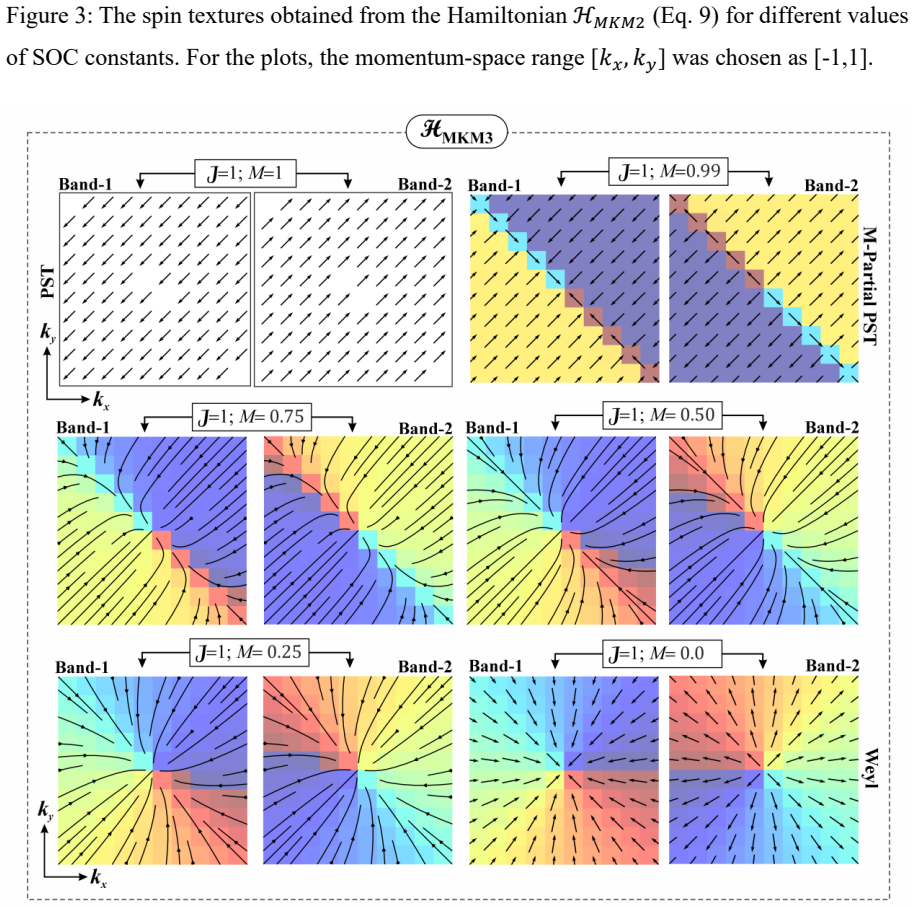
H_PST = γ k_y σ_z ... H_MKM2 = J(σ_x k_x + σ_y k_y) + β(σ_x k_x − σ_y k_y)
What do these tags mean?
- matches
- The paper's claim is directly supported by a theorem in the formal canon.
- supports
- The theorem supports part of the paper's argument, but the paper may add assumptions or extra steps.
- extends
- The paper goes beyond the formal theorem; the theorem is a base layer rather than the whole result.
- uses
- The paper appears to rely on the theorem as machinery.
- contradicts
- The paper's claim conflicts with a theorem or certificate in the canon.
- unclear
- Pith found a possible connection, but the passage is too broad, indirect, or ambiguous to say the theorem truly supports the claim.
Reference graph
Works this paper leans on
-
[1]
Introduction Silver iodide (AgI) is a prototypical halide semiconductor that has attracted sustained interest due to its rich polymorphism and diverse functional properties spanning ionic conduction, optoelectronics, and phase -change behaviour. Depending on the tempera ture and pressure, AgI stabilizes in multiple crystalline phases, most notably the low...
-
[2]
Computational Details The ab initio calculations were performed using the Quantum E spresso package. [15,16] Fully relativistic norm -conserving pseudopotentials from the pseudoDojo [17] library was employed to accurately account for spin-orbit coupling. A k-point mesh of 15 ×15 ×1 was used in the self -consistent calculations. The convergence criteria fo...
-
[3]
Results and Discussions 3.1 Crystal geometry and stability: The (110) facet of cubic zinc blende AgI belongs to the nonsymmorphic space group No. 31 with group order four, incorporating fundamental 4 symmetry elements such as rotation, mirror and translational operations. The crystal remains invariant under the following symmetry operations: (i) the ident...
-
[4]
9) for different values of SOC constants
( 0 1 0 ) 10 Figure 3: The spin textures obtained from the Hamiltonian ℋ𝑀𝐾𝑀2 (Eq. 9) for different values of SOC constants. For the plots, the momentum-space range [𝑘𝑥,𝑘𝑦] was chosen as [-1,1]. Figure 4: The spin textures obtained from the Hamiltonian ℋ𝑀𝐾𝑀3 (Eq. 10) for different values of SOC constants. For the plots, the momentum-space range [𝑘𝑥,𝑘𝑦] was...
-
[5]
The results indicate a systematic reduction in the band gap under strain. Notably, compressive strain is more effective than tensile strain in modulating the band gap of the AgI (110) surface. Despite these changes, the characteristic features of the PST remain robust under biaxial strain. The spin -projected band structures further confirm that the spin ...
-
[6]
Conclusion In summary, a systematic investigation of the structural, electronic, and spin -orbital transport properties of the AgI (110) surface is carried out using first -principles calculations and analytical modelling. The system is found to host a robust persistent spin texture (PST) arising from its nonsymmorphic symmetry, leading to highly anisotro...
work page 2025
-
[7]
C. A. Rains, J. R. Ray, and P . Vashishta, Phase transformations and polytypism in silver iodide: A molecular-dynamics study, Phys. Rev. B 44, 9228 (1991)
work page 1991
-
[8]
A. J. Majumdar and R. Roy, Experimental Study of the Polymorphism of AgI, J. Phys. Chem. 63, 1858 (1959). 17
work page 1959
-
[9]
P . R. Prager, Growth and characterization of AgI polytypes, Progress in Crystal Growth and Characterization 7, 451 (1983)
work page 1983
-
[10]
J. E. Maskasky, High phase-transition temperature for beta-AgI to alpha-AgI and an explanation of the memory effect, Phys. Rev. B 43, 5769 (1991)
work page 1991
-
[11]
J. R. G. Patnaik and C. S. Sunandana, Studies on gamma silver iodide, Journal of Physics and Chemistry of Solids 59, 1059 (1998)
work page 1998
-
[12]
A. Stroppa, D. Di Sante, P . Barone, M. Bokdam, G. Kresse, C. Franchini, M.-H. Whangbo, and S. Picozzi, Tunable ferroelectric polarization and its interplay with spin–orbit coupling in tin iodide perovskites, Nature Communications 5, 5900 (2014)
work page 2014
-
[13]
R. Kashikar, A. Popoola, S. Lisenkov, A. Stroppa, and I. Ponomareva, Persistent and Quasipersistent Spin Textures in Halide Perovskites Induced by Uniaxial Stress, J. Phys. Chem. Lett. 14, 8541 (2023)
work page 2023
-
[14]
H. J. Zhao, H. Nakamura, R. Arras, C. Paillard, P . Chen, J. Gosteau, X. Li, Y . Yang, and L. Bellaiche, Purely Cubic Spin Splittings with Persistent Spin Textures, Phys. Rev. Lett. 125, 216405 (2020)
work page 2020
-
[15]
M. K. Mohanta and P . Jena, MgTe (110) semiconductor for a magnetic-element-free nonballistic spin-field-effect transistor, Phys. Rev. B 109, 085415 (2024)
work page 2024
-
[16]
M. K. Mohanta and P . Jena, Symmetry-driven persistent spin texture for the two- dimensional nonsymmorphic CdTe and ZnTe crystal structures, Phys. Rev. B 108, 085432 (2023)
work page 2023
-
[17]
M. A. U. Absor, Y . Faishal, M. Anshory, I. Santoso, Sholihun, Harsojo, and F . Ishii, Highly persistent spin textures with giant tunable spin splitting in the two- dimensional germanium monochalcogenides, Journal of Physics: Condensed Matter 33, 305501 (2021)
work page 2021
-
[18]
Moh. A. U. Absor and F . Ishii, Intrinsic persistent spin helix state in two- dimensional group-IV monochalcogenide MX monolayers (M=Sn or Ge and X=S, Se, or Te), Phys. Rev. B 100, 115104 (2019)
work page 2019
-
[19]
J. Sławińska, F . T. Cerasoli, P . Gopal, M. Costa, S. Curtarolo, and M. B. Nardelli, Ultrathin SnTe films as a route towards all-in-one spintronics devices, 2D Materials 7, 025026 (2020)
work page 2020
-
[20]
L. L. Tao and E. Y . Tsymbal, Persistent spin texture enforced by symmetry, Nature Communications 9, 2763 (2018)
work page 2018
-
[21]
P . Giannozzi et al., QUANTUM ESPRESSO: a modular and open-source software project for quantum simulations of materials, Journal of Physics: Condensed Matter 21, 395502 (2009)
work page 2009
-
[22]
P . Giannozzi et al., Advanced capabilities for materials modelling with Quantum ESPRESSO, Journal of Physics: Condensed Matter 29, 465901 (2017)
work page 2017
-
[23]
M. J. van Setten, M. Giantomassi, E. Bousquet, M. J. Verstraete, D. R. Hamann, X. Gonze, and G.-M. Rignanese, The PseudoDojo: Training and grading a 85 element optimized norm-conserving pseudopotential table, Computer Physics Communications 226, 39 (2018)
work page 2018
-
[24]
N. Marzari and D. Vanderbilt, Maximally localized generalized Wannier functions for composite energy bands, Phys. Rev. B 56, 12847 (1997)
work page 1997
-
[25]
N. Marzari, A. A. Mostofi, J. R. Yates, I. Souza, and D. Vanderbilt, Maximally localized Wannier functions: Theory and applications, Rev. Mod. Phys. 84, 1419 (2012). 18
work page 2012
-
[26]
A. A. Mostofi, J. R. Yates, Y .-S. Lee, I. Souza, D. Vanderbilt, and N. Marzari, wannier90: A tool for obtaining maximally-localised Wannier functions, Computer Physics Communications 178, 685 (2008)
work page 2008
-
[27]
G. Pizzi et al., Wannier90 as a community code: new features and applications, Journal of Physics: Condensed Matter 32, 165902 (2020)
work page 2020
- [28]
-
[29]
Q. Wu, S. Zhang, H.-F . Song, M. Troyer, and A. A. Soluyanov, WannierTools: An open-source software package for novel topological materials, Computer Physics Communications 224, 405 (2018)
work page 2018
-
[30]
Resta, Theory of the electric polarization in crystals, Ferroelectrics 136, 51 (1992)
R. Resta, Theory of the electric polarization in crystals, Ferroelectrics 136, 51 (1992)
work page 1992
-
[31]
Resta, Macroscopic polarization in crystalline dielectrics: the geometric phase approach, Rev
R. Resta, Macroscopic polarization in crystalline dielectrics: the geometric phase approach, Rev. Mod. Phys. 66, 899 (1994)
work page 1994
-
[32]
R. D. King-Smith and D. Vanderbilt, Theory of polarization of crystalline solids, Phys. Rev. B 47, 1651 (1993)
work page 1993
-
[33]
A. Togo and I. Tanaka, First principles phonon calculations in materials science, Scripta Materialia 108, 1 (2015)
work page 2015
-
[34]
S. Guan, C. Liu, Y . Lu, Y . Yao, and S. A. Yang, Tunable ferroelectricity and anisotropic electric transport in monolayer beta-GeSe, Phys. Rev. B 97, 144104 (2018)
work page 2018
-
[35]
K. Chang et al., Discovery of robust in-plane ferroelectricity in atomic-thick SnTe, Science 353, 274 (2016)
work page 2016
-
[36]
J. Schliemann, J. C. Egues, and D. Loss, Nonballistic Spin-Field-Effect Transistor, Phys. Rev. Lett. 90, 146801 (2003)
work page 2003
-
[37]
M. K. Mohanta, A. Arora, and A. De Sarkar, Conflux of tunable Rashba effect and piezoelectricity in flexible magnesium monochalcogenide monolayers for next- generation spintronic devices, Nanoscale 13, 8210 (2021)
work page 2021
-
[38]
A. Bordoloi, A. C. Garcia-Castro, Z. Romestan, A. H. Romero, and S. Singh, Promises and technological prospects of two-dimensional Rashba materials, Journal of Applied Physics 135, 220901 (2024)
work page 2024
-
[39]
H. Wu, Q. Tian, J. Wei, Z. Xing, G. Qin, and Z. Qin, Rashba effect modulation in two-dimensional A2B2Te6 (A = Sb and Bi; B = Si and Ge) materials via charge transfer, Nanoscale 17, 17247 (2025)
work page 2025
-
[40]
Y . A. Bychkov and É. I. Rashba, Properties of a 2D electron gas with lifted spectral degeneracy, JETP Lett 39, 78 (1984)
work page 1984
-
[41]
M. K. Mohanta and P . Jena, Anomalous spin texture representation in quantum materials: Insights from density functional theory and analytical models, Phys. Rev. B 111, 045140 (2025)
work page 2025
-
[42]
Y . Sun et al., Fabrication of flexible and freestanding zinc chalcogenide single layers, Nature Communications 3, 1057 (2012)
work page 2012
discussion (0)
Sign in with ORCID, Apple, or X to comment. Anyone can read and Pith papers without signing in.