PAMNet: Cycle-aware Phase-Amplitude Modulation Network for Multivariate Time Series Forecasting
Pith reviewed 2026-05-09 19:24 UTC · model grok-4.3
The pith
PAMNet improves multivariate time series forecasting by explicitly separating phase and amplitude in periodic patterns with a dual-branch modulator.
A machine-rendered reading of the paper's core claim, the machinery that carries it, and where it could break.
Core claim
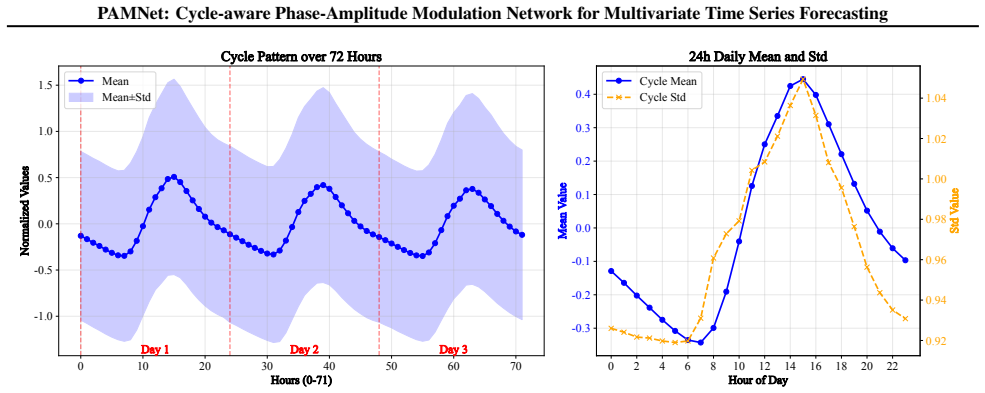
PAMNet explicitly decomposes periodic patterns into complementary phase and amplitude components. The phase branch employs cyclical embeddings to capture phase-dependent mean shifts, while the amplitude branch models intensity variations to adapt to changes in variance. A lightweight modulator with element-wise fusion combines these components to enable explicit modeling of their interactions without complex attention mechanisms, leading to state-of-the-art performance on twelve real-world datasets.
What carries the argument
Dual-branch modulator with cyclical embeddings for phase positioning and learnable embeddings for amplitude modulation, combined via element-wise fusion.
If this is right
- Explicit phase-amplitude decoupling captures periodic interactions more directly than implicit or coupled approaches.
- The method delivers state-of-the-art forecasting accuracy on diverse real-world multivariate datasets.
- Lightweight element-wise fusion provides an efficient alternative to attention-heavy architectures for cyclical time series.
- The decomposition offers a new perspective that treats phase shifts and amplitude variations as separately adaptable factors.
Where Pith is reading between the lines
- The same separation could extend to other cyclical signals such as audio waveforms or biological rhythms where phase and amplitude are physically distinct.
- Integrating the modulator with trend or residual components might yield hybrid models that handle non-stationary series more robustly.
- Controlled tests on synthetic series with known phase-amplitude relationships would provide a direct check on whether the decoupling recovers the ground-truth factors.
- The reduced reliance on attention suggests possible use in edge devices that require fast, low-memory periodic forecasting.
Load-bearing premise
Periodic components have an intrinsic phase-amplitude coupling that can be explicitly decomposed and modulated by learnable embeddings without losing critical interactions or causing overfitting.
What would settle it
Ablation experiments on the twelve datasets where disabling either the phase branch or the amplitude branch fails to increase forecasting error compared to the full model, or where non-separating baselines match or exceed PAMNet accuracy.
Figures




read the original abstract
Reliable periodic patterns serve as a fundamental basis for accurate multivariate time series forecasting. However, existing methods either implicitly extract periodicity through complex model architectures (e.g., Transformers) with high computational overhead or overlook the intrinsic phase-amplitude coupling when modeling periodic components explicitly. To address these issues, we propose a novel Cycle-aware Phase-Amplitude Modulation Network (PAMNet) that explicitly decomposes periodic patterns into complementary phase and amplitude components. The core innovation lies in its dual-branch modulator, featuring dedicated learnable embeddings for phase positioning and amplitude modulation. The phase branch employs cyclical embeddings to capture phase-dependent mean shifts, while the amplitude branch models intensity variations to adapt to changes in variance. A lightweight modulator with element-wise fusion efficiently combines these components, enabling explicit modeling of their interactions without complex attention mechanisms. Extensive experiments on twelve real-world datasets demonstrate that our method achieves state-of-the-art performance through its novel phase-amplitude decoupling mechanism, offering a new perspective for cyclical modeling in time series forecasting.
Editorial analysis
A structured set of objections, weighed in public.
Referee Report
Summary. The paper proposes PAMNet, a Cycle-aware Phase-Amplitude Modulation Network for multivariate time series forecasting. It explicitly decomposes periodic patterns into complementary phase and amplitude components using a dual-branch modulator with dedicated learnable cyclical embeddings for phase positioning (capturing mean shifts) and amplitude modulation (capturing variance changes), combined via lightweight element-wise fusion. The central claim is that this mechanism achieves state-of-the-art performance on twelve real-world datasets while avoiding the overhead of implicit periodicity extraction in complex architectures like Transformers and the coupling oversights of prior explicit methods.
Significance. If the empirical results and mechanism isolation hold, the work offers a lightweight, interpretable alternative for cyclical modeling in time series that could reduce computational costs relative to attention-heavy models while providing explicit control over phase-amplitude interactions. Strengths include the parameter-efficient design and focus on a previously underexplored decomposition, but significance hinges on demonstrating that gains stem from the decoupling rather than capacity increases.
major comments (2)
- [Abstract and Experiments] Abstract and Experiments section: The SOTA claim on twelve datasets lacks any reported quantitative metrics, baseline tables, statistical tests, or ablation results in the provided abstract, and the full manuscript does not isolate the contribution of the dual-branch phase-amplitude modulator from overall architecture capacity or added learnable embeddings. This is load-bearing for the novelty and mechanism claims, as improvements could arise from implicit effects rather than explicit decoupling.
- [§3 and §4] §3 (Method) and §4 (Experiments): No derivation or controlled comparison shows why independent phase (cyclical mean-shift) and amplitude (variance) embeddings with element-wise fusion suffice to capture arbitrary periodic coupling without residual interactions that attention-based models exploit; the premise that this avoids overfitting to dataset-specific periodicity remains untested against variants that retain implicit coupling.
minor comments (1)
- [§3] The description of the modulator fusion could include an explicit equation for the element-wise combination to clarify how phase and amplitude interact.
Simulated Author's Rebuttal
We thank the referee for the constructive feedback on our manuscript. We address each major comment below and will incorporate revisions to strengthen the presentation of results and mechanism validation.
read point-by-point responses
-
Referee: The SOTA claim on twelve datasets lacks any reported quantitative metrics, baseline tables, statistical tests, or ablation results in the provided abstract, and the full manuscript does not isolate the contribution of the dual-branch phase-amplitude modulator from overall architecture capacity or added learnable embeddings.
Authors: We agree the abstract would benefit from explicit metrics. In the revision we will update the abstract to report average relative improvements (e.g., 5–12% MSE reduction) over strong baselines across the twelve datasets. The experiments section already contains ablation tables comparing the full PAMNet against phase-only, amplitude-only, and embedding-ablated variants. To more rigorously isolate the dual-branch mechanism from capacity effects, we will add new controlled ablations that match parameter budgets exactly (by widening competing baselines) and report statistical significance via paired t-tests over five random seeds. revision: yes
-
Referee: No derivation or controlled comparison shows why independent phase (cyclical mean-shift) and amplitude (variance) embeddings with element-wise fusion suffice to capture arbitrary periodic coupling without residual interactions that attention-based models exploit; the premise that this avoids overfitting to dataset-specific periodicity remains untested against variants that retain implicit coupling.
Authors: Section 3 motivates the design by noting that phase and amplitude are complementary and largely separable in periodic signals; element-wise fusion provides an efficient interaction term without attention overhead. While a formal proof of sufficiency for arbitrary couplings is not provided (the approach is empirical), we will add in the revision two new controlled experiments: (i) a coupled-embedding variant that concatenates phase and amplitude before modulation, and (ii) a lightweight attention-based coupling baseline, both evaluated on the same twelve datasets with identical training protocols. These will directly test whether explicit decoupling reduces overfitting to dataset-specific periodicities relative to implicit-coupling alternatives. revision: yes
Circularity Check
No significant circularity in derivation chain
full rationale
The paper proposes an empirical neural architecture (PAMNet) for multivariate time series forecasting and validates it via experiments on twelve real-world datasets. No mathematical derivation, first-principles result, or prediction is claimed that reduces to the inputs by construction. The core mechanism (dual-branch phase-amplitude modulator with learnable embeddings) is an architectural design choice whose value is assessed through standard held-out test performance, not through any self-referential fitting or renaming. No uniqueness theorems, self-citations as load-bearing premises, or ansatzes smuggled via prior work appear in the provided text. This is a standard ML modeling paper whose claims rest on external empirical benchmarks rather than internal definitional loops.
Axiom & Free-Parameter Ledger
free parameters (2)
- learnable phase embeddings
- learnable amplitude embeddings
invented entities (1)
-
dual-branch phase-amplitude modulator
no independent evidence
Reference graph
Works this paper leans on
-
[1]
Proceedings of the 2023 7th International Conference on Advances in Artificial Intelligence (ICAAI) , pages =
Kristofers Volkovs and Evalds Urtans and Vairis Caune , title =. Proceedings of the 2023 7th International Conference on Advances in Artificial Intelligence (ICAAI) , pages =
2023
-
[2]
Proceedings of the 33rd
Peng Zhu and Yuante Li and Yifan Hu and Qinyuan Liu and Dawei Cheng and Yuqi Liang , title =. Proceedings of the 33rd
-
[3]
Wanneng Shu and Ken Cai and Neal Naixue Xiong , title =
-
[4]
Liu Sheng and Joseph Dunbar , title =
Mohammad Amin Morid and Olivia R. Liu Sheng and Joseph Dunbar , title =
-
[5]
Nguyen and Phanwadee Sinthong and Jayant Kalagnanam , title =
Yuqi Nie and Nam H. Nguyen and Phanwadee Sinthong and Jayant Kalagnanam , title =. The Eleventh International Conference on Learning Representations (ICLR) , year =
-
[6]
Advances in Neural Information Processing Systems (NeurIPS) , pages =
Haixu Wu and Jiehui Xu and Jianmin Wang and Mingsheng Long , title =. Advances in Neural Information Processing Systems (NeurIPS) , pages =
-
[7]
The Twelfth International Conference on Learning Representations (ICLR) , year =
Yong Liu and Tengge Hu and Haoran Zhang and Haixu Wu and Shiyu Wang and Lintao Ma and Mingsheng Long , title =. The Twelfth International Conference on Learning Representations (ICLR) , year =
-
[8]
International Conference on Machine Learning, (ICML) , volume =
Tian Zhou and Ziqing Ma and Qingsong Wen and Xue Wang and Liang Sun and Rong Jin , title =. International Conference on Machine Learning, (ICML) , volume =
-
[9]
Guoqi Yu and Jing Zou and Xiaowei Hu and Angelica I. Avil. Revitalizing Multivariate Time Series Forecasting: Learnable Decomposition with Inter-Series Dependencies and Intra-Series Variations Modeling , booktitle =
-
[10]
The Eleventh International Conference on Learning Representations (ICLR) , year =
Yunhao Zhang and Junchi Yan , title =. The Eleventh International Conference on Learning Representations (ICLR) , year =
-
[11]
Thirty-Seventh
Ailing Zeng and Muxi Chen and Lei Zhang and Qiang Xu , title =. Thirty-Seventh
-
[12]
Periodicity Decoupling Framework for Long-term Series Forecasting , booktitle =
Tao Dai and Beiliang Wu and Peiyuan Liu and Naiqi Li and Jigang Bao and Yong Jiang and Shu. Periodicity Decoupling Framework for Long-term Series Forecasting , booktitle =
-
[13]
Advances in Neural Information Processing Systems (NeurIPS) , year =
Minhao Liu and Ailing Zeng and Muxi Chen and Zhijian Xu and Qiuxia Lai and Lingna Ma and Qiang Xu , title =. Advances in Neural Information Processing Systems (NeurIPS) , year =
-
[14]
Forty-first International Conference on Machine Learning (ICML) , year =
Shengsheng Lin and Weiwei Lin and Wentai Wu and Haojun Chen and Junjie Yang , title =. Forty-first International Conference on Machine Learning (ICML) , year =
-
[15]
Advances in Neural Information Processing Systems (NeurIPS) , year =
Shengsheng Lin and Weiwei Lin and Xinyi Hu and Wentai Wu and Ruichao Mo and Haocheng Zhong , title =. Advances in Neural Information Processing Systems (NeurIPS) , year =
-
[16]
Forty-second International Conference on Machine Learning (ICML) , year=
Temporal Query Network for Efficient Multivariate Time Series Forecasting , author=. Forty-second International Conference on Machine Learning (ICML) , year=
-
[17]
International Conference on Machine Learning (ICML) , year=
TimeBridge: Non-Stationarity Matters for Long-term Time Series Forecasting , author=. International Conference on Machine Learning (ICML) , year=
-
[18]
The Eleventh International Conference on Learning Representations (ICLR) , year =
Haixu Wu and Tengge Hu and Yong Liu and Hang Zhou and Jianmin Wang and Mingsheng Long , title =. The Eleventh International Conference on Learning Representations (ICLR) , year =
-
[19]
Zhang and Jun Zhou , title =
Shiyu Wang and Haixu Wu and Xiaoming Shi and Tengge Hu and Huakun Luo and Lintao Ma and James Y. Zhang and Jun Zhou , title =. The Twelfth International Conference on Learning Representations (ICLR) , year =
-
[20]
Thirty-Fifth
Haoyi Zhou and Shanghang Zhang and Jieqi Peng and Shuai Zhang and Jianxin Li and Hui Xiong and Wancai Zhang , title =. Thirty-Fifth
-
[21]
Seeger and Jan Gasthaus and Lorenzo Stella and Yuyang Wang and Tim Januschowski , title =
Syama Sundar Rangapuram and Matthias W. Seeger and Jan Gasthaus and Lorenzo Stella and Yuyang Wang and Tim Januschowski , title =. Advances in Neural Information Processing Systems (NeurIPS) , pages =
-
[22]
arXiv , volume =
Shengsheng Lin and Weiwei Lin and Wentai Wu and Feiyu Zhao and Ruichao Mo and Haotong Zhang , title =. arXiv , volume =
-
[23]
The Twelfth International Conference on Learning Representations (ICLR) , year =
Donghao Luo and Xue Wang , title =. The Twelfth International Conference on Learning Representations (ICLR) , year =
-
[24]
Tsang and Hui Xiong , title =
Jinliang Deng and Feiyang Ye and Du Yin and Xuan Song and Ivor W. Tsang and Hui Xiong , title =. Advances in Neural Information Processing Systems (NeurIPS) , year =
-
[25]
Ihor Javorskyj and Roman Yuzefovych and Ivan Matsko and Zbigniew Zakrzewski and Jacek Majewski , title =. Digit. Signal Process. , volume =
-
[26]
Neural Networks , volume =
Stefan Elfwing and Eiji Uchibe and Kenji Doya , title =. Neural Networks , volume =
-
[27]
1968 , publisher=
Communication systems , author=. 1968 , publisher=
1968
-
[28]
PyTorch: An Imperative Style, High-Performance Deep Learning Library , booktitle =
Adam Paszke and Sam Gross and Francisco Massa and Adam Lerer and James Bradbury and Gregory Chanan and Trevor Killeen and Zeming Lin and Natalia Gimelshein and Luca Antiga and Alban Desmaison and Andreas K. PyTorch: An Imperative Style, High-Performance Deep Learning Library , booktitle =
-
[29]
The Thirteenth International Conference on Learning Representations (ICLR) , year =
Hao Wang and Lichen Pan and Yuan Shen and Zhichao Chen and Degui Yang and Yifei Yang and Sen Zhang and Xinggao Liu and Haoxuan Li and Dacheng Tao , title =. The Thirteenth International Conference on Learning Representations (ICLR) , year =
-
[30]
Kingma and Jimmy Ba , title =
Diederik P. Kingma and Jimmy Ba , title =. 3rd International Conference on Learning Representations (ICLR) , year =
-
[31]
The Association for the Advancement of Artificial Intelligence (AAAI) , pages =
Yulong Wang and Yushuo Liu and Xiaoyi Duan and Kai Wang , title =. The Association for the Advancement of Artificial Intelligence (AAAI) , pages =
-
[32]
The Association for the Advancement of Artificial Intelligence (AAAI) , pages =
Jingru Fei and Kun Yi and Wei Fan and Qi Zhang and Zhendong Niu , title =. The Association for the Advancement of Artificial Intelligence (AAAI) , pages =
-
[33]
Proceedings of the 31st
Pengfei Zhou and Yunlong Liu and Junli Liang and Qi Song and Xiangyang Li , title =. Proceedings of the 31st
-
[34]
Advances in Neural Information Processing Systems (NeurIPS) , year =
Yuxuan Wang and Haixu Wu and Jiaxiang Dong and Guo Qin and Haoran Zhang and Yong Liu and Yunzhong Qiu and Jianmin Wang and Mingsheng Long , title =. Advances in Neural Information Processing Systems (NeurIPS) , year =
-
[35]
Journal of Machine Learning Research , year =
Laurens van der Maaten and Geoffrey Hinton , title =. Journal of Machine Learning Research , year =
-
[36]
2026 , booktitle =
PAMod: Modeling Cyclical Shifts via Phase-Amplitude Modulation for Non-stationary Time Series Forecasting , author =. 2026 , booktitle =
2026
discussion (0)
Sign in with ORCID, Apple, or X to comment. Anyone can read and Pith papers without signing in.