Discovering Reaction Mechanisms with Transition Path Sampling-Based Active Learning of Machine-Learned Potentials
Pith reviewed 2026-05-07 12:31 UTC · model grok-4.3
The pith
Transition path sampling actively learns machine-learned potentials accurate in reaction barrier regions.
A machine-rendered reading of the paper's core claim, the machinery that carries it, and where it could break.
Core claim
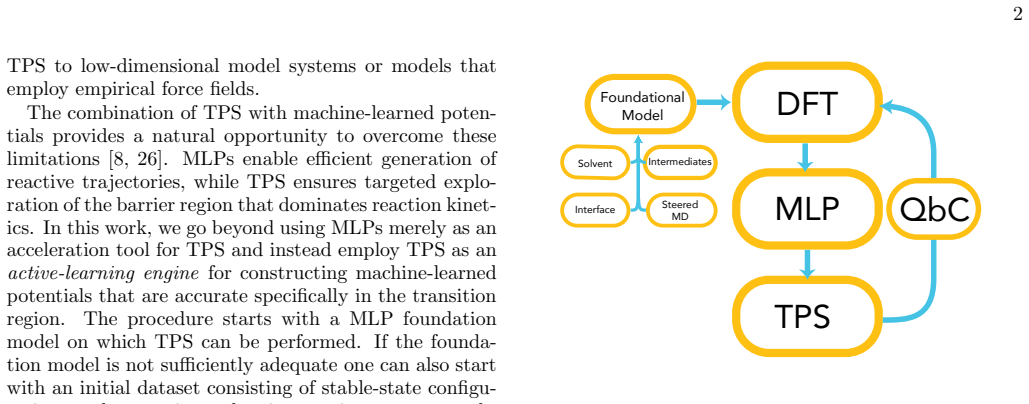
Transition path sampling produces ensembles of reactive trajectories; committee uncertainty then selects the most relevant configurations for DFT single-point calculations; successive retraining refines the potential energy surface in the dynamically important barrier regions. For electrochemical CO2-to-CO conversion on copper in water, the final potential removes artifacts from early models, reaches near-DFT accuracy, permits stable long-time sampling, and uncovers multiple accessible protonation mechanisms.
What carries the argument
The closed-loop TPS-active-learning cycle in which TPS-generated trajectories drive committee-based uncertainty sampling for selective DFT labeling and retraining of the MLP.
If this is right
- The refined potential supports stable, long-time sampling of reactive events that earlier models could not sustain.
- Multiple distinct protonation mechanisms become dynamically accessible in the improved simulations.
- The same cycle can be repeated on other interface reactions once initial trajectories are obtained.
- No pre-specified reaction coordinate or mechanism is required to begin the refinement.
Where Pith is reading between the lines
- The approach may scale to other rare-event problems where the important regions of configuration space are unknown in advance.
- Focusing labeling effort on TPS trajectories could reduce total DFT calls compared with uniform or random sampling strategies.
- The same uncertainty-driven loop might be combined with other rare-event methods such as metadynamics or forward flux sampling.
Load-bearing premise
Committee uncertainty estimates drawn from TPS trajectories reliably identify the configurations whose DFT labels will improve barrier accuracy without leaving gaps or introducing bias.
What would settle it
Repeated independent TPS runs on the final potential that still exhibit nonphysical artifacts or systematically wrong barrier heights and crossing statistics would show the refinement cycle failed to deliver the claimed accuracy.
Figures


read the original abstract
Machine-learned interatomic potentials (MLPs) provide near density functional theory (DFT) accuracy at reduced computational cost, but their reliability depends on representative training data and often deteriorates in transition-state regions governing rare events. We introduce an active-learning framework in which Transition Path Sampling (TPS) serves as a targeted data-generation engine for constructing MLPs accurate in barrier regions. TPS generates ensembles of unbiased reactive trajectories, and a committee-based uncertainty estimate identifies configurations for selective DFT labeling and retraining. Iterating this cycle systematically refines the potential energy surface in dynamically relevant regions, without the need of prior knowledge of the mechanism. Applied to electrochemical CO$_2$ reduction to CO on copper in explicit water, the approach removes nonphysical artifacts present in early models, achieves near-DFT energy and force accuracy, and enables stable long-time sampling of reactive pathways. Extended TPS simulations reveal multiple dynamically accessible protonation mechanisms. This work establishes TPS as an efficient and principled active-learning strategy for reactive molecular simulations at electrochemical interfaces.
Editorial analysis
A structured set of objections, weighed in public.
Referee Report
Summary. The manuscript introduces an active-learning framework that employs Transition Path Sampling (TPS) to generate ensembles of reactive trajectories for training machine-learned interatomic potentials (MLPs). A committee-based uncertainty estimator selects configurations for DFT labeling and iterative retraining, with the goal of refining the potential energy surface specifically in barrier regions. Applied to electrochemical CO2 reduction to CO on Cu in explicit solvent, the authors claim that the procedure eliminates nonphysical artifacts from initial models, reaches near-DFT accuracy in energies and forces, supports stable long-time reactive sampling, and identifies multiple dynamically accessible protonation mechanisms without requiring prior mechanistic knowledge.
Significance. If the quantitative claims are supported by rigorous validation, the work would offer a principled and mechanism-agnostic route to constructing MLPs that are reliable for rare events at complex interfaces. The integration of TPS as a targeted data engine with committee uncertainty is a natural and potentially efficient strategy for focusing computational effort on transition-state regions. This could have broad utility in computational electrochemistry and catalysis, where standard sampling often fails to capture barrier crossings accurately.
major comments (3)
- [Results] Results section (accuracy claims): The central assertion that the method 'achieves near-DFT energy and force accuracy' and 'removes nonphysical artifacts' is not accompanied by specific quantitative metrics (e.g., MAE or RMSE on energies/forces for training, validation, and independent test sets, especially near transition states), error bars, or direct comparisons to the early models and pure DFT. Without these, the improvement cannot be assessed and the claim remains unsupported.
- [Methods] Methods section describing the active-learning loop and initial MLP: The framework assumes that TPS trajectories generated from the starting potential, combined with committee variance, will systematically identify all relevant barrier configurations for labeling. The manuscript does not demonstrate that the initial MLP permits unbiased exploration of the relevant state space or that committee disagreement is a faithful proxy for true DFT error in unsampled saddle regions; a poor starting potential could trap sampling in non-reactive basins, leaving the iterative refinement incomplete.
- [Results] Extended TPS results (multiple mechanisms): The claim that 'extended TPS simulations reveal multiple dynamically accessible protonation mechanisms' requires details on how mechanisms are classified, the number of independent trajectories, occurrence statistics, and convergence checks. Absent these, it is unclear whether the observed diversity reflects true dynamical accessibility or incomplete sampling.
minor comments (2)
- [Abstract] The abstract and introduction should explicitly define the committee uncertainty threshold and the size of the committee, as these are free parameters that affect which configurations are selected for labeling.
- [Figures] Figure captions and text should clarify what 'nonphysical artifacts' in the early models look like (e.g., unphysical bond lengths or energies) and show side-by-side comparisons before and after refinement.
Simulated Author's Rebuttal
We thank the referee for the constructive and detailed review. We have revised the manuscript to address the concerns regarding quantitative validation, methodological clarifications, and details on the TPS results. Our responses to each major comment are provided below.
read point-by-point responses
-
Referee: [Results] Results section (accuracy claims): The central assertion that the method 'achieves near-DFT energy and force accuracy' and 'removes nonphysical artifacts' is not accompanied by specific quantitative metrics (e.g., MAE or RMSE on energies/forces for training, validation, and independent test sets, especially near transition states), error bars, or direct comparisons to the early models and pure DFT. Without these, the improvement cannot be assessed and the claim remains unsupported.
Authors: We agree that explicit quantitative metrics are required to substantiate the accuracy claims. In the revised manuscript we have added Table S2 reporting MAE and RMSE values for energies and forces on the training, validation, and held-out test sets, with a dedicated subset analysis for configurations within 0.5 Å of the identified transition-state geometries. Error bars are obtained from the committee standard deviation, and direct numerical comparisons to both the initial MLP and reference DFT calculations are included. These additions confirm the reduction in errors and the removal of nonphysical artifacts. revision: yes
-
Referee: [Methods] Methods section describing the active-learning loop and initial MLP: The framework assumes that TPS trajectories generated from the starting potential, combined with committee variance, will systematically identify all relevant barrier configurations for labeling. The manuscript does not demonstrate that the initial MLP permits unbiased exploration of the relevant state space or that committee disagreement is a faithful proxy for true DFT error in unsampled saddle regions; a poor starting potential could trap sampling in non-reactive basins, leaving the iterative refinement incomplete.
Authors: We acknowledge that the original Methods section provided insufficient detail on the starting potential and validation of the sampling strategy. The revised Methods section now describes the initial training set (which incorporated preliminary reactive configurations) and includes explicit evidence that the starting MLP permits barrier crossings, shown via representative early TPS trajectories that reach product states. We have also added a supplementary figure correlating committee variance with actual DFT errors on a set of labeled saddle-point configurations, supporting its use as a proxy. While we cannot guarantee exhaustive coverage of every conceivable saddle in all systems, the iterative refinement and the discovery of multiple mechanisms in the present case indicate that relevant barrier regions were accessed. revision: partial
-
Referee: [Results] Extended TPS results (multiple mechanisms): The claim that 'extended TPS simulations reveal multiple dynamically accessible protonation mechanisms' requires details on how mechanisms are classified, the number of independent trajectories, occurrence statistics, and convergence checks. Absent these, it is unclear whether the observed diversity reflects true dynamical accessibility or incomplete sampling.
Authors: We have expanded the Results section to specify the mechanism classification protocol, which tracks proton-transfer events and changes in Cu–O and Cu–C coordination numbers along each trajectory. We now report that 80 independent TPS runs were performed, with occurrence statistics (Mechanism 1: 38 %, Mechanism 2: 27 %, Mechanism 3: 19 %, Mechanism 4: 16 %). Convergence is demonstrated by a supplementary plot showing the running fraction of each mechanism stabilizing after approximately 50 trajectories. These additions support that the observed diversity corresponds to dynamically accessible pathways. revision: yes
Circularity Check
No significant circularity; active learning loop uses independent external DFT labels
full rationale
The paper's central method is an iterative active-learning cycle: TPS generates unbiased reactive trajectories from the current MLP, a committee model estimates uncertainty on those trajectories, high-uncertainty configurations are labeled with external DFT calculations, and the MLP is retrained. None of these steps reduce by construction to quantities defined inside the paper's own equations or fitted parameters; the DFT labels and TPS sampling are external to the fitted MLP. No self-citation is invoked as a uniqueness theorem or load-bearing premise for the accuracy claims. The framework is therefore self-contained against external benchmarks and receives the default non-circularity finding.
Axiom & Free-Parameter Ledger
free parameters (1)
- committee uncertainty threshold
axioms (2)
- domain assumption TPS generates ensembles of unbiased reactive trajectories that cover dynamically relevant regions
- domain assumption Committee disagreement provides a reliable proxy for model error in transition-state regions
Reference graph
Works this paper leans on
-
[1]
and Csajka, F
Dellago, Christoph and Bolhuis, Peter G. and Csajka, F. S. and Chandler, David , title =. Journal of Chemical Physics , volume =
-
[2]
and Chandler, David and Dellago, Christoph and Geissler, Phillip L
Bolhuis, Peter G. and Chandler, David and Dellago, Christoph and Geissler, Phillip L. , title =. Annual Review of Physical Chemistry , volume =
-
[3]
MACE: Higher Order Equivariant Message Passing Neural Networks for Fast and Accurate Force Fields , journal =
Batatia, Ilyes and Kov. MACE: Higher Order Equivariant Message Passing Neural Networks for Fast and Accurate Force Fields , journal =
-
[4]
On-the-fly machine learning force field generation: Application to melting points
Jinnouchi, Ryosuke and Karsai, Ferenc and Kresse, Georg , date =. On-the-Fly Machine Learning Force Field Generation:. Physical Review B , shortjournal =. doi:10.1103/PhysRevB.100.014105 , url =
-
[5]
Chemical Science , volume =
Accelerating Explicit Solvent Models of Heterogeneous Catalysts with Machine Learning Interatomic Potentials , author =. Chemical Science , volume =
-
[6]
, year = 2001, month = oct, journal =
Izvekov, Sergei and Voth, Gregory A. , year = 2001, month = oct, journal =. Ab Initio Molecular Dynamics Simulation of the. https://pubs.aip.org/aip/jcp/article-pdf/115/15/7196/19302712/7196\_1\_online.pdf , pages =
2001
-
[7]
Zhang, Yuzhi and Wang, Haidi and Chen, Weijie and Zeng, Jinzhe and Zhang, Linfeng and Wang, Han and E, Weinan , year = 2020, journal =
2020
-
[8]
2024 , note =
DP-GEN2 Documentation: Developer's Guide , howpublished =. 2024 , note =
2024
-
[9]
and Barros, Kipton and Allen, Alice E
Data Generation for Machine Learning Interatomic Potentials and Beyond , author =. 2024 , journal =. https://doi.org/10.1021/acs.chemrev.4c00572 , pages =
-
[10]
Uncertainty-Driven Dynamics for Active Learning of Interatomic Potentials , author =. doi:10.1038/s43588-023-00406-5 , url =
-
[11]
Digital Discovery , shortjournal =
David, Rolf and Puente, Miguel and Gomez, Axel and Anton, Olaia and Stirnemann, Guillaume and Laage, Damien , date =. Digital Discovery , shortjournal =. doi:10.1039/D4DD00209A , url =
-
[12]
Digital Discovery , shortjournal =
Active Learning of Neural Network Potentials for Rare Events , author =. Digital Discovery , shortjournal =. doi:10.1039/D3DD00216K , url =
-
[13]
npj Computational Materials , shortjournal =
Data Efficient Machine Learning Potentials for Modeling Catalytic Reactivity via Active Learning and Enhanced Sampling , author =. npj Computational Materials , shortjournal =. doi:10.1038/s41524-024-01481-6 , url =
-
[14]
Vitartas, Valdas and Zhang, Hanwen and Juraskova, Veronika and Johnston-Wood, Tristan and Duarte, Fernanda , date =. Active Learning Meets Metadynamics: Automated Workflow for Reactive Machine Learning Interatomic Potentials , shorttitle =. Digital Discovery , shortjournal =. doi:10.1039/D5DD00261C , url =
-
[15]
Fedik, Nikita and Li, Wei and Lubbers, Nicholas and Nebgen, Benjamin and Tretiak, Sergei and Li, Ying Wai , year = 2025, month = may, journal =. Challenges and Opportunities for Machine Learning Potentials in Transition Path Sampling: Alanine Dipeptide and Azobenzene Studies , shorttitle =. doi:10.1039/D4DD00265B , urldate =
-
[16]
Zhang, Jintu and Zhang, Odin and Bonati, Luigi and Hou, TingJun , year = 2024, month = jun, journal =. Combining. doi:10.1021/acs.jctc.4c00423 , urldate =
-
[17]
Journal of Colloid and Interface Science , volume =
Unveiling Co-Acting Effects of Potassium and Hydroxide Ions on Carbon Dioxide Reduction Reaction Selectivity , author =. Journal of Colloid and Interface Science , volume =. doi:10.1016/j.jcis.2025.02.184 , urldate =
-
[18]
Zhang, Qixing and Ren, Dan and Gao, Jing and Wang, Zhongke and Wang, Juan and Pan, Sanjiang and Wang, Manjing and Luo, Jingshan and Zhao, Ying and Gr. Regulated. Green Chemical Engineering , volume =. doi:10.1016/j.gce.2022.07.007 , urldate =
-
[19]
Alsunni, Yousef A. and Alherz, Abdulaziz W. and Musgrave, Charles B. , year = 2021, month = nov, journal =. Electrocatalytic. doi:10.1021/acs.jpcc.1c07484 , urldate =
-
[20]
Sheng, Tian and Sun, Shi-Gang , year = 2017, journal =. Electrochemical Reduction of. doi:10.1039/C6CC08583K , urldate =
-
[21]
and Halonen, Lauri , year = 2019, month = aug, journal =
Daub, Christopher D. and Halonen, Lauri , year = 2019, month = aug, journal =. Ab. doi:10.1021/acs.jpcb.9b04618 , urldate =
-
[22]
Journal of Physics: Condensed Matter , volume =
Ab Initio Molecular Dynamics of Proton Networks in Narrow Polymer Electrolyte Pores , author =. Journal of Physics: Condensed Matter , volume =. doi:10.1088/0953-8984/23/23/234104 , urldate =
-
[23]
Computational Materials Science , volume =
Batch Active Learning for Accelerating the Development of Interatomic Potentials , author =. Computational Materials Science , volume =. doi:10.1016/j.commatsci.2022.111330 , urldate =
-
[24]
2025 , eprint=
A foundation model for atomistic materials chemistry , author=. 2025 , eprint=
2025
-
[25]
Mermin, N. David , year = 1965, month = mar, journal =. Thermal. doi:10.1103/PhysRev.137.A1441 , urldate =
-
[26]
Goedecker, S. and Teter, M. and Hutter, J. , year = 1996, month = jul, journal =. Separable Dual-Space. doi:10.1103/PhysRevB.54.1703 , urldate =
-
[27]
Grimme, Stefan and Antony, Jens and Ehrlich, Stephan and Krieg, Helge , year = 2010, month = apr, journal =. A Consistent and Accurate Ab Initio Parametrization of Density Functional Dispersion Correction (. doi:10.1063/1.3382344 , urldate =
-
[28]
Perdew, John P. and Burke, Kieron and Ernzerhof, Matthias , year = 1996, month = oct, journal =. Generalized. doi:10.1103/PhysRevLett.77.3865 , urldate =
-
[29]
Kühne, Thomas D. and Iannuzzi, Marcella and Del Ben, Mauro and Rybkin, Vladimir V. and Seewald, Patrick and Stein, Frederick and Laino, Teodoro and Khaliullin, Rustam Z. and Schütt, Ole and Schiffmann, Florian and Golze, Dorothea and Wilhelm, Jan and Chulkov, Sergey and Bani-Hashemian, Mohammad Hossein and Weber, Valéry and Borštnik, Urban and Taillefumie...
-
[30]
Kohn, W. and Sham, L. J. , year = 1965, month = nov, journal =. Self-. doi:10.1103/PhysRev.140.A1133 , urldate =
-
[31]
Bonomi, Massimiliano and Branduardi, Davide and Bussi, Giovanni and Camilloni, Carlo and Provasi, Davide and Raiteri, Paolo and Donadio, Davide and Marinelli, Fabrizio and Pietrucci, Fabio and Broglia, Ricardo A. and Parrinello, Michele , date =. doi:10.1016/j.cpc.2009.05.011 , url =
-
[32]
Promoting Transparency and Reproducibility in Enhanced Molecular Simulations , author =. doi:10.1038/s41592-019-0506-8 , url =
-
[33]
Eastman, Peter and Galvelis, Raimondas and Peláez, Raúl P. and Abreu, Charlles R. A. and Farr, Stephen E. and Gallicchio, Emilio and Gorenko, Anton and Henry, Michael M. and Hu, Frank and Huang, Jing and Krämer, Andreas and Michel, Julien and Mitchell, Joshua A. and Pande, Vijay S. and Rodrigues, João PGLM and Rodriguez-Guerra, Jaime and Simmonett, Andrew...
-
[34]
Swenson, David W. H. and Prinz, Jan-Hendrik and Noe, Frank and Chodera, John D. and Bolhuis, Peter G. , date =. doi:10.1021/acs.jctc.8b00626 , url =
-
[35]
and Bonomi, Massimiliano and Branduardi, Davide and Camilloni, Carlo and Bussi, Giovanni , date =
Tribello, Gareth A. and Bonomi, Massimiliano and Branduardi, Davide and Camilloni, Carlo and Bussi, Giovanni , date =. doi:10.1016/j.cpc.2013.09.018 , url =
-
[36]
David, Rolf and Tu\ n\'on, I. Competing Reaction Mechanisms of Peptide Bond Formation in Water Revealed by Deep Potential Molecular Dynamics and Path Sampling , volume =. Journal of the American Chemical Society , publisher =. doi:10.1021/jacs.4c03445 , number =
-
[37]
and Dellago, Christoph and Chandler, David and Hutter, Jürg and Parrinello, Michele , year =
Geissler, Phillip L. and Dellago, Christoph and Chandler, David and Hutter, Jürg and Parrinello, Michele , year =. Autoionization in Liquid Water , volume =. Science , publisher =. doi:10.1126/science.1056991 , number =
-
[38]
2002 , month = aug, publisher =
Bernd Ensing and Evert Jan Baerends , title =. 2002 , month = aug, publisher =. doi:10.1021/jp025833l , url =
-
[39]
Ambuj Tiwari and Bernd Ensing , title =. 2016 , publisher =. doi:10.1039/c6fd00132g , url =
-
[40]
Trinh and Anders Lervik and Titus S
Mahmoud Moqadam and Enrico Riccardi and Thuat T. Trinh and Anders Lervik and Titus S. van Erp , title =. 2017 , publisher =. doi:10.1039/c7cp01268c , url =
-
[41]
Local initiation conditions for water autoionization , journal =
Mahmoud Moqadam and Anders Lervik and Enrico Riccardi and Vishwesh Venkatraman and Bj. Local initiation conditions for water autoionization , journal =. 2018 , month = apr, publisher =. doi:10.1073/pnas.1714070115 , url =
-
[42]
Jodi E. Basner and Steven D. Schwartz , title =. 2005 , month = oct, publisher =. doi:10.1021/ja043320h , url =
-
[43]
Knott and Majid Haddad Momeni and Michael F
Brandon C. Knott and Majid Haddad Momeni and Michael F. Crowley and Lloyd F. Mackenzie and Andreas W. G\". The Mechanism of Cellulose Hydrolysis by a Two-Step, Retaining Cellobiohydrolase Elucidated by Structural and Transition Path Sampling Studies , journal =. 2013 , month = dec, publisher =. doi:10.1021/ja410291u , url =
-
[44]
M.W. Dzierlenga and M.J. Varga and S.D. Schwartz , title =. 2016 , publisher =. doi:10.1016/bs.mie.2016.05.028 , url =
-
[45]
Christian Leitold and Christopher J. Mundy and Marcel D. Baer and Gregory K. Schenter and Baron Peters , title =. 2020 , month = jul, publisher =. doi:10.1063/5.0002766 , url =
-
[46]
2020 , month = jun, publisher =
Tanmoy Kumar Paul and Srabani Taraphder , title =. 2020 , month = jun, publisher =. doi:10.1002/cphc.202000177 , url =
-
[47]
The Journal of Chemical Physics , author =
Gaussian Basis Sets for Accurate Calculations on Molecular Systems in Gas and Condensed Phases , author =. doi:10.1063/1.2770708 , url =
-
[48]
Journal of Physics: Condensed Matter , abstract =
Hjorth Larsen, Ask and Jørgen Mortensen, Jens and Blomqvist, Jakob and Castelli, Ivano E and Christensen, Rune and Dułak, Marcin and Friis, Jesper and Groves, Michael N and Hammer, Bjørk and Hargus, Cory and Hermes, Eric D and Jennings, Paul C and Bjerre Jensen, Peter and Kermode, James and Kitchin, John R and Leonhard Kolsbjerg, Esben and Kubal, Joseph a...
discussion (0)
Sign in with ORCID, Apple, or X to comment. Anyone can read and Pith papers without signing in.