Nonlinear Compton scattering in a frequency-modulated field
Pith reviewed 2026-05-07 16:18 UTC · model grok-4.3
The pith
Squeezing in the driving field reduces to frequency modulation of the plane wave when fluctuations are negligible.
A machine-rendered reading of the paper's core claim, the machinery that carries it, and where it could break.
Core claim
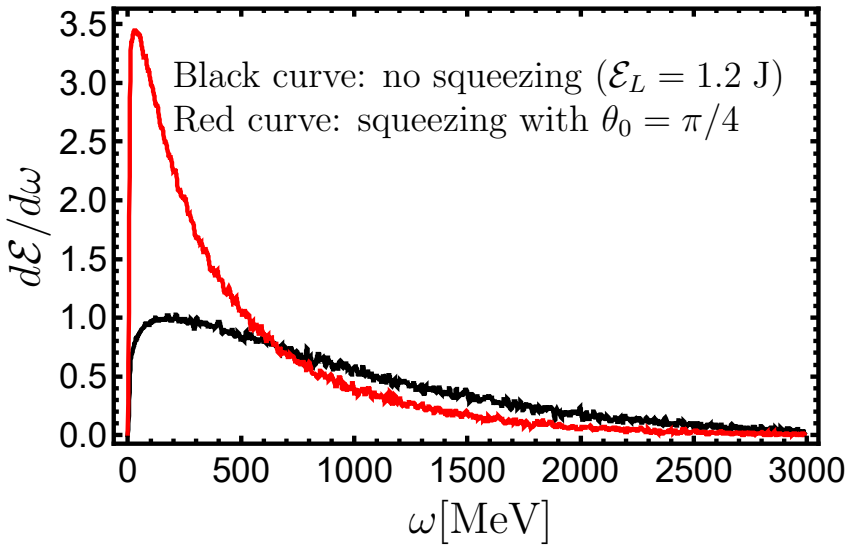
We show that, when quantum fluctuations induced by the squeezing in the coherent field are negligible, a condition well satisfied at available squeezing levels, the squeezing effects effectively reduce to a frequency modulation of the plane-wave field corresponding to the coherent state. By means of numerical examples we show that at already available squeezing levels the emission spectrum of nonlinear Compton scattering and the total photon yield can be altered significantly.
What carries the argument
The reduction of squeezing in a coherent plane-wave state to an effective frequency modulation of that wave, valid when squeezing-induced fluctuations remain small.
If this is right
- The spectrum of scattered photons acquires a shift and reshaping governed by the effective frequency change.
- The total number of emitted photons increases or decreases according to the modulated field parameters.
- Analytical expressions derived from the modulated-field picture reproduce the main features seen in the numerical spectra.
Where Pith is reading between the lines
- Similar reductions might appear in other strong-field QED processes once the background is prepared in a squeezed state.
- The modulation picture could guide the design of laser-based sources that tune radiation output by adjusting squeezing rather than intensity alone.
- The boundary between the modulation regime and the regime where fluctuations matter could be mapped by scanning squeezing strength in a single apparatus.
Load-bearing premise
Quantum fluctuations induced by the squeezing in the coherent field remain negligible at currently achievable squeezing levels.
What would settle it
Measure the emitted photon spectrum in a nonlinear Compton scattering experiment at a squeezing level high enough that the variance of quantum fluctuations becomes comparable to the modulation amplitude and check whether the spectrum deviates from the pure frequency-modulated prediction.
Figures

read the original abstract
When an electron is accelerated, it emits radiation. In the relativistic quantum realm the elementary radiation process is the emission of a single photon, a process known as nonlinear Compton scattering in the case of an electron moving in the presence of a strong electromagnetic wave. This process is typically described within the Furry picture, where the electromagnetic wave is described as a classical background field and the electron-positron field is quantized in the presence of that background field. Equivalently one can quantize the electron-positron field in the vacuum but then the photon emission process is described as a transition from an initial state to a final state both featuring, apart from the electron (the initial state) and the electron and the photon (the final state), the same coherent state of photons appropriately related to the electromagnetic wave. Here, we consider a more general situation where the initial and the final state feature the same squeezed coherent state. Then, we specialize to the case where the coherent state corresponds to a plane-wave field and the mostly populated modes of the coherent state are also squeezed. We show that, when quantum fluctuations induced by the squeezing in the coherent field are negligible, a condition well satisfied at available squeezing levels, the squeezing effects effectively reduce to a frequency modulation of the plane-wave field corresponding to the coherent state. By means of numerical examples we show that at already available squeezing levels the emission spectrum of nonlinear Compton scattering and the total photon yield can be altered significantly. Analytical explanations of the main numerical results are also provided.
Editorial analysis
A structured set of objections, weighed in public.
Referee Report
Summary. The manuscript examines nonlinear Compton scattering where the electromagnetic field is prepared in a squeezed coherent state rather than a pure coherent state. Specializing to plane-wave coherent states with squeezed populated modes, it argues that when squeezing-induced quantum fluctuations are negligible (a regime satisfied at current experimental squeezing levels), the squeezing effects reduce exactly to a frequency modulation of the corresponding plane-wave background. This equivalence permits reuse of standard Furry-picture calculations with a shifted laser frequency. Numerical examples demonstrate that both the emission spectrum and total photon yield can change substantially at already available squeezing levels, supported by analytical explanations of the principal features.
Significance. If the central reduction is rigorously justified, the work supplies a practical bridge between quantum-optics squeezing and strong-field QED, allowing existing Furry-picture codes to incorporate squeezing via a simple frequency adjustment rather than a full multimode quantum treatment. The combination of numerical demonstrations and accompanying analytical insights is a clear strength, as is the parameter-free character of the core mapping once the negligible-fluctuation condition is imposed.
major comments (2)
- [Section deriving the squeezing-to-frequency-modulation equivalence (following the specialization to plane-wave fields)] The reduction from the multimode squeezed coherent state to an effective frequency-modulated classical plane-wave field is the load-bearing step for all subsequent claims. The manuscript asserts this equivalence after specializing to plane-wave coherent states, but does not display the explicit operator algebra showing that the squeezing operator S(ξ) applied to the coherent amplitude produces only a frequency shift with no residual operator-valued corrections or mode-entanglement contributions that would survive the negligible-fluctuation limit. A concrete derivation of this limit, including the handling of commutation relations across modes, is required before the Furry-picture spectrum and yield formulas can be invoked.
- [Numerical results section] The numerical examples rely on the frequency-modulated background to compute spectra and yields, yet no direct side-by-side comparison is shown between the squeezed case (via the claimed mapping) and the unmodified coherent-state case at identical intensity and central frequency. Without this baseline, it is difficult to isolate the magnitude of the modulation-induced change from other parameter choices.
minor comments (3)
- The abstract states that the negligible-fluctuation condition is 'well satisfied at available squeezing levels' but does not quote the specific squeezing parameter range (in dB or ξ) or the corresponding fluctuation variance that was used to reach this conclusion.
- [Figure captions] Figure captions for the emission spectra should explicitly state the squeezing parameter, the modulation depth, and the electron energy used in each panel to allow immediate reproduction.
- [Theoretical framework] A brief remark on the validity range of the plane-wave approximation when the squeezed modes are multimode would clarify the domain of applicability.
Simulated Author's Rebuttal
We thank the referee for the careful reading of our manuscript and the constructive comments. We address each major comment below and will revise the manuscript to incorporate the suggested improvements for greater clarity and completeness.
read point-by-point responses
-
Referee: [Section deriving the squeezing-to-frequency-modulation equivalence (following the specialization to plane-wave fields)] The reduction from the multimode squeezed coherent state to an effective frequency-modulated classical plane-wave field is the load-bearing step for all subsequent claims. The manuscript asserts this equivalence after specializing to plane-wave coherent states, but does not display the explicit operator algebra showing that the squeezing operator S(ξ) applied to the coherent amplitude produces only a frequency shift with no residual operator-valued corrections or mode-entanglement contributions that would survive the negligible-fluctuation limit. A concrete derivation of this limit, including the handling of commutation relations across modes, is required before the Furry-picture spectrum and yield formulas can be invoked.
Authors: We appreciate the referee's request for a more explicit presentation of this central step. Although the manuscript provides the reasoning after specializing to plane-wave fields and states the conditions under which the reduction holds, we agree that displaying the operator algebra in detail will strengthen the justification. In the revised version we will add an expanded subsection (or short appendix) that derives the action of the squeezing operator S(ξ) on the multimode coherent state explicitly. We will show that, once the negligible-fluctuation condition is imposed (quantified by the squeezing level such that the relative variance remains small compared with the mean occupation, as holds at present experimental values), all residual operator-valued corrections and surviving mode-entanglement contributions vanish. The cross-mode commutators are handled by demonstrating that they generate only higher-order terms that are negligible under the same limit, thereby confirming that the state reduces to a classical plane-wave field whose frequency is modulated. This explicit limit then directly licenses the reuse of standard Furry-picture formulas with the shifted frequency. revision: yes
-
Referee: [Numerical results section] The numerical examples rely on the frequency-modulated background to compute spectra and yields, yet no direct side-by-side comparison is shown between the squeezed case (via the claimed mapping) and the unmodified coherent-state case at identical intensity and central frequency. Without this baseline, it is difficult to isolate the magnitude of the modulation-induced change from other parameter choices.
Authors: We agree that a direct baseline comparison would make the magnitude of the modulation-induced changes more transparent. In the revised manuscript we will add a side-by-side comparison—either as an additional figure or as supplementary panels in the existing numerical-results section—showing the emission spectrum and total photon yield for the frequency-modulated case (corresponding to the squeezed state via the mapping) against the standard coherent-state case. The comparison will be performed at fixed intensity and central frequency so that the effects attributable to the frequency modulation can be isolated cleanly. The analytical explanations already provided in the text will be used to interpret the differences. revision: yes
Circularity Check
No significant circularity; derivation is self-contained from standard QED states
full rationale
The paper begins from the standard Furry-picture formulation and the definition of squeezed coherent states in quantum optics, then specializes to plane-wave modes and shows algebraically that negligible squeezing-induced fluctuations reduce the problem to a frequency-modulated classical background. This reduction is derived directly from the mode expansions and commutation relations without fitting parameters, self-referential definitions, or load-bearing self-citations that presuppose the target result. The numerical examples and analytical explanations follow from the modified Volkov states in the modulated field, keeping the central claim independent of its own inputs.
Axiom & Free-Parameter Ledger
axioms (2)
- domain assumption The electromagnetic wave is described as a classical background field in the Furry picture while the electron-positron field is quantized in its presence.
- domain assumption Initial and final states feature the same squeezed coherent state of photons.
Reference graph
Works this paper leans on
-
[1]
V. B. Berestetskii, E. M. Lifshitz, and L. P. Pitaevskii,Quantum Electrodynamics(Elsevier Butterworth-Heinemann, Oxford, 1982)
work page 1982
-
[2]
C. Itzykson and J.-B. Zuber,Quantum Field Theory(McGraw-Hill Inc., New York, 1980)
work page 1980
-
[3]
W. Dittrich and M. Reuter,Effective Lagrangians in Quantum Electrodynamics(Springer, Heidelberg, 1985)
work page 1985
-
[4]
E. S. Fradkin, D. M. Gitman, and Sh. M. Shvartsman,Quantum Electrodynamics with Unstable Vacuum(Springer, Berlin, 1991)
work page 1991
-
[5]
V. N. Baier, V. M. Katkov, and V. M. Strakhovenko,Electromagnetic Processes at High Energies in Oriented Single Crystals(World Scientific, Singapore, 1998)
work page 1998
-
[6]
V. I. Ritus, J. Sov. Laser Res.6, 497 (1985)
work page 1985
-
[7]
A. Di Piazza, C. M¨ uller, K. Z. Hatsagortsyan, and C. H. Keitel, Rev. Mod. Phys.84, 1177 (2012)
work page 2012
-
[8]
T. G. Blackburn, Rev. Mod. Plasma Phys.4, 5 (2020)
work page 2020
-
[9]
A. Gonoskov, T. G. Blackburn, M. Marklund, and S. S. Bulanov, Rev. Mod. Phys.94, 045001 (2022)
work page 2022
-
[10]
A. Fedotov, A. Ilderton, F. Karbstein, B. King, D. Seipt, H. Taya, and G. Torgrimsson, Phys. Rep.1010, 1 (2023)
work page 2023
-
[11]
Apollon Research Infrastructure,https://apollonlaserfacility.cnrs.fr/en/home/. 15
-
[12]
Central Laser Facility (CLF),https://www.clf.stfc.ac.uk/Pages/home.aspx
-
[13]
Center for Relativistic Laser Science (CoReLS),https://www.ibs.re.kr/eng/sub02_03_05. do
-
[14]
Extreme Light Infrastructure (ELI),https://eli-laser.eu/
-
[15]
Zettawatt-Equivalent Ultrashort pulse laser System (ZEUS),https://zeus.engin.umich. edu/
-
[16]
National Science Foundation Optical Parametric Amplifier Lines (NSF OPAL),https:// nsf-opal.rochester.edu/
-
[17]
Station of Extreme Light (SEL),https://en.wikipedia.org/wiki/Station_of_Extreme_ Light
-
[18]
Vulcan 20-20,https://www.clf.stfc.ac.uk/Pages/Vulcan-2020.aspx
work page 2020
-
[19]
Exawatt Center for Extreme Light Studies (XCELS),https://www.cremlinplus.eu/ collaboration/russian_megascience_projects/xcels/
-
[20]
J. W. Yoon, Y. G. Kim, I. W. Choi, J. H. Sung, H. W. Lee, S. K. Lee, and C. H. Nam, Optica 8, 630 (2021)
work page 2021
-
[21]
A. J. Gonsalves, K. Nakamura, J. Daniels, C. Benedetti, C. Pieronek, T. C. H. de Raadt, S. Steinke, J. H. Bin, S. S. Bulanov, J. van Tilborg, C. G. R. Geddes, C. B. Schroeder, C. T´ oth, E. Esarey, K. Swanson, L. Fan-Chiang, G. Bagdasarov, N. Bobrova, V. Gasilov, G. Korn, P. Sasorov, and W. P. Leemans, Phys. Rev. Lett.122, 084801 (2019)
work page 2019
-
[22]
J. M. Cole, K. T. Behm, E. Gerstmayr, T. G. Blackburn, J. C. Wood, C. D. Baird, M. J. Duff, C. Harvey, A. Ilderton, A. S. Joglekar, K. Krushelnick, S. Kuschel, M. Marklund, P. McKenna, C. D. Murphy, K. Poder, C. P. Ridgers, G. M. Samarin, G. Sarri, D. R. Symes, A. G. R. Thomas, J. Warwick, M. Zepf, Z. Najmudin, and S. P. D. Mangles, Phys. Rev. X8, 011020 (2018)
work page 2018
-
[23]
K. Poder, M. Tamburini, G. Sarri, A. Di Piazza, S. Kuschel, C. D. Baird, K. Behm, S. Bohlen, J. M. Cole, D. J. Corvan, M. Duff, E. Gerstmayr, C. H. Keitel, K. Krushelnick, S. P. D. Mangles, P. McKenna, C. D. Murphy, Z. Najmudin, C. P. Ridgers, G. M. Samarin, D. R. Symes, A. G. R. Thomas, J. Warwick, and M. Zepf, Phys. Rev. X8, 031004 (2018)
work page 2018
-
[24]
M. Mirzaie, C. I. Hojbota, D. Y. Kim, V. B. Pathak, T. G. Pak, C. M. Kim, H. W. Lee, J. W. Yoon, S. K. Lee, Y. J. Rhee, M. Vranic, ´O. Amaro, K. Y. Kim, J. H. Sung, and C. H. Nam, Nature Photon.18, 1212 (2024). 16
work page 2024
-
[25]
E. E. Los, E. Gerstmayr, C. Arran, M. J. V. Streeter, C. Colgan, C. C. Cobo, B. Kettle, T. G. Blackburn, N. Bourgeois, L. Calvin, J. Cardarelli, N. Cavanagh, S. J. D. Dann, A. Di Piazza, R. Fitzgarrald, A. Ilderton, C. H. Keitel, M. Marklund, P. McKenna, C. D. Murphy, Z. Naj- mudin, P. Parsons, P. P. Rajeev, D. R. Symes, M. Tamburini, A. G. R. Thomas, J. ...
work page 2026
-
[26]
W. H. Furry, Phys. Rev.81, 115 (1951)
work page 1951
-
[27]
It has been conjectured that that interaction also becomes “strong” at values of the quantum nonlinearity parameterχ 0 such thatαχ 2/3 0 ≪1 [7, 10]
- [28]
-
[29]
M. Even Tzur, M. Birk, A. Gorlach, M. Kr¨ uger, I. Kaminer, and O. Cohen, Nature Photon. 17, 501 (2023)
work page 2023
-
[30]
M. E. Tzur, M. Birk, A. Gorlach, I. Kaminer, M. Kr¨ uger, and O. Cohen, Phys. Rev. Res.6, 033079 (2024)
work page 2024
-
[31]
D. Theidel, V. Cotte, R. Sondenheimer, V. Shiriaeva, M. Froidevaux, V. Severin, A. Merdji- Larue, P. Mosel, S. Fr¨ ohlich, K.-A. Weber, U. Morgner, M. Kovacev, J. Biegert, and H. Merdji, PRX Quantum5, 040319 (2024)
work page 2024
- [32]
-
[33]
D. F. Walls, Nature306, 141 (1983)
work page 1983
-
[34]
G. S. Agarwal and K. Qu, Phys. Rev. A85, 031802 (2012)
work page 2012
-
[35]
H. Vahlbruch, M. Mehmet, K. Danzmann, and R. Schnabel, Phys. Rev. Lett.117, 110801 (2016)
work page 2016
- [36]
- [37]
-
[38]
L. Mandel and E. Wolf,Optical Coherence and Quantum Optics(Cambridge University Press, Cambridge, 2013)
work page 2013
-
[39]
G. S. Agarwal,Quantum Optics(Cambridge University Press, Cambridge, 2013)
work page 2013
-
[40]
D. M. Volkov, Z. Phys.94, 250 (1935)
work page 1935
- [41]
- [42]
- [43]
- [44]
- [45]
-
[46]
A. Di Piazza, K. Z. Hatsagortsyan, and C. H. Keitel, Phys. Rev. Lett.105, 220403 (2010). 18
work page 2010
discussion (0)
Sign in with ORCID, Apple, or X to comment. Anyone can read and Pith papers without signing in.