Heterotic Flux Vacua with a Small Superpotential
Pith reviewed 2026-05-08 17:56 UTC · model grok-4.3
The pith
Heterotic Calabi-Yau flux compactifications forbid supersymmetric minima with small or vanishing superpotential except at special points away from the large complex structure limit.
A machine-rendered reading of the paper's core claim, the machinery that carries it, and where it could break.
Core claim
Working within a four-dimensional effective field theory and exploiting the special geometry of Calabi-Yau complex structure moduli spaces, supersymmetric vacua with vanishing |W0| occur only at singular loci in moduli space, while no supersymmetric vacua with small |W0| exist in the large complex structure limit. Explicit analysis of one- and two-parameter models away from this limit identifies flux choices yielding |W0| of order unity, with some one-parameter models admitting values moderately below unity. These findings indicate that small heterotic flux superpotentials are highly constrained.
What carries the argument
The special geometry of the complex-structure moduli space, used to solve the complex-structure F-term equations and derive constraints on the superpotential.
If this is right
- Supersymmetric flux vacua with exactly zero superpotential require singular points in the moduli space.
- All supersymmetric minima in the large complex structure limit have large |W0|.
- Away from the large complex structure limit, suitable flux choices in one- and two-parameter models can produce |W0| of order one or moderately below.
- The |W0| values obtained are only marginally compatible with the requirements for non-perturbative moduli stabilization.
Where Pith is reading between the lines
- Heterotic models may require additional mechanisms beyond flux plus non-perturbative effects to achieve reliable moduli stabilization.
- The constraints could imply that viable supersymmetric heterotic vacua with stabilized moduli are rarer than in type IIB.
- Further analysis of models with more moduli or including bundle moduli might reveal whether smaller |W0| becomes accessible in broader classes of compactifications.
Load-bearing premise
The four-dimensional effective field theory remains valid and the special geometry of the complex-structure moduli space can be used to solve the F-term equations even when |W0| is small and away from the large-complex-structure limit.
What would settle it
An explicit period computation in a one-parameter Calabi-Yau model that yields a supersymmetric minimum with |W0| much smaller than unity while remaining in the large complex structure regime, or a concrete counterexample to either no-go theorem.
Figures


read the original abstract
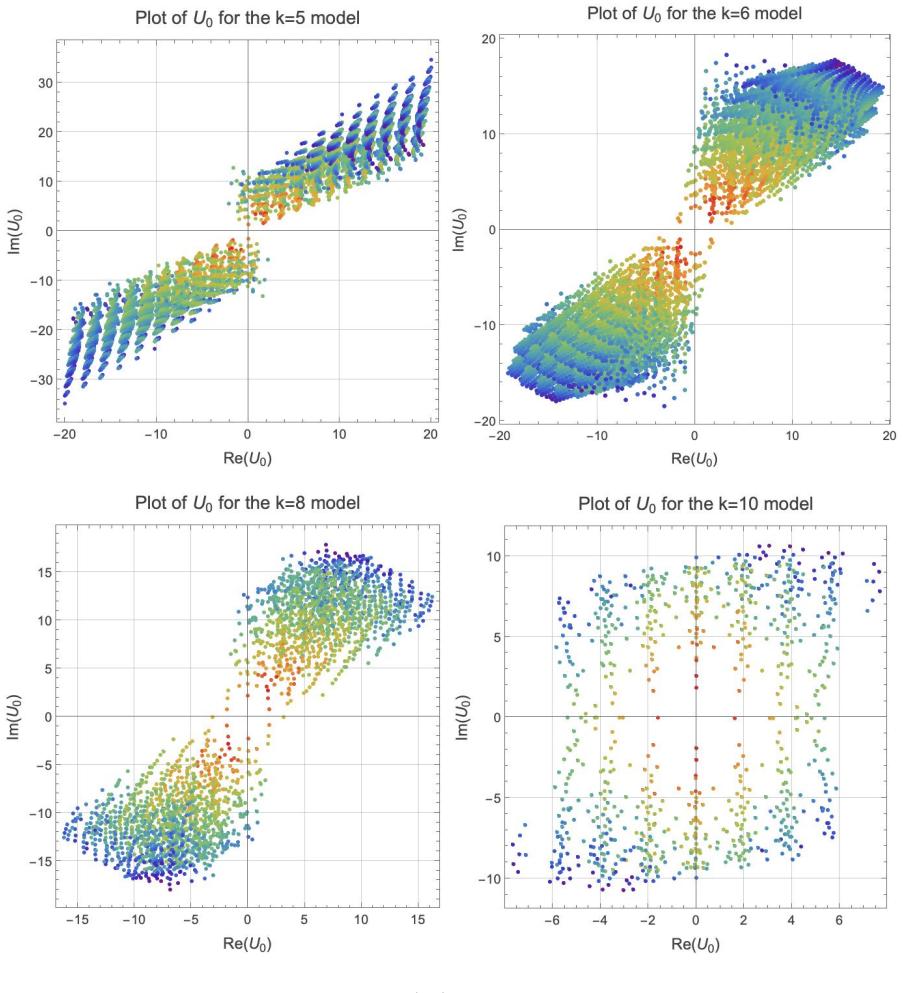
We study heterotic Calabi--Yau compactifications with NSNS three-form flux in view of moduli stabilisation and investigate whether the value $|W_0|$ of the flux superpotential evaluated at supersymmetric minima can be small. Unlike in type IIB string theory, heterotic compactifications lack a no-scale structure, so that a non-vanishing flux superpotential generically induces a tree-level scalar potential for all moduli. Controlled moduli stabilisation therefore requires the flux superpotential to be sufficiently small in order to compete with non-perturbative effects. Working within a four-dimensional effective field theory and exploiting the special geometry of Calabi--Yau complex structure moduli spaces, we analyse the complex structure F-term equations and derive two no-go theorems: (1) supersymmetric vacua with vanishing $|W_0|$, which would lead to a vanishing tree-level scalar potential as in type IIB, occur only at singular loci in moduli space, and (2) no supersymmetric vacua with small $|W_0|$ exist in the large complex structure limit. Motivated by these results, we analyse explicit models away from the large complex structure regime using exact period expressions and identify one- and two-parameter examples in which suitable flux choices allow for values of $|W_0|$ of order unity, with some one-parameter models admitting values moderately below unity. Our findings show that small heterotic flux superpotentials are highly constrained, with the values of $|W_0|$ found in the examples studied being only marginally compatible with moduli stabilisation.
Editorial analysis
A structured set of objections, weighed in public.
Referee Report
Summary. The manuscript derives two no-go theorems for supersymmetric complex-structure minima in heterotic Calabi-Yau compactifications with NSNS flux: (1) vanishing |W0| occurs only at singular loci in moduli space, and (2) no small-|W0| supersymmetric solutions exist in the large complex structure limit. It then constructs explicit one- and two-parameter models away from the LCS regime using exact period integrals, finding flux choices that yield |W0| of order unity (with some one-parameter cases moderately below unity), and concludes that small heterotic flux superpotentials are highly constrained and only marginally compatible with moduli stabilisation.
Significance. If the results hold, they provide concrete constraints on heterotic moduli stabilisation, underscoring the absence of no-scale structure and the resulting need for small |W0| to compete with non-perturbative effects. The explicit use of exact period expressions (rather than approximations) is a clear strength, furnishing falsifiable numerical examples that support the no-go theorems and quantify the limited range of achievable |W0|.
major comments (3)
- [F-term equations and no-go theorems] § on F-term equations and no-go theorems: the second no-go (no small |W0| in LCS limit) relies on the leading terms in the period expansion; it is not immediately clear whether sub-leading corrections in the exact periods could permit parametrically small |W0| while remaining in the LCS regime, which would affect the load-bearing claim that small |W0| is excluded there.
- [Explicit models section] Explicit models section: the chosen fluxes are stated to produce supersymmetric vacua with |W0| ~ O(1), but the manuscript does not report an explicit check of the scalar mass matrix or Hessian at these points to confirm they are genuine minima (as opposed to saddle points) once the full potential including non-perturbative terms is considered.
- [Discussion of 4D EFT validity] Discussion of 4D EFT validity: the central claim of marginal compatibility with moduli stabilisation rests on the assumption that the 4D effective theory and special geometry remain valid for the reported small |W0| values away from LCS; a quantitative estimate of the size of higher-order corrections (e.g., in the Kähler potential or flux-induced terms) would be needed to substantiate this.
minor comments (2)
- [Abstract] The abstract states that some models admit values 'moderately below unity' but does not quote the specific numerical values obtained; adding these numbers would improve clarity.
- [Explicit models] Notation for the periods and flux quanta is introduced without a dedicated table summarising the integer flux choices for each explicit model; a compact table would aid reproducibility.
Simulated Author's Rebuttal
We thank the referee for the careful reading and constructive comments. We address each major point below and indicate planned revisions.
read point-by-point responses
-
Referee: [F-term equations and no-go theorems] § on F-term equations and no-go theorems: the second no-go (no small |W0| in LCS limit) relies on the leading terms in the period expansion; it is not immediately clear whether sub-leading corrections in the exact periods could permit parametrically small |W0| while remaining in the LCS regime, which would affect the load-bearing claim that small |W0| is excluded there.
Authors: In the strict large complex structure limit the moduli are taken large, so that leading polynomial terms in the periods dominate while sub-leading corrections are suppressed by inverse powers of the moduli. These corrections are parametrically small and cannot cancel the leading O(1) piece to produce parametrically small |W0|. The no-go therefore continues to hold inside the LCS regime. We will add a clarifying sentence on this scaling in the revised manuscript. revision: yes
-
Referee: [Explicit models section] Explicit models section: the chosen fluxes are stated to produce supersymmetric vacua with |W0| ~ O(1), but the manuscript does not report an explicit check of the scalar mass matrix or Hessian at these points to confirm they are genuine minima (as opposed to saddle points) once the full potential including non-perturbative terms is considered.
Authors: Our analysis identifies points satisfying the complex-structure F-term equations with |W0| of order unity. We have not computed the full Hessian including non-perturbative Kähler-sector contributions, as this requires additional model-specific choices for gaugino condensation and Kähler moduli stabilization that lie outside the scope of the present work. The reported points are supersymmetric minima in the complex-structure sector at tree level. We will add a remark noting that a complete stability analysis of the full potential is left for future study. revision: yes
-
Referee: [Discussion of 4D EFT validity] Discussion of 4D EFT validity: the central claim of marginal compatibility with moduli stabilisation rests on the assumption that the 4D effective theory and special geometry remain valid for the reported small |W0| values away from LCS; a quantitative estimate of the size of higher-order corrections (e.g., in the Kähler potential or flux-induced terms) would be needed to substantiate this.
Authors: A fully model-independent quantitative bound on higher-order corrections is difficult without fixing the Kähler moduli and the specific Calabi-Yau geometry. In the explicit examples we employ exact periods and remain away from singular loci, so that the special-geometry description remains reliable. We will expand the discussion with a qualitative assessment of the regime of validity based on the distance from the LCS limit. revision: partial
Circularity Check
No significant circularity detected
full rationale
The paper's central results consist of two no-go theorems on supersymmetric complex-structure minima derived directly from the F-term equations via special geometry of Calabi-Yau moduli spaces, plus explicit numerical solutions of one- and two-parameter models using exact period integrals away from the large-complex-structure limit. These steps rely on standard, externally established mathematical structures and direct computation rather than any fitted parameter renamed as a prediction, self-definitional closure, or load-bearing self-citation chain. The conclusion that small |W0| values are constrained follows from these independent derivations without reduction to the paper's own inputs by construction.
Axiom & Free-Parameter Ledger
axioms (2)
- domain assumption The four-dimensional effective theory obtained from heterotic Calabi-Yau compactification with NSNS flux is valid for analyzing supersymmetric minima.
- standard math Special geometry governs the complex-structure moduli space and allows solution of the F-term equations.
Reference graph
Works this paper leans on
-
[1]
Distributions of flux vacua,
F. Denef and M. R. Douglas, “Distributions of flux vacua,”JHEP, vol. 05, p. 072, 2004
2004
-
[2]
Flux compactifications in string theory: A Comprehensive review,
M. Grana, “Flux compactifications in string theory: A Comprehensive review,”Phys. Rept., vol. 423, pp. 91–158, 2006
2006
-
[3]
L. E. Ibanez and A. M. Uranga,String theory and particle physics: An introduction to string phenomenology. Cambridge University Press, 2 2012
2012
-
[4]
Moduli Stabilization in String Theory,
L. McAllister and F. Quevedo, “Moduli Stabilization in String Theory,” 10 2023
2023
-
[5]
Gluino Condensation in Superstring Models,
M. Dine, R. Rohm, N. Seiberg, and E. Witten, “Gluino Condensation in Superstring Models,” Phys. Lett. B, vol. 156, pp. 55–60, 1985
1985
-
[6]
On the Low-Energy d = 4, N=1 Supergravity Theory Extracted from the d = 10, N=1 Superstring,
J. P. Derendinger, L. E. Ibanez, and H. P. Nilles, “On the Low-Energy d = 4, N=1 Supergravity Theory Extracted from the d = 10, N=1 Superstring,”Phys. Lett. B, vol. 155, pp. 65–70, 1985
1985
-
[7]
Nonperturbative Effects on the String World Sheet,
M. Dine, N. Seiberg, X. G. Wen, and E. Witten, “Nonperturbative Effects on the String World Sheet,”Nucl. Phys. B, vol. 278, pp. 769–789, 1986. 21
1986
-
[8]
Nonperturbative Effects on the String World Sheet. 2.,
M. Dine, N. Seiberg, X. G. Wen, and E. Witten, “Nonperturbative Effects on the String World Sheet. 2.,”Nucl. Phys. B, vol. 289, pp. 319–363, 1987
1987
-
[9]
Supersymmetry Breaking From Duality Invariant Gaugino Condensation,
A. Font, L. E. Ibanez, D. Lust, and F. Quevedo, “Supersymmetry Breaking From Duality Invariant Gaugino Condensation,”Phys. Lett. B, vol. 245, pp. 401–408, 1990
1990
-
[10]
Hierarchical Supersymmetry Breaking and Dynamical Determination of Compactification Parameters by Nonperturbative Effects,
J. A. Casas, Z. Lalak, C. Munoz, and G. G. Ross, “Hierarchical Supersymmetry Breaking and Dynamical Determination of Compactification Parameters by Nonperturbative Effects,”Nucl. Phys. B, vol. 347, pp. 243–269, 1990
1990
-
[11]
Duality and supersymmetry breaking in string theory,
S. Ferrara, N. Magnoli, T. R. Taylor, and G. Veneziano, “Duality and supersymmetry breaking in string theory,”Phys. Lett. B, vol. 245, pp. 409–416, 1990
1990
-
[12]
Gaugino Condensation and Duality Invariance,
H. P. Nilles and M. Olechowski, “Gaugino Condensation and Duality Invariance,”Phys. Lett. B, vol. 248, pp. 268–272, 1990
1990
-
[13]
Nonperturbative superpotentials in string theory,
E. Witten, “Nonperturbative superpotentials in string theory,”Nucl. Phys. B, vol. 474, pp. 343– 360, 1996
1996
-
[14]
On the four-dimensional effective action of strongly coupled heterotic string theory,
A. Lukas, B. A. Ovrut, and D. Waldram, “On the four-dimensional effective action of strongly coupled heterotic string theory,”Nucl. Phys. B, vol. 532, pp. 43–82, 1998
1998
-
[15]
World-sheet corrections viaD-instantons.,
E. Witten, “World-sheet corrections viaD-instantons.,”JHEP, vol. 02, p. 030, 2000
2000
-
[16]
CFT’s from Calabi-Yau four folds,
S. Gukov, C. Vafa, and E. Witten, “CFT’s from Calabi-Yau four folds,”Nucl. Phys. B, vol. 584, pp. 69–108, 2000. [Erratum: Nucl.Phys.B 608, 477–478 (2001)]
2000
-
[17]
Hierarchies from fluxes in string compactifica- tions,
S. B. Giddings, S. Kachru, and J. Polchinski, “Hierarchies from fluxes in string compactifica- tions,”Phys. Rev. D, vol. 66, p. 106006, 2002
2002
-
[18]
De Sitter vacua in string theory,
S. Kachru, R. Kallosh, A. D. Linde, and S. P. Trivedi, “De Sitter vacua in string theory,”Phys. Rev. D, vol. 68, p. 046005, 2003
2003
-
[19]
Moduli stabilisation in heterotic string compactifications,
B. de Carlos, S. Gurrieri, A. Lukas, and A. Micu, “Moduli stabilisation in heterotic string compactifications,”JHEP, vol. 03, p. 005, 2006
2006
-
[20]
Systematics of moduli sta- bilisation in Calabi-Yau flux compactifications,
V. Balasubramanian, P. Berglund, J. P. Conlon, and F. Quevedo, “Systematics of moduli sta- bilisation in Calabi-Yau flux compactifications,”JHEP, vol. 03, p. 007, 2005
2005
-
[21]
Large-volume flux compactifications: Moduli spec- trum and D3/D7 soft supersymmetry breaking,
J. P. Conlon, F. Quevedo, and K. Suruliz, “Large-volume flux compactifications: Moduli spec- trum and D3/D7 soft supersymmetry breaking,”JHEP, vol. 08, p. 007, 2005
2005
-
[22]
Superpotentials for vector bundle moduli,
E. I. Buchbinder, R. Donagi, and B. A. Ovrut, “Superpotentials for vector bundle moduli,” Nucl. Phys. B, vol. 653, pp. 400–420, 2003
2003
-
[23]
Vector bundle moduli superpotentials in het- erotic superstrings and M theory,
E. I. Buchbinder, R. Donagi, and B. A. Ovrut, “Vector bundle moduli superpotentials in het- erotic superstrings and M theory,”JHEP, vol. 07, p. 066, 2002
2002
-
[24]
Vacuum stability in heterotic M theory,
E. I. Buchbinder and B. A. Ovrut, “Vacuum stability in heterotic M theory,”Phys. Rev. D, vol. 69, p. 086010, 2004
2004
-
[25]
Heterotic on half-flat,
S. Gurrieri, A. Lukas, and A. Micu, “Heterotic on half-flat,”Phys. Rev. D, vol. 70, p. 126009, 2004
2004
-
[26]
Gaugino condensation in M theory onS 1/Z2,
A. Lukas, B. A. Ovrut, and D. Waldram, “Gaugino condensation in M theory onS 1/Z2,”Phys. Rev. D, vol. 57, pp. 7529–7538, 1998
1998
-
[27]
Flux, gaugino condensation and anti-branes in heterotic M-theory,
J. Gray, A. Lukas, and B. Ovrut, “Flux, gaugino condensation and anti-branes in heterotic M-theory,”Phys. Rev. D, vol. 76, p. 126012, 2007
2007
-
[28]
Worldsheet instantons and torsion curves, part A: Direct computation,
V. Braun, M. Kreuzer, B. A. Ovrut, and E. Scheidegger, “Worldsheet instantons and torsion curves, part A: Direct computation,”JHEP, vol. 10, p. 022, 2007
2007
-
[29]
Worldsheet instantons, torsion curves, and non-perturbative superpotentials,
V. Braun, M. Kreuzer, B. A. Ovrut, and E. Scheidegger, “Worldsheet instantons, torsion curves, and non-perturbative superpotentials,”Phys. Lett. B, vol. 649, pp. 334–341, 2007
2007
-
[30]
Worldsheet Instantons and Torsion Curves, Part B: Mirror Symmetry,
V. Braun, M. Kreuzer, B. A. Ovrut, and E. Scheidegger, “Worldsheet Instantons and Torsion Curves, Part B: Mirror Symmetry,”JHEP, vol. 10, p. 023, 2007. 22
2007
-
[31]
Stabilizing All Geometric Moduli in Heterotic Calabi-Yau Vacua,
L. B. Anderson, J. Gray, A. Lukas, and B. Ovrut, “Stabilizing All Geometric Moduli in Heterotic Calabi-Yau Vacua,”Phys. Rev. D, vol. 83, p. 106011, 2011
2011
-
[32]
Heterotic Moduli Stabilisation,
M. Cicoli, S. de Alwis, and A. Westphal, “Heterotic Moduli Stabilisation,”JHEP, vol. 10, p. 199, 2013
2013
-
[33]
The Heterotic Superpotential and Moduli,
X. de la Ossa, E. Hardy, and E. E. Svanes, “The Heterotic Superpotential and Moduli,”JHEP, vol. 01, p. 049, 2016
2016
-
[34]
Non-vanishing Superpotentials in Heterotic String Theory and Discrete Torsion,
E. I. Buchbinder and B. A. Ovrut, “Non-vanishing Superpotentials in Heterotic String Theory and Discrete Torsion,”JHEP, vol. 01, p. 038, 2017
2017
-
[35]
Heterotic Instanton Superpotentials from Complete Intersection Calabi-Yau Manifolds,
E. Buchbinder, A. Lukas, B. Ovrut, and F. Ruehle, “Heterotic Instanton Superpotentials from Complete Intersection Calabi-Yau Manifolds,”JHEP, vol. 10, p. 032, 2017
2017
-
[36]
Non-vanishing Heterotic Superpotentials on Elliptic Fibrations,
E. I. Buchbinder, L. Lin, and B. A. Ovrut, “Non-vanishing Heterotic Superpotentials on Elliptic Fibrations,”JHEP, vol. 09, p. 111, 2018
2018
-
[37]
Heterotic Instantons for Monad and Extension Bundles,
E. I. Buchbinder, A. Lukas, B. A. Ovrut, and F. Ruehle, “Heterotic Instantons for Monad and Extension Bundles,”JHEP, vol. 02, p. 081, 2020
2020
-
[38]
Instantons and Hilbert Functions,
E. I. Buchbinder, A. Lukas, B. A. Ovrut, and F. Ruehle, “Instantons and Hilbert Functions,” Phys. Rev. D, vol. 102, no. 2, p. 026019, 2020
2020
-
[39]
Vacua with Small Flux Superpotential,
M. Demirtas, M. Kim, L. Mcallister, and J. Moritz, “Vacua with Small Flux Superpotential,” Phys. Rev. Lett., vol. 124, no. 21, p. 211603, 2020
2020
-
[40]
Small cosmological con- stants in string theory,
M. Demirtas, M. Kim, L. McAllister, J. Moritz, and A. Rios-Tascon, “Small cosmological con- stants in string theory,”JHEP, vol. 12, p. 136, 2021
2021
-
[41]
Moduli axions, stabilizing moduli, and the large field swampland conjecture in heterotic M-theory,
C. Deffayet, B. A. Ovrut, and P. J. Steinhardt, “Moduli axions, stabilizing moduli, and the large field swampland conjecture in heterotic M-theory,”Phys. Rev. D, vol. 109, no. 12, p. 126004, 2024
2024
-
[42]
Stable vacua with realistic phenomenology and cosmology in heterotic M-theory satisfying Swampland conjectures,
C. Deffayet, B. A. Ovrut, and P. J. Steinhardt, “Stable vacua with realistic phenomenology and cosmology in heterotic M-theory satisfying Swampland conjectures,”JHEP, vol. 07, p. 288, 2024
2024
-
[43]
Moduli Space of Calabi-Yau Manifolds,
P. Candelas and X. de la Ossa, “Moduli Space of Calabi-Yau Manifolds,”Nucl. Phys. B, vol. 355, pp. 455–481, 1991
1991
-
[44]
A Pair of Calabi-Yau manifolds as an exactly soluble superconformal theory,
P. Candelas, X. C. De La Ossa, P. S. Green, and L. Parkes, “A Pair of Calabi-Yau manifolds as an exactly soluble superconformal theory,”Nucl. Phys. B, vol. 359, pp. 21–74, 1991
1991
-
[45]
New Manifolds for Superstring Compactification,
A. Strominger and E. Witten, “New Manifolds for Superstring Compactification,”Commun. Math. Phys., vol. 101, p. 341, 1985
1985
-
[46]
Considerations of one modulus Calabi-Yau compactifications: Picard-Fuchs equations, Kahler potentials and mirror maps,
A. Klemm and S. Theisen, “Considerations of one modulus Calabi-Yau compactifications: Picard-Fuchs equations, Kahler potentials and mirror maps,”Nucl. Phys. B, vol. 389, pp. 153– 180, 1993
1993
-
[47]
Quark Mass Models and Reinforcement Learning,
T. R. Harvey and A. Lukas, “Quark Mass Models and Reinforcement Learning,”JHEP, vol. 08, p. 161, 2021
2021
-
[48]
Solving inverse problems of Type IIB flux vacua with conditional generative models,
S. Krippendorf and Z. Liu, “Solving inverse problems of Type IIB flux vacua with conditional generative models,” 6 2025
2025
-
[49]
Sampling string vacua using generative models,
M. Walden and M. Larfors, “Sampling string vacua using generative models,”Mach. Learn. Sci. Tech., vol. 7, no. 1, p. 015018, 2026
2026
-
[50]
Heterotic String Model Building with Monad Bundles and Reinforcement Learning,
A. Constantin, T. R. Harvey, and A. Lukas, “Heterotic String Model Building with Monad Bundles and Reinforcement Learning,”Fortsch. Phys., vol. 70, no. 2-3, p. 2100186, 2022
2022
-
[51]
Evolving Heterotic Gauge Backgrounds: Genetic Algorithms versus Reinforcement Learning,
S. Abel, A. Constantin, T. R. Harvey, and A. Lukas, “Evolving Heterotic Gauge Backgrounds: Genetic Algorithms versus Reinforcement Learning,”Fortsch. Phys., vol. 70, no. 5, p. 2200034, 2022. 23
2022
-
[52]
Decoding Nature with Nature’s Tools: Heterotic Line Bundle Models of Particle Physics with Genetic Algorithms and Quantum Anstringnealing,
S. A. Abel, A. Constantin, T. R. Harvey, A. Lukas, and L. A. Nutricati, “Decoding Nature with Nature’s Tools: Heterotic Line Bundle Models of Particle Physics with Genetic Algorithms and Quantum Anstringnealing,”Fortsch. Phys., vol. 72, no. 2, p. 2300260, 2024
2024
-
[53]
Mirror symmetry for two parameter models. 1.,
P. Candelas, X. De La Ossa, A. Font, S. H. Katz, and D. R. Morrison, “Mirror symmetry for two parameter models. 1.,”Nucl. Phys. B, vol. 416, pp. 481–538, 1994
1994
-
[54]
Periods for Calabi-Yau and Landau-Ginzburg vacua,
P. Berglund, P. Candelas, X. De La Ossa, A. Font, T. Hubsch, D. Jancic, and F. Quevedo, “Periods for Calabi-Yau and Landau-Ginzburg vacua,”Nucl. Phys. B, vol. 419, pp. 352–403, 1994
1994
-
[55]
Tables of Calabi–Yau equa- tions,
G. Almkvist, C. van Enckevort, D. van Straten, and W. Zudilin, “Tables of Calabi–Yau equa- tions,” 7 2005. 24
2005
discussion (0)
Sign in with ORCID, Apple, or X to comment. Anyone can read and Pith papers without signing in.