Finite steps optimise dissipation in stochastically controlled quantum systems
Pith reviewed 2026-05-08 17:32 UTC · model grok-4.3
The pith
Weak Gaussian noise in quantum control fields creates a finite optimal number of steps that minimizes average dissipated work and its variance.
A machine-rendered reading of the paper's core claim, the machinery that carries it, and where it could break.
Core claim
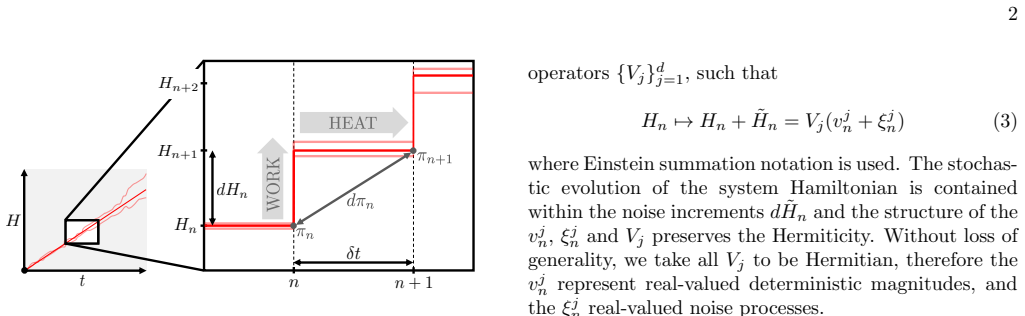
When classical stochastic control is modeled as weak Gaussian noise superimposed on deterministic step-equilibration protocols, the average dissipated work acquires a term linear in the number of steps. This linear growth offsets the usual inverse scaling of deterministic dissipation, so the total dissipated work and its variance both reach minima at a finite, noise-dependent number of steps. The quantum thermodynamic length provides the exact relation that yields the optimal step count and the corresponding minimal values, as illustrated for a strongly coupled qubit undergoing a Landau-Zener sweep and for the erasure of a transverse-field Ising model.
What carries the argument
The quantum thermodynamic length, which geometrically bounds the irreversible work and here isolates the linear noise-induced contribution to dissipation.
If this is right
- A finite, noise-dependent number of steps minimizes both the mean dissipated work and its variance.
- The same optimum applies to step-wise protocols for Landau-Zener transitions in strongly coupled qubits and for erasure of transverse-field Ising models.
- The quantum thermodynamic length directly supplies the expression for the optimal step count once the noise variance is known.
- Dissipation no longer decreases without limit as the number of steps is increased.
Where Pith is reading between the lines
- Control-noise spectra measured in an experiment can be inserted into the thermodynamic-length formula to forecast the best step count before running the protocol.
- The linear-noise scaling suggests that protocols with stronger or non-Gaussian fluctuations will shift the optimum to even fewer steps.
- The same trade-off may appear in any quantum process where control imperfections accumulate additively with each discrete operation.
Load-bearing premise
The stochastic control fields can be treated as weak Gaussian perturbations on deterministic protocols without generating strong-noise or non-Markovian corrections that would change how dissipation is quantified.
What would settle it
Measure the average dissipated work versus number of steps in a controlled Landau-Zener sweep of a qubit under calibrated weak Gaussian control noise; the curve should exhibit a minimum at the predicted finite step count rather than continuing to fall.
Figures


read the original abstract
Motivated by the need for precise, energy-efficient, and experimentally realistic quantum control protocols, we investigate the thermodynamic cost of performing quantum step-equilibration processes under the influence of classical stochastic control fields. Whereas purely deterministic protocols exhibit dissipation that scales inversely with the number of steps, we show that weak Gaussian noise in the control variables induces dissipative contributions that grow linearly with the number of steps. Consequently, we derive the finite optimal number of steps and minimal achievable average dissipated work and its variance using the quantum thermodynamic length. These results are demonstrated using two paradigmatic examples: a Landau-Zener sweep of a qubit strongly coupled to a thermal bath and the erasure of a transverse-field Ising model.
Editorial analysis
A structured set of objections, weighed in public.
Referee Report
Summary. The manuscript examines the thermodynamic cost of quantum step-equilibration under classical stochastic control. It claims that deterministic protocols dissipate energy scaling as 1/N while weak Gaussian noise in the controls adds a term linear in N; balancing these via the quantum thermodynamic length yields a finite optimal step count that minimizes average dissipated work and its variance. The results are illustrated on a Landau-Zener qubit sweep strongly coupled to a bath and on erasure of a transverse-field Ising model.
Significance. If the weak-noise derivation and applicability of the thermodynamic length hold, the work supplies a concrete, experimentally relevant prescription for choosing finite step numbers in noisy quantum control to minimize dissipation. It usefully extends geometric quantum thermodynamics to stochastic settings and supplies two paradigmatic examples. The explicit use of the thermodynamic length to bound both mean and variance of dissipated work is a methodological strength.
major comments (2)
- [Landau-Zener example] Landau-Zener section: the qubit is stated to be strongly coupled to the thermal bath, yet the central derivation treats control fluctuations as weak Gaussian noise superimposed on a deterministic protocol without additional corrections. This risks violating the perturbative or Markovian conditions underlying the quantum thermodynamic length, which could make the linear-in-N coefficient itself N-dependent or introduce cross terms not captured by the geometric approach.
- [Main derivation (thermodynamic length application)] Derivation of optimal N and minimal work: the abstract asserts that noise induces dissipative contributions linear in step count N that balance the deterministic 1/N scaling, but the manuscript provides no explicit equations, error analysis, or validation details for how the minimal average work and variance are obtained from the length metric. The central claim therefore rests on unshown steps whose validity cannot be checked from the given material.
minor comments (2)
- [Abstract] Abstract: the claim that the optimal step count and minimal work are 'derived' would be clearer if the explicit dependence on noise strength or the thermodynamic length were indicated, even at the level of a scaling relation.
- [Introduction / Methods] Notation: the distinction between the deterministic protocol and the stochastic control field should be introduced with a single consistent symbol set early in the text to avoid later ambiguity when the linear noise term is added.
Simulated Author's Rebuttal
We thank the referee for the detailed and constructive report on our manuscript. We address the major comments point by point below, providing clarifications and indicating planned revisions where appropriate.
read point-by-point responses
-
Referee: [Landau-Zener example] Landau-Zener section: the qubit is stated to be strongly coupled to the thermal bath, yet the central derivation treats control fluctuations as weak Gaussian noise superimposed on a deterministic protocol without additional corrections. This risks violating the perturbative or Markovian conditions underlying the quantum thermodynamic length, which could make the linear-in-N coefficient itself N-dependent or introduce cross terms not captured by the geometric approach.
Authors: We acknowledge the referee's valid point about potential inconsistencies in the assumptions for the Landau-Zener example. The strong coupling refers to the system-bath interaction, which is treated using a suitable open quantum system formalism that remains valid under the Markovian approximation for the bath. The weak Gaussian noise is an additional classical stochastic component in the control fields, assumed to be small enough that it does not invalidate the underlying geometric framework or introduce significant N-dependent corrections to the linear coefficient. To strengthen the manuscript, we will include a brief discussion of the validity conditions and why cross terms are negligible in the revised version. revision: partial
-
Referee: [Main derivation (thermodynamic length application)] Derivation of optimal N and minimal work: the abstract asserts that noise induces dissipative contributions linear in step count N that balance the deterministic 1/N scaling, but the manuscript provides no explicit equations, error analysis, or validation details for how the minimal average work and variance are obtained from the length metric. The central claim therefore rests on unshown steps whose validity cannot be checked from the given material.
Authors: We apologize for the lack of explicitness in presenting the derivation of the optimal step count and minimal dissipated work. In the manuscript, the total average dissipated work is expressed as the sum of the deterministic contribution, which scales as the square of the thermodynamic length divided by the total time (hence 1/N for fixed total time), and the stochastic contribution linear in N arising from the integrated noise variance along the path. The minimum is found by differentiation, yielding N_opt proportional to the length, and the minimal value is twice the geometric mean of the two coefficients. Similarly for the variance. We will expand this section with all intermediate equations, error bounds, and additional validation plots in the revision to ensure the steps are fully transparent and verifiable. revision: yes
Circularity Check
No circularity: optimal step count derived by balancing independent scalings against external thermodynamic length metric
full rationale
The paper's central result balances the known 1/N decay of deterministic dissipation against a linear-in-N term induced by weak Gaussian control noise, then minimizes the sum to obtain finite optimal N and minimal work using the quantum thermodynamic length as an input quantity. This length is invoked as a pre-existing geometric tool from the literature rather than fitted or redefined inside the derivation; the linear noise contribution is obtained from a perturbative stochastic analysis that does not presuppose the final optimum. No self-definitional equations, fitted parameters relabeled as predictions, or load-bearing self-citations that reduce the claim to its own inputs appear in the described chain. The derivation therefore remains non-circular and externally anchored.
Axiom & Free-Parameter Ledger
axioms (2)
- domain assumption Quantum thermodynamic length quantifies dissipation in step-equilibration processes
- domain assumption Control fields can be decomposed into deterministic protocol plus weak additive Gaussian noise
Reference graph
Works this paper leans on
-
[1]
the most energy efficient protocols are the slowest
Parameter values are identical to those in Fig. 2. numeric calculations and to have a minimum ofW opt at optimal durationN opt. We are primarily interested in the effects of changing temperature and noise strength on Nopt andW opt. (In Appendix C we find thatN opt and Wopt are largely independent ofL, beyondL >4). We keepJ= 1, and define other energy-rela...
-
[2]
Seifert, Stochastic thermodynamics, fluctuation the- orems and molecular machines, Rep
U. Seifert, Stochastic thermodynamics, fluctuation the- orems and molecular machines, Rep. Prog. Phys.75, 126001 (2012)
2012
-
[3]
Binder, L
F. Binder, L. A. Correa, C. Gogolin, J. Anders, and G. Adesso, eds.,Thermodynamics in the Quantum 6 Regime: Fundamental Aspects and New Directions, Vol. 195 (Springer, 2018)
2018
-
[4]
Campbell, I
S. Campbell, I. d’Amico, M. A. Ciampini, J. Anders, N. Ares, S. Artini, A. Auff` eves, L. Bassman Oftelie, L. P. Bettmann, M. V. Bonan¸ ca,et al., Roadmap on quan- tum thermodynamics, Quantum Sci. Technol.11, 012501 (2026)
2026
-
[5]
Cavina, A
V. Cavina, A. Mari, A. Carlini, and V. Giovannetti, Op- timal thermodynamic control in open quantum systems, Phys. Rev. A98, 012139 (2018)
2018
-
[6]
Abiuso, H
P. Abiuso, H. J. Miller, M. Perarnau-Llobet, and M. Scandi, Geometric optimisation of quantum thermo- dynamic processes, Entropy22, 1076 (2020)
2020
-
[7]
Abiuso and M
P. Abiuso and M. Perarnau-Llobet, Optimal cycles for low-dissipation heat engines, Phys. Rev. Lett.124, 110606 (2020)
2020
-
[8]
Brandner and K
K. Brandner and K. Saito, Thermodynamic geometry of microscopic heat engines, Phys. Rev. Lett.124, 040602 (2020)
2020
-
[9]
P. A. Erdman, A. Rolandi, P. Abiuso, M. Perarnau- Llobet, and F. No´ e, Pareto-optimal cycles for power, effi- ciency and fluctuations of quantum heat engines using re- inforcement learning, Phys. Rev. Res.5, L022017 (2023)
2023
-
[10]
Van Vu and Y
T. Van Vu and Y. Hasegawa, Geometrical bounds of the irreversibility in markovian systems, Phys. Rev. Lett. 126, 010601 (2021)
2021
-
[11]
Van Vu and K
T. Van Vu and K. Saito, Thermodynamic unification of optimal transport: Thermodynamic uncertainty relation, minimum dissipation, and thermodynamic speed limits, Phys. Rev. X13, 011013 (2023)
2023
-
[12]
P. R. Zulkowski and M. R. DeWeese, Optimal protocols for slowly driven quantum systems, Phys. Rev. E92, 032113 (2015)
2015
-
[13]
A. A. Clerk, M. H. Devoret, S. M. Girvin, F. Marquardt, and R. J. Schoelkopf, Introduction to quantum noise, measurement, and amplification, Rev. Mod. Phys.82, 1155 (2010)
2010
-
[14]
H. M. Wiseman and G. J. Milburn,Quantum Measure- ment and Control(Cambridge University Press, 2009)
2009
-
[15]
J. Koch, T. M. Yu, J. Gambetta, A. A. Houck, D. I. Schuster, J. Majer, A. Blais, M. H. Devoret, S. M. Girvin, and R. J. Schoelkopf, Charge-insensitive qubit design de- rived from the cooper pair box, Phys. Rev. A76, 042319 (2007)
2007
-
[16]
Krantz, M
P. Krantz, M. Kjaergaard, F. Yan, T. P. Orlando, S. Gus- tavsson, and W. D. Oliver, A quantum engineer’s guide to superconducting qubits, Appl. Phys. Rev.6, 021318 (2019)
2019
-
[17]
J. T. Barreiro, M. M¨ uller, P. Schindler, D. Nigg, T. Monz, M. Chwalla, M. Hennrich, C. F. Roos, P. Zoller, and R. Blatt, An open-system quantum simulator with trapped ions, Nature470, 486 (2011)
2011
-
[18]
J. P. Home, D. Hanneke, J. D. Jost, J. M. Amini, D. Leibfried, and D. J. Wineland, Complete methods set for scalable ion trap quantum information process- ing, Science325, 1227 (2009)
2009
-
[19]
Z. X. Koong, U. Haeusler, J. M. Kaspari, C. Schimpf, B. Dejen, A. M. Hassanen, D. Graham, A. J. G. Jr., M. Peter, E. Clarke, M. Hugues, A. Rastelli, D. E. Re- iter, M. Atat¨ ure, and D. A. Gangloff, Coherent control of quantum-dot spins with cyclic optical transitions (2025), arXiv:2509.14445 [quant-ph]
-
[20]
C. J. Myatt, B. E. King, Q. A. Turchette, C. A. Sackett, D. Kielpinski, W. M. Itano, C. Monroe, and D. J. Wineland, Decoherence of quantum superpositions through coupling to engineered reservoirs, Nature403, 269 (2000)
2000
-
[21]
Gu´ ery-Odelin, C
D. Gu´ ery-Odelin, C. Jarzynski, C. A. Plata, A. Prados, and E. Trizac, Driving rapidly while remaining in con- trol: classical shortcuts from hamiltonian to stochastic dynamics, Rep. Prog. Phys.86, 035902 (2023)
2023
-
[22]
Y. Chen, T. T. Georgiou, and A. Tannenbaum, Stochas- tic control and nonequilibrium thermodynamics: Funda- mental limits, IEEE Trans. Autom. Control.65, 2979 (2020)
2020
-
[23]
Neri, Thermodynamic cost of random-time protocols, Phys
I. Neri, Thermodynamic cost of random-time protocols, Phys. Rev. E112, 044114 (2025)
2025
-
[24]
B. B. Machta, Dissipation bound for thermodynamic con- trol, Phys. Rev. Lett.115, 260603 (2015)
2015
-
[25]
S. J. Large, R. Chetrite, and D. A. Sivak, Stochastic con- trol in microscopic nonequilibrium systems, EPL124, 20001 (2018)
2018
-
[26]
S. J. Bryant and B. B. Machta, Energy dissipation bounds for autonomous thermodynamic cycles, PNAS 117, 3478 (2020)
2020
-
[27]
G. E. Crooks, Measuring thermodynamic length, Phys. Rev. Lett.99, 100602 (2007)
2007
-
[28]
D. A. Sivak and G. E. Crooks, Thermodynamic metrics and optimal paths, Phys. Rev. Lett.108, 190602 (2012)
2012
-
[29]
Meinert, M
F. Meinert, M. J. Mark, E. Kirilov, K. Lauber, P. Wein- mann, A. J. Daley, and H.-C. N¨ agerl, Quantum quench in an atomic one-dimensional ising chain, Phys. Rev. Lett. 111, 053003 (2013)
2013
-
[30]
Guardado-Sanchez, P
E. Guardado-Sanchez, P. T. Brown, D. Mitra, T. De- vakul, D. A. Huse, P. Schauß, and W. S. Bakr, Probing the quench dynamics of antiferromagnetic correlations in a 2d quantum ising spin system, Phys. Rev. X8, 021069 (2018)
2018
-
[31]
Jurcevic, B
P. Jurcevic, B. P. Lanyon, P. Hauke, C. Hempel, P. Zoller, R. Blatt, and C. F. Roos, Quasiparticle engineering and entanglement propagation in a quantum many-body sys- tem, Nature511, 202 (2014)
2014
-
[32]
X.-Y. Guo, C. Yang, Y. Zeng, Y. Peng, H.-K. Li, H. Deng, Y.-R. Jin, S. Chen, D. Zheng, and H. Fan, Observation of a dynamical quantum phase transition by a supercon- ducting qubit simulation, Phys. Rev. Appl.11, 044080 (2019)
2019
-
[33]
Anders and V
J. Anders and V. Giovannetti, Thermodynamics of dis- crete quantum processes, New J. Phys.15, 033022 (2013)
2013
-
[34]
Gallego, A
R. Gallego, A. Riera, and J. Eisert, Thermal machines be- yond the weak coupling regime, New J. Phys.16, 125009 (2014)
2014
-
[35]
B¨ aumer, M
E. B¨ aumer, M. Perarnau-Llobet, P. Kammerlander, H. Wilming, and R. Renner, Imperfect Thermalizations Allow for Optimal Thermodynamic Processes, Quantum 3, 153 (2019)
2019
-
[36]
H. J. D. Miller and M. Mehboudi, Geometry of work fluctuations versus efficiency in microscopic thermal ma- chines, Phys. Rev. Lett.125, 260602 (2020)
2020
-
[37]
Esposito, U
M. Esposito, U. Harbola, and S. Mukamel, Nonequilib- rium fluctuations, fluctuation theorems, and counting statistics in quantum systems, Rev. Mod. Phys.81, 1665 (2009)
2009
-
[38]
Scandi, H
M. Scandi, H. J. D. Miller, J. Anders, and M. Perarnau- Llobet, Quantum work statistics close to equilibrium, Phys. Rev. Res.2, 023377 (2020)
2020
-
[39]
H. J. D. Miller, M. Scandi, J. Anders, and M. Perarnau- 7 Llobet, Work fluctuations in slow processes: Quantum signatures and optimal control, Phys. Rev. Lett.123, 230603 (2019)
2019
-
[40]
Nulton, P
J. Nulton, P. Salamon, B. Andresen, and Q. Anmin, Qua- sistatic processes as step equilibrations, J. Chem. Phys. 83, 334 (1985)
1985
-
[41]
J. M. Parrondo, J. M. Horowitz, and T. Sagawa, Ther- modynamics of information, Nat. Phys.11, 131 (2015)
2015
-
[42]
Scandi and M
M. Scandi and M. Perarnau-Llobet, Thermodynamic length in open quantum systems, Quantum3, 197 (2019)
2019
-
[43]
A. A. Budini, Quantum systems subject to the action of classical stochastic fields, Phys. Rev. A64, 052110 (2001)
2001
-
[44]
Nazir, Correlation-dependent coherent to incoherent transitions in resonant energy transfer dynamics, Phys
A. Nazir, Correlation-dependent coherent to incoherent transitions in resonant energy transfer dynamics, Phys. Rev. Lett.103, 146404 (2009)
2009
-
[45]
Jang, Y.-C
S. Jang, Y.-C. Cheng, D. R. Reichman, and J. D. Eaves, Theory of coherent resonance energy transfer, J. Chemi. Phys.129, 101104 (2008)
2008
-
[46]
D. P. S. McCutcheon and A. Nazir, Consistent treatment of coherent and incoherent energy transfer dynamics us- ing a variational master equation, J. Chem. Phys.135, 114501 (2011)
2011
-
[47]
O. Diba, H. J. D. Miller, J. Iles-Smith, and A. Nazir, Quantum work statistics at strong reservoir coupling, Phys. Rev. Lett.132, 190401 (2024)
2024
-
[48]
Suba¸ si, C
Y. Suba¸ si, C. H. Fleming, J. M. Taylor, and B. L. Hu, Equilibrium states of open quantum systems in the strong coupling regime, Phys. Rev. E86, 061132 (2012)
2012
-
[49]
A. S. Trushechkin, M. Merkli, J. D. Cresser, and J. An- ders, Open quantum system dynamics and the mean force gibbs state, AVS Quantum Science4, 012301 (2022)
2022
-
[50]
J. D. Cresser and J. Anders, Weak and ultrastrong cou- pling limits of the quantum mean force gibbs state, Phys. Rev. Lett.127, 250601 (2021)
2021
-
[51]
Nazir and D
A. Nazir and D. P. S. McCutcheon, Modelling exciton– phonon interactions in optically driven quantum dots, J. Phys. Condens. Matter28, 103002 (2016)
2016
-
[52]
N. G. Van Kampen,Stochastic processes in physics and chemistry, 3rd ed. (Elsevier, 2007)
2007
-
[53]
Pfeuty, The one-dimensional ising model with a trans- verse field, Ann
P. Pfeuty, The one-dimensional ising model with a trans- verse field, Ann. Phys. (N. Y.)57, 79 (1970)
1970
-
[54]
Sachdev,Quantum Phase Transitions, 2nd ed
S. Sachdev,Quantum Phase Transitions, 2nd ed. (Cam- bridge University Press, 2011)
2011
-
[55]
Borish, O
V. Borish, O. Markovi´ c, J. A. Hines, S. V. Rajagopal, and M. Schleier-Smith, Transverse-field ising dynamics in a rydberg-dressed atomic gas, Phys. Rev. Lett.124, 063601 (2020)
2020
-
[56]
Scholl, M
P. Scholl, M. Schuler, H. J. Williams, A. A. Eberharter, D. Barredo, K.-N. Schymik, V. Lienhard, L.-P. Henry, T. C. Lang, T. Lahaye, A. M. L¨ auchli, and A. Browaeys, Quantum simulation of 2d antiferromagnets with hun- dreds of rydberg atoms, Nature595, 233 (2021)
2021
-
[57]
I. Layton and H. J. D. Miller, Restoring the second law to classical-quantum dynamics (2025), arXiv:2504.10587 [quant-ph]
-
[58]
Eglinton, F
J. Eglinton, F. Carollo, I. Lesanovsky, and K. Brand- ner, Stochastic thermodynamics at the quantum-classical boundary: A self-consistent framework based on adiabatic-response theory, Quantum8, 1486 (2024)
2024
-
[59]
T. McKeeever, Data for: Finite steps optimise dis- sipation in stochastically controlled quantum systems, 10.48420/c.8430816 (2026)
-
[60]
Scandi,Quantifying dissipation via thermody- namic length, Ph.D
M. Scandi,Quantifying dissipation via thermody- namic length, Ph.D. thesis, master’s thesis, Ludwig- Maximilians-Universit¨ at M¨ unchen and Technische (2018)
2018
-
[61]
Hiai and D
F. Hiai and D. Petz,Introduction to matrix analysis and applications(Springer Science & Business Media, 2014)
2014
-
[62]
B. C. Levy, Wiener process and white gaussian noise, inRandom Processes with Applications to Circuits and Communications(Springer, Cham, 2020) pp. 207–234
2020
-
[63]
R. H. Shumway and D. S. Stoffer,Time Series Analysis and Its Applications, 5th ed. (Springer, 2025)
2025
-
[64]
Jordan and E
P. Jordan and E. Wigner, ¨Uber das paulische ¨ aquivalen- zverbot, Z. Phys.47, 631 (1928)
1928
-
[65]
He and H
Y. He and H. Guo, The boundary effects of transverse field ising model, J. Stat. Mech.: Theory Exp.2017(9), 093101
2017
-
[66]
Nambu, Quasi-particles and gauge invariance in the theory of superconductivity, Phys
Y. Nambu, Quasi-particles and gauge invariance in the theory of superconductivity, Phys. Rev.117, 648 (1960)
1960
-
[67]
Talkner, E
P. Talkner, E. Lutz, and P. H¨ anggi, Fluctuation theo- rems: Work is not an observable, Phys. Rev. E75, 050102 (2007)
2007
-
[68]
Deffner, J
S. Deffner, J. P. Paz, and W. H. Zurek, Quantum work and the thermodynamic cost of quantum measurements, Phys. Rev. E94, 010103 (2016)
2016
-
[69]
Kammerlander and J
P. Kammerlander and J. Anders, Coherence and mea- surement in quantum thermodynamics, Sci. Rep.6, 22174 (2016)
2016
-
[70]
V. B. Braginsky, Y. I. Vorontsov, and K. S. Thorne, Quantum nondemolition measurements, Science209, 547 (1980)
1980
-
[71]
Blais, R.-S
A. Blais, R.-S. Huang, A. Wallraff, S. M. Girvin, and R. J. Schoelkopf, Cavity quantum electrodynamics for superconducting electrical circuits: An architecture for quantum computation, Phys. Rev. A69, 062320 (2004)
2004
-
[72]
Gambetta, W
J. Gambetta, W. A. Braff, A. Wallraff, S. M. Girvin, and R. J. Schoelkopf, Quantum trajectory approach to circuit qed: Quantum jumps and the zeno effect, Phys. Rev. A 77, 012112 (2008)
2008
-
[73]
Bianchetti, S
R. Bianchetti, S. Filipp, M. Baur, J. M. Fink, M. G¨ oppl, P. J. Leek, L. Steffen, A. Blais, and A. Wallraff, Dynam- ics of dispersive single-qubit readout in circuit quantum electrodynamics, Phys. Rev. A80, 043840 (2009). 8 Appendix A: Noise expansions In this appendix, we start from the established deterministic expression forW diss [37] (which underpin...
2009
discussion (0)
Sign in with ORCID, Apple, or X to comment. Anyone can read and Pith papers without signing in.