Perturbations and greybody bounds of Euler-Heisenberg black holes surrounded by perfect fluid dark matter
Pith reviewed 2026-05-08 15:56 UTC · model grok-4.3
The pith
The Euler-Heisenberg and perfect fluid dark matter parameters deform effective potentials for scalar, electromagnetic and Dirac perturbations around black holes, altering greybody factors and absorption spectra.
A machine-rendered reading of the paper's core claim, the machinery that carries it, and where it could break.
Core claim
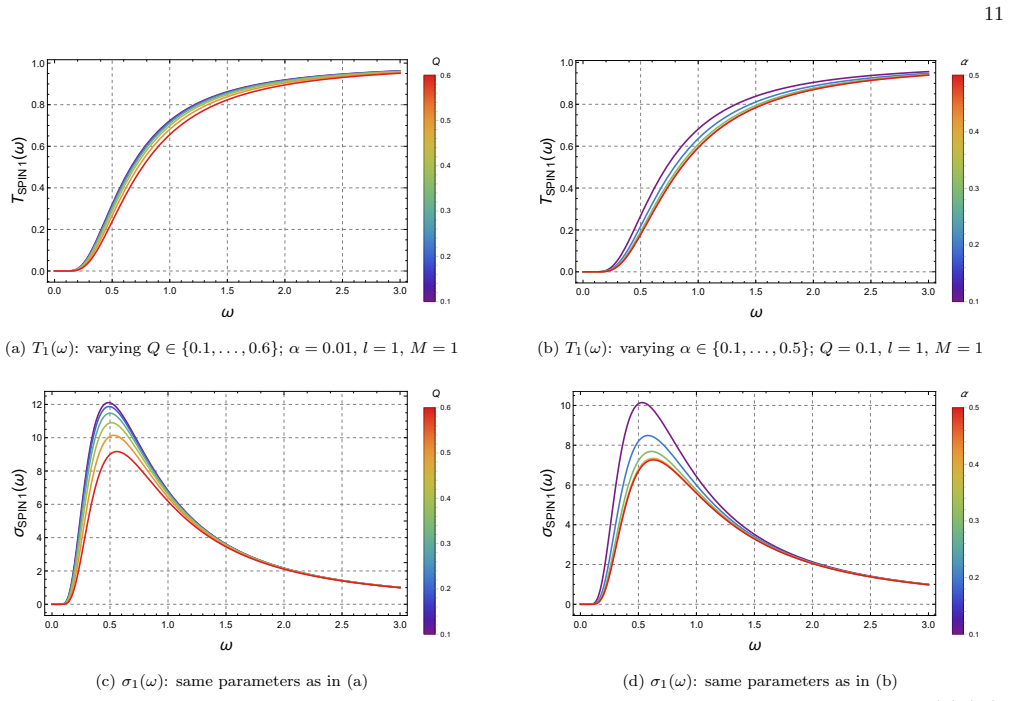
The combined Euler-Heisenberg and perfect fluid dark matter background deforms the effective potential barriers for massless fields of spins 0, 1 and 1/2. The Boonserm-Visser lower bounds on the greybody factors increase monotonically with frequency and approach the geometric-optics limit at high frequency, while their low-frequency values depend on the spin and on the values of the nonlinear electrodynamic and dark matter parameters. The resulting absorption cross sections and energy emission rates differ from those of the Schwarzschild, Reissner-Nordström and pure Euler-Heisenberg limits.
What carries the argument
The spin-dependent effective potential appearing in the Schrödinger-like radial wave equation, constructed from the Euler-Heisenberg plus perfect fluid dark matter metric and used to compute Boonserm-Visser greybody lower bounds.
If this is right
- Greybody lower bounds rise steadily with frequency and reach the high-frequency geometric-optics limit.
- Low-frequency transmission depends strongly on field spin and on the nonlinear electrodynamic and dark matter parameters.
- Partial absorption cross sections and energy emission rates can be computed directly from the greybody lower bounds.
- The combined background produces scattering signatures distinguishable from Schwarzschild, Reissner-Nordström and pure Euler-Heisenberg black holes.
Where Pith is reading between the lines
- Astrophysical measurements of Hawking spectra or scattering could in principle constrain the size of the nonlinear electrodynamic and dark matter parameters.
- The same effective-potential construction could be applied to other nonlinear electrodynamic theories or to different dark matter profiles to test robustness.
- If the deformations are large, they may also shift quasinormal-mode frequencies, offering a second independent observable.
Load-bearing premise
The given metric is an exact solution of the Einstein equations coupled to nonlinear electrodynamics and perfect fluid dark matter, so that linear perturbation theory applies without significant back-reaction.
What would settle it
Numerical integration of the exact radial wave equations for chosen values of the Euler-Heisenberg and dark matter parameters that either violates the reported monotonic increase of the greybody lower bounds or shows no deformation relative to the pure Euler-Heisenberg case.
Figures




read the original abstract
We investigate the propagation of massless fields with spins $s=0$, $s=1$, and $s=1/2$ in the spacetime of an Euler-Heisenberg (EH) black hole surrounded by perfect fluid dark matter (PFDM). This background incorporates both the nonlinear electrodynamic correction associated with the EH effective theory and the logarithmic contribution induced by the surrounding dark matter distribution. After deriving the corresponding Schr\"odinger-like radial equations, we construct the effective potentials for scalar, electromagnetic, and Dirac perturbations and analyze how they are modified by the black hole charge, the EH parameter, and the PFDM parameter. The greybody factors are estimated through the rigorous Boonserm-Visser lower-bound method, and the associated partial absorption cross sections are obtained for different spin sectors using these bounds. Our results show that the nonlinear electrodynamic and dark matter parameters significantly deform the effective potential barrier, leading to potentially distinguishable changes in the transmission probabilities and absorption spectra within the model. In particular, the greybody lower bounds increase monotonically with the frequency and approach the high-frequency limit, while their low-frequency behavior is strongly affected by the geometry and by the spin of the perturbing field. Moreover, we utilize the greybody lower bound to calculate the energy emission rate. Finally, we make comparisons with the Schwarzschild, Reissner-Nordstr\"om, and pure EH limits, showing that the combined EH+PFDM background produces distinguishable corrections to black-hole scattering within the model. These results highlight greybody bounds as sensitive diagnostic probes of nonlinear electrodynamic effects and dark matter halos around compact objects.
Editorial analysis
A structured set of objections, weighed in public.
Referee Report
Summary. The manuscript examines the propagation of scalar (s=0), electromagnetic (s=1), and Dirac (s=1/2) fields in the spacetime of an Euler-Heisenberg black hole surrounded by perfect fluid dark matter. It derives the Schrödinger-like radial wave equations and effective potentials for these perturbations, applies the Boonserm-Visser method to obtain lower bounds on the greybody factors, computes the corresponding absorption cross sections, and analyzes the energy emission rates. The effects of the black hole charge, the Euler-Heisenberg parameter, and the PFDM parameter are studied, with comparisons to the Schwarzschild, Reissner-Nordström, and pure Euler-Heisenberg cases.
Significance. Provided the assumed metric is a valid exact solution to the Einstein equations with the specified sources, this work offers a detailed investigation into how nonlinear electrodynamics and dark matter halos modify black hole perturbation spectra and scattering properties. The use of rigorous lower bounds on greybody factors and the systematic comparison across spin sectors and parameter regimes could serve as a useful reference for exploring observational signatures in modified black hole models.
major comments (1)
- [Section 2] Section 2 (metric ansatz): The line element incorporating the Euler-Heisenberg nonlinear correction and the logarithmic PFDM term is introduced without an explicit verification that it satisfies the Einstein equations G_μν = 8π(T_μν^EH + T_μν^PFDM). This verification (e.g., by direct computation of the Einstein tensor components and matching to the combined stress-energy tensors) is load-bearing, as all subsequent effective potentials, Boonserm-Visser integrals, greybody bounds, and absorption cross sections rest on the background being an exact solution.
minor comments (2)
- [Abstract] Abstract: The description of the PFDM contribution as 'logarithmic' is clear, but a one-sentence statement of the explicit metric function f(r) (including the definitions of the EH parameter and PFDM parameter) would make the setup immediately accessible without requiring the reader to reach Section 2.
- [Figures] Figures (e.g., effective potential plots): The curves for different parameter values are informative, but adding a panel or inset showing the high-frequency asymptotic behavior of the greybody bounds (to confirm they approach the geometric-optics limit) would strengthen the visual evidence for the monotonicity claim.
Simulated Author's Rebuttal
We thank the referee for their detailed review and for highlighting the importance of verifying the background metric. We address the single major comment below and will incorporate the requested verification in the revised manuscript.
read point-by-point responses
-
Referee: [Section 2] Section 2 (metric ansatz): The line element incorporating the Euler-Heisenberg nonlinear correction and the logarithmic PFDM term is introduced without an explicit verification that it satisfies the Einstein equations G_μν = 8π(T_μν^EH + T_μν^PFDM). This verification (e.g., by direct computation of the Einstein tensor components and matching to the combined stress-energy tensors) is load-bearing, as all subsequent effective potentials, Boonserm-Visser integrals, greybody bounds, and absorption cross sections rest on the background being an exact solution.
Authors: We agree that an explicit verification is essential for rigor. Although the metric is constructed from the standard Euler-Heisenberg Lagrangian coupled to a perfect-fluid dark-matter source (as introduced in prior literature), the manuscript does not contain the direct computation. In the revised version we will add, in Section 2, the non-vanishing components of the Einstein tensor for the given line element and demonstrate their equality to 8π(T_EH + T_PFDM), thereby confirming that the spacetime is an exact solution. This addition will be placed immediately after the metric ansatz and before the derivation of the effective potentials. revision: yes
Circularity Check
No circularity: derivation proceeds from assumed metric via standard perturbation and bound techniques
full rationale
The paper starts from a given line element incorporating EH and PFDM parameters, derives the radial Schrödinger-like equations and effective potentials explicitly, then applies the independent Boonserm-Visser integral lower-bound method to obtain greybody factors and absorption cross-sections. No step equates a derived quantity to a fitted parameter by construction, no load-bearing uniqueness theorem is imported via self-citation, and the Boonserm-Visser bounds are computed directly from the potentials without statistical fitting or renaming of known results. The central claim of distinguishable deformations follows from the explicit parameter dependence in the potentials and is not forced by the paper's own equations.
Axiom & Free-Parameter Ledger
free parameters (2)
- Euler-Heisenberg parameter
- PFDM parameter
axioms (2)
- domain assumption The background metric combining Euler-Heisenberg nonlinear electrodynamics with a perfect fluid dark matter halo satisfies the Einstein field equations.
- domain assumption Linear perturbation theory for massless fields of spins 0, 1, and 1/2 is sufficient and back-reaction can be neglected.
invented entities (1)
-
Perfect fluid dark matter halo
no independent evidence
Forward citations
Cited by 2 Pith papers
-
Quasinormal modes of massless scalar and electromagnetic perturbations for Euler-Heisenberg black holes surrounded by perfect fluid dark matter
Quasinormal frequencies and greybody factors for massless scalar and electromagnetic perturbations in Euler-Heisenberg black holes with perfect fluid dark matter are calculated via AIM and sixth-order WKB, showing tha...
-
Quasinormal modes of massless scalar and electromagnetic perturbations for Euler-Heisenberg black holes surrounded by perfect fluid dark matter
Quasinormal frequencies and greybody factors for massless scalar and electromagnetic perturbations are calculated for charged Euler-Heisenberg black holes surrounded by perfect fluid dark matter, showing that charge Q...
Reference graph
Works this paper leans on
-
[1]
=±(l+ 1) is the Dirac angular quantum number introduced in Section III. In Fig. 5, the greybody lower bound for the fermionic fieldT spin 1/2(ω) is depicted and again shows an increasing function of the frequency, but it remains above the scalar and vector curves for the same choice of parameters. This indicates that spin-1/2 particles cross the effective...
work page 2025
-
[2]
T. Regge and J. A. Wheeler, Stability of a schwarzschild singularity, Phys. Rev.108, 1063 (1957)
work page 1957
-
[3]
F. J. Zerilli, Effective potential for even-parity regge- wheeler gravitational perturbation equations, Phys. Rev. Lett.24, 737 (1970)
work page 1970
-
[4]
C. V. Vishveshwara, Scattering of gravitational radiation by a schwarzschild black-hole, Nature227, 936 (1970)
work page 1970
-
[5]
S. A. Teukolsky, Perturbations of a rotating black hole. i. fundamental equations for gravitational, electromag- netic, and neutrino-field perturbations, Astrophys. J. 185, 635 (1973)
work page 1973
-
[6]
S. Chandrasekhar and S. Detweiler, The quasi-normal modes of the schwarzschild black hole, Proc. Roy. Soc. Lond. A344, 441 (1975)
work page 1975
-
[7]
K. D. Kokkotas and B. G. Schmidt, Quasi-normal modes of stars and black holes, Living Rev. Rel.2, 2 (1999)
work page 1999
- [8]
-
[9]
R. A. Konoplya and A. Zhidenko, Quasinormal modes of black holes: From astrophysics to string theory, Rev. Mod. Phys.83, 793 (2011)
work page 2011
-
[10]
V. Cardoso and P. Pani, Testing the nature of dark com- pact objects: a status report, Living Rev. Rel.22, 4 (2019)
work page 2019
-
[11]
J. D. Bekenstein, Black holes and entropy, Phys. Rev. D 7, 2333 (1973)
work page 1973
-
[12]
J. M. Bardeen, B. Carter, and S. W. Hawking, The four laws of black hole mechanics, Commun. Math. Phys.31, 161 (1973)
work page 1973
-
[13]
S. W. Hawking, Particle creation by black holes, Com- mun. Math. Phys.43, 199 (1975)
work page 1975
-
[14]
S. W. Hawking and D. N. Page, Thermodynamics of black holes in anti-de sitter space, Commun. Math. Phys. 87, 577 (1983)
work page 1983
-
[15]
A. Chamblin, R. Emparan, C. V. Johnson, and R. C. Myers, Charged ads black holes and catastrophic holog- raphy, Phys. Rev. D60, 064018 (1999)
work page 1999
-
[16]
A. Chamblin, R. Emparan, C. V. Johnson, and R. C. Myers, Holography, thermodynamics and fluctuations of charged ads black holes, Phys. Rev. D60, 104026 (1999)
work page 1999
-
[17]
M. M. Caldarelli, G. Cognola, and D. Klemm, Thermo- dynamics of kerr-newman-ads black holes and conformal field theories, Class. Quant. Grav.17, 399 (2000)
work page 2000
- [18]
-
[19]
B. P. Dolan, The cosmological constant and black- hole thermodynamic potentials, Class. Quant. Grav.28, 125020 (2011)
work page 2011
-
[20]
D. Kubiznak and R. B. Mann,p−vcriticality of charged ads black holes, JHEP07, 033
-
[21]
J. L. Synge, The escape of photons from gravitation- ally intense stars, Mon. Not. Roy. Astron. Soc.131, 463 (1966)
work page 1966
- [22]
-
[23]
Event Horizon Telescope Collaboration, First m87 event horizon telescope results. i. the shadow of the supermas- sive black hole, Astrophys. J. Lett.875, L1 (2019)
work page 2019
-
[24]
Event Horizon Telescope Collaboration, First m87 event horizon telescope results. vi. the shadow and mass of the central black hole, Astrophys. J. Lett.875, L6 (2019)
work page 2019
-
[25]
Event Horizon Telescope Collaboration, First sagittarius a* event horizon telescope results. i. the shadow of the supermassive black hole in the center of the milky way, Astrophys. J. Lett.930, L12 (2022)
work page 2022
-
[26]
V. Perlick and O. Y. Tsupko, Calculating black hole shadows: Review of analytical studies, Phys. Rept.947, 1 (2022)
work page 2022
-
[27]
M. Born and L. Infeld, Foundations of the new field the- ory, Proc. Roy. Soc. Lond. A144, 425 (1934)
work page 1934
-
[28]
W. Heisenberg and H. Euler, Folgerungen aus der dirac- schen theorie des positrons, Z. Phys.98, 714 (1936)
work page 1936
-
[29]
J. S. Schwinger, On gauge invariance and vacuum polar- ization, Phys. Rev.82, 664 (1951)
work page 1951
-
[30]
Z. Bialynicka-Birula and I. Bialynicki-Birula, Nonlinear effects in quantum electrodynamics. photon propagation and photon splitting in an external field, Phys. Rev. D 2, 2341 (1970)
work page 1970
-
[31]
M. Novello, V. A. De Lorenci, J. M. Salim, and R. Klip- pert, Geometrical aspects of light propagation in nonlin- ear electrodynamics, Phys. Rev. D61, 045001 (2000)
work page 2000
-
[32]
E. Ayon-Beato and A. Garcia, Regular black hole in general relativity coupled to nonlinear electrodynamics, Phys. Rev. Lett.80, 5056 (1998)
work page 1998
-
[33]
E. Ayon-Beato and A. Garcia, New regular black hole solution from nonlinear electrodynamics, Phys. Lett. B 464, 25 (1999)
work page 1999
-
[34]
K. A. Bronnikov, Regular magnetic black holes and monopoles from nonlinear electrodynamics, Phys. Rev. 18 D63, 044005 (2001)
work page 2001
-
[35]
I. Dymnikova, Regular electrically charged structures in nonlinear electrodynamics coupled to general relativity, Class. Quant. Grav.21, 4417 (2004)
work page 2004
-
[36]
A. Al-Badawi and F. Ahmed, A new black hole cou- pled with nonlinear electrodynamics surrounded by quintessence: Thermodynamics, geodesics, and regge– wheeler potential, Chinese Journal of Physics94, 185 (2025)
work page 2025
- [37]
-
[38]
H. Yajima and T. Tamaki, Black hole solutions in euler- heisenberg theory, Phys. Rev. D63, 064007 (2001)
work page 2001
-
[39]
R. Ruffini, Y. B. Wu, and S. S. Xue, Einstein-euler- heisenberg theory and charged black holes, Phys. Rev. D88, 085004 (2013)
work page 2013
-
[40]
D. Magos and N. Breton, Thermodynamics of the euler- heisenberg-ads black hole, Phys. Rev. D102, 084011 (2020)
work page 2020
-
[41]
M. Guerrero and D. Rubiera-Garcia, Nonsingular black holes in nonlinear gravity coupled to euler-heisenberg electrodynamics, Phys. Rev. D102, 024005 (2020)
work page 2020
-
[42]
D. Amaro and A. Macias, Geodesic structure of the euler- heisenberg static black hole, Phys. Rev. D102, 104054 (2020)
work page 2020
-
[43]
N. Breton and L. A. Lopez, Birefringence and quasinor- mal modes of the einstein-euler-heisenberg black hole, Phys. Rev. D104, 024064 (2021)
work page 2021
-
[44]
X. X. Zeng, K. J. He, G. P. Li, E. W. Liang, and S. Guo, Qed and accretion flow models effect on optical appear- ance of euler-heisenberg black holes, Eur. Phys. J. C82, 764 (2022)
work page 2022
-
[45]
H. Dai, Z. Zhao, and S. Zhang, Thermodynamic phase transition of euler-heisenberg-ads black hole on free en- ergy landscape, Nucl. Phys. B991, 116219 (2023)
work page 2023
-
[46]
G. R. Li, S. Guo, and E. W. Liang, High-order qed correc- tion impacts on phase transition of the euler-heisenberg ads black hole, Phys. Rev. D106, 064011 (2022)
work page 2022
-
[47]
Zwicky, Die rotverschiebung von extragalaktischen nebeln, Helv
F. Zwicky, Die rotverschiebung von extragalaktischen nebeln, Helv. Phys. Acta6, 110 (1933)
work page 1933
-
[48]
V. C. Rubin and W. K. Ford, Rotation of the andromeda nebula from a spectroscopic survey of emission regions, Astrophys. J.159, 379 (1970)
work page 1970
-
[49]
J. F. Navarro, C. S. Frenk, and S. D. M. White, A uni- versal density profile from hierarchical clustering, Astro- phys. J.490, 493 (1997)
work page 1997
-
[50]
G. Bertone, D. Hooper, and J. Silk, Particle dark matter: Evidence, candidates and constraints, Phys. Rept.405, 279 (2005)
work page 2005
-
[51]
J. L. Feng, Dark matter candidates from particle physics and methods of detection, Ann. Rev. Astron. Astrophys. 48, 495 (2010)
work page 2010
-
[52]
Planck Collaboration, Planck 2018 results. vi. cosmolog- ical parameters, Astron. Astrophys.641, A6 (2020)
work page 2018
-
[53]
V. V. Kiselev, Quintessence and black holes, Class. Quant. Grav.20, 1187 (2003)
work page 2003
-
[54]
F. Rahaman, K. K. Nandi, A. Bhadra, M. Kalam, and K. Chakraborty, Perfect fluid dark matter, Phys. Lett. B 694, 10 (2010)
work page 2010
-
[55]
M.-H. Li and K.-C. Yang, Galactic dark matter in the phantom field, Phys. Rev. D86, 123015 (2012)
work page 2012
-
[56]
Z. Xu, X. Hou, and J. Wang, Kerr-anti-de sitter/de sitter black hole in perfect fluid dark matter background, Class. Quant. Grav.35, 115003 (2018)
work page 2018
- [57]
- [58]
- [59]
- [60]
-
[61]
D. N. Page, Particle emission rates from a black hole: Massless particles from an uncharged, nonrotating hole, Phys. Rev. D13, 198 (1976)
work page 1976
-
[62]
D. N. Page, Particle emission rates from a black hole. ii. massless particles from a rotating hole, Phys. Rev. D14, 3260 (1976)
work page 1976
-
[63]
W. G. Unruh, Absorption cross section of small black holes, Phys. Rev. D14, 3251 (1976)
work page 1976
-
[64]
N. G. Sanchez, Absorption and emission spectra of a schwarzschild black hole, Phys. Rev. D18, 1030 (1978)
work page 1978
-
[65]
Kanti, Black holes in theories with large extra dimen- sions: A review, Int
P. Kanti, Black holes in theories with large extra dimen- sions: A review, Int. J. Mod. Phys. A19, 4899 (2004)
work page 2004
-
[66]
P. Kanti and J. March-Russell, Calculable corrections to brane black hole decay. ii. greybody factors for spin 1/2 and 1, Phys. Rev. D67, 104019 (2003)
work page 2003
-
[67]
P. Boonserm and M. Visser, Bounding the greybody factors for schwarzschild black holes, Phys. Rev. D78, 101502 (2008)
work page 2008
-
[68]
P. Boonserm, T. Ngampitipan, and P. Wongjun, Grey- body factor for black holes in drgt massive gravity, Eur. Phys. J. C78, 492 (2018)
work page 2018
-
[69]
P. Boonserm, T. Ngampitipan, and P. Wongjun, Grey- body factor for black string in drgt massive gravity, Eur. Phys. J. C79, 330 (2019)
work page 2019
-
[70]
L. C. B. Crispino, A. Higuchi, E. S. Oliveira, and J. V. Rocha, Greybody factors for nonminimally coupled scalar fields in schwarzschild-de sitter spacetime, Phys. Rev. D87, 104034 (2013)
work page 2013
-
[71]
A. Chowdhury and N. Banerjee, Greybody factor and sparsity of hawking radiation from a charged spherical black hole with scalar hair, Phys. Lett. B805, 135417 (2020)
work page 2020
-
[72]
C. Y. Zhang, P. C. Li, and M. Guo, Greybody factor and power spectra of the hawking radiation in the 4d einstein- gauss-bonnet de-sitter gravity, Eur. Phys. J. C80, 874 (2020)
work page 2020
-
[73]
A. Rincon and V. Santos, Greybody factor and quasinor- mal modes of regular black holes, Eur. Phys. J. C80, 910 (2020)
work page 2020
-
[74]
M. Okyay and A. Ovgun, Nonlinear electrodynamics ef- fects on the black hole shadow, deflection angle, quasi- normal modes and greybody factors, JCAP01, 009
-
[75]
R. C. Pantig, L. Mastrototaro, G. Lambiase, and A. Ov- gun, Shadow, lensing, quasinormal modes, greybody 19 bounds and neutrino propagation by dyonic modmax black holes, Eur. Phys. J. C82, 1155 (2022)
work page 2022
- [76]
-
[77]
W. D. Guo, Q. Tan, and Y. X. Liu, Quasinormal modes and greybody factor of a lorentz-violating black hole, JCAP07, 008
-
[78]
F. M. Belchior, R. V. Maluf, A. Y. Petrov, and P. J. Porf´ ırio, Global monopole in a ricci-coupled kalb–ramond bumblebee gravity, European Physical Journal C85, 658 (2025)
work page 2025
-
[79]
A. Al-Badawi, Greybody factor and perturbation of a schwarzschild black hole with string clouds and quintessence, General Relativity and Gravitation54, 11 (2022)
work page 2022
discussion (0)
Sign in with ORCID, Apple, or X to comment. Anyone can read and Pith papers without signing in.