The Kubo-Thermalization Correspondence
Pith reviewed 2026-05-08 03:28 UTC · model grok-4.3
The pith
An exact correspondence connects the long-time thermalized magnetization of a weakly driven spin to its short-time linear-response spectra.
A machine-rendered reading of the paper's core claim, the machinery that carries it, and where it could break.
Core claim
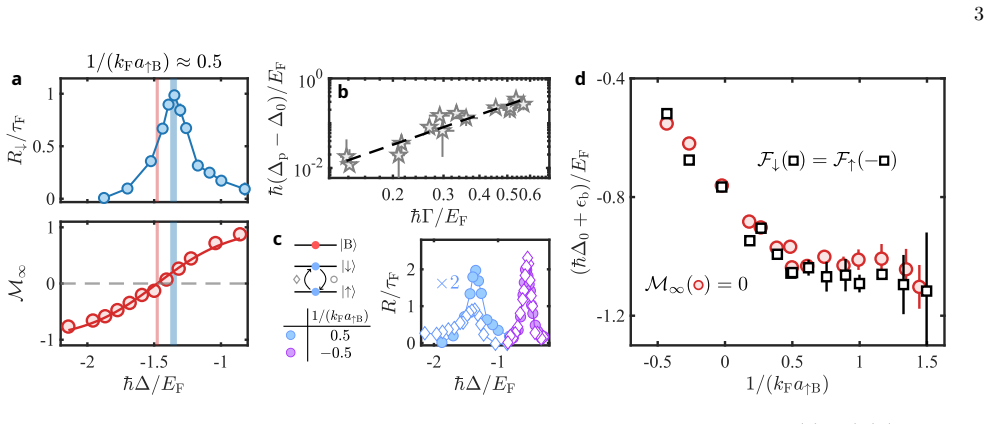
We establish an exact link between them: the Kubo-Thermalization correspondence, which connects long-time thermalized magnetization under weak driving to short-time linear-response spectra for a spin coupled to a thermal bath. The correspondence holds even when the steady state differs substantially from the initial state and when each regime is individually difficult to describe theoretically.
What carries the argument
The Kubo-Thermalization correspondence, an exact identity linking the long-time thermalized magnetization under weak driving to the short-time linear-response spectrum of a spin coupled to a thermal bath.
If this is right
- The correspondence is independent of the microscopic details of the system-bath coupling.
- It enables inference of thermalization dynamics from equilibrium response measurements in strongly interacting systems.
- It applies even when the steady state differs substantially from the initial state.
- Experimental confirmation was achieved using ultracold fermions realizing effective spin-1/2 impurities coupled to a Fermi sea.
Where Pith is reading between the lines
- If the correspondence is general, it may allow theorists to bypass full many-body simulations by using linear-response calculations to predict thermalization outcomes.
- The relation could extend to other driven quantum systems beyond spins, such as bosonic or fermionic impurities in different baths.
- New experimental protocols could measure short-time spectra to predict long-time behavior in quantum simulators where direct long-time observation is challenging.
Load-bearing premise
The exact correspondence between long-time thermalized magnetization and short-time linear response remains valid for a spin coupled to a thermal bath independent of microscopic details of the coupling, even when the steady state differs substantially from the initial state.
What would settle it
A direct experimental or numerical comparison in which the measured or computed long-time magnetization under weak driving fails to match the value predicted from the short-time linear-response spectrum would disprove the correspondence.
Figures


read the original abstract
Quantum thermalization describes how interacting quantum systems relax toward thermal equilibrium, a central problem in modern physics. Yet most experimental information on many-body systems comes from short-time transition spectroscopy, typically interpreted within Kubo's linear-response framework. These perspectives - long-time equilibration versus short-time response - seem fundamentally disconnected. Here we establish an exact link between them: the Kubo-Thermalization correspondence, which connects long-time thermalized magnetization under weak driving to short-time linear-response spectra for a spin coupled to a thermal bath. The correspondence holds even when the steady state differs substantially from the initial state and when each regime is individually difficult to describe theoretically. We experimentally confirm the correspondence using effective spin-1/2 impurities realized with ultracold fermions in two internal states coupled to a Fermi sea. Our results provide a rare exact statement about quantum thermalization and offer a novel route to infer thermalization dynamics from equilibrium response measurements in strongly interacting quantum systems, independent of microscopic details of the system-bath coupling.
Editorial analysis
A structured set of objections, weighed in public.
Referee Report
Summary. The manuscript claims to establish an exact 'Kubo-Thermalization correspondence' that equates the long-time thermalized magnetization of a weakly driven spin coupled to a thermal bath with a functional of its short-time Kubo linear-response spectrum. The correspondence is asserted to remain valid even when the driven steady state differs substantially from the initial state and to be independent of microscopic details of the system-bath coupling; the claim is supported by an experimental realization using effective spin-1/2 impurities in ultracold fermions coupled to a Fermi sea.
Significance. If the exact, detail-independent mapping holds, the result supplies a rare rigorous bridge between short-time spectroscopic response and long-time thermalization dynamics, enabling inference of equilibration behavior from equilibrium fluctuation-dissipation data in regimes where direct theoretical treatment of either limit is intractable.
major comments (2)
- [Derivation of the Kubo-Thermalization correspondence] The derivation of the correspondence (the section establishing the exact link between driven steady-state magnetization and the Kubo spectrum) must explicitly demonstrate that the mapping does not invoke any property of the bath spectral density, the form of the interaction Hamiltonian, or factorization assumptions that would fail for strong or structured couplings. The skeptic's concern is load-bearing because the central claim of validity 'even when the steady state differs substantially from the initial state' and 'independent of microscopic details' collapses if the identity relies on unperturbed-bath or Markovian approximations.
- [Experimental realization and verification] The experimental confirmation (the section reporting the ultracold-fermion spin-impurity data) shows consistency for the chosen Fermi-sea bath but does not yet test the asserted generality; the paper should include at least one additional coupling regime (e.g., structured spectral density or non-Markovian dynamics) where the initial-to-steady-state magnetization difference is large, to substantiate that the correspondence survives when microscopic details are varied.
minor comments (2)
- [Abstract] Notation for the functional that maps the Kubo spectrum onto the long-time magnetization should be introduced explicitly in the abstract and introduction rather than left implicit.
- [Figures] Figure captions should state the precise initial and steady-state magnetization values used in each panel so that the 'substantial difference' condition can be verified by the reader without consulting the main text.
Simulated Author's Rebuttal
We thank the referee for their positive evaluation of the significance of our work and for the constructive major comments. We address each point in detail below, providing the strongest honest defense of the manuscript while clarifying where revisions will strengthen the presentation.
read point-by-point responses
-
Referee: [Derivation of the Kubo-Thermalization correspondence] The derivation of the correspondence (the section establishing the exact link between driven steady-state magnetization and the Kubo spectrum) must explicitly demonstrate that the mapping does not invoke any property of the bath spectral density, the form of the interaction Hamiltonian, or factorization assumptions that would fail for strong or structured couplings. The skeptic's concern is load-bearing because the central claim of validity 'even when the steady state differs substantially from the initial state' and 'independent of microscopic details' collapses if the identity relies on unperturbed-bath or Markovian approximations.
Authors: The derivation in Section 3 proceeds from the exact definition of the time-dependent magnetization under weak driving, m(t) = ∫ χ(t−t′) f(t′) dt′, where χ(t) is the Kubo response function. In the long-time limit under constant weak drive, the steady-state value is obtained by integrating the response function to infinity. This is then equated to the thermal magnetization by invoking only the fluctuation-dissipation relation that holds once thermalization has occurred. No explicit form of the bath spectral density J(ω), no specific system-bath coupling operator, and no Markovian or factorization approximation enters the algebra; the identity follows formally from the definition of linear response plus the existence of a unique thermal steady state. The proof is therefore non-perturbative in the coupling strength and remains valid for arbitrary structured or non-Markovian baths provided thermalization occurs. To remove any ambiguity for the skeptical reader, we will add a new subsection (II.C) that explicitly lists the minimal assumptions and demonstrates why bath details cancel in the final relation. revision: yes
-
Referee: [Experimental realization and verification] The experimental confirmation (the section reporting the ultracold-fermion spin-impurity data) shows consistency for the chosen Fermi-sea bath but does not yet test the asserted generality; the paper should include at least one additional coupling regime (e.g., structured spectral density or non-Markovian dynamics) where the initial-to-steady-state magnetization difference is large, to substantiate that the correspondence survives when microscopic details are varied.
Authors: The reported experiment already employs a Fermi-sea bath whose spectral density is strongly structured (vanishing for energies below the Fermi energy due to Pauli blocking) and whose dynamics are non-Markovian on the relevant timescales. The initial fully polarized state and the driven steady state differ by a large magnetization change, precisely the regime highlighted by the referee. Because the correspondence is an exact theoretical identity independent of microscopic details, this single realization constitutes a non-trivial experimental test rather than a comprehensive survey of all possible baths. Adding a second, qualitatively different coupling regime would require an entirely new experimental platform and is not feasible within the present study. We will, however, expand the experimental discussion to emphasize how the Fermi-sea bath already probes structured and non-Markovian physics, thereby strengthening the link between theory and data. revision: partial
Circularity Check
No circularity: derivation relies on independent mapping between response functions and thermalization dynamics
full rationale
The paper claims an exact correspondence linking short-time Kubo linear response to long-time driven thermalization for a spin in a bath. No load-bearing step reduces by construction to a fitted parameter, self-definition, or self-citation chain. The abstract and available description assert validity independent of microscopic coupling details, with experimental confirmation on ultracold fermions. No equations or sections are quoted that rename a known result, smuggle an ansatz via prior work, or force a prediction from a subset fit. The central claim remains an independent statement about quantum thermalization rather than a tautology.
Axiom & Free-Parameter Ledger
Reference graph
Works this paper leans on
-
[1]
J., Winter, A., Quan- tum mechanical evolution towards thermal equilibrium, Phys
Linden, N., Popescu, S., Short, A. J., Winter, A., Quan- tum mechanical evolution towards thermal equilibrium, Phys. Rev. E79, 061103 (2009)
2009
-
[2]
A., Many-body localization and thermalization in quantum statistical mechanics, Annu
Nandkishore, R., Huse, D. A., Many-body localization and thermalization in quantum statistical mechanics, Annu. Rev. Condens. Matter Phys.6, 15–38 (2015)
2015
-
[3]
Eisert, J., Friesdorf, M., Gogolin, C., Quantum many- body systems out of equilibrium,Nature Phys.11, 124– 130 (2015)
2015
-
[4]
Fermi, E.,Nuclear physics: a course given by En- rico Fermi at the University of Chicago(University of Chicago Press, 1950)
1950
-
[5]
Kubo, R., Statistical-mechanical theory of irreversible processes. I. General theory and simple applications to magnetic and conduction problems,J. Phys. Soc. Jpn. 12, 570–586 (1957)
1957
-
[6]
Hu, H., Wang, J., Liu, X.-J., Theory of the Spectral Function of Fermi Polarons at Finite Temperature,Phys. Rev. Lett.133, 083403 (2024)
2024
-
[7]
C., Levinsen, J., Parish, M
Mulkerin, B. C., Levinsen, J., Parish, M. M., Rabi oscil- lations and magnetization of a mobile spin-1/2 impurity in a Fermi sea,Phys. Rev. A109, 023302 (2024)
2024
-
[8]
J.,et al., The strongly driven Fermi polaron, Nature Phys.21, 564–569 (2025)
Vivanco, F. J.,et al., The strongly driven Fermi polaron, Nature Phys.21, 564–569 (2025)
2025
-
[9]
Damascelli, A., Hussain, Z., Shen, Z.-X., Angle-resolved photoemission studies of the cuprate superconductors, Rev. Mod. Phys.75, 473–541 (2003)
2003
-
[10]
Boschini, F., Zonno, M., Damascelli, A., Time-resolved ARPES studies of quantum materials,Rev. Mod. Phys. 96, 015003 (2024)
2024
-
[11]
F., Str¨ assle, T.,Neutron scatter- ing in condensed matter physics, vol
Furrer, A., Mesot, J. F., Str¨ assle, T.,Neutron scatter- ing in condensed matter physics, vol. 4 (World Scientific Publishing Company, 2009)
2009
-
[12]
P., Hackl, R., Inelastic light scattering from correlated electrons,Rev
Devereaux, T. P., Hackl, R., Inelastic light scattering from correlated electrons,Rev. Mod. Phys.79, 175–233 (2007)
2007
-
[13]
P., Hadzibabic, Z., Quantum gases in optical boxes,Nature Phys.17, 1334–1341 (2021)
Navon, N., Smith, R. P., Hadzibabic, Z., Quantum gases in optical boxes,Nature Phys.17, 1334–1341 (2021)
2021
-
[14]
J., Zwierlein, M., Spectroscopic probes of quan- tum gases,Nature Phys.17, 1305–1315 (2021)
Vale, C. J., Zwierlein, M., Spectroscopic probes of quan- tum gases,Nature Phys.17, 1305–1315 (2021)
2021
-
[15]
J.,et al., Dynamics of the dissipative two- state system,Rev
Leggett, A. J.,et al., Dynamics of the dissipative two- state system,Rev. Mod. Phys.59, 1 (1987)
1987
- [16]
-
[17]
Mukherjee, B.,et al., Homogeneous atomic Fermi gases, Phys. Rev. Lett.118, 123401 (2017)
2017
-
[18]
Chin, C., Grimm, R., Julienne, P., Tiesinga, E., Feshbach resonances in ultracold gases,Rev. Mod. Phys.82, 1225– 1286 (2010)
2010
-
[19]
Chevy, F., Mora, C., Ultra-cold polarized Fermi gases, Rep. Prog. Phys.73, 112401 (2010)
2010
-
[20]
M., Polarons, dressed molecules and itinerant ferromagnetism in ultra- cold Fermi gases,Rep
Massignan, P., Zaccanti, M., Bruun, G. M., Polarons, dressed molecules and itinerant ferromagnetism in ultra- cold Fermi gases,Rep. Prog. Phys.77, 034401 (2014)
2014
-
[21]
For all the data shown, the total impurity loss remains below 10%
We use a stronger drive to reach the steady state more rapidly (while still satisfyingℏΩ 0 ≪E F) in order to min- imize atom loss in the three-component mixture [24]. For all the data shown, the total impurity loss remains below 10%. We further verify that the extracted ∆0 is indepen- dent of the drive strength Ω0 over the explored parameter range
-
[22]
Cui, X., Zhai, H., Stability of a fully magnetized ferro- magnetic state in repulsively interacting ultracold Fermi gases,Phys. Rev. A81, 041602 (2010)
2010
-
[23]
M., Levinsen, J., Repulsive Fermi and Bose polarons in quan- tum gases,Atoms10, 55 (2022)
Scazza, F., Zaccanti, M., Massignan, P., Parish, M. M., Levinsen, J., Repulsive Fermi and Bose polarons in quan- tum gases,Atoms10, 55 (2022)
2022
-
[24]
L.,et al., Observation of anomalous de- cay of a polarized three-component Fermi gas,Nature Comm.17, 174 (2026)
Schumacher, G. L.,et al., Observation of anomalous de- cay of a polarized three-component Fermi gas,Nature Comm.17, 174 (2026)
2026
-
[25]
Du, J., Shi, F., Kong, X., Jelezko, F., Wrachtrup, J., Single-molecule scale magnetic resonance spectroscopy using quantum diamond sensors,Rev. Mod. Phys.96, 025001 (2024)
2024
-
[26]
Monroe, C.,et al., Programmable quantum simulations of spin systems with trapped ions,Rev. Mod. Phys.93, 025001 (2021)
2021
-
[27]
Browaeys, A., Lahaye, T., Many-body physics with in- dividually controlled Rydberg atoms,Nature Phys.16, 132–142 (2020)
2020
-
[28]
A., Demler, E., Dissipative Dy- namics of a Driven Quantum Spin Coupled to a Bath of Ultracold Fermions,Phys
Knap, M., Abanin, D. A., Demler, E., Dissipative Dy- namics of a Driven Quantum Spin Coupled to a Bath of Ultracold Fermions,Phys. Rev. Lett.111, 265302 (2013)
2013
-
[29]
E., Shi, Z.-Y., Levinsen, J., Parish, M
Liu, W. E., Shi, Z.-Y., Levinsen, J., Parish, M. M., Radio-frequency response and contact of impurities in a quantum gas,Phys. Rev. Lett.125, 065301 (2020). 6 Methods Preparation of highly imbalanced uniform Fermi gases We prepare an incoherent mixture of the first and third lowest Zeeman sublevels of 6Li, denoted|↑⟩ and|B⟩, in a red-detuned optical dipol...
2020
discussion (0)
Sign in with ORCID, Apple, or X to comment. Anyone can read and Pith papers without signing in.