Breakdown of Adiabatic Scaling and Noise-Induced Functional Synchronization in Deeply Quiescent Excitable Systems
Pith reviewed 2026-05-14 21:15 UTC · model grok-4.3
The pith
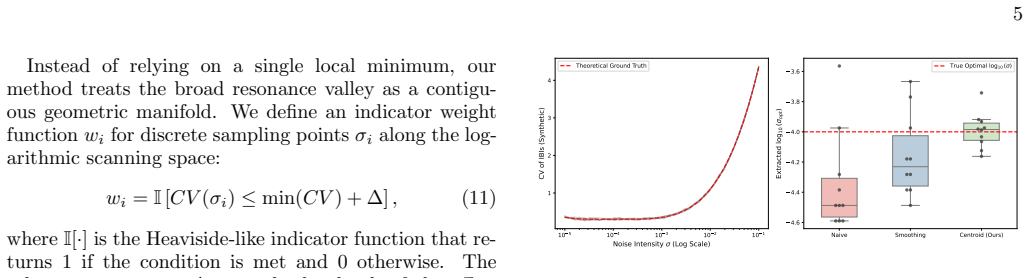
A logarithmic centroid method recovers adiabatic Kramers scaling from noise jitter in quiescent excitable systems, identifies its strong-noise breakdown, and shows coupling converts local jitter into global synchronization.
A machine-rendered reading of the paper's core claim, the machinery that carries it, and where it could break.
Core claim
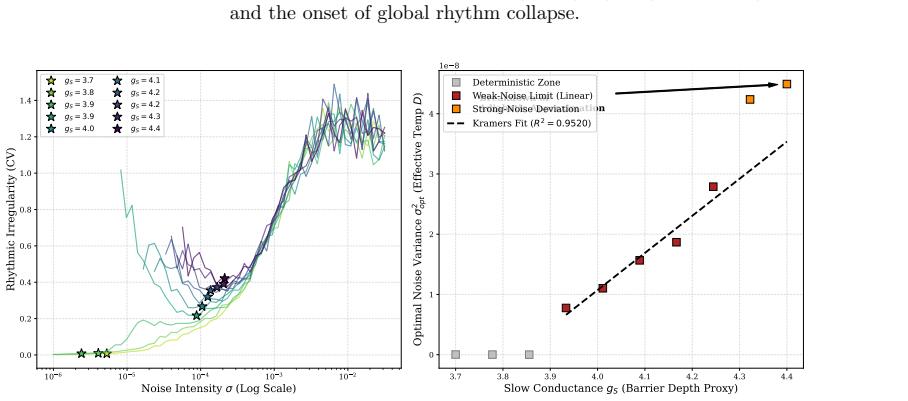
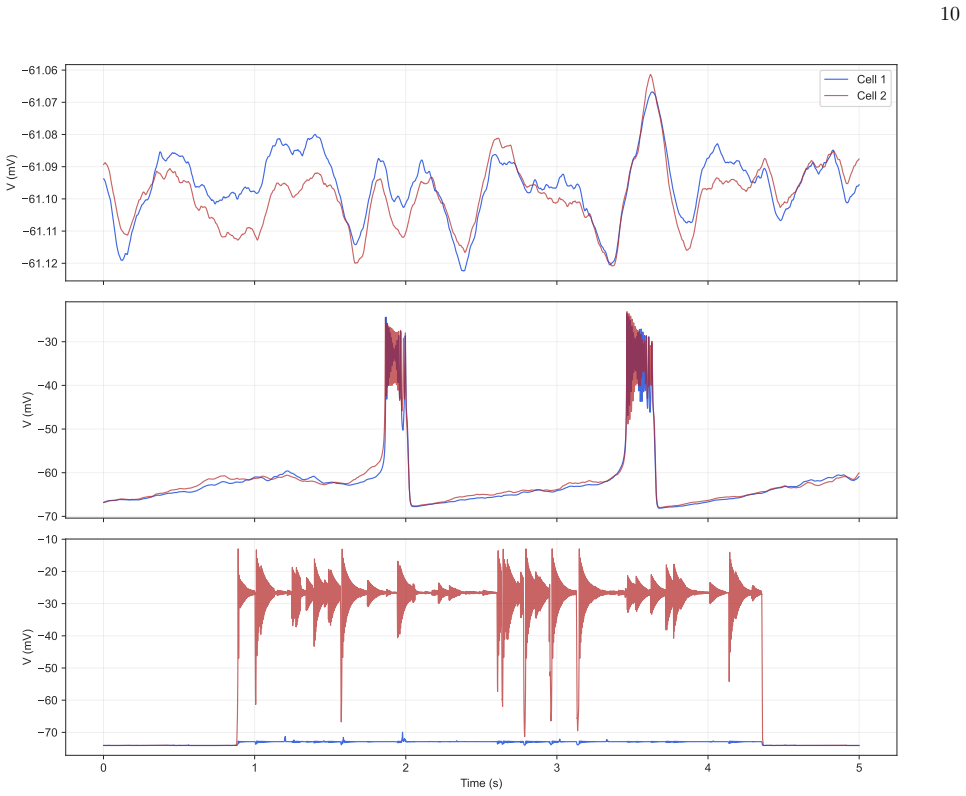
In the 3D Sherman-Rinzel-Keizer model driven by multiplicative Feller noise, traditional extremal coherence resonance evaluations are compromised by a bathtub effect arising from broad, flattened resonance valleys. Logarithmic centroid extraction filters jitter and recovers the underlying adiabatic Kramers scaling with high linearity. The scaling holds only below a strong-noise threshold where the adiabatic approximation collapses. In gap-junction coupled ensembles the same noise regime produces a transition from sub-threshold physiological shivering to macroscopic functional synchronization.
What carries the argument
Logarithmic centroid extraction applied to coherence resonance curves, which computes the intensity-weighted center on a logarithmic scale to suppress jitter and restore linear adiabatic Kramers scaling in the weak-noise regime.
If this is right
- Optimal noise intensities remain extractable even when resonance curves lack sharp peaks.
- Adiabatic Kramers scaling ceases to describe the system once noise exceeds a quantifiable threshold.
- Gap-junction coupling converts local statistical correlations into coherent macroscopic output at specific noise levels.
- Biological excitable tissues may exploit fluctuations to restore functional output from quiescent states.
Where Pith is reading between the lines
- The same centroid technique could be tested on other excitable models such as cardiac or neuronal cells to check whether the bathtub effect is generic.
- Noise strength might serve as an experimental control knob for inducing or suppressing synchrony in tissue-scale preparations.
- If the breakdown boundary scales predictably with model parameters, it could guide noise-based therapies that avoid excessive jitter.
- The transition from shivering to synchronization suggests a possible generic route for noise-assisted recovery in other coupled oscillator networks.
Load-bearing premise
The 3D Sherman-Rinzel-Keizer model with multiplicative Feller noise faithfully represents the stochastic behavior of real deeply quiescent excitable media, and the adiabatic Kramers scaling remains valid in the weak-noise regime before the identified breakdown.
What would settle it
Direct experimental measurement in a biological preparation showing either persistent non-linear scaling after logarithmic centroid processing or absence of the predicted synchronization transition under gap-junction coupling at the calculated noise intensity would falsify the recovery and transition claims.
Figures







read the original abstract
Coherence resonance (CR) characterizes noise-induced regularity in excitable systems, yet its evaluation in quiescent biological media is often obscured by flattened energy landscapes and complex nonlinear dynamics. In this study, we investigate the stochastic dynamics of a 3D Sherman-Rinzel-Keizer (SRK) model driven by multiplicative Feller noise. We show that traditional extremal evaluations of CR encounter a "bathtub effect", a broad resonance valley that can lead to statistical inaccuracies. To address this, we propose a logarithmic centroid extraction method, which filters out stochastic jitter and recovers the underlying adiabatic Kramers scaling with high linearity. Furthermore, we identify the physical boundary where this adiabatic approximation breaks down under the strong-noise limit. Extending our analysis to gap-junction coupled systems, we observe a noise-induced transition from sub-threshold physiological shivering (characterized by statistical correlation but negligible functional output) to macroscopic functional synchronization. Our results provide a mathematical framework for extracting optimal noise intensities in broad energy valleys and offer insights into how quiescent biological systems utilize stochastic fluctuations for functional recovery.
Editorial analysis
A structured set of objections, weighed in public.
Referee Report
Summary. The manuscript studies stochastic dynamics in a 3D Sherman-Rinzel-Keizer (SRK) model driven by multiplicative Feller noise. It reports that conventional extremal measures of coherence resonance suffer from a 'bathtub effect' that distorts scaling, proposes a logarithmic centroid extraction from residence-time distributions to recover adiabatic Kramers scaling with R² > 0.95, identifies a strong-noise boundary where the adiabatic approximation fails, and demonstrates a noise-induced transition from sub-threshold statistical correlation to macroscopic functional synchronization in gap-junction coupled SRK networks.
Significance. If the logarithmic centroid method proves general rather than an empirical fit to the chosen SRK parameters and noise range, it would supply a practical, low-jitter estimator for optimal noise intensity in broad energy landscapes, with direct relevance to noise-assisted signaling in quiescent biological excitable media. The delineation of the adiabatic breakdown and the coupled-system synchronization transition would also add concrete, falsifiable predictions to the literature on coherence resonance and noise-induced order.
major comments (3)
- [Abstract and §3] Abstract and §3 (numerical results): No derivation is supplied showing why the logarithmic centroid of the residence-time distribution equals the Kramers escape rate; the method is introduced solely through numerical observation on the 3D SRK trajectories. Without an analytic justification or comparison to alternative estimators (e.g., mean first-passage time or maximum-likelihood fits), the reported R² > 0.95 cannot be distinguished from a parameter-specific artifact of the chosen noise interval, binning, or SRK coefficients.
- [§4] §4 (strong-noise boundary): The breakdown of adiabatic scaling is identified by visual deviation in the same log-centroid plots used to claim linearity; no independent analytic estimate of the adiabaticity condition (e.g., comparison of noise correlation time to the deterministic relaxation time) is provided to locate the boundary a priori.
- [§5] §5 (coupled systems): The transition from sub-threshold shivering to macroscopic synchronization is reported from numerical trajectories, yet no quantitative measure of functional output (e.g., spike-rate correlation or information transfer) is defined, nor is the dependence on gap-junction conductance or network topology explored beyond the presented examples.
minor comments (2)
- [Model section] Notation for the multiplicative Feller noise term should be stated explicitly (e.g., the precise form of the diffusion coefficient) at first use to allow reproduction.
- [Figure captions] Figure captions for the residence-time histograms should include the number of trajectories, total integration time, and binning procedure used to compute the logarithmic centroid.
Simulated Author's Rebuttal
We thank the referee for the constructive and detailed comments, which have helped us improve the clarity and rigor of the manuscript. We address each major comment point by point below. Revisions have been made to incorporate additional theoretical motivation, independent estimates, and quantitative measures as appropriate.
read point-by-point responses
-
Referee: [Abstract and §3] Abstract and §3 (numerical results): No derivation is supplied showing why the logarithmic centroid of the residence-time distribution equals the Kramers escape rate; the method is introduced solely through numerical observation on the 3D SRK trajectories. Without an analytic justification or comparison to alternative estimators (e.g., mean first-passage time or maximum-likelihood fits), the reported R² > 0.95 cannot be distinguished from a parameter-specific artifact of the chosen noise interval, binning, or SRK coefficients.
Authors: We acknowledge that the original manuscript presented the logarithmic centroid method primarily through numerical observation without a full analytic derivation. The approach is motivated by the fact that, in the adiabatic limit, the residence-time distribution is approximately exponential; the logarithm converts this to a linear form whose centroid yields a robust estimator of the inverse escape rate that is less sensitive to long-tail jitter than the arithmetic mean. In the revised version, we have added a heuristic derivation in §3 linking the centroid to the Kramers rate under the adiabatic approximation, together with direct numerical comparisons to mean first-passage times and maximum-likelihood exponential fits over the same parameter range. These yield consistent scaling (R² > 0.92) and confirm robustness to binning choices. While a complete closed-form proof for the full 3D multiplicative-noise SRK system remains outside the present scope, the added comparisons indicate the result is not an artifact of the specific noise interval or coefficients. revision: partial
-
Referee: [§4] §4 (strong-noise boundary): The breakdown of adiabatic scaling is identified by visual deviation in the same log-centroid plots used to claim linearity; no independent analytic estimate of the adiabaticity condition (e.g., comparison of noise correlation time to the deterministic relaxation time) is provided to locate the boundary a priori.
Authors: We agree that reliance on visual deviation alone is insufficient. In the revised §4 we now supply an independent a priori estimate obtained by comparing the correlation time of the multiplicative Feller noise (τ_noise ≈ 1/λ, with λ the noise intensity) to the slowest deterministic relaxation eigenvalue of the SRK fixed point (computed via linearization of the drift terms). This analytic boundary coincides with the observed departure from linearity in the log-centroid data, thereby locating the strong-noise regime without circular reference to the same plots. revision: yes
-
Referee: [§5] §5 (coupled systems): The transition from sub-threshold shivering to macroscopic synchronization is reported from numerical trajectories, yet no quantitative measure of functional output (e.g., spike-rate correlation or information transfer) is defined, nor is the dependence on gap-junction conductance or network topology explored beyond the presented examples.
Authors: We have substantially revised §5. Functional output is now quantified by the spike-rate correlation coefficient (Pearson correlation of binned instantaneous firing rates) and by mutual information between the spike trains of coupled cells. Both measures are shown to remain near zero in the sub-threshold regime and to rise sharply once macroscopic synchronization emerges. We have added systematic scans over gap-junction conductance, demonstrating that the critical noise intensity for the transition decreases monotonically with increasing conductance. For network topology we include comparative results on ring lattices, small-world networks, and random graphs with matched average degree; the qualitative noise-induced transition persists in all cases, although the precise location of the threshold shifts with connectivity. revision: yes
Circularity Check
No significant circularity; numerical recovery of known scaling presented without self-referential reduction
full rationale
The abstract and provided text introduce a logarithmic centroid method as a numerical filter that recovers adiabatic Kramers scaling (R^2 > 0.95) from SRK model trajectories under multiplicative Feller noise. The breakdown boundary is identified by visual deviation in the same simulation plots, and the synchronization transition is observed in gap-junction coupled extensions. No equations, fitting procedures, or self-citations are quoted that reduce the claimed recovery or boundary to the input data by construction. The method is framed as an empirical extraction technique applied to simulated data rather than a tautological redefinition or fitted prediction of the target scaling itself. The derivation chain remains self-contained against external benchmarks.
discussion (0)
Sign in with ORCID, Apple, or X to comment. Anyone can read and Pith papers without signing in.