MAGIQ: A Post-Quantum Multi-Agentic AI Governance System with Provable Security
Pith reviewed 2026-05-20 22:28 UTC · model grok-4.3
The pith
MAGIQ enables users to define and enforce secure communication policies for AI agents using post-quantum cryptography.
A machine-rendered reading of the paper's core claim, the machinery that carries it, and where it could break.
Core claim
The central claim is that MAGIQ provides a framework for policy definition and enforcement in multi-agent AI systems using novel post-quantum cryptographic protocols, allowing rich communication and access-control policy budgets for sessions and tasks, with support for one-to-many interactions, message attribution for accountability, and formal proofs of correctness and security.
What carries the argument
Post-quantum cryptographic primitives that enforce policy budgets during agent-to-agent and group sessions while enabling message attribution.
If this is right
- Agents can operate within defined budgets for communication and access control.
- Security holds for both pairwise and one-to-many agent sessions.
- Accountability is achieved through linking messages to specific agents and users.
- The approach provides formal security guarantees against quantum threats.
Where Pith is reading between the lines
- This approach could be extended to other types of AI interactions beyond the modeled sessions.
- Integration with existing agent platforms might require adapting the policy definition interface.
- Long-term, it points toward quantum-secure standards for governing autonomous AI systems in open environments.
Load-bearing premise
The new cryptographic protocols must be both efficient in practice and secure under assumptions that resist quantum attacks, while the formal model must fully capture real threats to agent accountability.
What would settle it
Discovery of an efficient attack breaking the post-quantum primitives or a flaw in the security proof that allows an adversary to violate the policy or accountability without detection.
Figures
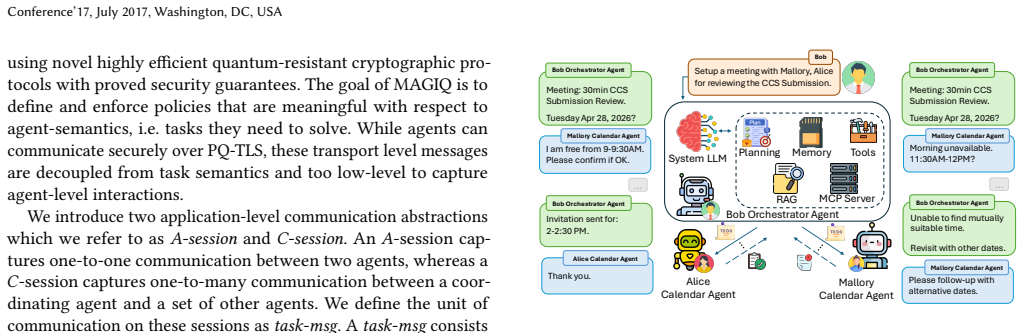


read the original abstract
Our computing ecosystem is being transformed by two emerging paradigms: the increased deployment of agentic AI systems and advancements in quantum computing. With respect to agentic AI systems, one of the most critical problems is creating secure governing architectures that ensure agents follow their owners' communication and interaction policies and can be held accountable for the messages they exchange with other agents. With respect to quantum computing, existing systems must be retrofitted and new cryptographic mechanisms must be designed to ensure long-term security and quantum resistance. In fact, NIST recommends that standard public-key cryptographic algorithms, including RSA, Diffie-Hellman (DH), and elliptic-curve constructions (ECC), be deprecated starting in 2030 and disallowed after 2035. In this paper, we present MAGIQ, a framework for policy definition and enforcement in multi-agent AI systems using novel, highly efficient, quantum-resistant cryptographic protocols with proven security guarantees. MAGIQ (i) allows users to define rich communication and access-control policy budgets for agent-to-agent sessions and tasks, including global budgets for one-to-many agent sessions; (ii) enforces such policies using post-quantum cryptographic primitives; (iii) supports session-based enforcement of policies for agent-to-agent and one-to-many agent sessions; and (iv) provides accountability of agents to their users through message attribution. We formally model and prove the correctness and security of the system using the Universal Composability (UC) framework. We evaluate the computation and communication overhead of our framework and compare it with the state-of-the-art agentic AI framework SAGA. MAGIQ is a first step toward post-quantum-secure solutions for agentic AI systems.
Editorial analysis
A structured set of objections, weighed in public.
Referee Report
Summary. The paper introduces MAGIQ, a framework for policy definition and enforcement in multi-agent AI systems that uses novel post-quantum cryptographic primitives. It supports rich communication and access-control policy budgets for agent-to-agent and one-to-many sessions, session-based enforcement, message attribution for accountability, and formal modeling plus proofs of correctness and security in the Universal Composability (UC) framework. The work also evaluates computation and communication overhead and compares results to the SAGA framework.
Significance. If the UC proofs are rigorous and the overhead numbers support the efficiency claims, the result would be significant for securing agentic AI against quantum threats. The explicit use of the UC framework to model policy enforcement and attribution, together with the comparison to prior work, provides a concrete foundation that aligns with NIST timelines for deprecating classical public-key cryptography.
major comments (1)
- [UC ideal functionality definition] The section defining the UC ideal functionality for agent sessions and policy enforcement: the functionality models only static message flows and classical adversaries, which does not capture adaptive message generation by autonomous AI agents or composition against quantum adversaries. This is load-bearing for the central security claim because the simulation argument cannot transfer to the dynamic multi-agent setting asserted in the abstract and introduction.
minor comments (1)
- [Evaluation section] The abstract and introduction assert 'highly efficient' protocols and concrete overhead reductions versus SAGA, but the evaluation section should include explicit parameter settings, key sizes, and timing tables to allow independent verification of those numbers.
Simulated Author's Rebuttal
We are grateful to the referee for their thorough review and valuable feedback on our manuscript. We have addressed the major comment point by point below, providing clarifications and indicating revisions where necessary.
read point-by-point responses
-
Referee: [UC ideal functionality definition] The section defining the UC ideal functionality for agent sessions and policy enforcement: the functionality models only static message flows and classical adversaries, which does not capture adaptive message generation by autonomous AI agents or composition against quantum adversaries. This is load-bearing for the central security claim because the simulation argument cannot transfer to the dynamic multi-agent setting asserted in the abstract and introduction.
Authors: We respectfully disagree that our UC ideal functionality is limited to static message flows. The functionality is defined to allow the adversary to initiate sessions and deliver messages in an adaptive manner, subject to the policy constraints defined by the users. This models the dynamic interactions in multi-agent systems, where autonomous agents can generate messages adaptively within their allocated budgets. The simulation argument accounts for this adaptivity by having the simulator respond to the adversary's choices in real-time. For quantum adversaries, our proofs leverage the post-quantum security of the cryptographic building blocks, ensuring resistance to quantum attacks. We will revise the manuscript to include a more explicit discussion of adaptivity in the UC model and clarify how the security extends to the quantum setting. revision: yes
Circularity Check
No significant circularity; derivation relies on standard UC framework and external post-quantum primitives
full rationale
The paper's core claims rest on defining policies, enforcing them via post-quantum primitives, and proving security/correctness in the UC framework. The abstract explicitly states reliance on the Universal Composability framework for formal modeling and proof, which is an independent, externally defined methodology not constructed from the paper's own inputs. Post-quantum primitives are referenced as coming from prior literature and NIST recommendations rather than self-derived or fitted quantities. No equations, self-citations, or ansatzes in the provided text reduce the security guarantees or policy enforcement to tautological redefinitions of the inputs. The derivation chain is therefore self-contained against external benchmarks.
Axiom & Free-Parameter Ledger
Lean theorems connected to this paper
-
IndisputableMonolith/Cost/FunctionalEquation.leanwashburn_uniqueness_aczel unclear?
unclearRelation between the paper passage and the cited Recognition theorem.
We use hash chains to enforce task-msg count budgets... Starting from a random seed s0, an agent computes a chain si = H(si−1)... Each message consumes one chain element
-
IndisputableMonolith/Foundation/RealityFromDistinction.leanreality_from_one_distinction unclear?
unclearRelation between the paper passage and the cited Recognition theorem.
We formally model and prove the correctness and security of the system using the Universal Composability (UC) framework.
What do these tags mean?
- matches
- The paper's claim is directly supported by a theorem in the formal canon.
- supports
- The theorem supports part of the paper's argument, but the paper may add assumptions or extra steps.
- extends
- The paper goes beyond the formal theorem; the theorem is a base layer rather than the whole result.
- uses
- The paper appears to rely on the theorem as machinery.
- contradicts
- The paper's claim conflicts with a theorem or certificate in the canon.
- unclear
- Pith found a possible connection, but the passage is too broad, indirect, or ambiguous to say the theorem truly supports the claim.
Reference graph
Works this paper leans on
-
[1]
Matt Adorjan. 2025. cloudping.co: AWS Inter-Region Latency Monitoring. https: //github.com/mda590/cloudping.co Accessed: 2025-04-18
work page 2025
-
[2]
Alfonso Amayuelas, Xianjun Yang, Antonis Antoniades, Wenyue Hua, Liang- ming Pan, and William Yang Wang. 2024. MultiAgent Collaboration Attack: Investigating Adversarial Attacks in Large Language Model Collaborations via Debate. InFindings of the Association for Computational Linguistics: EMNLP 2024. 6929–6948
work page 2024
-
[3]
Zeynab Anbiaee, Mahdi Rabbani, Mansur Mirani, Gunjan Piya, Igor Opushnyev, Ali Ghorbani, and Sajjad Dadkhah. 2026. Security Threat Modeling for Emerging AI-Agent Protocols: A Comparative Analysis of MCP, A2A, Agora, and ANP. arXiv:2602.11327 [cs.CR] https://arxiv.org/abs/2602.11327
work page internal anchor Pith review Pith/arXiv arXiv 2026
-
[4]
Sepideh Avizheh, Mahmudun Nabi, and Reihaneh Safavi-Naini. 2024. Refereed delegation of computation using smart contracts.IEEE Transactions on Dependable and Secure Computing21, 6 (2024), 5208–5227
work page 2024
-
[5]
Varun Pratap Bhardwaj. 2026. Agent Behavioral Contracts: Formal Specification and Runtime Enforcement for Reliable Autonomous AI Agents. doi:10.5281/ ZENODO.18775393
work page 2026
-
[6]
Johannes Buchmann, Erik Dahmen, Sarah Ereth, Andreas Hülsing, and Markus Rückert. 2013. On the security of the Winternitz one-time signature scheme. International Journal of Applied Cryptography3, 1 (2013), 84–96
work page 2013
-
[7]
Johannes Buchmann, Erik Dahmen, and Andreas Hülsing. 2011. XMSS-a practical forward secure signature scheme based on minimal security assumptions. In International Workshop on Post-Quantum Cryptography. Springer, 117–129
work page 2011
-
[8]
CAIDA. [n. d.]. The CAIDA Archipelago Monitor Statistics. https://www.caida. org/projects/ark/statistics/. Accessed April 2025
work page 2025
-
[9]
Jan Camenisch, Manu Drijvers, Tommaso Gagliardoni, Anja Lehmann, and Gre- gory Neven. 2018. The wonderful world of global random oracles. InAnnual international conference on the theory and applications of cryptographic techniques. Springer, 280–312
work page 2018
-
[10]
Ran Canetti. 2001. Universally composable security: A new paradigm for cryp- tographic protocols. InProceedings 42nd IEEE Symposium on Foundations of Computer Science. IEEE, 136–145
work page 2001
-
[11]
Ran Canetti. 2004. Universally composable signature, certification, and authenti- cation. InProceedings. 17th IEEE Computer Security Foundations Workshop, 2004. IEEE, 219–233
work page 2004
-
[12]
Ran Canetti, Kyle Hogan, Aanchal Malhotra, and Mayank Varia. 2017. A univer- sally composable treatment of network time. In2017 IEEE 30th Computer Security Foundations Symposium (CSF). IEEE, 360–375
work page 2017
-
[13]
Ran Canetti, Pratik Sarkar, and Xiao Wang. 2020. Efficient and round-optimal oblivious transfer and commitment with adaptive security. InInternational Con- ference on the Theory and Application of Cryptology and Information Security. Springer, 277–308
work page 2020
- [14]
-
[15]
Hadfield, and Markus Anderljung
Alan Chan, Kevin Wei, Sihao Huang, Nitarshan Rajkumar, Elija Perrier, Seth Lazar, Gillian K. Hadfield, and Markus Anderljung. 2025. Infrastructure for AI Agents.arXiv preprint arXiv:2501.10114(2025)
-
[16]
Jianming Chen, Yawen Wang, Junjie Wang, Xiaofei Xie, Yuanzhe Hu, Qing Wang, and Fanjiang Xu. 2026. Adversarial Attack on Black-Box Multi-Agent by Adaptive Perturbation.Proceedings of the AAAI Conference on Artificial Intelligence40, 35 (Mar. 2026), 29359–29367. doi:10.1609/aaai.v40i35.40176
-
[17]
Zhaoliang Chen. 2026. AITH: A Post-Quantum Continuous Delegation Protocol for Human-AI Trust Establishment. arXiv:2604.07695 [cs.CR] https://arxiv.org/ abs/2604.07695
work page internal anchor Pith review Pith/arXiv arXiv 2026
-
[18]
Model Context Protocol Contributors. 2025. Model Context Protocol Registry. https://github.com/modelcontextprotocol/registry. Accessed: 2025-12-11
work page 2025
-
[19]
Edoardo Debenedetti, Ilia Shumailov, Tianqi Fan, Jamie Hayes, Nicholas Car- lini, Daniel Fabian, Christoph Kern, Chongyang Shi, Andreas Terzis, and Flo- rian Tramèr. 2026. Defeating Prompt Injections by Design. arXiv preprint arXiv:2503.18813. InIEEE Conference on Secure and Trustworthy Machine Learning (SaTML). https://arxiv.org/abs/2503.18813
work page internal anchor Pith review Pith/arXiv arXiv 2026
-
[20]
Stefan Dziembowski, Lisa Eckey, and Sebastian Faust. 2018. Fairswap: How to fairly exchange digital goods. InProceedings of the 2018 ACM SIGSAC Conference on Computer and Communications Security. 967–984
work page 2018
-
[21]
Lisa Eckey, Sebastian Faust, and Benjamin Schlosser. 2020. Optiswap: Fast opti- mistic fair exchange. InProceedings of the 15th ACM Asia Conference on Computer and Communications Security. 543–557
work page 2020
-
[22]
2020.Falcon: Fast-Fourier Lattice-based Compact Signa- tures over NTRU, Specification v1.2
Pierre-Alain Fouque, Jeffrey Hoffstein, Paul Kirchner, Vadim Lyubashevsky, Thomas Pornin, Thomas Prest, Thomas Ricosset, Gregor Seiler, William Whyte, and Zhenfei Zhang. 2020.Falcon: Fast-Fourier Lattice-based Compact Signa- tures over NTRU, Specification v1.2. Cryptographic Specification. falcon-sign.info. https://falcon-sign.info/falcon.pdf Accessed: 2026-02-12
work page 2020
-
[23]
Sebastian Gajek, Mark Manulis, Olivier Pereira, Ahmad-Reza Sadeghi, and Jörg Schwenk. 2008. Universally composable security analysis of TLS. InInternational Conference on Provable Security. Springer, 313–327
work page 2008
-
[24]
Google Developer Blog. 2025. Announcing the Agent2Agent Proto- col (A2A). https://developers.googleblog.com/en/a2a-a-new-era-of-agent- interoperability/. Accessed: 2025-07-22
work page 2025
-
[25]
Lov K. Grover. 1996. A fast quantum mechanical algorithm for database search. InProceedings of the Twenty-Eighth Annual ACM Symposium on Theory of Com- puting(Philadelphia, Pennsylvania, USA)(STOC ’96). Association for Computing Machinery, New York, NY, USA, 212–219. doi:10.1145/237814.237866
-
[26]
gsiros. 2024. saga. https://github.com/gsiros/saga
work page 2024
-
[27]
Xiangming Gu, Xiaosen Zheng, Tianyu Pang, Chao Du, Qian Liu, Ye Wang, Jing Jiang, and Min Lin. 2024. Agent Smith: A Single Image Can Jailbreak One Million Multimodal LLM Agents Exponentially Fast
work page 2024
- [28]
-
[29]
Julia Hesse, Stanislaw Jarecki, Hugo Krawczyk, and Christopher Wood. 2023. Password-authenticated TLS via OPAQUE and post-handshake authentication. In Annual International Conference on the Theory and Applications of Cryptographic Techniques. Springer, 98–127
work page 2023
-
[30]
Sirui Hong, Mingchen Zhuge, Jonathan Chen, Xiawu Zheng, Yuheng Cheng, Jinlin Wang, Ceyao Zhang, Zili Wang, Steven Ka Shing Yau, Zijuan Lin, Liyang Zhou, Chenyu Ran, Lingfeng Xiao, Chenglin Wu, and Jürgen Schmidhuber
-
[31]
InThe Twelfth International Conference on Learning Representations
MetaGPT: Meta Programming for A Multi-Agent Collaborative Frame- work. InThe Twelfth International Conference on Learning Representations. https: //openreview.net/forum?id=VtmBAGCN7o
-
[32]
Andreas Huelsing, Denis Butin, Stefan-Lukas Gazdag, Joost Rijneveld, and Aziz Mohaisen. 2018. XMSS: eXtended Merkle Signature Scheme. RFC 8391. doi:10. 17487/RFC8391
work page 2018
-
[33]
Andreas Hülsing, Denis Butin, Stefan-Lukas Gazdag, Joost Rijneveld, and Aziz Mohaisen. 2018. XMSS: eXtended Merkle Signature Scheme. RFC 8391. doi:10. 17487/RFC8391
work page 2018
- [34]
- [35]
- [36]
-
[37]
Leslie Lamport. 1979. Constructing digital signatures from a one way function. Technical Report SRI-CSL-98(1979)
work page 1979
-
[38]
Donghyun Lee and Mo Tiwari. 2024. Prompt infection: Llm-to-llm prompt injection within multi-agent systems.arXiv preprint arXiv:2410.07283(2024)
work page internal anchor Pith review Pith/arXiv arXiv 2024
-
[39]
Evan Li, Tushin Mallick, Evan Rose, William Robertson, Alina Oprea, and Cristina Nita-Rotaru. 2026. ACE: A Security Architecture for LLM-Integrated App Systems. InProceedings of the Network and Distributed System Security Symposium (NDSS)
work page 2026
- [40]
-
[41]
Dustin Moody, Ray Perlner, Andrew Regenscheid, Angela Robinson, and David Cooper. 2024.Transition to Post-Quantum Cryptography Standards. Technical Conference’17, July 2017, Washington, DC, USA Report NIST IR 8547 (Initial Public Draft). National Institute of Standards and Technology, Gaithersburg, MD, USA. doi:10.6028/NIST.IR.8547.ipd Initial Public Draft
- [42]
-
[43]
National Institute of Standards and Technology (NIST). August 13, 2024. FIPS 203 Module-Lattice-Based Key-Encapsulation Mechanism Standard. https://csrc. nist.gov/pubs/fips/203/final Available at https://csrc.nist.gov/pubs/fips/203/final
work page 2024
-
[44]
National Institute of Standards and Technology (NIST). August 13, 2024. FIPS 204 Module-Lattice-Based Digital Signature Standard. https://csrc.nist.gov/pubs/ fips/204/final Available at https://csrc.nist.gov/pubs/fips/204/final
work page 2024
-
[45]
National Institute of Standards and Technology (NIST). August 13, 2024. FIPS 205 Stateless Hash-Based Digital Signature Standard. https://csrc.nist.gov/pubs/ fips/205/final Available at https://csrc.nist.gov/pubs/fips/205/final
work page 2024
-
[46]
Ramesh Raskar, Pradyumna Chari, Jared James Grogan, Mahesh Lambe, Robert Lincourt, Raghu Bala, Aditi Joshi, Abhishek Singh, Ayush Chopra, Rajesh Ranjan, Shailja Gupta, Dimitris Stripelis, Maria Gorskikh, and Sichao Wang. 2025. Up- grade or Switch: Do We Need a Next-Gen Trusted Architecture for the Internet of AI Agents? arXiv:2506.12003 [cs.NI] https://ar...
-
[47]
Tirumaleswar Reddy and Hannes Tschofenig. 2025. Post-Quantum Cryptography Recommendations for TLS-based Applications. Internet-Draft, draft-ietf-uta-pqc- app-00. https://www.ietf.org/archive/id/draft-ietf-uta-pqc-app-00.html Work in progress
work page 2025
-
[48]
Ronald L Rivest and Adi Shamir. 1996. PayWord and MicroMint: Two simple micropayment schemes. InInternational workshop on security protocols. Springer, 69–87
work page 1996
-
[49]
Yonadav Shavit, Sandhini Agarwal, Miles Brundage, Steven Adler, Cullen O’Keefe, Rosie Campbell, Teddy Lee, Pamela Mishkin, Tyna Eloundou, Alan Hickey, et al
-
[50]
Practices for governing agentic AI systems.Research Paper, OpenAI(2023)
work page 2023
-
[51]
P.W. Shor. 1994. Algorithms for quantum computation: discrete logarithms and factoring. InProceedings 35th Annual Symposium on Foundations of Computer Science. 124–134. doi:10.1109/SFCS.1994.365700
- [52]
-
[53]
Rao Surapaneni, Miku Jha, Michael Vakoc, and Todd Segal. 2025. Announcing the Agent2Agent Protocol (A2A). Google Developers Blog. https://developers. googleblog.com/en/a2a-a-new-era-of-agent-interoperability/ Accessed: 2025- 04-10
work page 2025
-
[54]
Georgios Syros, Anshuman Suri, Jacob Ginesin, Cristina Nita-Rotaru, and Alina Oprea. 2026. SAGA: A Security Architecture for Governing AI Agentic Systems. InProceedings of the Network and Distributed System Security Symposium (NDSS)
work page 2026
-
[55]
Haochuan Kevin Wang and Zechen Zhang. 2026. Kill-Chain Canaries: Stage- Level Tracking of Prompt Injection Across Attack Surfaces and Model Safety Tiers. arXiv:2603.28013 [cs.CR] https://arxiv.org/abs/2603.28013
work page internal anchor Pith review Pith/arXiv arXiv 2026
-
[56]
Qingyun Wu, Gagan Bansal, Jieyu Zhang, Yiran Wu, Beibin Li, Erkang Zhu, Li Jiang, Xiaoyun Zhang, Shaokun Zhang, Jiale Liu, Ahmed Hassan Awadallah, Ryen W White, Doug Burger, and Chi Wang. 2023. AutoGen: Enabling Next- Gen LLM Applications via Multi-Agent Conversation. arXiv:2308.08155 [cs.AI] https://arxiv.org/abs/2308.08155
work page internal anchor Pith review Pith/arXiv arXiv 2023
-
[57]
Weichen Yu, Kai Hu, Tianyu Pang, Chao Du, Min Lin, and Matt Fredrikson. 2025. Infecting LLM Agents via Generalizable Adversarial Attack. InRed Teaming GenAI: What Can We Learn from Adversaries?https://openreview.net/forum? id=udsmFGMwlp
work page 2025
-
[58]
Weibo Zhao, Jiahao Liu, Bonan Ruan, Shaofei Li, and Zhenkai Liang
-
[59]
When mcp servers attack: Taxonomy, feasibility, and mitigation,
When MCP Servers Attack: Taxonomy, Feasibility, and Mitigation. arXiv:2509.24272 [cs.CR] https://arxiv.org/abs/2509.24272 A Ethical Considerations Our paper is not an attack paper, it does not use any public dataset, or human data collection, so we believe that there are no ethical concerns. B Notations We present the notations used throughout the paper i...
discussion (0)
Sign in with ORCID, Apple, or X to comment. Anyone can read and Pith papers without signing in.