CarCrashNet: A Large-Scale Dataset and Hierarchical Neural Solver for Data-Driven Structural Crash Simulation
Pith reviewed 2026-05-20 22:42 UTC · model grok-4.3
The pith
CarCrashNet supplies a validated open dataset of vehicle crashes and a neural solver that predicts full-vehicle responses better than prior geometric deep learning methods.
A machine-rendered reading of the paper's core claim, the machinery that carries it, and where it could break.
Core claim
CarCrashNet is introduced as a multi-modal public benchmark that pairs component-scale and full-vehicle finite-element crash data with validated open-source simulation results, and CrashSolver is presented as the hierarchical neural model that delivers superior accuracy on full-vehicle crash prediction relative to state-of-the-art geometric deep learning and transformer-based alternatives when evaluated on the released datasets.
What carries the argument
CrashSolver, the hierarchical neural model trained directly on high-resolution finite-element crash data from the CarCrashNet benchmark to predict full-vehicle structural responses.
If this is right
- The benchmark enables direct, reproducible comparison of new neural solvers on nonlinear contact, large-deformation, and material-failure problems.
- CrashSolver demonstrates that data-driven models can be applied to full-vehicle meshes while preserving accuracy relative to conventional finite-element methods.
- The released multi-modal dataset supports development of virtual crash-testing pipelines that reduce reliance on physical prototypes.
Where Pith is reading between the lines
- If the benchmark remains reliable, similar hierarchical architectures could be tested on higher-resolution meshes or on crash scenarios outside the current training distribution.
- Widespread adoption might allow vehicle manufacturers to explore larger design spaces early in development before committing to physical builds.
- A natural next measurement would be to assess how well CrashSolver generalizes to impact velocities or angles absent from the 825 full-vehicle cases.
Load-bearing premise
The open-source OpenRadioss finite-element simulations produce results that match experimental crash data and commercial Ansys LS-DYNA outputs for the tested vehicle models and impact conditions.
What would settle it
Physical crash tests performed on one of the included vehicle models that show large discrepancies in structural deformation, force histories, or energy absorption compared with the corresponding OpenRadioss simulations stored in CarCrashNet.
Figures




read the original abstract
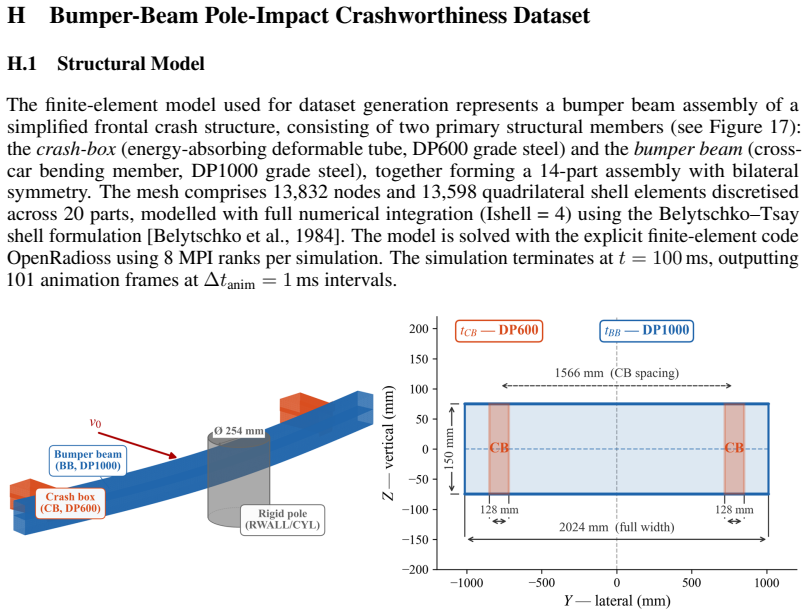
Crash simulation is a cornerstone of modern vehicle development because it reduces the need for costly physical prototypes, accelerates safety-driven design iteration, and increasingly supports virtual testing workflows. At the same time, modeling structural crash mechanics remains exceptionally challenging: the response is governed by nonlinear contact, large deformation, material plasticity, failure, and complex multi-body interactions evolving over space and time on high-resolution finite-element meshes. In this work, we introduce CarCrashNet, a public high-fidelity open-source benchmark for data-driven structural crash simulation. CarCrashNet combines component-scale and full-vehicle simulations in a multi-modal format, including more than 14,000 bumper-beam pole-impact simulations with varying geometry, materials, and boundary conditions, together with 825 full-vehicle crash simulations built from three industry-standard vehicle models of increasing structural complexity: Dodge Neon, Toyota Yaris, and Chevrolet Silverado. To establish the reliability of the benchmark, we validate our open-source finite-element workflow based on OpenRadioss against both experimental crash data and the commercial solver Ansys LS-DYNA. We also introduce CrashSolver, a machine-learning model designed for full-vehicle crash prediction from high-resolution finite-element crash data. We further perform extensive benchmarking across the released datasets and evaluate CrashSolver against state-of-the-art geometric deep learning and transformer-based neural solvers. Our results position CarCrashNet as a foundation for reproducible research in structural simulation, crashworthiness modeling, and AI-driven virtual crash testing. The dataset is available at https://github.com/Mohamedelrefaie/CarCrashNet.
Editorial analysis
A structured set of objections, weighed in public.
Referee Report
Summary. The manuscript introduces CarCrashNet, a public large-scale benchmark dataset for data-driven structural crash simulation. It comprises more than 14,000 component-scale bumper-beam pole-impact simulations with varied geometry, materials, and boundary conditions, plus 825 full-vehicle crash simulations using three industry-standard models (Dodge Neon, Toyota Yaris, Chevrolet Silverado). The authors validate their open-source OpenRadioss finite-element workflow against both experimental crash data and the commercial Ansys LS-DYNA solver. They further propose CrashSolver, a hierarchical neural model for full-vehicle crash prediction, and benchmark it against geometric deep learning and transformer-based neural solvers, reporting superior performance on held-out data.
Significance. If the OpenRadioss validation holds with quantitative fidelity, CarCrashNet would address a critical gap by providing the first open high-fidelity multi-modal dataset and solver for structural crash mechanics, enabling reproducible AI research in crashworthiness and virtual testing. The empirical outperformance claims and dataset release constitute concrete contributions that could accelerate progress in the field.
major comments (1)
- The central claim that CarCrashNet constitutes a reliable benchmark rests on the assertion that the OpenRadioss workflow faithfully reproduces structural crash physics. The abstract states validation against experimental data and LS-DYNA, but the manuscript must report quantitative agreement metrics (e.g., L2 errors on force-time histories, energy absorption, or nodal displacement fields) specifically for the full-vehicle cases across the three models; qualitative or bumper-beam-only comparisons would leave open the possibility of systematic biases in contact, plasticity, or failure modeling that undermine both the dataset value and the reported superiority of CrashSolver.
minor comments (3)
- Clarify the precise input/output tensor shapes and hierarchical processing steps in CrashSolver (e.g., how component-scale features are aggregated for full-vehicle prediction) to aid reproducibility.
- Add error bars or statistical significance tests to the benchmarking tables comparing CrashSolver against geometric deep learning and transformer baselines.
- Ensure the GitHub repository link includes the exact OpenRadioss input decks and post-processing scripts used for the validation studies.
Simulated Author's Rebuttal
We thank the referee for the positive evaluation of our work and for the constructive major comment. We address it point by point below and will revise the manuscript accordingly.
read point-by-point responses
-
Referee: The central claim that CarCrashNet constitutes a reliable benchmark rests on the assertion that the OpenRadioss workflow faithfully reproduces structural crash physics. The abstract states validation against experimental data and LS-DYNA, but the manuscript must report quantitative agreement metrics (e.g., L2 errors on force-time histories, energy absorption, or nodal displacement fields) specifically for the full-vehicle cases across the three models; qualitative or bumper-beam-only comparisons would leave open the possibility of systematic biases in contact, plasticity, or failure modeling that undermine both the dataset value and the reported superiority of CrashSolver.
Authors: We agree that quantitative validation metrics for the full-vehicle simulations are essential to substantiate the benchmark's reliability. The current manuscript provides validation of the OpenRadioss workflow against experimental data primarily at the component (bumper-beam) scale and includes qualitative comparisons plus selected global metrics for the full-vehicle models (Dodge Neon, Toyota Yaris, Chevrolet Silverado). However, we acknowledge that comprehensive quantitative agreement metrics—such as L2 errors on force-time histories, energy absorption, and nodal displacement fields—specifically comparing OpenRadioss to LS-DYNA and experiments across all three full-vehicle cases are not reported in sufficient detail. In the revised manuscript we will add these quantitative metrics for the full-vehicle cases to close this gap and further support the claims regarding dataset fidelity and CrashSolver performance. revision: yes
Circularity Check
No circularity: empirical dataset release and trained model evaluation on held-out splits
full rationale
The paper introduces CarCrashNet as a new public dataset of bumper-beam and full-vehicle crash simulations generated via OpenRadioss, validates the workflow against external experimental data and the independent commercial solver LS-DYNA, and trains CrashSolver on the data with performance reported on separate test splits. No derivation chain, equations, or first-principles results are presented that reduce to fitted parameters or self-citations by construction. The central claims rest on new data release plus empirical comparisons rather than any self-referential prediction step.
Axiom & Free-Parameter Ledger
free parameters (1)
- CrashSolver network hyperparameters
axioms (1)
- domain assumption OpenRadioss finite-element models with chosen material and contact settings reproduce real crash mechanics to sufficient accuracy
Lean theorems connected to this paper
-
IndisputableMonolith/Cost/FunctionalEquation.leanwashburn_uniqueness_aczel unclear?
unclearRelation between the paper passage and the cited Recognition theorem.
Semi-discrete crash dynamics... M ü(t) + f_int(u,ú;θ_mat) + f_cont = f_ext(t;ξ)
What do these tags mean?
- matches
- The paper's claim is directly supported by a theorem in the formal canon.
- supports
- The theorem supports part of the paper's argument, but the paper may add assumptions or extra steps.
- extends
- The paper goes beyond the formal theorem; the theorem is a base layer rather than the whole result.
- uses
- The paper appears to rely on the theorem as machinery.
- contradicts
- The paper's claim conflicts with a theorem or certificate in the canon.
- unclear
- Pith found a possible connection, but the passage is too broad, indirect, or ambiguous to say the theorem truly supports the claim.
Reference graph
Works this paper leans on
-
[1]
Transolver: A Fast Transformer Solver for PDEs on General Geometries
Transolver: A fast transformer solver for pdes on general geometries , author=. arXiv preprint arXiv:2402.02366 , year=
work page internal anchor Pith review Pith/arXiv arXiv
-
[2]
arXiv preprint arXiv:2512.20399 , year=
GeoTransolver: Learning Physics on Irregular Domains Using Multi-scale Geometry Aware Physics Attention Transformer , author=. arXiv preprint arXiv:2512.20399 , year=
-
[3]
International Journal of Impact Engineering , volume=
Axial crushing of thin-walled high-strength steel sections , author=. International Journal of Impact Engineering , volume=. 2006 , doi=
work page 2006
- [4]
- [5]
-
[6]
2010 Toyota Yaris Finite Element Model Validation: Coarse Mesh , howpublished =. 2016 , doi =
work page 2010
-
[7]
2010 Toyota Yaris Finite Element Model Validation: Detail Mesh , howpublished =. 2016 , doi =
work page 2010
-
[8]
Development and Validation of a Finite Element Model for the 2010 Toyota Yaris Passenger Sedan , institution =. 2011 , number =
work page 2010
-
[9]
Extended Validation of the Finite Element Model for the 2010 Toyota Yaris Passenger Sedan , institution =. 2012 , number =
work page 2010
-
[10]
Computer Methods in Applied Mechanics and Engineering , volume=
A machine learning framework for accelerating the design process using CAE simulations: An application to finite element analysis in structural crashworthiness , author=. Computer Methods in Applied Mechanics and Engineering , volume=. 2021 , publisher=
work page 2021
-
[11]
Computer Methods in Applied Mechanics and Engineering , volume=
Introducing finite element method integrated networks (FEMIN) , author=. Computer Methods in Applied Mechanics and Engineering , volume=. 2024 , publisher=
work page 2024
-
[12]
Computer Methods in Applied Mechanics and Engineering , volume=
Accelerating crash simulations with Finite Element Method Integrated Networks (FEMIN): Comparing two approaches to replace large portions of a FEM simulation , author=. Computer Methods in Applied Mechanics and Engineering , volume=. 2025 , publisher=
work page 2025
-
[13]
Bubbleformer: Forecasting Boiling with Transformers , author=. The Thirty-ninth Annual Conference on Neural Information Processing Systems Datasets and Benchmarks Track , year=
-
[14]
Comparing traditional surrogate modelling and neural fields for vehicle crash simulation data , author=. SIA Simulation num
-
[15]
arXiv preprint arXiv:2503.17386 , year=
A new graph-based surrogate model for rapid prediction of crashworthiness performance of vehicle panel components , author=. arXiv preprint arXiv:2503.17386 , year=
-
[16]
International Journal of Crashworthiness , volume=
Crashworthiness performance of thin-walled structures towards design configuration in vehicle crash boxes application: a review , author=. International Journal of Crashworthiness , volume=. 2025 , publisher=
work page 2025
-
[17]
International Journal of Impact Engineering , volume=
Neural network modelling of mechanical joints for the application in large-scale crash analyses , author=. International Journal of Impact Engineering , volume=. 2023 , publisher=
work page 2023
-
[18]
International Journal of Crashworthiness , volume=
A review on finite element modelling and experimental analysis of crashworthiness design of automotive body , author=. International Journal of Crashworthiness , volume=. 2025 , publisher=
work page 2025
-
[19]
International Journal for Numerical Methods in Engineering , volume=
Nonintrusive Local/Global Coupling With Local Deep Learning-Based Models for the Effective Simulation of Spotwelded Structures Under Impact , author=. International Journal for Numerical Methods in Engineering , volume=. 2025 , publisher=
work page 2025
-
[20]
Thin-walled structures , volume=
Design and analysis of an automotive bumper beam in low-speed frontal crashes , author=. Thin-walled structures , volume=. 2009 , publisher=
work page 2009
-
[21]
The Journal of Engineering , volume=
The Automotive Bumper Beam in the Era of the 4th Industrial Revolution , author=. The Journal of Engineering , volume=. 2025 , publisher=
work page 2025
-
[22]
Intelligent Damage Prediction During Vehicle Collisions Based on Simulation Datasets , author=. Inventions , volume=. 2025 , publisher=
work page 2025
-
[23]
Machine learning enhanced optimisation of crash box design for crashworthiness analysis , author=. PAMM , volume=. 2023 , publisher=
work page 2023
-
[24]
Computers in Industry , volume=
Explainable artificial intelligence for enhancing system understanding and interpretability of numerical crash simulations , author=. Computers in Industry , volume=. 2026 , publisher=
work page 2026
-
[25]
arXiv preprint arXiv:2511.10821 , year=
MECHBench: A Set of Black-Box Optimization Benchmarks originated from Structural Mechanics , author=. arXiv preprint arXiv:2511.10821 , year=
-
[26]
Journal of complexity , volume=
Scrambling Sobol'and Niederreiter--Xing Points , author=. Journal of complexity , volume=. 1998 , publisher=
work page 1998
-
[27]
Proceedings of the 7th International Symposium on Ballistics, Am
A constitutive model and data for metals subjected to large strains, high strain rates and high temperatures , author=. Proceedings of the 7th International Symposium on Ballistics, Am. Def. Prep. Org.(ADPA), Netherlands, 1983 , pages=
work page 1983
-
[28]
Computer Methods in Applied Mechanics and Engineering , volume =
Explicit algorithms for the nonlinear dynamics of shells , author =. Computer Methods in Applied Mechanics and Engineering , volume =. 1984 , doi =
work page 1984
-
[29]
A comparison of three methods for selecting values of input variables in the analysis of output from a computer code , author=. Technometrics , volume=. 2000 , publisher=
work page 2000
-
[30]
Journal of statistical planning and inference , volume=
Minimax and maximin distance designs , author=. Journal of statistical planning and inference , volume=. 1990 , publisher=
work page 1990
-
[31]
TabPFN: A Transformer That Solves Small Tabular Classification Problems in a Second
Tabpfn: A transformer that solves small tabular classification problems in a second , author=. arXiv preprint arXiv:2207.01848 , year=
work page internal anchor Pith review Pith/arXiv arXiv
-
[32]
AutoGluon-Tabular: Robust and Accurate AutoML for Structured Data
Autogluon-tabular: Robust and accurate automl for structured data , author=. arXiv preprint arXiv:2003.06505 , year=
work page internal anchor Pith review Pith/arXiv arXiv 2003
-
[33]
A., Chavare, S., Akhare, D., Ranade, R., Cherukuri, R., and Tadepalli, S
Automotive Crash Dynamics Modeling Accelerated with Machine Learning , author=. arXiv preprint arXiv:2510.15201 , year=
-
[34]
Journal of Machine Learning Research , volume=
Neural operator: Learning maps between function spaces with applications to pdes , author=. Journal of Machine Learning Research , volume=
-
[35]
International Conference on Learning Representations , year =
Pfaff, Tobias and Fortunato, Meire and Sanchez-Gonzalez, Alvaro and Battaglia, Peter , title =. International Conference on Learning Representations , year =
-
[36]
Advances in neural information processing systems , volume=
Attention is all you need , author=. Advances in neural information processing systems , volume=
-
[37]
International Conference on Learning Representations , year =
Fourier Neural Operator for Parametric Partial Differential Equations , author =. International Conference on Learning Representations , year =
-
[38]
Nature machine intelligence , volume=
Learning nonlinear operators via DeepONet based on the universal approximation theorem of operators , author=. Nature machine intelligence , volume=. 2021 , publisher=
work page 2021
-
[39]
International conference on machine learning , pages=
Learning to simulate complex physics with graph networks , author=. International conference on machine learning , pages=. 2020 , organization=
work page 2020
-
[40]
Advances in Neural Information Processing Systems , volume=
Towards foundation models for scientific machine learning: Characterizing scaling and transfer behavior , author=. Advances in Neural Information Processing Systems , volume=
-
[41]
Advances in Neural Information Processing Systems , volume=
Drivaernet++: A large-scale multimodal car dataset with computational fluid dynamics simulations and deep learning benchmarks , author=. Advances in Neural Information Processing Systems , volume=
-
[42]
Advances in neural information processing systems , volume=
Pdebench: An extensive benchmark for scientific machine learning , author=. Advances in neural information processing systems , volume=
-
[43]
Advances in Neural Information Processing Systems , volume=
Airfrans: High fidelity computational fluid dynamics dataset for approximating reynolds-averaged navier--stokes solutions , author=. Advances in Neural Information Processing Systems , volume=
-
[44]
arXiv preprint arXiv:2310.05963 , year =
Luo, Yining and Chen, Yingfa and Zhang, Zhen , title =. arXiv preprint arXiv:2310.05963 , year =
-
[45]
Advances in Neural Information Processing Systems , volume=
Lagrangebench: A lagrangian fluid mechanics benchmarking suite , author=. Advances in Neural Information Processing Systems , volume=
-
[46]
Advances in Neural Information Processing Systems , volume=
The well: a large-scale collection of diverse physics simulations for machine learning , author=. Advances in Neural Information Processing Systems , volume=
-
[47]
Advances in Neural Information Processing Systems , volume=
Apebench: A benchmark for autoregressive neural emulators of pdes , author=. Advances in Neural Information Processing Systems , volume=
-
[48]
Advances in Neural Information Processing Systems , volume=
Pinnacle: A comprehensive benchmark of physics-informed neural networks for solving pdes , author=. Advances in Neural Information Processing Systems , volume=
-
[49]
Advances in Neural Information Processing Systems , volume=
Poseidon: Efficient foundation models for pdes , author=. Advances in Neural Information Processing Systems , volume=
-
[50]
Journal of Advances in Modeling Earth Systems , volume=
WeatherBench: a benchmark data set for data-driven weather forecasting , author=. Journal of Advances in Modeling Earth Systems , volume=. 2020 , publisher=
work page 2020
-
[51]
0: A benchmark for data-driven climate projections , author=
ClimateBench v1. 0: A benchmark for data-driven climate projections , author=. Journal of Advances in Modeling Earth Systems , volume=. 2022 , publisher=
work page 2022
-
[52]
WxC-Bench: A novel dataset for weather and climate downstream tasks , author=. Scientific Data , year=
-
[53]
arXiv preprint arXiv:2601.01829 , year =
Hu, Peiyan and Feng, Haodong and Liu, Hongyuan and Yan, Tongtong and Deng, Wenhao and Gao, Tianrun and others , title =. arXiv preprint arXiv:2601.01829 , year =
-
[54]
Open catalyst 2020 (OC20) dataset and community challenges , author=. Acs Catalysis , volume=. 2021 , publisher=
work page 2020
-
[55]
Tripnet: Learning large-scale high-fidelity 3d car aerodynamics with triplane networks , author=. arXiv preprint arXiv:2503.17400 , year=
-
[56]
Blendednet: A blended wing body aircraft dataset and surrogate model for aerodynamic predictions , author=. International Design Engineering Technical Conferences and Computers and Information in Engineering Conference , volume=. 2025 , organization=
work page 2025
-
[57]
arXiv preprint arXiv:2512.07847 , year =
Elrefaie, Mohamed and Shu, Dule and Klenk, Matt and Ahmed, Faez , title =. arXiv preprint arXiv:2512.07847 , year =
-
[58]
Journal of Mechanical Design , volume=
Drivaernet: A parametric car dataset for data-driven aerodynamic design and prediction , author=. Journal of Mechanical Design , volume=. 2025 , publisher=
work page 2025
-
[59]
Drivaernet: A parametric car dataset for data-driven aerodynamic design and graph-based drag prediction , author=. International Design Engineering Technical Conferences and Computers and Information in Engineering Conference , volume=. 2024 , organization=
work page 2024
-
[60]
BlendedNet++: A Large-Scale Blended Wing Body Aerodynamics Dataset and Benchmark , author=. arXiv preprint arXiv:2512.03280 , year=
work page internal anchor Pith review Pith/arXiv arXiv
-
[61]
arXiv preprint arXiv:2502.04317 , year=
Factorized implicit global convolution for automotive computational fluid dynamics prediction , author=. arXiv preprint arXiv:2502.04317 , year=
discussion (0)
Sign in with ORCID, Apple, or X to comment. Anyone can read and Pith papers without signing in.