N\"urnberg NLP at PsyDefDetect: Multi-Axis Voter Ensembles for Psychological Defence Mechanism Classification
Pith reviewed 2026-05-11 01:49 UTC · model grok-4.3
The pith
On ambiguous tasks with overlapping categories, ensembles whose voters make independent errors outperform stronger single models.
A machine-rendered reading of the paper's core claim, the machinery that carries it, and where it could break.
Core claim
On tasks where defence-mechanism categories share surface language and inter-annotator agreement is only moderate, error independence across an ensemble is more effective than improving any individual classifier. The authors construct a nine-member voter ensemble by varying class granularity (a gatekeeper on all classes versus specialists on the eight defences), training method (generative and discriminative), and base model. The resulting system attains an F1 score of 0.42 on the hidden test set and ranks first among 21 teams.
What carries the argument
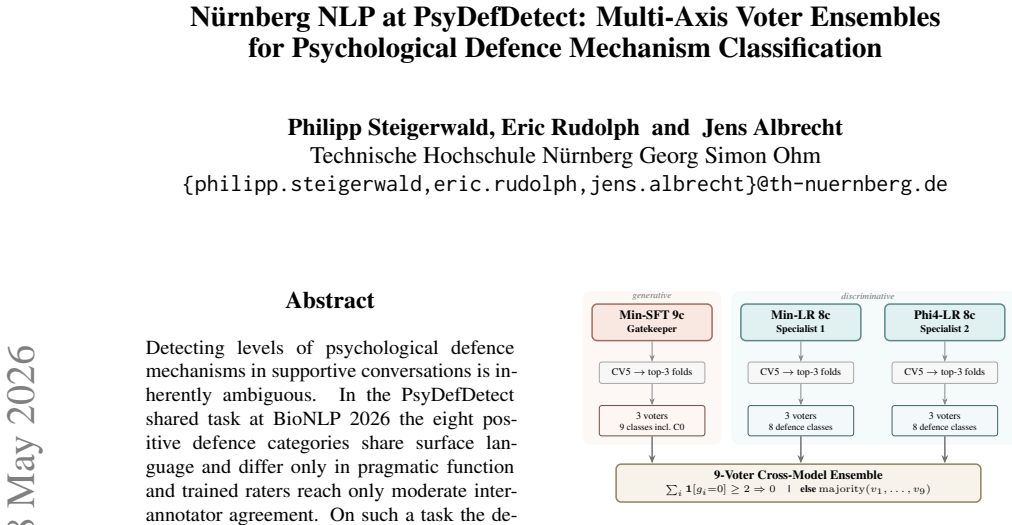
A nine-voter ensemble whose members differ along three orthogonal axes of class granularity, training method, and base model.
If this is right
- The ensemble reaches first place among 21 teams on the PsyDefDetect hidden test set.
- Error independence across the three axes compensates for overlapping defence boundaries more effectively than scaling a single model.
- Mixing generative and discriminative training supplies complementary strengths on the same data.
- Separating a gatekeeper model from specialist models focuses capacity on the hardest distinctions.
Where Pith is reading between the lines
- The same multi-axis construction could be tested on other subjective text-classification problems that exhibit low annotator agreement.
- Further orthogonal axes, such as different data augmentations or prompt styles, might yield additional error diversity.
- The result implies that for fuzzy categories the engineering effort should first target disagreement among voters rather than marginal gains on a single model.
- Performance on this shared task may indicate how well the approach transfers to domains outside psychology.
Load-bearing premise
The three chosen axes generate sufficiently independent errors to overcome the moderate inter-annotator agreement and overlapping category boundaries.
What would settle it
A single model trained with more data or a larger architecture matching or exceeding the ensemble's F1 score on the identical hidden test set.
Figures


read the original abstract
Detecting levels of psychological defence mechanisms in supportive conversations is inherently ambiguous. In the PsyDefDetect shared task at BioNLP 2026 the eight positive defence categories share surface language and differ only in pragmatic function and trained raters reach only moderate inter-annotator agreement. On such a task the decisive lever is not a stronger single model but error independence, since any single representation will waver on the overlapping defence boundaries. We translate this insight into a 9-voter ensemble spanning three orthogonal axes: class granularity (all nine classes for the gatekeeper, only the eight defence classes for the specialists), training method (generative and discriminative) and base model. The system reaches $F1_{test}{=}.420$ on the hidden test set, placing first among 21 registered teams.
Editorial analysis
A structured set of objections, weighed in public.
Referee Report
Summary. The paper describes a 9-voter ensemble for the PsyDefDetect shared task on classifying psychological defence mechanisms in supportive conversations. It posits that error independence across three orthogonal axes (class granularity, training method, and base model) is the key to handling overlapping categories and moderate inter-annotator agreement, achieving F1_test = 0.420 on the hidden test set and first place among 21 teams.
Significance. If the independence hypothesis is validated, the work offers a replicable ensemble design for ambiguous multi-label NLP tasks with pragmatic rather than lexical distinctions. The hidden-test result supplies direct, competition-verified evidence of practical utility.
major comments (2)
- [Abstract] Abstract: the central claim that 'the decisive lever is not a stronger single model but error independence' is unsupported by any quantitative verification. No pairwise error correlations, Q-statistics, disagreement rates, or ablation studies isolating each axis (while holding the others fixed) are reported, so the performance gain cannot be attributed to orthogonality rather than simple averaging of nine models.
- [Abstract] The manuscript supplies no error analysis or inter-voter agreement metrics on the development set that would substantiate the 'sufficiently independent errors' assumption given the moderate IAA and overlapping defence boundaries.
Simulated Author's Rebuttal
We thank the referee for the careful and constructive comments. We address the major points below and describe the changes we will make.
read point-by-point responses
-
Referee: [Abstract] Abstract: the central claim that 'the decisive lever is not a stronger single model but error independence' is unsupported by any quantitative verification. No pairwise error correlations, Q-statistics, disagreement rates, or ablation studies isolating each axis (while holding the others fixed) are reported, so the performance gain cannot be attributed to orthogonality rather than simple averaging of nine models.
Authors: We agree that the current manuscript does not contain explicit quantitative verification of error independence (pairwise correlations, Q-statistics, or axis-isolated ablations). The claim is grounded in the task properties described in the introduction—overlapping pragmatic categories and moderate IAA—together with the observed test-set result. In the revision we will add (i) ablation tables that vary one axis while freezing the other two and (ii) pairwise disagreement rates and Q-statistics computed on the development set, allowing readers to assess whether the performance lift is attributable to orthogonality. revision: yes
-
Referee: [Abstract] The manuscript supplies no error analysis or inter-voter agreement metrics on the development set that would substantiate the 'sufficiently independent errors' assumption given the moderate IAA and overlapping defence boundaries.
Authors: We acknowledge that no inter-voter agreement or error-analysis figures on the development set appear in the submitted version. We will compute and report (a) pairwise agreement rates among the nine voters, (b) a confusion-matrix-style breakdown of disagreements, and (c) a short qualitative error analysis on the development set, all of which will be added to the revised manuscript. revision: yes
Circularity Check
No circularity: empirical F1 on hidden test set stands independently
full rationale
The paper's derivation consists of stating an insight about error independence on an ambiguous task, constructing a 9-voter ensemble along three axes (class granularity, training method, base model), and reporting the resulting F1_test=.420 measured on the hidden test set. This outcome is an external empirical measurement and does not reduce to any self-referential definition, fitted parameter renamed as prediction, or self-citation chain. No equations are present that equate the result to its inputs by construction, and the provided text contains no load-bearing self-citations or ansatzes smuggled from prior author work. The assumption of orthogonality is stated but not used to derive the score; the score itself is independently falsifiable via the shared-task evaluation.
Axiom & Free-Parameter Ledger
Lean theorems connected to this paper
-
IndisputableMonolith/Foundation/RealityFromDistinction.leanreality_from_one_distinction unclear?
unclearRelation between the paper passage and the cited Recognition theorem.
We translate this insight into a 9-voter ensemble spanning three orthogonal axes: class granularity (all nine classes for the gatekeeper, only the eight defence classes for the specialists), training method (generative and discriminative) and base model.
-
IndisputableMonolith/Foundation/AbsoluteFloorClosure.leanabsolute_floor_iff_bare_distinguishability unclear?
unclearRelation between the paper passage and the cited Recognition theorem.
The system reaches F1_test=.420 on the hidden test set, placing first among 21 registered teams.
What do these tags mean?
- matches
- The paper's claim is directly supported by a theorem in the formal canon.
- supports
- The theorem supports part of the paper's argument, but the paper may add assumptions or extra steps.
- extends
- The paper goes beyond the formal theorem; the theorem is a base layer rather than the whole result.
- uses
- The paper appears to rely on the theorem as machinery.
- contradicts
- The paper's claim conflicts with a theorem or certificate in the canon.
- unclear
- Pith found a possible connection, but the passage is too broad, indirect, or ambiguous to say the theorem truly supports the claim.
Reference graph
Works this paper leans on
-
[1]
Na, Hongbin and Wang, Zimu and Chen, Zhaoming and Hua, Yining and Gao, Rena and Yang, Kailai and Chen, Ling and Wang, Wei and Ji, Shaoxiong and Torous, John and Ananiadou, Sophia , booktitle =. Overview of the. 2026 , address =
work page 2026
-
[2]
A Survey of Large Language Models in Psychotherapy: Current Landscape and Future Directions
A Survey of Large Language Models in Psychotherapy: Current Landscape and Future Directions , author =. Findings of the Association for Computational Linguistics: ACL 2025 , month = jul, year =. doi:10.18653/v1/2025.findings-acl.385 , pages =
-
[3]
Findings of the Association for Computational Linguistics: ACL 2026 , month = jul, year =
You Never Know a Person, You Only Know Their Defenses: Detecting Levels of Psychological Defense Mechanisms in Supportive Conversations , author =. Findings of the Association for Computational Linguistics: ACL 2026 , month = jul, year =
work page 2026
-
[4]
Proceedings of the 59th Annual Meeting of the Association for Computational Linguistics , pages=
Towards Emotional Support Dialog Systems , author=. Proceedings of the 59th Annual Meeting of the Association for Computational Linguistics , pages=
-
[5]
Defense Mechanism Rating Scales (
Perry, J Christopher , edition=. Defense Mechanism Rating Scales (
-
[6]
Journal of Clinical Psychology , volume=
Anomalies and Specific Functions in the Clinical Identification of Defense Mechanisms , author=. Journal of Clinical Psychology , volume=
-
[7]
Ego Mechanisms of Defense: A Guide for Clinicians and Researchers , author=
-
[8]
Proceedings of the IEEE International Conference on Computer Vision , pages=
Focal Loss for Dense Object Detection , author=. Proceedings of the IEEE International Conference on Computer Vision , pages=
-
[9]
Multiple Classifier Systems , series=
Ensemble Methods in Machine Learning , author=. Multiple Classifier Systems , series=. 2000 , publisher=
work page 2000
-
[10]
Steigerwald, Philipp and Burghardt, Jennifer and Rudolph, Eric and Albrecht, Jens , year=
-
[11]
Steigerwald, Philipp and Albrecht, Jens , year=. From ``
-
[12]
Steigerwald, Philipp and Bienlein, Nico and Burghardt, Jennifer and Stieler, Mara and Lehmann, Robert and Albrecht, Jens , booktitle=. 2025 , publisher=
work page 2025
discussion (0)
Sign in with ORCID, Apple, or X to comment. Anyone can read and Pith papers without signing in.