Recognition: 2 theorem links
· Lean TheoremPhonon-assisted charge-cycling of nitrogen-vacancy centres in diamond
Pith reviewed 2026-05-11 03:33 UTC · model grok-4.3
The pith
Sub-resonant charge cycling in NV centres arises from phonon-assisted anti-Stokes excitation
A machine-rendered reading of the paper's core claim, the machinery that carries it, and where it could break.
Core claim
Sub-resonant charge cycling of the NV centre arises from phonon-assisted anti-Stokes excitation. The models show that low-energy acoustic phonons contribute strongly to the transition close to the zero-phonon line, and that a 43 meV vibrational mode additionally shapes the charge-cycling dynamics at longer excitation wavelengths.
What carries the argument
Quantitative models of phonon-assisted anti-Stokes excitation that extract the relative weights of specific phonon modes in driving NV0 to NV- transitions
If this is right
- Charge-state initialisation protocols can be refined by avoiding wavelengths where specific phonon modes are active
- Optical excitation schemes can be designed to minimise anti-Stokes contributions and thereby raise sensing sensitivity
- The same modelling approach can be applied to other diamond defects to predict their charge-stability windows
- Temperature-dependent measurements of charge-cycling rates will directly test the acoustic-phonon dominance near the zero-phonon line
Where Pith is reading between the lines
- Engineering the phonon spectrum of diamond, for instance via isotopic purification or nanostructuring, could suppress the unwanted transitions
- The models may generalise to other solid-state emitters whose charge states are controlled optically
- Temperature-controlled experiments on NV ensembles would provide an independent check on the acoustic-phonon contribution without requiring new samples
Load-bearing premise
The observed sub-resonant transitions are produced exclusively by phonon-assisted anti-Stokes excitation and the models correctly separate the dominant phonon contributions from any other mechanisms or fitting effects.
What would settle it
Direct measurement of charge-cycling rates in a phonon-engineered sample or at millikelvin temperatures where acoustic-phonon populations are frozen out would show whether the rates drop to zero as predicted.
Figures



read the original abstract
The nitrogen-vacancy (NV) centre in diamond is a leading platform for room-temperature quantum sensing. Improvements in sensitivity require precise control of the NV charge state. Transitions from the neutral NV$^0$ charge state to the negative NV$^-$ charge state can occur during excitation with photon energies below the ZPL transition of NV$^0$. These sub-resonant charge transitions limit modern initialisation protocols and have not been studied in full detail. In this paper we show that sub-resonant charge cycling arises from phonon-assisted anti-Stokes excitation. We further uncover the phonon states which contribute most strongly to the anti-Stokes transition via the development of novel quantitative models. The models indicate that low energy acoustic phonons strongly contribute to the transition close to the ZPL. At longer wavelengths a 43\,meV mode additionally impacts the charge cycling dynamics.
Editorial analysis
A structured set of objections, weighed in public.
Referee Report
Summary. The manuscript claims that sub-resonant charge transitions from the neutral (NV^0) to the negative (NV^-) charge state of the nitrogen-vacancy centre occur under excitation below the zero-phonon line (ZPL) of NV^0. It attributes these transitions to phonon-assisted anti-Stokes excitation and introduces novel quantitative models that identify the dominant phonon contributions: low-energy acoustic phonons near the ZPL and an additional 43 meV mode at longer wavelengths.
Significance. If the models hold, the work is significant for NV-based quantum sensing, where charge-state instability limits initialization fidelity and sensitivity. The quantitative models are a strength, particularly given the absence of free parameters and the direct linkage of specific phonon modes to observed dynamics; this could enable predictive improvements in excitation protocols and falsifiable tests of phonon-assisted processes.
minor comments (2)
- Abstract: the phrasing 'we show that sub-resonant charge cycling arises from phonon-assisted anti-Stokes excitation' would benefit from a brief qualifier on the range of wavelengths or conditions under which this holds, to avoid over-generalization.
- The manuscript should include explicit comparison of the model predictions to experimental charge-cycling rates (with error bars) in a dedicated results section or figure, to confirm that the identified phonon modes quantitatively reproduce the data without residual discrepancies.
Simulated Author's Rebuttal
We thank the referee for their positive summary of our work and for recommending minor revision. We are pleased that the significance for NV-based quantum sensing and the strength of our parameter-free models linking specific phonon modes to the observed dynamics are recognized.
Circularity Check
No significant circularity in derivation chain
full rationale
The paper attributes sub-resonant charge cycling to phonon-assisted anti-Stokes excitation and develops novel quantitative models to identify dominant phonon contributions (low-energy acoustic phonons near ZPL and a 43 meV mode at longer wavelengths). No load-bearing step reduces by construction to a fitted parameter renamed as prediction, self-citation chain, or self-definitional ansatz. The models are presented as explanatory tools grounded in physical mechanisms and observations, remaining self-contained against external benchmarks with no quoted reduction of outputs to inputs.
Axiom & Free-Parameter Ledger
axioms (1)
- domain assumption Phonon-assisted anti-Stokes processes occur in solid-state defect systems
Reference graph
Works this paper leans on
-
[1]
These approximations reduce the full vibronic sum in Eq
Model derivation In order to obtain a minimal, analytically tractable de- scription of the anti-Stokes excitation rate, we introduce a quasi-continuum model based on two approximations. These approximations reduce the full vibronic sum in Eq. (2) to a form directly related to the commonly observed photon emission spectrum of NV 0, while retaining the esse...
-
[2]
The emission spectra are shown in Fig
Quasi-continuum model results The quasi-continuum model was fit to the transition rate data using an experimentally measured emission spectrum and a spectrum which was calculated using DFT [24]. The emission spectra are shown in Fig. 3(a) and the results of the fits are shown in Fig. 3(b). The DFT derived model deviates from the experimen- tal data at wav...
-
[3]
Model derivation In principle, the diamond lattice contains a very large number of vibrational normal modes. Within the har- monic approximation, these modes may be treated as independent quantum harmonic oscillators (see Section IV of the SM [17] for a detailed derivation and refer- ences [21, 25–27] therein). A scematic of this transition is shown in Fi...
-
[4]
Firstly, a single effective mode was fit using a mode energy at the 7 (a) (b) FIG
Fitting procedure The model was fit to the experimental data. Firstly, a single effective mode was fit using a mode energy at the 7 (a) (b) FIG. 5: (a) The spectrum of electron-phonon coupling generated from the effective vibrational modes found from the fitting procedure. The dashed line shows the single mode fit for the 100 K data. The solid lines are t...
-
[5]
Effective mode model results The fit results are shown in Fig. 5(b). The single 43 meV mode model was unable to accurately represent the data, and the addition of the 9 meV acoustic mode was required to achieve quantitative agreement. The necessity of the acoustic mode further indicates that, for small detunings from the ZPL energy, anti- Stokes excitatio...
- [6]
-
[7]
V. M. Acosta, E. Bauch, M. P. Ledbetter, C. Santori, K.-M. C. Fu, P. E. Barclay, R. G. Beausoleil, H. Linget, J. F. Roch, F. Treussart, S. Chemerisov, W. Gawlik, and D. Budker, Diamonds with a high density of nitrogen- vacancy centers for magnetometry applications, Phys. Rev. B80, 115202 (2009)
work page 2009
- [8]
-
[9]
J. F. Barry, J. M. Schloss, E. Bauch, M. J. Turner, C. A. Hart, L. M. Pham, and R. L. Walsworth, Sensitivity optimization for nv-diamond magnetometry, Rev. Mod. Phys.92, 015004 (2020)
work page 2020
-
[10]
G. Balasubramanian, P. Neumann, D. Twitchen, M. Markham, R. Kolesov, N. Mizuochi, J. Isoya, J. Achard, J. Beck, J. Tissler, V. Jacques, P. Hemmer, and F. Jelezko, Ultralong spin coherence time in isotopi- cally engineered diamond, Nat. Mat.8, 383 (2009)
work page 2009
-
[11]
A. Gali, Theory of the neutral nitrogen-vacancy center in diamond and its application to the realization of a qubit, Phys. Rev. B79, 235210 (2009)
work page 2009
-
[12]
M. S. Barson, E. Krausz, N. B. Manson, and M. W. Do- herty, The fine structure of the neutral nitrogen-vacancy center in diamond, Nanophotonics8, 1985 (2019)
work page 1985
- [13]
-
[14]
B. J. Shields, Q. P. Unterreithmeier, N. P. de Leon, H. Park, and M. D. Lukin, Efficient readout of a sin- gle spin state in diamond via spin-to-charge conversion, Phys. Rev. Lett.114, 136402 (2015). 9
work page 2015
-
[15]
J. Jaskula, B. Shields, E. Bauch, M. Lukin, A. Trifonov, and R. Walsworth, Improved quantum sensing with a sin- gle solid-state spin via spin-to-charge conversion, Phys. Rev. Appl.11, 064003 (2019)
work page 2019
-
[16]
D. A. Hopper, J. D. Lauigan, T.-Y. Huang, and L. C. Bassett, Real-time charge initialization of dia- mond nitrogen-vacancy centers for enhanced spin read- out, Phys. Rev. Appl.13, 024016 (2020)
work page 2020
-
[17]
A. A. Wood, A. Lozovoi, R. M. Goldblatt, C. A. Meriles, and A. M. Martin, Wavelength dependence of nitrogen vacancy center charge cycling, Phys. Rev. B109, 134106 (2024)
work page 2024
- [18]
-
[19]
Y. F. Gao, J. M. Lai, Y. J. Sun, X. L. Liu, C. N. Lin, P. H. Tan, C. X. Shan, and J. Zhang, Charge state manipula- tion of nv centers in diamond under phonon-assisted anti- stokes excitation of nv0, ACS Photonics9, 1605 (2022)
work page 2022
-
[20]
R. Giri, C. Dorigoni, S. Tambalo, F. Gorrini, and A. Bi- fone, Selective measurement of charge dynamics in an en- semble of nitrogen-vacancy centers in nanodiamond and bulk diamond, Phys. Rev. B99, 155426 (2019)
work page 2019
-
[21]
Lax, The franck-condon principle and its application to crystals, J
M. Lax, The franck-condon principle and its application to crystals, J. Chem. Phys.20, 1752 (1952)
work page 1952
-
[22]
See Supplemental Material for details about the NV cen- tre used in the experiment, a discussion of the time-series data taken at 4K, a derivation of the effective transition rate from the ground state of NV 0 to the ground state of NV−, and a derivation of the nuclear modes of vibration and their quantum state representations
-
[24]
V. Zwiller, H. Blom, P. Jonsson, N. Panev, S. Jeppesen, T. Tsegaye, E. Goobar, M.-E. Pistol, L. Samuelson, and G. Bj¨ ork, Single quantum dots emit single photons at a time: Antibunching experiments, Appl. Phys. Lett.78, 2476 (2001)
work page 2001
-
[25]
L. J. S. Allen,An Introduction to Stochastic Processes with Applications to Biology(Chapman and Hall, Lon- don, 2010)
work page 2010
-
[27]
K. Mishra and J. Collins, Formulation of radiative and nonradiative transitions of a polyatomic system within the crude adiabatic approximation, Opt. Mater. X15, 100190 (2022)
work page 2022
-
[28]
I. Bersuker and V. Polinger,Vibronic Interactions in Molecules and Crystals(Springer, Berlin Heidelberg, 2012)
work page 2012
-
[29]
G. Thiering and A. Gali, Photoexcitation and recombina- tion processes of the neutral nitrogen-vacancy center in diamond from first principles, J. Appl. Phys.136, 084401 (2024)
work page 2024
- [31]
-
[33]
Davies, The jahn-teller effect and vibronic coupling at deep levels in diamond, Rep
G. Davies, The jahn-teller effect and vibronic coupling at deep levels in diamond, Rep. Prog. Phys.44, 787 (1981)
work page 1981
-
[34]
K. B. Moller, T. G. Jorgensen, and J. P. Dahl, Displaced squeezed number states: Position space representation, inner product, and some applications, Phys. Rev. A54, 5378 (1996)
work page 1996
-
[35]
F. Iachello and M. Ibrahim, Analytic and algebraic eval- uation of franck condon overlap integrals, J. Phys. Chem. A102, 9427 (1998)
work page 1998
-
[36]
Phonon-assisted charge-cycling of nitrogen-vacancy centres in diamond
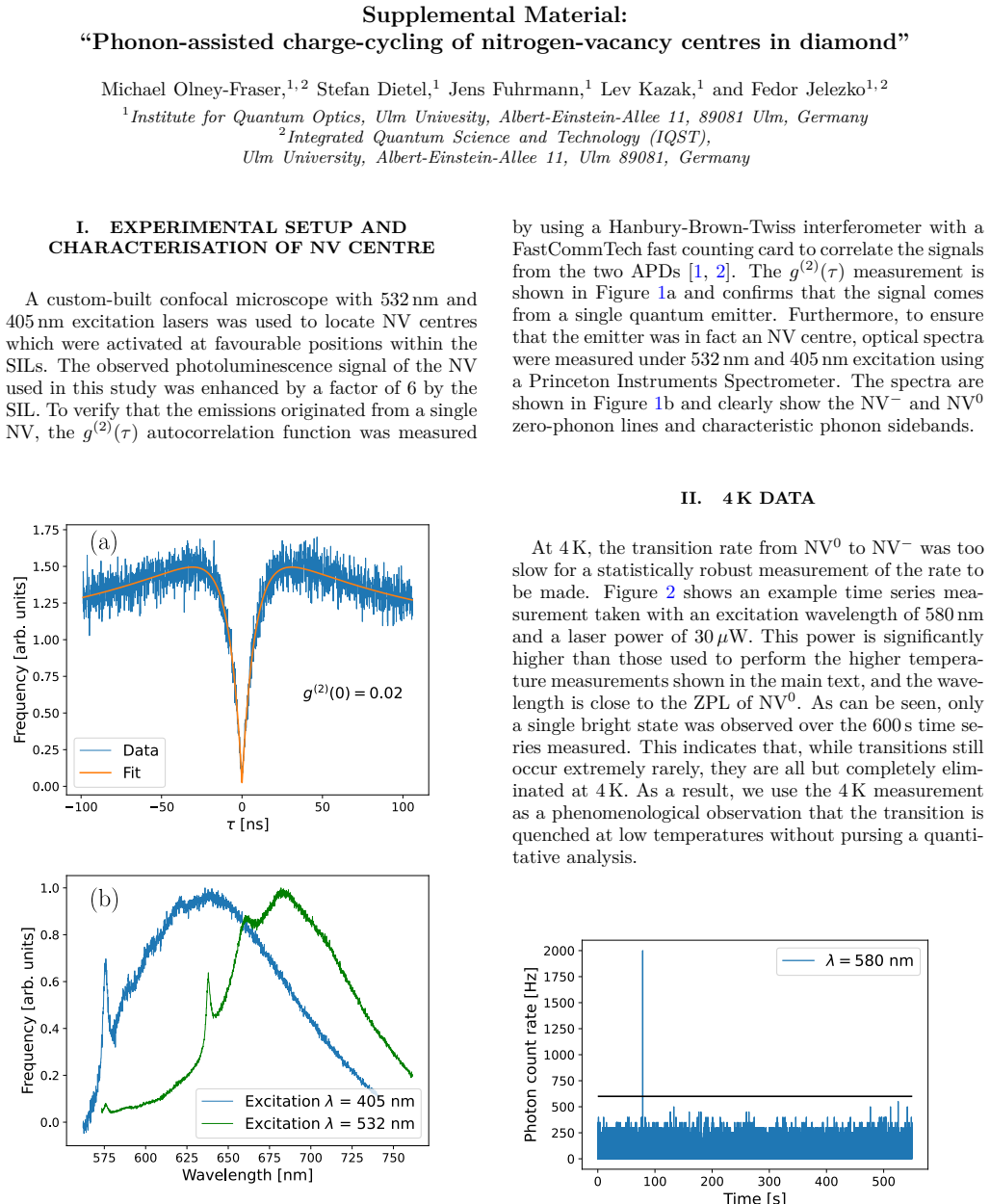
Z. Su, Z. Ren, Y. Bao, X. Lao, J. Zhang, J. Zhang, D. Zhu, Y. Lu, Y. Hao, and S. Xu, Luminescence land- scapes of nitrogen-vacancy centers in diamond: quasi- localized vibrational resonances and selective coupling, J. Mater. Chem. C7, 8086 (2019). Supplemental Material: “Phonon-assisted charge-cycling of nitrogen-vacancy centres in diamond” Michael Olney-...
work page 2019
-
[37]
R. Hanbury Brown and R. Twiss, Correlation between photons in two coherent beams of light, Nature177, 27 (1956)
work page 1956
-
[38]
V. Zwiller, H. Blom, P. Jonsson, N. Panev, S. Jeppesen, T. Tsegaye, E. Goobar, M.-E. Pistol, L. Samuelson, and G. Björk, Single quantum dots emit single photons at a time: Antibunching experiments, Appl. Phys. Lett.78, 2476 (2001)
work page 2001
-
[39]
L. J. S. Allen,An Introduction to Stochastic Processes with Applications to Biology(Chapman and Hall, London, 2010)
work page 2010
-
[40]
A. Alkauskas, B. B. Buckley, D. D. Awschalom, and C. G. Van de Walle, First-principles theory of the luminescence lineshape for the triplet transition in diamond nv centres, New J. Phys.16, 073026 (2014)
work page 2014
- [41]
-
[42]
L. Razinkovas, M. W. Doherty, N. B. Manson, C. G. Van de Walle, and A. Alkauskas, Vibrational and vibronic structure of isolated point defects: The nitrogen-vacancy center in diamond, Phys. Rev. B104, 045303 (2021)
work page 2021
-
[43]
McQuarrie,Statistical Mechanics(University Science Books, Boston, 2000)
D. McQuarrie,Statistical Mechanics(University Science Books, Boston, 2000)
work page 2000
discussion (0)
Sign in with ORCID, Apple, or X to comment. Anyone can read and Pith papers without signing in.