Study of the Superradiance Phenomenon in the α--attractor Potential using the Log Derivative Method
Pith reviewed 2026-05-12 04:37 UTC · model grok-4.3
The pith
The α-attractor potential exhibits superradiance, as shown by reflection and transmission coefficients from the Klein-Gordon equation solved with the log derivative method.
A machine-rendered reading of the paper's core claim, the machinery that carries it, and where it could break.
Core claim
By solving the Klein-Gordon equation in the α-attractor potential with the log derivative method, the authors obtain reflection and transmission coefficients that demonstrate the presence of the superradiance phenomenon.
What carries the argument
The log derivative method, which evaluates the logarithmic derivative of the wave function to extract scattering coefficients R and T for the given potential.
If this is right
- Superradiance is present in scattering off the α-attractor potential.
- The computed coefficients match the exact analytical solution for the hyperbolic tangent potential.
- The method can be applied to obtain scattering data for this class of potentials.
Where Pith is reading between the lines
- The same numerical approach could be used to test superradiance in other potentials that lack closed-form solutions.
- If the potential models aspects of cosmological or analog gravity systems, the amplification effect might appear in those settings.
Load-bearing premise
The log derivative method accurately captures the scattering behavior for the α-attractor potential without numerical artifacts or convergence issues that would invalidate the coefficients.
What would settle it
A numerical solution of the Klein-Gordon equation for the α-attractor potential in which the reflection coefficient never exceeds unity for any frequency would falsify the claim that superradiance is present.
Figures
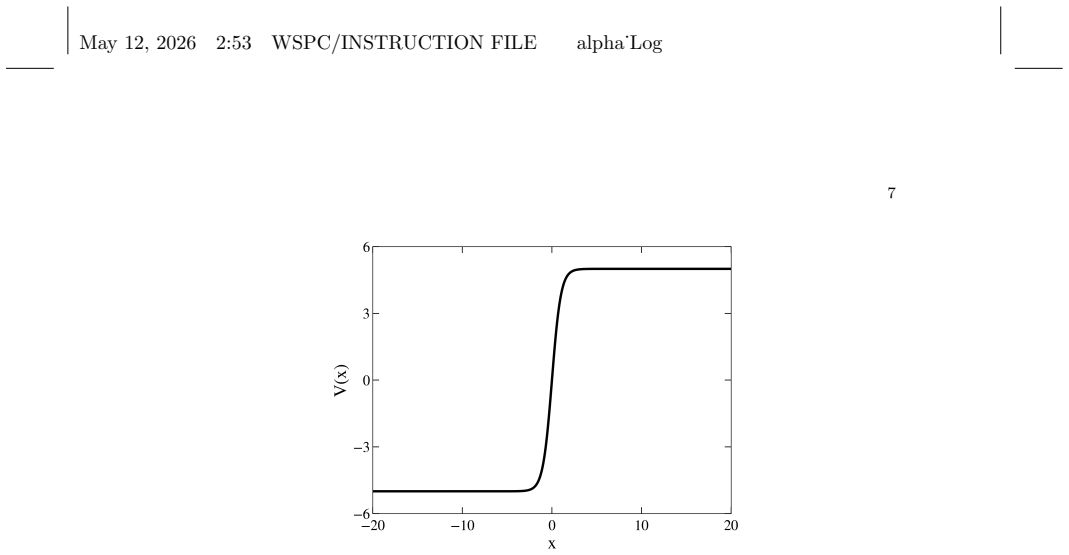


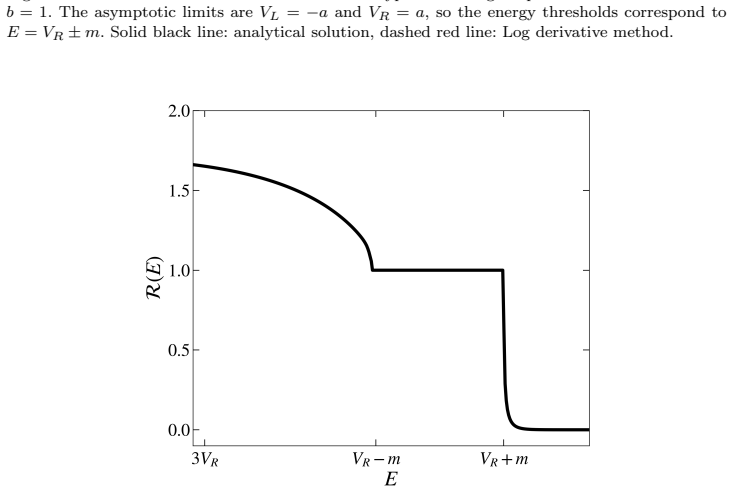
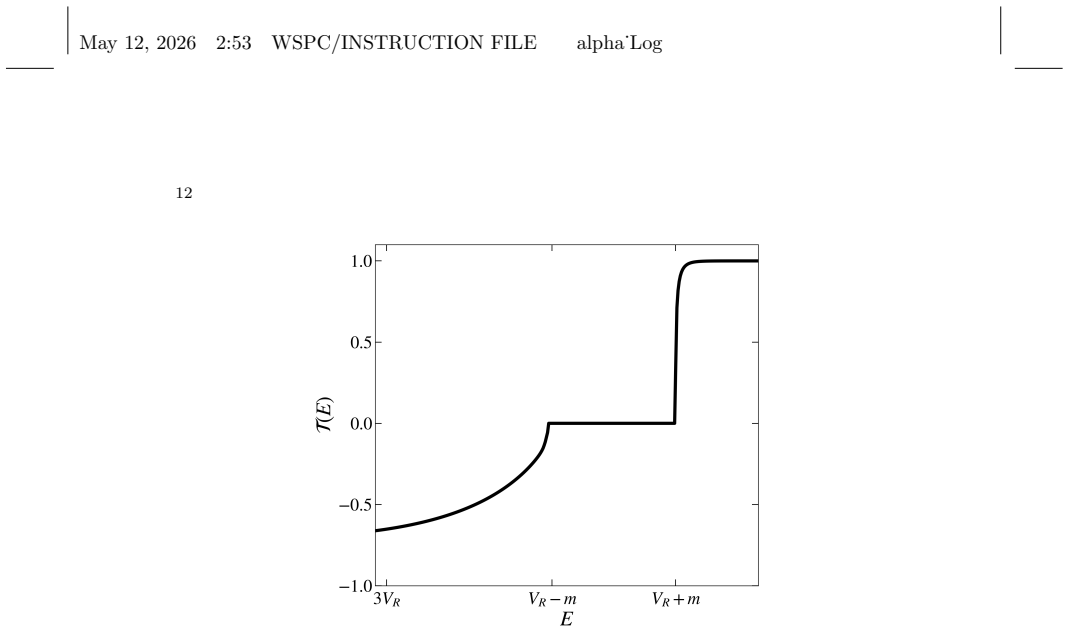
read the original abstract
In this article, we solved the time--independent one--dimensional Klein--Gordon equation in the presence of $\alpha$--attractor potential using the Log derivative method. We calculated the reflection coefficient $\mathcal{R}$ and the transmission coefficient $\mathcal{T}$, showing that the superradiance phenomenon is present. In order to demonstrate the accuracy of our method, we performed a comparison with the analytical solution for the hyperbolic tangent potential.
Editorial analysis
A structured set of objections, weighed in public.
Referee Report
Summary. The manuscript solves the time-independent one-dimensional Klein-Gordon equation for the α-attractor potential using the log-derivative method. It computes the reflection coefficient ℛ and transmission coefficient 𝒯 to demonstrate the presence of superradiance (|ℛ| > 1 in the relevant frequency window) and validates the numerical implementation by reproducing the known analytic scattering coefficients for the hyperbolic-tangent potential.
Significance. If the numerical extraction of ℛ and 𝒯 is accurate and free of artifacts, the work provides a concrete demonstration of superradiance for a smooth potential motivated by inflationary cosmology. The direct validation against an analytic case with comparable asymptotic structure is a strength, as it supports the reliability of the log-derivative approach for this class of potentials without introducing fitted parameters or circular definitions.
minor comments (2)
- The abstract states that superradiance is shown but does not report specific coefficient values, frequency ranges, error estimates, or parameter values used; adding a brief quantitative statement (e.g., peak |ℛ| and the interval where |ℛ| > 1) would strengthen the claim without altering the manuscript length.
- The validation section would benefit from an explicit statement of the numerical convergence criteria (grid spacing, integration limits, or tolerance on the log-derivative) to allow readers to assess possible discretization artifacts for the α-attractor case.
Simulated Author's Rebuttal
We thank the referee for their careful reading of the manuscript and for the positive recommendation of minor revision. The referee's summary correctly describes our use of the log-derivative method to solve the time-independent Klein-Gordon equation for the α-attractor potential, our computation of the reflection and transmission coefficients to identify superradiance, and our validation against the analytic hyperbolic-tangent case.
Circularity Check
No significant circularity detected
full rationale
The paper numerically solves the 1D time-independent Klein-Gordon equation for the alpha-attractor potential via the log-derivative method, extracts scattering coefficients R and T, and reports superradiance (|R| > 1). Validation consists of reproducing the known analytic R/T for the hyperbolic-tangent potential. No step reduces by construction to a fitted parameter, self-definition, or load-bearing self-citation; the central result is obtained directly from the numerical integration of a standard differential equation with an independent benchmark case.
Axiom & Free-Parameter Ledger
axioms (1)
- domain assumption The time-independent one-dimensional Klein-Gordon equation governs the wave behavior in the given potential.
Lean theorems connected to this paper
-
IndisputableMonolith/Cost/FunctionalEquation.leanwashburn_uniqueness_aczel unclear?
unclearRelation between the paper passage and the cited Recognition theorem.
We solved the time-independent one-dimensional Klein-Gordon equation ... using the Log derivative method. We calculated the reflection coefficient R and the transmission coefficient T, showing that the superradiance phenomenon is present.
-
IndisputableMonolith/Foundation/RealityFromDistinction.leanreality_from_one_distinction unclear?
unclearRelation between the paper passage and the cited Recognition theorem.
the Log derivative method ... y'(x) = -k²(x) - y²(x)
What do these tags mean?
- matches
- The paper's claim is directly supported by a theorem in the formal canon.
- supports
- The theorem supports part of the paper's argument, but the paper may add assumptions or extra steps.
- extends
- The paper goes beyond the formal theorem; the theorem is a base layer rather than the whole result.
- uses
- The paper appears to rely on the theorem as machinery.
- contradicts
- The paper's claim conflicts with a theorem or certificate in the canon.
- unclear
- Pith found a possible connection, but the passage is too broad, indirect, or ambiguous to say the theorem truly supports the claim.
Reference graph
Works this paper leans on
-
[1]
O. Klein. Quantentheorie und f¨ unfdimensionale Relativit¨ atstheorie.Z. Phys., 37:895, 1926
work page 1926
-
[2]
W. Gordon. Der Comptoneffekt nach der Schr¨ odingerschen Theorie.Z. Phys., 40:117, 1926
work page 1926
-
[3]
S. Valladares, and C. Rojas. The superradiance phenomenon in spin–one particles. Int. J. Mod. Phys. A, 38:2350020, 2023
work page 2023
-
[4]
V. H. Badalov and S. V. Badalov. Generalised tanh-shaped hyperbolic potential: Klein–Gordon equation’s bound state solution.Commun. Theor. Phys., 75:075003, 2023
work page 2023
-
[5]
Nadjat Benchiheub, M. Berrehail, and N. Grar. A Proper Quantization Rule for Solv- ing the Klein–Gordon Equation with Equal and Unequal Scalar and Vector Interaction Potentials.Jordan J. Phys., 17:517, 2024
work page 2024
-
[6]
S. M. Ikhdair and R. Sever. Anyℓ-State Solutions of the Woods–Saxon Potential in Arbitrary Dimensions within the New Improved Quantization Rule.Int. J. Mod. Phys. A, 25:3941, 2010
work page 2010
-
[7]
C. Rojas. Scattering solutions of the Klein–Gordon equation for a step potential with hyperbolic tangent potential.Int. J. Mod. Phys. A, 29:1450146, 2014
work page 2014
- [8]
-
[9]
H. I. Ahmadov, E. A. Dadashov, N. Sh. Huseynova, and V. H. Badalov. Generalized tanh–shaped hyperbolic potential: bound state solution of Schr¨ odinger equation.Eur. Phys. J. Plus, 136:244, 2021
work page 2021
-
[10]
M. Abramowitz and I. A. Stegun.Handbook of Mathematical Functions. Dover, New York, 1965
work page 1965
-
[11]
C. A. Manogue. The Klein paradox and superradiance.Ann. Phys., 181:261, 1988
work page 1988
-
[12]
Seventy years of the klein paradox.Physics Reports, 315(1-3):41–58, 1999
Norman Dombey and Alex Calogeracos. Seventy years of the klein paradox.Physics Reports, 315(1-3):41–58, 1999
work page 1999
-
[13]
L. A. Sal´ o, D. Benisty, E. I. Guendelman, and. J. d. Haro.α–attractors in quintessen- tial inflation motivated by supergravity.Phys. Rev. D, 103:123535, 2021
work page 2021
-
[14]
B. de Zayas and C. Rojas. Proof of the non-existence of Liouvillian solutions and of representations in terms of compositions of classical special functions for the DKP equation and theα–attractor potential. In preparation, 2026
work page 2026
-
[15]
B. R. Johnson. Multichannel log-derivative method for scattering calculations.J. Com- put. Phys., 13:445, 1973
work page 1973
-
[16]
M. Hamzavi, and S. M. Ikhdair. Approximate solution of the Duffin–Kemmer–Petiau equation for a vector Yukawa potential with arbitrary total angular momenta.Few- Body Syst., 54:1753, 2013. May 12, 2026 2:53 WSPC/INSTRUCTION FILE alpha˙Log 14
work page 2013
-
[17]
D. E. Manolopoulos. An improved log–derivative method for inelastic scattering.J. Chem. Phys., 85:6425, 1986
work page 1986
-
[18]
D. E. Manolopoulos, M. J. Jamieson, and A. D. Pradhan. Johnson’s Log Derivative Algorithm Rederived.J. Comput. Phys., 105:169, 1993
work page 1993
-
[19]
J. M. Hutson. Coupled channel methods for solving the bound–state Schr¨ odinger equation.Comput. Phys. Commun., 84:1, 1994
work page 1994
-
[20]
A. Andrade, D. Laroze, L. P´ erez, B. de Zayas, and C. Rojas. Study of the superradi- ance phenomenon in theα–attractor potential using the transfer matrix method. In preparation, 2026
work page 2026
-
[21]
K. Dimopoulos, and C. Owen. Quintessential Inflation withα-attractors.JCAP, 2017:027, 2017
work page 2017
-
[22]
J. Zambrano, Miguel Agama, M. Garz´ on, W. Br¨ amer–Escamilla, C. Rojas and T. Vargas. Quintessential inflation studied through semiclassical methods.Int. J. Mod. Phys. D, 35:2550093, 2025
work page 2025
-
[23]
New frontiers in black hole physics.Lecture Notes in Phys, 906:1, 2015
Richard Brito, Vitor Cardoso, and PP Superradiance. New frontiers in black hole physics.Lecture Notes in Phys, 906:1, 2015
work page 2015
-
[24]
Quantization Rule for Relativistic Klein–Gordon Equation.Bull
Hosung Sun. Quantization Rule for Relativistic Klein–Gordon Equation.Bull. Korean Chem. Soc., 32:4233, 2011
work page 2011
-
[25]
W. Greiner,et. al.Relativistic Quantum Mechanics, volume 2. Springer, 2000
work page 2000
-
[26]
L. Mel´ endez–Lugo. A General Analytical Solution to the Nonlinear Riccati Differential Equation.JHEPGC, 11:1285, 2025
work page 2025
-
[27]
Johnson B. R. New numerical methods applied to solving the one–dimensional eigen- value problem.J. Chem. Phys., 67:4086, 1977
work page 1977
-
[28]
Adam E. Parker. Runge–Kutta 4 (and Other Numerical Methods for ODEs), 2021
work page 2021
-
[29]
A. Calogeracos, and N. Dombey. History and physics of the Klein paradox.Contemp. Phys., 40:313, 1999
work page 1999
-
[30]
C. Rojas. Scattering of a scalar relativistic particle by the hyperbolic tangent potential. Can. J. Phys, 43:1147, 2015
work page 2015
-
[31]
Wolfram Research, Inc.Mathematica, Version 14.3. Champaign, IL, 2026
work page 2026
discussion (0)
Sign in with ORCID, Apple, or X to comment. Anyone can read and Pith papers without signing in.