LLMs for Secure Hardware Design and Related Problems: Opportunities and Challenges
Pith reviewed 2026-05-21 08:54 UTC · model grok-4.3
The pith
Large language models can generate RTL hardware code and automate security analysis but introduce severe vulnerabilities in the designs they create.
A machine-rendered reading of the paper's core claim, the machinery that carries it, and where it could break.
Core claim
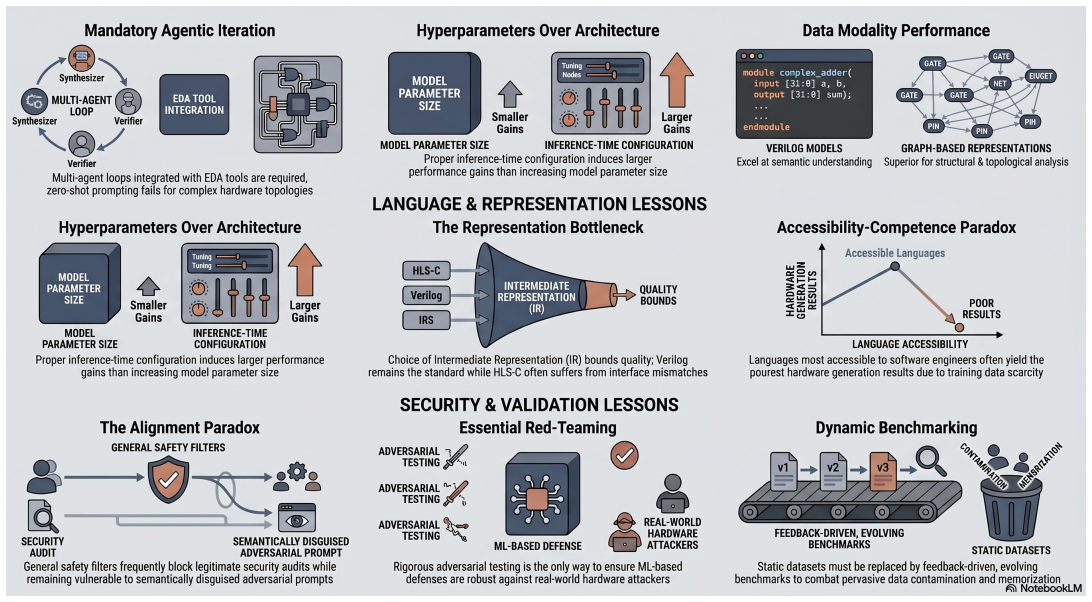
The paper asserts that LLMs offer unprecedented capabilities in generating Register Transfer Level (RTL) code, automating testbenches, and bridging the semantic gap between high-level specifications and silicon, while simultaneously introducing severe vulnerabilities, and it reviews the state-of-the-art along with countermeasures such as dynamic benchmarking and aggressive red-teaming.
What carries the argument
The central mechanism is the structured survey of methodologies including reasoning-driven synthesis, multi-agent vulnerability extraction, data contamination, and adversarial machine learning evasion, which frames both the opportunities in hardware design and the security challenges.
Load-bearing premise
The review depends on the premise that the cited recent breakthroughs in LLM applications to hardware accurately represent the full state of the field without significant selection bias.
What would settle it
An independent study that applies multiple LLMs to a fixed set of hardware design tasks, then subjects the outputs to exhaustive security audits and finds neither data leaks nor new attack surfaces, would undermine the claim of severe vulnerabilities.
Figures
read the original abstract
The integration of Large Language Models (LLMs) into Electronic Design Automation (EDA) and hardware security is rapidly reshaping the semiconductor industry. While LLMs offer unprecedented capabilities in generating Register Transfer Level (RTL) code, automating testbenches, and bridging the semantic gap between high-level specifications and silicon, they simultaneously introduce severe vulnerabilities. This comprehensive review provides an in-depth analysis of the state-of-the-art in LLM-driven hardware design, organized around key advancements in EDA synthesis, hardware trust, design for security, and education. We systematically expand on the methodologies of recent breakthroughs -- from reasoning-driven synthesis and multi-agent vulnerability extraction to data contamination and adversarial machine learning (ML) evasion. We integrate general discussions on critical countermeasures, such as dynamic benchmarking to combat data memorization and aggressive red-teaming for robust security assessment. Finally, we synthesize cross-cutting lessons learned to guide future research toward secure, trustworthy, and autonomous design ecosystems.
Editorial analysis
A structured set of objections, weighed in public.
Referee Report
Summary. The manuscript is a review paper claiming to deliver a comprehensive analysis of LLMs in Electronic Design Automation (EDA) and hardware security. It organizes coverage around advancements in RTL code generation, testbench automation, hardware trust, design for security, and education; expands on methodologies including reasoning-driven synthesis, multi-agent vulnerability extraction, data contamination, and adversarial ML evasion; integrates discussions of countermeasures such as dynamic benchmarking and red-teaming; and synthesizes cross-cutting lessons for secure, trustworthy design ecosystems.
Significance. If the survey achieves balanced coverage without selection bias, it would offer a useful synthesis of how LLMs can bridge semantic gaps in hardware design while surfacing introduced vulnerabilities and countermeasures. The paper's explicit integration of both opportunities and risks, plus its focus on cross-cutting lessons, is a strength that could guide future work on autonomous yet secure EDA systems.
major comments (2)
- [Abstract and Introduction] Abstract and Introduction: the claim that the review 'systematically expand[s] on the methodologies of recent breakthroughs' and provides 'comprehensive' coverage is load-bearing for the central thesis that cited work on reasoning-driven synthesis, multi-agent vulnerability extraction, and data contamination accurately reflects the full state of LLM use in hardware. No explicit inclusion criteria, search strings, databases, or coverage statistics are provided, raising the risk of over-representation of high-profile results and omission of contradictory or incremental work.
- [State-of-the-art advancements] Section on state-of-the-art advancements (EDA synthesis / hardware trust): the assumption that the surveyed breakthroughs represent both opportunities and risks across the field lacks supporting evidence of systematic selection; without this, the cross-cutting lessons on countermeasures cannot be verified as robust against selection bias.
minor comments (2)
- [Throughout] Ensure consistent use of terminology such as 'EDA synthesis' versus 'hardware trust' and 'design for security' to aid readers crossing from LLM to hardware-security communities.
- [Conclusion / lessons learned] The final synthesis of lessons learned would benefit from one or two concrete, referenced examples of how a specific countermeasure (e.g., dynamic benchmarking) has been applied in cited work.
Simulated Author's Rebuttal
We thank the referee for their constructive review and for recognizing the paper's integration of opportunities and risks in LLM-driven hardware design. The comments on methodological transparency are well-taken and point to areas where we can improve clarity without altering the core synthesis. We address each major comment below and indicate the revisions we will make.
read point-by-point responses
-
Referee: [Abstract and Introduction] Abstract and Introduction: the claim that the review 'systematically expand[s] on the methodologies of recent breakthroughs' and provides 'comprehensive' coverage is load-bearing for the central thesis that cited work on reasoning-driven synthesis, multi-agent vulnerability extraction, and data contamination accurately reflects the full state of LLM use in hardware. No explicit inclusion criteria, search strings, databases, or coverage statistics are provided, raising the risk of over-representation of high-profile results and omission of contradictory or incremental work.
Authors: We acknowledge that the abstract and introduction assert systematic expansion and comprehensive coverage without detailing the underlying literature selection process. This is a fair observation that could raise valid concerns about selection bias. In the revised manuscript, we will add a new subsection in the Introduction titled 'Review Scope and Methodology.' This subsection will specify the primary sources consulted (arXiv, IEEE Xplore, ACM Digital Library, and proceedings from DAC, ICCAD, USENIX Security, and CHES), representative search terms employed (e.g., 'LLM RTL generation,' 'LLM hardware security,' 'LLM EDA vulnerabilities'), the approximate time window (primarily 2022–2024), and the criteria for selecting illustrative works (focus on methodological novelty and security implications rather than exhaustive enumeration). We will also explicitly note that the review prioritizes key trends and representative breakthroughs over a formal PRISMA-style systematic literature review, and we will highlight limitations in coverage. These additions will provide the requested transparency while preserving the paper's narrative focus. revision: yes
-
Referee: [State-of-the-art advancements] Section on state-of-the-art advancements (EDA synthesis / hardware trust): the assumption that the surveyed breakthroughs represent both opportunities and risks across the field lacks supporting evidence of systematic selection; without this, the cross-cutting lessons on countermeasures cannot be verified as robust against selection bias.
Authors: We agree that the absence of explicit selection evidence weakens the ability to verify robustness of the cross-cutting lessons against bias. To address this directly, we will revise the state-of-the-art advancements section to include a short paragraph justifying the inclusion of the surveyed works as representative of both opportunity and risk dimensions. We will also incorporate additional citations to incremental or contrasting studies (e.g., works emphasizing limitations of current LLM approaches or alternative non-LLM baselines) where they strengthen the discussion of countermeasures such as dynamic benchmarking and red-teaming. These changes will make the basis for the synthesized lessons more verifiable while maintaining the paper's emphasis on cross-cutting insights for secure design ecosystems. revision: yes
Circularity Check
Survey paper exhibits no circularity in literature synthesis
full rationale
This is a review paper that summarizes and organizes existing literature on LLMs for hardware design, EDA, and security without presenting original derivations, equations, fitted parameters, or predictions. The central claims rest on descriptions of cited breakthroughs from other works rather than any self-referential reduction or construction from the paper's own inputs. Self-citations, if present, function as standard references to prior independent research and do not load-bear the synthesis or force conclusions via uniqueness theorems or ansatzes. The analysis of opportunities, challenges, and countermeasures is externally grounded in the surveyed state-of-the-art, making the review self-contained.
discussion (0)
Sign in with ORCID, Apple, or X to comment. Anyone can read and Pith papers without signing in.