Dynamical aspects of steady-state subradiance: Detailed balance and its breakdown
Pith reviewed 2026-05-20 19:15 UTC · model grok-4.3
The pith
In the subradiant regime of a bad-cavity laser, one phase makes the underlying Markov chain time-reversible with growing atom number while the other breaks detailed balance through circulating currents.
A machine-rendered reading of the paper's core claim, the machinery that carries it, and where it could break.
Core claim
A dissipative phase transition in the subradiant regime of the bad-cavity laser divides the steady-state behavior into two phases for the Markov chain on collective angular momentum states: one phase satisfies detailed balance with increasing atom number N and is therefore effectively time-reversible, while the other phase exhibits time-asymmetric probability currents that break detailed balance and produce a macroscopic internal entropy production rate scaling extensively with N.
What carries the argument
The two-dimensional Markov chain on collective angular momentum states that describes the bad-cavity laser dynamics, together with the detailed-balance condition and the probability currents that appear in its state space.
If this is right
- Collective atomic emission reduces the Markov chain to one dimension and restores time-reversibility in one phase.
- Time-asymmetric probability currents emerge in the two-dimensional state space of the other phase.
- Internal entropy production grows extensively with atom number N when detailed balance is broken.
- Self-pulsing appears in the cavity light output and produces a detectable anti-correlation dip in the intensity correlation function.
Where Pith is reading between the lines
- The same reduction to collective states might allow other dissipative many-body systems to be classified according to whether their effective classical descriptions remain time-reversible.
- The scaling of entropy production with system size offers a route to quantify the thermodynamic cost of maintaining steady-state subradiance in larger ensembles.
- Detecting the anti-correlation dip provides a practical experimental handle on the breakdown of detailed balance without requiring full tomography of the atomic state.
Load-bearing premise
The dissipative dynamics of the bad-cavity laser can be reduced to a classical Markov chain on a two-dimensional space of collective angular momentum states.
What would settle it
Measure the second-order intensity correlation function of the cavity output and check whether an anti-correlation dip appears only in one of the two subradiant phases while the entropy production rate scales linearly with atom number N in that same phase.
Figures


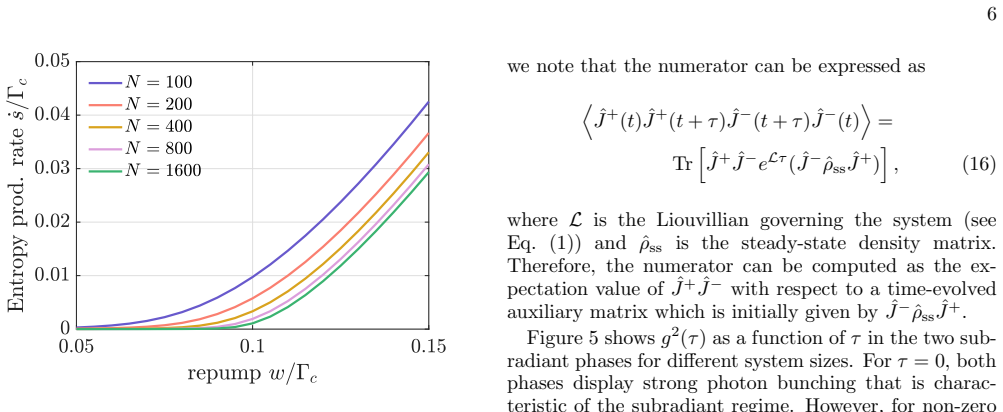

read the original abstract
The dynamics of dissipative many-body quantum systems sometimes admit an emergent classical description in terms of a Markov chain even though the corresponding state space contains highly entangled states. In particular, a bad-cavity laser is a paradigm system whose dynamics can be formulated as a Markov chain in a two-dimensional state space spanned by collective angular momentum states. In this article, we investigate the connection between a dissipative phase transition that occurs in the subradiant regime of this system in the large atom number limit, and the properties of the underlying Markov chain. In one of the phases, the Markov chain approaches the detailed-balance condition with increasing atom number $N$ and hence becomes effectively time-reversible. This is caused by a collective atomic emission process that effectively reduces the Markov chain to one dimension. In the other phase, we find the emergence of time-asymmetric probability currents in the two-dimensional state space that signals a breakdown of detailed balance. This is accompanied by a macroscopic internal entropy production rate in the Markov chain that scales extensively with the atom number $N$. An observable consequence of the probability currents is a self-pulsing of the cavity light output in this phase, which can be detected as an anti-correlation dip in the intensity correlation function.
Editorial analysis
A structured set of objections, weighed in public.
Referee Report
Summary. The manuscript examines the connection between a dissipative phase transition in the subradiant regime of a bad-cavity laser and the properties of its Markov-chain description on collective angular-momentum states. In one phase the chain approaches detailed balance (and effective time-reversibility) with growing N because a single collective emission process reduces the dynamics to one dimension; in the other phase time-asymmetric probability currents appear, producing an extensive internal entropy-production rate and an observable self-pulsing signature in the cavity intensity correlation function.
Significance. The work links dissipative phase transitions in open quantum systems to nonequilibrium thermodynamic notions (detailed-balance restoration versus breakdown, macroscopic entropy production) while retaining an explicit, experimentally accessible observable. The demonstration that highly entangled states can still yield an emergent low-dimensional classical Markov chain is a useful conceptual contribution.
major comments (1)
- [§3.2] §3.2 and the rate-scaling discussion following Eq. (11): the central claim that collective emission reduces the chain to an effectively one-dimensional, detailed-balance-satisfying dynamics rests on the assertion that all other transition channels are suppressed by at least 1/N. An explicit asymptotic bound or numerical check confirming that non-collective rates remain negligible uniformly across the phase (including near the transition) is needed; without it the reduction argument is not yet load-bearing.
minor comments (2)
- [§4] The definition of the internal entropy production rate (Eq. (19)) is given only after the probability-current discussion; moving the definition earlier would improve readability.
- [Figure 3] Figure 3 caption: the anti-correlation dip is described as 'clearly visible,' but the vertical scale and the value of the minimum should be stated numerically for quantitative comparison with experiment.
Simulated Author's Rebuttal
We thank the referee for their positive assessment of our work and for the constructive comment, which helps strengthen the central argument. We address the point below and will revise the manuscript accordingly.
read point-by-point responses
-
Referee: [§3.2] §3.2 and the rate-scaling discussion following Eq. (11): the central claim that collective emission reduces the chain to an effectively one-dimensional, detailed-balance-satisfying dynamics rests on the assertion that all other transition channels are suppressed by at least 1/N. An explicit asymptotic bound or numerical check confirming that non-collective rates remain negligible uniformly across the phase (including near the transition) is needed; without it the reduction argument is not yet load-bearing.
Authors: We thank the referee for this observation. The manuscript states that the collective emission rate scales as N while non-collective channels remain O(1), implying 1/N suppression, but we agree that an explicit uniform bound and supporting numerics would make the reduction to one-dimensional detailed-balance dynamics fully rigorous. In the revision we will add (i) an asymptotic analysis bounding the ratio of non-collective to collective transition rates by C/N for a constant C independent of the control parameter (including in a neighborhood of the transition), and (ii) numerical checks of the steady-state distribution and entropy-production rate for N up to 100 that confirm the suppression holds uniformly across the phase diagram. These additions will be placed in §3.2 and the discussion after Eq. (11). revision: yes
Circularity Check
No significant circularity; Markov chain reduction and detailed-balance analysis are derived from rate equations
full rationale
The paper starts from the quantum master equation for the bad-cavity laser, projects onto collective angular-momentum states to obtain an explicit two-dimensional Markov chain with N-dependent transition rates, and then performs an asymptotic large-N analysis of those rates. The claim that one phase is dominated by a single collective emission channel (reducing the chain to effectively one dimension and restoring detailed balance) follows from comparing the scaling of the competing rates; the entropy production and probability currents are computed directly from the same rate matrix via the standard stochastic thermodynamics formulas. None of these steps redefines a fitted quantity as a prediction or imports a uniqueness result from self-citation; the derivation remains self-contained against the underlying Liouvillian.
Axiom & Free-Parameter Ledger
axioms (1)
- domain assumption The dynamics of the dissipative many-body quantum system admit an emergent classical Markov chain description in a two-dimensional state space spanned by collective angular momentum states.
Lean theorems connected to this paper
-
IndisputableMonolith/Foundation/ArrowOfTime.leanarrow_from_z unclear?
unclearRelation between the paper passage and the cited Recognition theorem.
the dynamics can be formulated as a Markov chain in a two-dimensional state space spanned by collective angular momentum states... recurrence relation Eq. (9) is the condition for detailed balance... internal entropy production rate ˙Si
-
IndisputableMonolith/Foundation/ArithmeticFromLogic.leanembed_strictMono_of_one_lt unclear?
unclearRelation between the paper passage and the cited Recognition theorem.
steady-state population distribution... Gaussian with mean μ = N/2 [(γ−w)/(γ+w)]
What do these tags mean?
- matches
- The paper's claim is directly supported by a theorem in the formal canon.
- supports
- The theorem supports part of the paper's argument, but the paper may add assumptions or extra steps.
- extends
- The paper goes beyond the formal theorem; the theorem is a base layer rather than the whole result.
- uses
- The paper appears to rely on the theorem as machinery.
- contradicts
- The paper's claim conflicts with a theorem or certificate in the canon.
- unclear
- Pith found a possible connection, but the passage is too broad, indirect, or ambiguous to say the theorem truly supports the claim.
Reference graph
Works this paper leans on
-
[1]
Open System Control of Atomic and Photonic Matter
The corresponding density matrix is ˆρs a,b =|ψ a,b⟩s ⟨ψa,b|s. Then, the PIJ= 0 state can be expressed as ˆS0,0,0 = ˆρs 12 ⊗ˆρs 34 ⊗. . .⊗ˆρ s N−1,N PI ,(6) representing the fact that this state consists of a mixture ofN/2 singlet pairs. We now combine the above observations to write down the form of the states for 0< J < N/2. We propose that any general ...
work page 2023
-
[2]
= 6 29 ≈0.207 P1 = 3P 0 ≈0.621 P2 = 5 18 P1 ≈0.172.(C8) 9 The neglected populationP 3 = 7P 2/75≈0.016≪1, therefore these steady-state population estimates are rea- sonably accurate. b. Steady-state population for0< w < γ Numerically, we find that only theM=−Jstates are occupied even whenγ >0, provided that 0< w < γ. Therefore, we can restrict our analysis...
-
[3]
R. H. Dicke, Coherence in spontaneous radiation pro- cesses, Phys. Rev.93, 99 (1954)
work page 1954
-
[4]
L. Ostermann, H. Ritsch, and C. Genes, Protected state enhanced quantum metrology with interacting two-level ensembles, Phys. Rev. Lett.111, 123601 (2013)
work page 2013
-
[5]
D. Meiser and M. J. Holland, Steady-state superradi- ance with alkaline-earth-metal atoms, Phys. Rev. A81, 033847 (2010)
work page 2010
-
[6]
A. Shankar, J. T. Reilly, S. B. J¨ ager, and M. J. Hol- land, Subradiant-to-subradiant phase transition in the bad cavity laser, Phys. Rev. Lett.127, 073603 (2021)
work page 2021
-
[7]
J. T. Reilly, S. B. J¨ ager, J. Cooper, and M. J. Holland, Fully collective superradiant lasing with vanishing sensi- tivity to cavity length vibrations, Phys. Rev. Lett.136, 143803 (2026)
work page 2026
- [8]
-
[9]
Y. Zhang, Y.-X. Zhang, and K. Mølmer, Monte-carlo sim- ulations of superradiant lasing, New Journal of Physics 20, 112001 (2018)
work page 2018
-
[10]
P. Gaspard, Time-reversed dynamical entropy and ir- reversibility in markovian random processes, Journal of Statistical Physics , 599 (2004)
work page 2004
-
[11]
U. Seifert, Stochastic thermodynamics, fluctuation the- orems and molecular machines, Reports on Progress in Physics75, 126001 (2012)
work page 2012
-
[12]
M. Esposito and C. Van den Broeck, Three faces of the second law. i. master equation formulation, Phys. Rev. E 82, 011143 (2010)
work page 2010
-
[13]
U. Seifert, Entropy production along a stochastic tra- jectory and an integral fluctuation theorem, Phys. Rev. Lett.95, 040602 (2005)
work page 2005
-
[14]
L. Cocconi, R. Garcia-Millan, Z. Zhen, B. Buturca, and G. Pruessner, Entropy production in exactly solvable sys- tems, Entropy22, 10.3390/e22111252 (2020)
-
[15]
G. T. Landi and M. Paternostro, Irreversible entropy pro- duction: From classical to quantum, Rev. Mod. Phys.93, 035008 (2021)
work page 2021
-
[16]
V. V. Temnov and U. Woggon, Photon statistics in the cooperative spontaneous emission, Opt. Express17, 5774 (2009)
work page 2009
-
[17]
J. P. Santos, G. T. Landi, and M. Paternostro, Wigner entropy production rate, Phys. Rev. Lett.118, 220601 (2017)
work page 2017
-
[18]
J. P. Santos, L. C. C´ eleri, F. Brito, G. T. Landi, and M. Paternostro, Spin-phase-space-entropy production, Phys. Rev. A97, 052123 (2018)
work page 2018
-
[19]
B. O. Goes, C. E. Fiore, and G. T. Landi, Quantum features of entropy production in driven-dissipative tran- sitions, Phys. Rev. Research2, 013136 (2020)
work page 2020
-
[20]
Xu,Theory of steady-state superradiance, Ph.D
M. Xu,Theory of steady-state superradiance, Ph.D. the- sis, University of Colorado at Boulder (2016)
work page 2016
-
[21]
S. B. J¨ ager, T. Schmit, G. Morigi, M. J. Holland, and R. Betzholz, Lindblad master equations for quantum sys- tems coupled to dissipative bosonic modes, Phys. Rev. Lett.129, 063601 (2022)
work page 2022
- [22]
-
[23]
M. Xu, D. A. Tieri, and M. J. Holland, Simulating open quantum systems by applying su(4) to quantum master equations, Phys. Rev. A87, 062101 (2013)
work page 2013
-
[24]
N. Shammah, S. Ahmed, N. Lambert, S. De Liberato, and F. Nori, Open quantum systems with local and col- lective incoherent processes: Efficient numerical simula- tions using permutational invariance, Phys. Rev. A98, 063815 (2018)
work page 2018
-
[25]
L. Mandel and E. Wolf,Optical Coherence and Quantum Optics(Cambridge University Press, 1995)
work page 1995
-
[26]
B. A. Chase and J. M. Geremia, Collective processes of an ensemble of spin-1/2 particles, Phys. Rev. A78, 052101 (2008)
work page 2008
-
[27]
B. Q. Baragiola, B. A. Chase, and J. Geremia, Collective uncertainty in partially polarized and partially decohered spin- 1 2 systems, Phys. Rev. A81, 032104 (2010)
work page 2010
-
[28]
I. Urizar-Lanz, P. Hyllus, I. L. Egusquiza, M. W. Mitchell, and G. T´ oth, Macroscopic singlet states for gra- dient magnetometry, Phys. Rev. A88, 013626 (2013)
work page 2013
-
[29]
E. Rold´ an, I. Neri, M. D¨ orpinghaus, H. Meyr, and F. J¨ ulicher, Decision making in the arrow of time, Phys. Rev. Lett.115, 250602 (2015)
work page 2015
-
[30]
Dynamical aspects of steady-state subradiance: De- tailed balance and its breakdown (code to generate data) (2026)
work page 2026
-
[31]
H. Georgi,Lie Algebras In Particle Physics: from Isospin To Unified Theories, Frontiers in Physics (Avalon Pub- lishing, 1999)
work page 1999
-
[32]
Pfeifer,The Lie Algebras su(N), An Introduction (Birkh¨ auser, 2003)
W. Pfeifer,The Lie Algebras su(N), An Introduction (Birkh¨ auser, 2003)
work page 2003
discussion (0)
Sign in with ORCID, Apple, or X to comment. Anyone can read and Pith papers without signing in.