Warm inflation in Weyl geometric gravity
Pith reviewed 2026-05-19 20:43 UTC · model grok-4.3
pith:MGOOYFUI Add to your LaTeX paper
What is a Pith Number?\usepackage{pith}
\pithnumber{MGOOYFUI}
Prints a linked pith:MGOOYFUI badge after your title and writes the identifier into PDF metadata. Compiles on arXiv with no extra files. Learn more
The pith
Warm inflation in Weyl geometric gravity allows the universe to transition naturally from inflation to radiation domination.
A machine-rendered reading of the paper's core claim, the machinery that carries it, and where it could break.
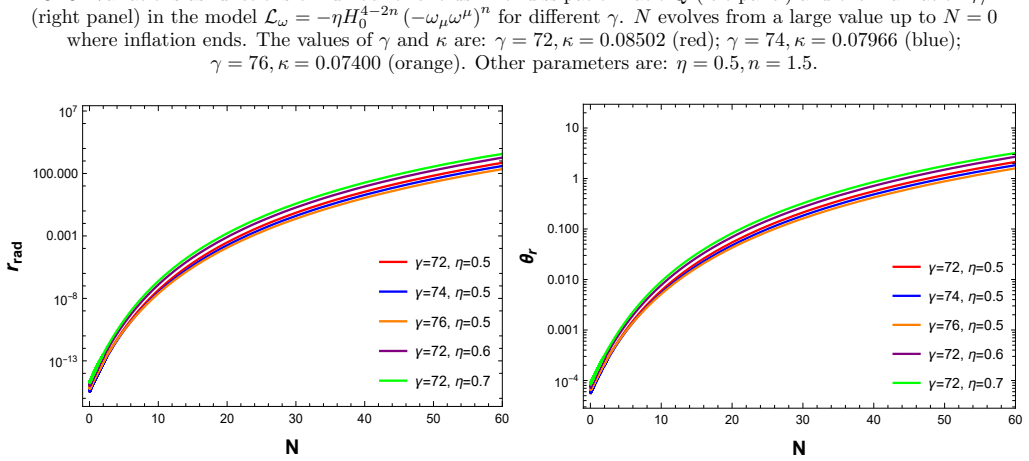
Core claim
We have successfully developed a warm inflationary model in which the Universe transitions naturally from an inflationary epoch to a radiation-dominated era. The relevant cosmological observables have been calculated and compared with the latest observational constraints from the ACT data after investigating the influence of the Weyl vector term on the dynamics for the linear dissipation coefficient model along with a quartic potential.
What carries the argument
The warm inflationary dynamics in which radiation, the inflaton field, and the Weyl vector coexist inside the conformally invariant Weyl geometric gravity action.
If this is right
- The model achieves the required transition for multiple coupling choices between the Weyl vector and the inflaton.
- Observable quantities such as the scalar spectral index and tensor-to-scalar ratio can be computed numerically and remain compatible with ACT data.
- The higher-order curvature terms are equivalently recast as an additional scalar degree of freedom whose effects are incorporated into the warm-inflation equations.
Where Pith is reading between the lines
- If the Weyl vector modifies the dissipation rate in the manner shown, similar vector fields could be tested as a source of reduced fine-tuning in other modified-gravity inflationary models.
- The framework suggests that future CMB experiments sensitive to vector-mode contributions might place independent limits on the Weyl coupling strength.
- The same numerical approach could be repeated with different potentials or temperature-dependent dissipation coefficients to map the viable parameter space more broadly.
Load-bearing premise
The assumption that the linear dissipation coefficient together with a quartic potential remains a valid and sufficient description once the Weyl vector is included, and that the chosen coupling models allow the required transition without additional fine-tuning or post-hoc adjustments.
What would settle it
A numerical result or observational datum showing that the Weyl vector term prevents the smooth exit into radiation domination or pushes the predicted spectral index and tensor-to-scalar ratio outside the ACT-allowed ranges.
Figures




read the original abstract
We investigate the warm inflationary scenario in the Weyl geometric gravity theory, in which the action is constructed by adding matter to the simplest conformally invariant gravitational action in Weyl geometry. The $\tilde{R}^2$ theory can be formulated equivalently as a linear theory supplemented by an additional scalar degree of freedom originating from higher-order curvature terms, with the equations of motion obtained via variational methods. We investigate the cosmological implications of the theory by considering the warm inflationary scenario of the early evolution of the Universe, in which radiation, the inflaton field, and the Weyl vector coexist. We consider the widely studied linear dissipation coefficient model along with a quartic potential, and investigate the influence of the Weyl vector term on the dynamics. We have performed numerical computations for different coupling models, and we have successfully developed a warm inflationary model in which the Universe transitions naturally from an inflationary epoch to a radiation-dominated era. The relevant cosmological observables have been calculated and compared with the latest observational constraints from the ACT data.
Editorial analysis
A structured set of objections, weighed in public.
Referee Report
Summary. The paper develops a warm inflationary model within Weyl geometric gravity by supplementing the conformally invariant gravitational action with matter. It reformulates the theory as an equivalent linear gravity model plus an extra scalar degree of freedom, derives the equations of motion, and studies the early-universe dynamics in which the inflaton, radiation, and Weyl vector field coexist. Using a linear dissipation coefficient and quartic potential, the authors perform numerical computations for several coupling models, report a natural exit from inflation into a radiation-dominated era, and compare the resulting cosmological observables with ACT constraints.
Significance. If the numerical evidence can be strengthened to demonstrate that the transition remains robust across a measurable fraction of parameter space and is insensitive to reasonable initial conditions for the Weyl vector, the work would constitute a concrete example of warm inflation realized in a modified-gravity setting that automatically incorporates an additional vector degree of freedom. Such a construction could offer a new route to addressing the graceful-exit problem while remaining compatible with current observational bounds.
major comments (3)
- [Abstract / numerical results] Abstract and numerical-results section: the central claim that the Universe 'transitions naturally' from inflation to radiation domination rests on numerical computations whose details are not supplied. No measure of the successful parameter volume, no scan over initial values of the Weyl vector, and no demonstration that the vector's kinetic term or non-minimal couplings do not spoil the exit are provided; without these, the adjective 'natural' cannot be assessed.
- [Equations of motion] Equations-of-motion section: explicit dynamical equations for the coupled system (inflaton, radiation, Weyl vector) are not displayed. Consequently it is impossible to verify how the Weyl-vector energy density is diluted relative to radiation or whether the chosen linear dissipation coefficient remains sufficient once the vector is included.
- [Observables and data comparison] Observables comparison: the manuscript states that observables have been compared with ACT data, yet no error bars, covariance matrices, or tables of best-fit values versus observational uncertainties are shown. This omission prevents evaluation of whether the model genuinely satisfies the constraints or merely passes through a post-hoc tuned point.
minor comments (2)
- [Introduction / model setup] Notation for the Weyl vector and its coupling constants should be introduced once and used consistently; several symbols appear without prior definition in the text provided.
- [Inflationary setup] The quartic potential and linear dissipation coefficient are standard choices; a brief justification for retaining them unchanged when the Weyl vector is added would improve clarity.
Simulated Author's Rebuttal
We thank the referee for the constructive and detailed report on our manuscript. We address each major comment point by point below, indicating where revisions have been made to improve clarity and strengthen the presentation of our results.
read point-by-point responses
-
Referee: [Abstract / numerical results] Abstract and numerical-results section: the central claim that the Universe 'transitions naturally' from inflation to radiation domination rests on numerical computations whose details are not supplied. No measure of the successful parameter volume, no scan over initial values of the Weyl vector, and no demonstration that the vector's kinetic term or non-minimal couplings do not spoil the exit are provided; without these, the adjective 'natural' cannot be assessed.
Authors: We agree that the original presentation of the numerical results was insufficient to fully substantiate the claim of a natural transition. In the revised manuscript we have expanded the numerical section to describe the explored ranges of the coupling parameters, to report the fraction of sampled points that yield a successful exit, and to include additional runs varying the initial value of the Weyl vector. These new results show that the transition remains robust over a substantial portion of the considered parameter space and that the vector kinetic term and non-minimal couplings do not prevent the exit for the linear dissipation model. revision: yes
-
Referee: [Equations of motion] Equations-of-motion section: explicit dynamical equations for the coupled system (inflaton, radiation, Weyl vector) are not displayed. Consequently it is impossible to verify how the Weyl-vector energy density is diluted relative to radiation or whether the chosen linear dissipation coefficient remains sufficient once the vector is included.
Authors: We accept that the absence of the explicit equations hinders verification. The revised manuscript now displays the complete set of background equations obtained from the variational principle: the modified Friedmann equations, the Klein-Gordon equation for the inflaton including the dissipation term, the continuity equation for radiation, and the evolution equation for the Weyl vector. These equations make explicit how the vector energy density redshifts relative to radiation and confirm that the linear dissipation coefficient continues to drive the dynamics as required. revision: yes
-
Referee: [Observables and data comparison] Observables comparison: the manuscript states that observables have been compared with ACT data, yet no error bars, covariance matrices, or tables of best-fit values versus observational uncertainties are shown. This omission prevents evaluation of whether the model genuinely satisfies the constraints or merely passes through a post-hoc tuned point.
Authors: We acknowledge that a quantitative comparison table was missing. The revised version includes a table of representative values for the scalar spectral index and tensor-to-scalar ratio together with the corresponding ACT central values and 1-sigma uncertainties. Our computed points lie inside the allowed region for the explored parameter choices. A full covariance-matrix analysis lies beyond the scope of the present work and would require a separate statistical study; we therefore provide only the direct comparison with the reported uncertainties. revision: partial
Circularity Check
Model construction and numerical exploration remain self-contained without definitional reduction
full rationale
The paper starts from the Weyl geometric gravity action, reformulates it equivalently as a linear theory plus scalar degree of freedom, then augments it with matter to study warm inflation including radiation, inflaton, and Weyl vector. It adopts the standard linear dissipation coefficient and quartic potential, performs numerical computations across coupling models, demonstrates a transition to radiation domination, and computes observables for comparison against ACT constraints. No equation or step reduces the claimed natural transition or observables to a tautological redefinition of the chosen couplings or dissipation form; the numerical results constitute an independent exploration rather than a fit renamed as prediction. External data comparison supplies a non-circular benchmark.
Axiom & Free-Parameter Ledger
free parameters (2)
- Weyl-vector coupling strengths
- Linear dissipation coefficient parameters
axioms (2)
- domain assumption The action is constructed by adding matter to the simplest conformally invariant gravitational action in Weyl geometry
- standard math Variational methods yield the correct equations of motion for the combined inflaton-radiation-Weyl-vector system
invented entities (1)
-
Weyl vector field
no independent evidence
Lean theorems connected to this paper
-
IndisputableMonolith/Cost/FunctionalEquation.leanwashburn_uniqueness_aczel unclear?
unclearRelation between the paper passage and the cited Recognition theorem.
We consider the widely studied linear dissipation coefficient model along with a quartic potential... numerical computations for different coupling models
-
IndisputableMonolith/Foundation/AlexanderDuality.leanalexander_duality_circle_linking unclear?
unclearRelation between the paper passage and the cited Recognition theorem.
The ˜R² theory can be formulated equivalently as a linear theory supplemented by an additional scalar degree of freedom
What do these tags mean?
- matches
- The paper's claim is directly supported by a theorem in the formal canon.
- supports
- The theorem supports part of the paper's argument, but the paper may add assumptions or extra steps.
- extends
- The paper goes beyond the formal theorem; the theorem is a base layer rather than the whole result.
- uses
- The paper appears to rely on the theorem as machinery.
- contradicts
- The paper's claim conflicts with a theorem or certificate in the canon.
- unclear
- Pith found a possible connection, but the passage is too broad, indirect, or ambiguous to say the theorem truly supports the claim.
Reference graph
Works this paper leans on
-
[1]
The non-minimal coupling model 12
Numerical results 9 B. The non-minimal coupling model 12
-
[2]
Warm inflation in Weyl geometric gravity
Numerical results 13 V. Discussions and final remarks 14 Acknowledgments 17 ∗ e-mail:huangrh27@mail2.sysu.edu.cn † tiberiu.harko@aira.astro.ro ‡ stslsd@mail.sysu.edu.cn § zhh98@mail.sysu.edu.cn ¶ minglei@scnu.edu.cn A. Derivation of energy balance equation 17 References 18 I. INTRODUCTION Inflationary cosmology materialized first as a theory in [ 1], where t...
work page internal anchor Pith review Pith/arXiv arXiv 2026
-
[3]
one finds the connection ˜Γ of the Weyl geometry as having the form ˜Γλ µν = Γ λ µν + 1 2α [ δλ µ ων +δλ ν ωµ − gµν ωλ ] = Γλ µν + Ξλ µν, (5) where Γ λ µν is the Levi-Civita connection, given by its usual definition, Γ α µν (g) = (1 / 2)gαλ (∂µgλν + ∂νgλµ − ∂λgµν ), and Ξλ µν = α 2 [ δλ µ ων +δλ ν ωµ − gµν ωλ ] , (6) respectively. Hence, in Weyl geometry, t...
-
[4]
with Eq. ( 14), we obtain the action of the Weyl geometric theory defined in the Riemannian space, and given by S = ∫ ( 2 4!ξ2φ 2 ( R − 3α ∇ λωλ − 3 2α 2ωλωλ ) (18) − 1 4!ξ2φ 4 − 1 4FµνFµν + Leff ) √ −gdx4. The variation of the action (18) with respect to the metric tensor gives the field equation φ 2 ( Rµν − 1 2Rgµν ) + (gµν □ − ∇ µ ∇ ν )φ 2 + 3 2α 2φ 2 ( 1...
-
[5]
( 32) is equivalent to ˙ρψ + 3H (ρψ +pψ ) = − Γ ˙ψ 2
and ( 31), Eq. ( 32) is equivalent to ˙ρψ + 3H (ρψ +pψ ) = − Γ ˙ψ 2. (33) The term on the right-hand side of Eq. ( 33) indicates the dissipation of inflaton’s energy. According to energy con- servation, this dissipated energy must be transferred to radiation, thereby generating radiation during the infla- tionary epoch. Eqs. ( 28), ( 29) and ( 33) yield the...
-
[6]
from the classical model to remain valid. According to Eqs. ( 37), (39), (40) and (41),r andns are given by [67, 71, 72] r = 16ǫH 1 +Q F − 1, (60) ns − 1 = 1 HPR dPR dt , (61) where ǫH ≡ − ˙H H2 is the slow-roll parameter. Inflation ends when ǫH reach 1. The Tensor-to-scalar ratio is sup- pressed by factor F and dissipation coefficient 1 + Q. In the limit Tr...
-
[8]
The value of f ′(0) and ξ are constrained by Eqs
1, Ψ(0) = 180 , Ψ ′(0) = 0. The value of f ′(0) and ξ are constrained by Eqs. ( 73) and ( 74), for any given values of n,κ,γ and η. As introduced earlier in Eq. ( 44), the effective energy density ρeff is composed of the radiation energy density ρr the inflaton energy density ρψ , and the energy den- sityρω . In this model, for positive values of η, we obtai...
-
[9]
The deceler- ation parameter increases monotonically from negative values and eventually crosses zero. For different values of γ, the deceleration parameters exhibit nearly identi- cal initial evolution, with deviations emerging only after 10 ρr / H0 4 ρψ / H0 4 0 10 20 30 40 50 60 10-16 10-11 10-6 0.1 104 109 N ρ H0 4 ρr =ρψ FIG. 1: Evolution of the dimen...
-
[10]
On each curve, γ increases from left to right
and ( 63). On each curve, γ increases from left to right. The values of κ are cho- sen to enforce PR ≃ 2. 1 × 10− 9 at N∗ = 50 (blue) and N∗ = 60 (red), respectively. r decreases as ns increases. A suitable interval of parameter γ can be identified for the chosen pivot point, within which the observables are consistent with the observational constraints. A...
-
[11]
can be written as ˙ρψ +3H(ρψ +pψ ) = − Γ ˙ψ 2 − ηm ˙ψH 2− m 0 ψm− 1 (−ωµωµ )n. (78) Given that η >0 and ˙ψ < 0, the Lω term dissipates en- ergy from inflaton when m is negative, and sources energy into it when m is positive. Both scenarios have signifi- cant effects on both the inflationary dynamics and the values of observables. In the following, we will stu...
- [12]
-
[13]
The value of f ′(0) and ξ are constrained by Eqs
1, Ψ(0) = 180 , Ψ ′(0) = 0. The value of f ′(0) and ξ are constrained by Eqs. ( 84) and ( 85), for any given values of κ,γ,η,n and m. Fig. 7 shows the time evolution of the dimensionless in- flaton energy density ρψ/H 4 0 and the dimensionless radi- ation energy density ρr/H 4 0 for different functional forms of ψ in the Lω term. The value of m significantly...
-
[14]
Both Q andTr/H increase as N decreases. Compared with the minimal coupling model, when m > 0, the evolution of Q and Tr/H is almost the same as that in the minimal coupling model, while when m< 0, Q and Tr/H are significantly reduced. Similar to the minimal coupling scenario, we still haveTr/H < 1 for N >40, indicating that radiation fluctuations do not sig...
-
[15]
1 3 . 94 0 7 . 91 − 0. 1 34 . 86 TABLE III: The temperatures at the end of inflation θend for different values of m, in the model Lω = −ηH 4− 2n− m 0 ψm (−ωµωµ )n. Other parameters are: η = 0. 5,γ = 72,n = 1. 5. Fig. 11 shows the values of scalar spectral index ns (left panel) and tensor-to-scalar ratio r (right panel) with respect to number of e-folds N fo...
-
[16]
Alan H. Guth. The Inflationary Universe: A Possible Solution to the Horizon and Flatness Problems. Phys. Rev. D , 23:347–356, 1981
work page 1981
-
[17]
George F. Smoot et al. Structure in the COBE differen- tial microwave radiometer first year maps. Astrophys. J. Lett., 396:L1–L5, 1992
work page 1992
-
[18]
C. L. Bennett et al. First year Wilkinson Microwave Anisotropy Probe (WMAP) observations: Preliminary maps and basic results. Astrophys. J. Suppl. , 148:1–27, 2003
work page 2003
-
[19]
Y. Akrami et al. Planck 2018 results. X. Constraints on inflation. Astron. Astrophys., 641:A10, 2020
work page 2018
-
[20]
Thermally induced den- sity perturbations in the inflation era
Arjun Berera and Li-Zhi Fang. Thermally induced den- sity perturbations in the inflation era. Phys. Rev. Lett. , 74:1912–1915, 1995
work page 1912
- [21]
-
[22]
Arjun Berera, Marcelo Gleiser, and Rudnei O. Ramos. A First principles warm inflation model that solves the cos- mological horizon / flatness problems. Phys. Rev. Lett. , 83:264–267, 1999
work page 1999
-
[23]
Arjun Berera. The Warm Inflation Story. Universe, 9(6):272, 2023
work page 2023
-
[24]
Mar Bastero-Gil and Arjun Berera. Warm inflation model building. Int. J. Mod. Phys. A , 24:2207–2240, 2009
work page 2009
-
[25]
Vahid Kamali, Meysam Motaharfar, and Rudnei O. Ramos. Recent Developments in Warm Inflation. Uni- verse, 9(3):124, 2023
work page 2023
-
[26]
Mar Bastero-Gil, Arjun Berera, Rudnei O. Ramos, and Joao G. Rosa. Warm Little Inflaton. Phys. Rev. Lett. , 117(15):151301, 2016
work page 2016
-
[27]
Mar Bastero-Gil, Arjun Berera, Rudnei O. Ramos, and Jo˜ ao G. Rosa. Towards a reliable effective field theory of inflation. Phys. Lett. B , 813:136055, 2021
work page 2021
-
[28]
Sam Bartrum, Mar Bastero-Gil, Arjun Berera, Rafael Cerezo, Rudnei O. Ramos, and Joao G. Rosa. The im- portance of being warm (during inflation). Phys. Lett. B , 732:116–121, 2014
work page 2014
-
[29]
Kim V. Berghaus, Peter W. Graham, and David E. Ka- plan. Minimal Warm Inflation. JCAP, 03:034, 2020. [Erratum: JCAP 10, E02 (2023)]
work page 2020
-
[30]
Meysam Motaharfar, Vahid Kamali, and Rudnei O. Ramos. Warm inflation as a way out of the swampland. Phys. Rev. D , 99(6):063513, 2019
work page 2019
-
[31]
Arjun Berera. Warm inflation at arbitrary adiabaticity: A Model, an existence proof for inflationary dynamics in quantum field theory. Nucl. Phys. B , 585:666–714, 2000
work page 2000
-
[32]
Suratna Das and Rudnei O. Ramos. Runaway potentials in warm inflation satisfying the swampland conjectures. Phys. Rev. D , 102(10):103522, 2020
work page 2020
-
[33]
On the Geometry of the String Landscape and the Swampland
Hirosi Ooguri and Cumrun Vafa. On the Geometry of the String Landscape and the Swampland. Nucl. Phys. B, 766:21–33, 2007
work page 2007
-
[34]
De Sitter Space and the Swampland
Georges Obied, Hirosi Ooguri, Lev Spodyneiko, and Cumrun Vafa. De Sitter Space and the Swamp- land, 6 2018. arXiv:1806.08362. Available at https://arxiv.org/abs/1806.08362
work page internal anchor Pith review Pith/arXiv arXiv 2018
-
[35]
Micol Benetti and Rudnei O. Ramos. Warm inflation dissipative effects: predictions and constraints from the Planck data. Phys. Rev. D , 95(2):023517, 2017
work page 2017
-
[36]
Suratna Das and Rudnei O. Ramos. Graceful exit prob- lem in warm inflation. Phys. Rev. D , 103(12):123520, 2021
work page 2021
- [37]
-
[38]
M. Alhallak, N. Chamoun, and M. S. Eldaher. Salvaging power-law inflation through warming. Eur. Phys. J. C , 83(6):533, 2023
work page 2023
-
[39]
Lisa M. H. Hall, Ian G. Moss, and Arjun Berera. Scalar perturbation spectra from warm inflation. Phys. Rev. D , 69:083525, 2004
work page 2004
-
[40]
Chris Graham and Ian G. Moss. Density fluctuations from warm inflation. JCAP, 07:013, 2009
work page 2009
-
[41]
WarmSPy: a numerical study of cosmological perturbations in warm inflation
Gabriele Montefalcone, Vikas Aragam, Luca Visinelli, and Katherine Freese. WarmSPy: a numerical study of cosmological perturbations in warm inflation. JCAP, 01:032, 2024
work page 2024
-
[42]
Gabriel S. Rodrigues and Rudnei O. Ramos. WI2easy: warm inflation dynamics made easy. JCAP, 09:014, 2025
work page 2025
-
[43]
M. Sharif and Ayesha Ikram. Warm Inflation in f (G) Theory of Gravity. J. Exp. Theor. Phys. , 123(1):40–50, 2016
work page 2016
-
[44]
Warm Inflation in f (Q) gravity, 3 2025
Tuhina Ghorui, Prabir Rudra, Farook Rahaman, and Behnam Pourhassan. Warm Inflation in f (Q) gravity, 3 2025. arXiv:2503.10716. Available at https://arxiv.org/abs/2503.10716
-
[45]
Perturbation Spectra of Warm Inflation in f(Q, T) Gravity
Maryam Shiravand, Mehrdad Farhoudi, and Parviz Goodarzi. Perturbation Spectra of Warm Inflation in f(Q, T) Gravity. Astrophys. J. , 971(2):138, 2024
work page 2024
-
[46]
Warm inflation in f(R,T) gravity
Sabina Yeasmin, Biswajit Deb, and Atri Deshamukhya. Warm inflation in f(R,T) gravity. Chin. J. Phys. , 85:359– 374, 2023
work page 2023
-
[47]
Embedding warm natural inflation in f( φ )T gravity
Sabina Yeasmin and Atri Deshamukhya. Embedding warm natural inflation in f( φ )T gravity. Int. J. Mod. Phys. A , 40(03):2450158, 2025
work page 2025
-
[48]
The Atacama Cosmology Telescope: DR6 Power Spectra, Likelihoods and $\Lambda$CDM Parameters
Thibaut Louis et al. The Atacama Cosmology Tele- scope: DR6 Power Spectra, Likelihoods and ΛCDM Parameters, 3 2025. arXiv:2503.14452. Available at https://arxiv.org/abs/2503.14452
work page internal anchor Pith review Pith/arXiv arXiv 2025
-
[49]
The Atacama Cosmology Telescope: DR6 Constraints on Extended Cosmological Models
Erminia Calabrese et al. The Atacama Cosmology Telescope: DR6 Constraints on Extended Cosmolog- ical Models, 3 2025. arXiv:2503.14454. Available at https://arxiv.org/abs/2503.14454
work page internal anchor Pith review Pith/arXiv arXiv 2025
-
[50]
The Atacama Cosmology Telescope: DR6 maps
Sigurd Naess et al. The Atacama Cosmology Telescope: DR6 maps. JCAP, 11:061, 2025
work page 2025
-
[51]
P. A. R. Ade et al. Improved Constraints on Primor- dial Gravitational Waves using Planck, WMAP, and BI- CEP/Keck Observations through the 2018 Observing Season. Phys. Rev. Lett. , 127(15):151301, 2021
work page 2018
-
[52]
Split supersymme- try and hybrid inflation in light of Atacama Cosmology Telescope DR6 data, 7 2025
Nobuchika Okada and Qaisar Shafi. Split supersymme- try and hybrid inflation in light of Atacama Cosmology Telescope DR6 data, 7 2025. arXiv:2507.16246. Available at https://arxiv.org/abs/2507.16246
-
[53]
ACT Implications for Hilltop Inflation, 7 2025
Monika Lynker and Rolf Schimmrigk. ACT Implications for Hilltop Inflation, 7 2025. arXiv:2507.15076. Available at https://arxiv.org/abs/2507.15076
- [54]
- [55]
-
[56]
Smooth hybrid inflation in light of ACT DR6 data
Nobuchika Okada and Osamu Seto. Smooth hybrid inflation in light of ACT DR6 data. Phys. Rev. D , 112(8):083549, 2025
work page 2025
-
[57]
Mini- mal Plateau Inflation in light of ACT DR6 Ob- servations, 5 2025
Md Riajul Haque and Debaprasad maity. Mini- mal Plateau Inflation in light of ACT DR6 Ob- servations, 5 2025. arXiv:2505.18267. Available at https://arxiv.org/abs/2505.18267
-
[58]
Inflation in light of ACT/SPT: a new perspective from Weyl grav- ity, 12 2025
Qing-Yang Wang. Inflation in light of ACT/SPT: a new perspective from Weyl grav- ity, 12 2025. arXiv:2512.10862. Available at https://arxiv.org/abs/2512.10862
-
[59]
L. Balkenhol et al. Inflation at the End of 2025: Constraints on r and ns Using the Latest CMB and BAO Data, 12 2025. arXiv:2512.10613. Available at https://arxiv.org/abs/2512.10613
-
[60]
Arjun Berera, Suddhasattwa Brahma, Zizang Qiu, Rud- nei O. Ramos, and Gabriel S. Rodrigues. The early uni- verse is ACT-ing warm. JCAP, 11:059, 2025
work page 2025
-
[61]
Dibya Chakraborty and Rudnei O. Ramos. Warming up the fibres. JHEP, 09:020, 2025
work page 2025
-
[62]
Behavior of α -attractors in warm inflation
Dibya Chakraborty and Suratna Das. Behavior of α -attractors in warm inflation. Phys. Rev. D , 112(6):063535, 2025
work page 2025
-
[63]
D. M. Ghilencea. Spontaneous breaking of Weyl quadratic gravity to Einstein action and Higgs potential. JHEP, 03:049, 2019
work page 2019
-
[64]
D. M. Ghilencea and Hyun Min Lee. Weyl gauge symme- try and its spontaneous breaking in the standard model and inflation. Phys. Rev. D , 99(11):115007, 2019
work page 2019
-
[65]
D. M. Ghilencea. Weyl R 2 inflation with an emergent Planck scale. JHEP, 10:209, 2019
work page 2019
-
[66]
D. M. Ghilencea. Stueckelberg breaking of Weyl confor- mal geometry and applications to gravity. Phys. Rev. D , 101(4):045010, 2020
work page 2020
-
[67]
Arjun Berera, Ian G. Moss, and Rudnei O. Ramos. Warm Inflation and its Microphysical Basis. Rept. Prog. Phys. , 72:026901, 2009
work page 2009
-
[68]
Re- constructing f(T) gravity and exploring the torsion driven warm inflationary cosmology
Moli Ghosh, Can Akta¸ s, and Surajit Chattopadhyay. Re- constructing f(T) gravity and exploring the torsion driven warm inflationary cosmology. Eur. Phys. J. C , 85(7):727, 2025
work page 2025
-
[69]
A. Riotto. Inflation and the Theory of Cosmological Per- turbations, 2018. Available at arXiv:hep-ph/0210162
work page internal anchor Pith review Pith/arXiv arXiv 2018
-
[70]
On Effective Degrees of Freedom in the Early Universe
Lars Husdal. On Effective Degrees of Freedom in the Early Universe. Galaxies, 4(4):78, 2016
work page 2016
-
[71]
A generalized method of constraining Warm Inflation with CMB data
Umang Kumar and Suratna Das. A generalized method of constraining Warm Inflation with CMB data. JCAP, 10:058, 2024
work page 2024
-
[72]
Dissipation coefficients for supersymmetric inflatonary models
Ian G Moss and Chun Xiong. Dissipation coefficients for supersymmetric inflatonary models. 3 2006
work page 2006
-
[73]
Asuka Ito and Rudnei O. Ramos. Warm multi-natural inflation. JCAP, 08:076, 2025
work page 2025
-
[74]
Berghaus, Marco Drewes, and Sebastian Zell
Kim V. Berghaus, Marco Drewes, and Sebastian Zell. Warm Inflation with the Standard Model. Phys. Rev. Lett., 135(17):171002, 2025
work page 2025
-
[75]
Mar Bastero-Gil, Arjun Berera, Rudnei O. Ramos, and Joao G. Rosa. General dissipation coefficient in low- temperature warm inflation. JCAP, 01:016, 2013
work page 2013
-
[76]
F. B. M. dos Santos, R. de Souza, and J. S. Alcaniz. A comparative analysis of dissipation coefficients in warm inflation. JCAP, 10:071, 2024
work page 2024
-
[77]
Ayush Sahu, Richa Arya, Sergio E. Jor´ as, and Karim H. Seleim. Composite Dissipation in Warm Inflation: Implications for the Primordial Power Spectrum, 11 2025. arXiv:2511.10024. Available at https://arxiv.org/abs/2511.10024
-
[78]
Warm Inflation With A General Form Of The Dissipative Coefficient
Yi Zhang. Warm Inflation With A General Form Of The Dissipative Coefficient. JCAP, 03:023, 2009
work page 2009
-
[79]
Mar Bastero-Gil, Arjun Berera, and Rudnei O. Ramos. Dissipation coefficients from scalar and fermion quantum field interactions. JCAP, 09:033, 2011
work page 2011
-
[80]
Rudnei O. Ramos and Gabriel S. Rodrigues. Viability of warm inflation with standard model interactions. Phys. Rev. D , 111(12):123527, 2025
work page 2025
-
[81]
Warm inflation dy- namics in the low temperature regime
Mar Bastero-Gil and Arjun Berera. Warm inflation dy- namics in the low temperature regime. Phys. Rev. D , 76:043515, 2007
work page 2007
discussion (0)
Sign in with ORCID, Apple, or X to comment. Anyone can read and Pith papers without signing in.