Stability and Discretization Error of State Space Model Neural Operators
Pith reviewed 2026-05-20 14:54 UTC · model grok-4.3
The pith
The paper proves analytical bounds linking PDE solution regularity to discretization error for neural operators, deriving a specific theorem for SS-NOs and FNOs along with stability analysis.
A machine-rendered reading of the paper's core claim, the machinery that carries it, and where it could break.
Core claim
We prove analytical bounds that link solution regularity to input discretization, providing a formal quantification of neural operator accuracy under real-world numerical constraints. We derive these bounds to the specific cases of State Space Model-based Neural Operators (SS-NOs) and FNOs, thus providing a new discretization error theorem for these models. Additionally, through an input-to-state stability (ISS) analysis, we formally assess the impact of discretization on the stability of SS-NOs results obtained in the continuous domain.
What carries the argument
The discretization error theorem that bounds approximation error in terms of solution regularity and discretization level, together with the input-to-state stability analysis applied to SS-NOs.
If this is right
- The discretization error theorem supplies explicit error controls that practitioners can use to select input resolutions for a given PDE regularity class.
- SS-NOs retain their continuous-domain stability properties under discretization according to the ISS analysis.
- The same regularity-to-error linkage applies to FNOs, adjusting their known algebraic convergence for finite-resolution inputs.
- Empirical robustness across resolutions on 1D and 2D benchmarks follows directly from the theoretical bounds.
Where Pith is reading between the lines
- Similar bounds could be derived for additional neural operator families once their continuous formulations are shown to satisfy comparable regularity assumptions.
- The framework offers a way to trade off computational cost against guaranteed accuracy by choosing the coarsest discretization still compatible with a target solution class.
- Relaxing the regularity hypothesis to weaker function spaces would broaden applicability to rougher real-world PDEs.
Load-bearing premise
The analysis assumes that the underlying PDE solutions possess sufficient regularity such as Sobolev or Hölder continuity.
What would settle it
Measure whether the derived error bounds are violated when SS-NOs or FNOs are applied to PDE solutions that lack the assumed regularity, for instance by using discontinuous or merely continuous but non-differentiable target functions and checking if observed errors exceed the predicted rates.
Figures




read the original abstract
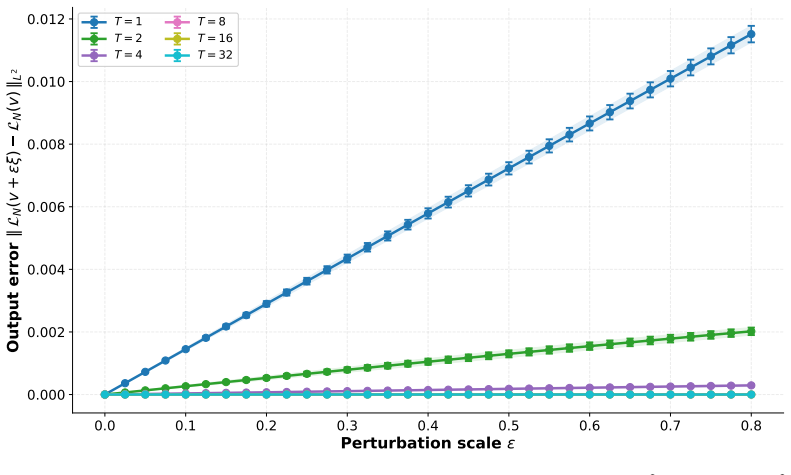
Neural operators have emerged as a powerful, discretization-invariant framework for solving partial differential equations (PDEs). Although established approaches like the Deep Operator Network (DeepONet) have successfully achieved universal approximation for operators, and architectures such as Fourier Neural Operators (FNOs) have shown algebraic convergence rates, a precise theoretical connection between the continuous theory and its discrete numerical implementation remains a challenge. Specifically, the relationship between the continuous formulation and the discrete numerical stability has yet to be fully explored. In this paper, we address this gap by establishing theoretical guarantees for the discretization error and stability of neural operator approximation schemes. We prove analytical bounds that link solution regularity to input discretization, providing a formal quantification of neural operator accuracy under real-world numerical constraints. We derive these bounds to the specific cases of State Space Model-based Neural Operators (SS-NOs) and FNOs, thus providing a new discretization error theorem for these models. Additionally, through an input-to-state stability (ISS) analysis, we formally assess the impact of discretization on the stability of SS-NOs results obtained in the continuous domain. Our empirical experiments on 1D and 2D benchmarks validate our theoretical bounds and show the robustness of SS-NOs under varying resolutions.
Editorial analysis
A structured set of objections, weighed in public.
Referee Report
Summary. The paper claims to derive a new discretization error theorem for State Space Model-based Neural Operators (SS-NOs) and FNOs that analytically bounds the gap between continuous neural operator outputs and their discrete implementations by linking solution regularity (Sobolev or Hölder) to input discretization. It further provides an input-to-state stability (ISS) analysis for SS-NOs and reports empirical validation on 1D and 2D PDE benchmarks showing robustness under varying resolutions.
Significance. If the central bounds are shown to apply without circularity or unverified assumptions, the work would supply a useful theoretical bridge between continuous neural operator theory and practical discrete implementations, quantifying accuracy under real-world grid constraints for SS-NOs and FNOs.
major comments (3)
- [Discretization error theorem (likely §3)] Discretization error theorem: the proof invokes Sobolev/Hölder regularity of PDE solutions to control the approximation error when passing from the continuous SSM or Fourier integral operator to its discretized version, yet the manuscript provides no verification that the specific 1D/2D benchmark solutions satisfy the precise regularity index required for the bounds to hold.
- [ISS analysis section] ISS stability analysis: the formal assessment of discretization impact on SS-NO stability inherits the same regularity dependence; without confirming that the benchmark problems meet the assumed regularity, the stability guarantees cannot be directly read as confirmation for the reported numerical results.
- [Experiments section] Empirical validation: the experiments on 1D and 2D benchmarks are presented as validating the theoretical bounds, but absent explicit regularity checks or error-bar reporting on the solution smoothness, the numerical results do not constitute a direct test of the theorem's hypotheses.
minor comments (2)
- [Theorem statement] Notation for the discretization parameter and regularity index should be introduced consistently in the theorem statement and reused in the ISS section to improve readability.
- [Abstract and introduction] The abstract states that bounds are 'derived to the specific cases' of SS-NOs and FNOs; a brief comparison table or remark clarifying which parts of the proof are model-specific versus general would help readers.
Simulated Author's Rebuttal
We thank the referee for the constructive feedback. We address each major comment below, clarifying the role of regularity assumptions in our theorems and their relation to the benchmarks while committing to targeted revisions for improved transparency.
read point-by-point responses
-
Referee: [Discretization error theorem (likely §3)] Discretization error theorem: the proof invokes Sobolev/Hölder regularity of PDE solutions to control the approximation error when passing from the continuous SSM or Fourier integral operator to its discretized version, yet the manuscript provides no verification that the specific 1D/2D benchmark solutions satisfy the precise regularity index required for the bounds to hold.
Authors: The discretization error theorem is explicitly conditional on the solution belonging to a Sobolev space of sufficient index or satisfying a Hölder condition; this is stated in the theorem statement and used to bound the operator approximation error via standard embedding and interpolation arguments. The 1D and 2D benchmarks (viscous Burgers equation, advection-diffusion, and 2D incompressible Navier-Stokes) are classical test problems whose solutions are known to possess the required regularity for the smooth initial conditions and forcing terms used in the literature. We will add a concise remark in Section 3 and the experiments section referencing these established regularity properties and citing the relevant PDE analysis to make the link explicit. revision: partial
-
Referee: [ISS analysis section] ISS stability analysis: the formal assessment of discretization impact on SS-NO stability inherits the same regularity dependence; without confirming that the benchmark problems meet the assumed regularity, the stability guarantees cannot be directly read as confirmation for the reported numerical results.
Authors: The ISS analysis for SS-NOs is derived under the identical regularity hypothesis as the discretization theorem, ensuring that the continuous-to-discrete stability margin remains controlled. Because the benchmark problems satisfy this hypothesis by standard PDE theory, the reported numerical robustness under grid refinement is consistent with the guarantees. We will revise the ISS section to restate the assumption clearly and note its satisfaction for the chosen benchmarks, thereby allowing the numerical results to be read as supporting evidence under the theorem's hypotheses. revision: partial
-
Referee: [Experiments section] Empirical validation: the experiments on 1D and 2D benchmarks are presented as validating the theoretical bounds, but absent explicit regularity checks or error-bar reporting on the solution smoothness, the numerical results do not constitute a direct test of the theorem's hypotheses.
Authors: The experiments primarily illustrate practical robustness of SS-NOs across resolutions rather than serving as a direct numerical test of the regularity index. We agree that adding explicit references to solution smoothness and, where feasible, error-bar information on discretization-induced variations would tighten the connection to the theorem. In the revised manuscript we will include such discussion and supplementary plots that quantify how observed errors behave with respect to the regularity parameters appearing in the bounds. revision: yes
Circularity Check
No circularity: discretization error theorem relies on standard external regularity assumptions
full rationale
The paper derives analytical bounds linking PDE solution regularity (Sobolev/Hölder) to discretization error for SS-NOs and FNOs, then performs ISS stability analysis. These steps invoke classical functional analysis results on approximation under grid refinement rather than defining regularity via the error bounds themselves or fitting parameters to data and relabeling them as predictions. No load-bearing self-citations, ansatz smuggling, or renaming of known results appear in the derivation chain; the central theorem remains independent of the paper's own inputs or empirical fits. Benchmarks illustrate applicability but do not close the proof.
Axiom & Free-Parameter Ledger
axioms (2)
- domain assumption PDE solutions possess sufficient regularity (e.g., Sobolev or Hölder) to apply the error bounds
- standard math Standard neural operator approximation properties hold in the continuous setting
Lean theorems connected to this paper
-
IndisputableMonolith/Cost/FunctionalEquation.leanwashburn_uniqueness_aczel unclear?
unclearRelation between the paper passage and the cited Recognition theorem.
We prove analytical bounds that link solution regularity to input discretization... under standard Sobolev regularity assumptions
What do these tags mean?
- matches
- The paper's claim is directly supported by a theorem in the formal canon.
- supports
- The theorem supports part of the paper's argument, but the paper may add assumptions or extra steps.
- extends
- The paper goes beyond the formal theorem; the theorem is a base layer rather than the whole result.
- uses
- The paper appears to rely on the theorem as machinery.
- contradicts
- The paper's claim conflicts with a theorem or certificate in the canon.
- unclear
- Pith found a possible connection, but the passage is too broad, indirect, or ambiguous to say the theorem truly supports the claim.
Reference graph
Works this paper leans on
-
[1]
Neural operator: Graph kernel network for partial differential equations
Anima Anandkumar, Kamyar Azizzadenesheli, Kaushik Bhattacharya, Nikola Kovachki, Zongyi Li, Burigede Liu, and Andrew Stuart. Neural operator: Graph kernel network for partial differential equations. In ICLR 2020 workshop on integration of deep neural models and differential equations, 2020
work page 2020
-
[4]
A mathematical guide to operator learning
Nicolas Boull \'e and Alex Townsend. A mathematical guide to operator learning. In Handbook of Numerical Analysis. Elsevier, 2024
work page 2024
-
[9]
G.B. Folland. Real Analysis: Modern Techniques and Their Applications. Pure and Applied Mathematics: A Wiley Series of Texts, Monographs and Tracts. Wiley, 1999. ISBN 9780471317166. URL https://books.google.fr/books?id=N8jVDwAAQBAJ
work page 1999
-
[10]
Craig R. Gin, Daniel E. Shea, Steven L. Brunton, and J. Nathan. Kutz. Deepgreen: Deep learning of green's functions for nonlinear boundary value problems, 2020. URL https://arxiv.org/abs/2101.07206
-
[11]
On the parameterization and initialization of diagonal state space models
Albert Gu, Karan Goel, Ankit Gupta, and Christopher R \'e . On the parameterization and initialization of diagonal state space models. Advances in Neural Information Processing Systems, 2022
work page 2022
-
[12]
Merging memory and space: A state space neural operator
Nodens Koren and Samuel Lanthaler. Merging memory and space: A state space neural operator. Submitted to Transactions on Machine Learning Research, 2025. URL https://openreview.net/forum?id=SwLxxz0x58. Under review
work page 2025
-
[13]
On universal approximation and error bounds for fourier neural operators, 2021
Nikola Kovachki, Samuel Lanthaler, and Siddhartha Mishra. On universal approximation and error bounds for fourier neural operators, 2021. URL https://arxiv.org/abs/2107.07562
-
[14]
Neural operator: Learning maps between function spaces with applications to pdes
Nikola Kovachki, Zongyi Li, Burigede Liu, Kamyar Azizzadenesheli, Kaushik Bhattacharya, Andrew Stuart, and Anima Anandkumar. Neural operator: Learning maps between function spaces with applications to pdes. Journal of Machine Learning Research, 24 0 (89): 0 1--97, 2023. URL http://jmlr.org/papers/v24/21-1524.html
work page 2023
-
[15]
Operator learning: Algorithms and analysis
Nikola B Kovachki, Samuel Lanthaler, and Andrew M Stuart. Operator learning: Algorithms and analysis. Handbook of Numerical Analysis, 25: 0 419--467, 2024
work page 2024
-
[16]
Samuel Lanthaler, Andrew M. Stuart, and Margaret Trautner. Discretization error of fourier neural operators, 2025. URL https://arxiv.org/abs/2405.02221
-
[17]
Multipole graph neural operator for parametric partial differential equations
Zongyi Li, Nikola Kovachki, Kamyar Azizzadenesheli, Burigede Liu, Andrew Stuart, Kaushik Bhattacharya, and Anima Anandkumar. Multipole graph neural operator for parametric partial differential equations. Advances in Neural Information Processing Systems, 33: 0 6755--6766, 2020
work page 2020
-
[18]
Fourier neural operator for parametric partial differential equations
Zongyi Li, Nikola Borislavov Kovachki, Kamyar Azizzadenesheli, Kaushik Bhattacharya, Andrew Stuart, Anima Anandkumar, et al. Fourier neural operator for parametric partial differential equations. In International Conference on Learning Representations, 2021
work page 2021
-
[19]
Fourier neural operator with learned deformations for pdes on general geometries
Zongyi Li, Daniel Zhengyu Huang, Burigede Liu, and Anima Anandkumar. Fourier neural operator with learned deformations for pdes on general geometries. Journal of Machine Learning Research, 2023 a
work page 2023
-
[20]
Geometry-informed neural operator for large-scale 3d pdes
Zongyi Li, Nikola Kovachki, Chris Choy, Boyi Li, Jean Kossaifi, Shourya Otta, Mohammad Amin Nabian, Maximilian Stadler, Christian Hundt, Kamyar Azizzadenesheli, and Animashree Anandkumar. Geometry-informed neural operator for large-scale 3d pdes. In A. Oh, T. Naumann, A. Globerson, K. Saenko, M. Hardt, and S. Levine, editors, Advances in Neural Informatio...
work page 2023
-
[21]
Physics-informed neural operator for learning partial differential equations
Zongyi Li, Hongkai Zheng, Nikola Kovachki, David Jin, Haoxuan Chen, Burigede Liu, Kamyar Azizzadenesheli, and Anima Anandkumar. Physics-informed neural operator for learning partial differential equations. ACM/IMS Journal of Data Science, 1 0 (3): 0 1--27, 2024
work page 2024
-
[22]
Learning nonlinear operators via DeepONet based on the universal approximation theorem of operators
Lu Lu, Pengzhan Jin, Guofei Pang, Zhongqiang Zhang, and George Em Karniadakis. Learning nonlinear operators via DeepONet based on the universal approximation theorem of operators. Nature Machine Intelligence, 3 0 (3): 0 218--229, March 2021
work page 2021
-
[24]
Topics in Fourier Analysis and Function Spaces
Hans-J \"u rgen Schmeisser and Hans Triebel. Topics in Fourier Analysis and Function Spaces. John Wiley & Sons, Chichester, 1987. ISBN 978-0471910806
work page 1987
-
[26]
Learning to discretize denoising diffusion odes, 2025
Vinh Tong, Hoang Trung-Dung, Anji Liu, Guy Van den Broeck, and Mathias Niepert. Learning to discretize denoising diffusion odes, 2025. URL https://arxiv.org/abs/2405.15506
-
[28]
Chapter 3 - A mathematical guide to operator learning , editor =
Nicolas Boullé and Alex Townsend , keywords =. Chapter 3 - A mathematical guide to operator learning , editor =. 2024 , booktitle =. doi:https://doi.org/10.1016/bs.hna.2024.05.003 , url =
-
[29]
Submitted to Transactions on Machine Learning Research , year=
Merging Memory and Space: A State Space Neural Operator , author=. Submitted to Transactions on Machine Learning Research , year=
-
[30]
arXiv preprint arXiv:2507.23428 , year=
Merging Memory and Space: A Spatiotemporal State Space Neural Operator , author=. arXiv preprint arXiv:2507.23428 , year=
-
[31]
The Eleventh International Conference on Learning Representations , year=
Steeven Janny and Aur. The Eleventh International Conference on Learning Representations , year=
-
[32]
Journal of Machine Learning Research , year =
Nikola Kovachki and Zongyi Li and Burigede Liu and Kamyar Azizzadenesheli and Kaushik Bhattacharya and Andrew Stuart and Anima Anandkumar , title =. Journal of Machine Learning Research , year =
-
[33]
Learning nonlinear operators via DeepONet based on the universal approximation theorem of operators
Lu, Lu and Jin, Pengzhan and Pang, Guofei and Zhang, Zhongqiang and Karniadakis, George Em. Learning nonlinear operators via DeepONet based on the universal approximation theorem of operators. Nature Machine Intelligence
-
[34]
Journal of Machine Learning Research , year=
Fourier neural operator with learned deformations for pdes on general geometries , author=. Journal of Machine Learning Research , year=
-
[35]
Handbook of Numerical Analysis , year=
A mathematical guide to operator learning , author=. Handbook of Numerical Analysis , year=
-
[36]
2021 60th IEEE Conference on Decision and Control (CDC) , pages=
Deep learning-based luenberger observer design for discrete-time nonlinear systems , author=. 2021 60th IEEE Conference on Decision and Control (CDC) , pages=. 2021 , organization=
work page 2021
-
[37]
International Conference on Learning Representations , year=
Fourier Neural Operator for Parametric Partial Differential Equations , author=. International Conference on Learning Representations , year=
-
[38]
Advances in Neural Information Processing Systems , year=
On the parameterization and initialization of diagonal state space models , author=. Advances in Neural Information Processing Systems , year=
-
[39]
Discretization Error of Fourier Neural Operators , author=. 2025 , eprint=
work page 2025
-
[40]
Learning to Discretize Denoising Diffusion ODEs , author=. 2025 , eprint=
work page 2025
-
[41]
The Sobolev Inequality on the Torus Revisited , journal =. 2013 , publisher =
work page 2013
-
[42]
Operator learning: Algorithms and analysis , year =
Kovachki, Nikola B and Lanthaler, Samuel and Stuart, Andrew M , journal =. Operator learning: Algorithms and analysis , year =
-
[43]
Bahouri, Hajer and Chemin, Jean-Yves and Danchin, Rapha \"e l. Basic Analysis. Fourier Analysis and Nonlinear Partial Differential Equations. 2011. doi:10.1007/978-3-642-16830-7_1
-
[44]
Bahouri, Hajer and Chemin, Jean-Yves and Danchin, Rapha \"e l. Littlewood--Paley Theory. Fourier Analysis and Nonlinear Partial Differential Equations. 2011. doi:10.1007/978-3-642-16830-7_2
-
[45]
Sobolev Spaces of Fractional Order, Nemytskij Operators, and Nonlinear Partial Differential Equations , author =. 1996 , lastchecked =. doi:doi:10.1515/9783110812411 , isbn =
-
[46]
Triebel, Hans. Function Spaces on Rn. Theory of Function Spaces. 1983. doi:10.1007/978-3-0346-0416-1_2
-
[47]
Analysis and Applications , volume =
Dai, Yichen and Hu, Weiwei and Wu, Jiahong and Xiao, Bei , title =. Analysis and Applications , volume =. 2020 , doi =. https://doi.org/10.1142/S0219530519500234 , abstract =
-
[48]
Function Space and Operator Theory for Nonlinear Analysis
Taylor, Michael E. Function Space and Operator Theory for Nonlinear Analysis. Partial Differential Equations III: Nonlinear Equations. 2023. doi:10.1007/978-3-031-33928-8_1
-
[49]
Topics in Fourier Analysis and Function Spaces , publisher =
Schmeisser, Hans-J. Topics in Fourier Analysis and Function Spaces , publisher =. 1987 , address =
work page 1987
-
[50]
Real Analysis: Modern Techniques and Their Applications , author=. 1999 , publisher=
work page 1999
- [51]
-
[52]
Geometry-Informed Neural Operator for Large-Scale 3D PDEs , volume =
Li, Zongyi and Kovachki, Nikola and Choy, Chris and Li, Boyi and Kossaifi, Jean and Otta, Shourya and Nabian, Mohammad Amin and Stadler, Maximilian and Hundt, Christian and Azizzadenesheli, Kamyar and Anandkumar, Animashree , booktitle =. Geometry-Informed Neural Operator for Large-Scale 3D PDEs , volume =
-
[53]
arXiv preprint arXiv:2303.17078 , year=
Machine learning for partial differential equations , author=. arXiv preprint arXiv:2303.17078 , year=
-
[54]
ACM/IMS Journal of Data Science , volume=
Physics-informed neural operator for learning partial differential equations , author=. ACM/IMS Journal of Data Science , volume=. 2024 , publisher=
work page 2024
-
[55]
Advances in Neural Information Processing Systems , volume=
Multipole graph neural operator for parametric partial differential equations , author=. Advances in Neural Information Processing Systems , volume=
-
[56]
ICLR 2020 workshop on integration of deep neural models and differential equations , year=
Neural operator: Graph kernel network for partial differential equations , author=. ICLR 2020 workshop on integration of deep neural models and differential equations , year=
work page 2020
-
[57]
The International Conference on Learning Representations (
Efficiently Modeling Long Sequences with Structured State Spaces , author=. The International Conference on Learning Representations (
-
[58]
DeepGreen: Deep Learning of Green's Functions for Nonlinear Boundary Value Problems , author=. 2020 , eprint=
work page 2020
-
[59]
On universal approximation and error bounds for Fourier Neural Operators , author=. 2021 , eprint=
work page 2021
-
[60]
Error estimates for DeepOnets: A deep learning framework in infinite dimensions , author=. 2022 , eprint=
work page 2022
-
[61]
Bourdaud, G. and Kateb, M. E. D. , title=. Mathematische Zeitschrift , year=. doi:10.1007/BF02571817 , url=
-
[62]
Composition operators acting on Besov spaces on the real line , journal=
Bourdaud, G. Composition operators acting on Besov spaces on the real line , journal=. 2014 , month=. doi:10.1007/s10231-013-0342-x , url=
-
[63]
Harmonic Analysis and Nonlinear Partial Differential Equations , series =
Bourdaud, G\'erard and Sickel, Winfried , title =. Harmonic Analysis and Nonlinear Partial Differential Equations , series =. 2011 , note =
work page 2011
discussion (0)
Sign in with ORCID, Apple, or X to comment. Anyone can read and Pith papers without signing in.