ECUAS_n: A family of metrics for principled evaluation of uncertainty-augmented systems
Pith reviewed 2026-05-22 08:51 UTC · model grok-4.3
The pith
ECUAS_n metrics evaluate uncertainty-augmented systems as proper scoring rules that balance prediction errors and uncertainty quality via one tunable parameter.
A machine-rendered reading of the paper's core claim, the machinery that carries it, and where it could break.
Core claim
The ECUAS_n family of metrics, formulated as proper scoring rules for the task of interest, provides a more adequate assessment of the overall performance of uncertainty-augmented systems for decision making under uncertainty than current approaches using separate metrics, fixed rejection costs, or coverage-risk curves. The parameter n controls the trade-off between the cost of incorrect predictions and imperfect uncertainties depending on the needs of the use-case.
What carries the argument
The ECUAS_n metric, a parameterized proper scoring rule that combines prediction accuracy and uncertainty quality into one score, with n controlling the relative cost of errors versus bad uncertainty estimates.
If this is right
- UA systems can be ranked and selected for a concrete use-case simply by picking the n that matches its cost structure.
- Differences in system quality that are invisible to separate accuracy and uncertainty metrics become visible in the combined score.
- Training or post-processing choices can be guided by direct optimization toward the metric that will be used at deployment.
- Comparisons across papers become more reproducible when authors report ECUAS_n at the n values relevant to common decision settings.
Where Pith is reading between the lines
- If widely adopted, ECUAS_n could shift model development away from maximizing accuracy alone toward explicitly optimizing the uncertainty that supports downstream decisions.
- The approach could be extended to regression or structured prediction tasks by redefining the base proper scoring rule while keeping the same n-controlled trade-off structure.
- One could measure whether models trained to minimize ECUAS_n at a target n actually improve real-world utility on a held-out decision policy compared with models trained on standard losses.
Load-bearing premise
A single tunable parameter n can meaningfully capture application-specific cost trade-offs between incorrect predictions and imperfect uncertainties without requiring additional validation or introducing new selection biases in practice.
What would settle it
Run a decision task with known, application-specific rejection costs on held-out data; if the system ranked best by ECUAS_n for the matching n does not produce the highest expected utility when users reject according to its uncertainty scores, the claim of superior adequacy would be falsified.
Figures
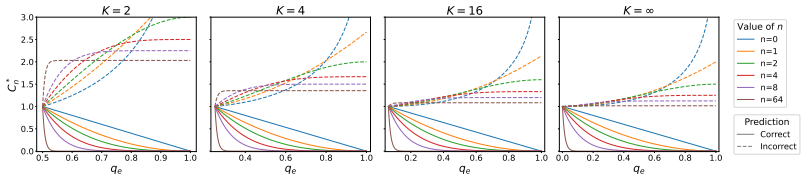

read the original abstract
In high-stakes automated decision-making, access to predictive uncertainty is essential for enabling users -- human or downstream systems -- to accept or reject predictions based on application-specific cost trade-offs. Such uncertainty-augmented (UA) systems -- i.e., systems that output both predictions and uncertainty scores -- are currently being assessed in the literature in a variety of ways, using separate metrics to evaluate the predictions and the uncertainty scores, setting a cost function with a fixed rejection cost or integrating over a coverage-risk curve. We argue that these evaluation approaches are inadequate for assessing overall performance of the UA system for decision making under uncertainty and propose a novel family of metrics, ECUAS$_n$, formulated as proper scoring rules for the task of interest. The parameter $n$ controls the trade-off between the cost of incorrect predictions and imperfect uncertainties depending on the needs of the use-case. We demonstrate the advantages of the ECUAS$_n$ metrics both theoretically and empirically, through experiments on diverse classification and generation datasets, including a manually annotated subset of TriviaQA.
Editorial analysis
A structured set of objections, weighed in public.
Referee Report
Summary. The paper proposes the ECUAS_n family of metrics for evaluating uncertainty-augmented (UA) systems that output both predictions and uncertainty scores. It argues that current practices—separate metrics for predictions and uncertainties, fixed rejection costs, or coverage-risk curves—are inadequate for assessing overall performance in decision-making under uncertainty. ECUAS_n is formulated as proper scoring rules with a single tunable parameter n that controls the trade-off between the cost of incorrect predictions and imperfect uncertainties according to use-case needs. Theoretical advantages and empirical results are presented on classification and generation tasks, including a manually annotated subset of TriviaQA.
Significance. If the proper-scoring-rule formulation holds and the empirical comparisons demonstrate clear, bias-free advantages, the work could establish a more unified and application-adaptable standard for evaluating UA systems in high-stakes settings, reducing reliance on fragmented or arbitrarily parameterized evaluation protocols.
major comments (2)
- [§3] §3 (theoretical formulation): the claim that ECUAS_n constitutes a proper scoring rule for the joint prediction-uncertainty task requires an explicit derivation showing that the expected score is minimized precisely when both the prediction is correct and the uncertainty is well-calibrated; without this, the asserted superiority over separate metrics or fixed-cost approaches remains unsubstantiated.
- [§5] §5 (empirical evaluation, TriviaQA experiments): the procedure for selecting or tuning n is not shown to avoid the very selection bias the paper criticizes in fixed-rejection-cost methods; if n is chosen on held-out data or expert knowledge of downstream costs, the metric loses its claimed advantage of being a single, principled scalar.
minor comments (2)
- [Abstract] The abstract and introduction could more explicitly list all datasets used beyond the TriviaQA subset to allow immediate assessment of diversity.
- [§3] Notation for the scoring rule should be introduced with a single running example before the general n-parameterized form to improve readability.
Simulated Author's Rebuttal
We thank the referee for their constructive comments on our manuscript. We address each of the major comments in detail below and outline the revisions we will make to improve the clarity and rigor of the paper.
read point-by-point responses
-
Referee: [§3] §3 (theoretical formulation): the claim that ECUAS_n constitutes a proper scoring rule for the joint prediction-uncertainty task requires an explicit derivation showing that the expected score is minimized precisely when both the prediction is correct and the uncertainty is well-calibrated; without this, the asserted superiority over separate metrics or fixed-cost approaches remains unsubstantiated.
Authors: We acknowledge that the current manuscript would benefit from a more explicit derivation of the proper scoring rule property. In the revised version, we will expand Section 3 to include a step-by-step derivation proving that the expected value of ECUAS_n is minimized if and only if the prediction is correct and the uncertainty is perfectly calibrated to the true posterior. This will directly address the concern and provide a stronger theoretical basis for the metric's advantages. revision: yes
-
Referee: [§5] §5 (empirical evaluation, TriviaQA experiments): the procedure for selecting or tuning n is not shown to avoid the very selection bias the paper criticizes in fixed-rejection-cost methods; if n is chosen on held-out data or expert knowledge of downstream costs, the metric loses its claimed advantage of being a single, principled scalar.
Authors: We appreciate this point and agree that the selection of n must be handled carefully to maintain the principled nature of the metric. Unlike fixed-rejection-cost methods where the cost parameter is often chosen arbitrarily or tuned on data, n in ECUAS_n is meant to reflect the relative costs in the specific use-case, which can be determined from domain expertise or cost-benefit analysis without reference to the evaluation data. To clarify this, we will add a subsection in the revised Section 5 discussing guidelines for choosing n based on application requirements, along with empirical sensitivity analyses showing results for a range of n values on the TriviaQA experiments. This preserves the advantage of a single scalar while making the choice transparent and use-case driven. revision: yes
Circularity Check
ECUAS_n defined as proper scoring rules with independent theoretical and empirical support
full rationale
The paper formulates ECUAS_n directly as a family of proper scoring rules for uncertainty-augmented decision making, with n as an explicit tunable parameter for cost trade-offs. It contrasts this with separate metrics or fixed-cost approaches and validates via theoretical properties plus experiments on external datasets (e.g., TriviaQA). No derivation step reduces a claimed prediction or uniqueness result to a fitted input, self-citation chain, or ansatz imported from prior work by the same authors. The central claim rests on the proper-scoring-rule construction and external empirical checks rather than self-referential definitions.
Axiom & Free-Parameter Ledger
free parameters (1)
- n
axioms (1)
- domain assumption Proper scoring rules are the appropriate framework for assessing overall performance of uncertainty-augmented systems in decision making under uncertainty.
Lean theorems connected to this paper
-
IndisputableMonolith/Cost/FunctionalEquation.leanwashburn_uniqueness_aczel unclear?
unclearRelation between the paper passage and the cited Recognition theorem.
We propose a novel family of metrics, ECUAS_n, formulated as proper scoring rules... The parameter n controls the trade-off between the cost of incorrect predictions and imperfect uncertainties
-
IndisputableMonolith/Foundation/AlphaCoordinateFixation.leanJ_uniquely_calibrated_via_higher_derivative unclear?
unclearRelation between the paper passage and the cited Recognition theorem.
C^*_n(y,q) obtained by integrating w_n(γ)C^*_γ over γ
What do these tags mean?
- matches
- The paper's claim is directly supported by a theorem in the formal canon.
- supports
- The theorem supports part of the paper's argument, but the paper may add assumptions or extra steps.
- extends
- The paper goes beyond the formal theorem; the theorem is a base layer rather than the whole result.
- uses
- The paper appears to rely on the theorem as machinery.
- contradicts
- The paper's claim conflicts with a theorem or certificate in the canon.
- unclear
- Pith found a possible connection, but the passage is too broad, indirect, or ambiguous to say the theorem truly supports the claim.
discussion (0)
Sign in with ORCID, Apple, or X to comment. Anyone can read and Pith papers without signing in.