Local Covariate Selection for Average Causal Effect Estimation without Pretreatment and Causal Sufficiency Assumptions
Pith reviewed 2026-05-22 00:57 UTC · model grok-4.3
The pith
A local boundary around the treatment and outcome contains a valid adjustment set for total causal effect estimation whenever one exists at all.
A machine-rendered reading of the paper's core claim, the machinery that carries it, and where it could break.
Core claim
The local learning procedure first characterizes a local boundary guaranteed to contain at least one valid adjustment set for the total causal effect whenever any valid adjustment set exists, then supplies identification algorithms that search only inside this boundary; these algorithms are proven sound and complete, returning a valid adjustment set precisely when one lies inside the boundary and never returning an invalid one.
What carries the argument
The local boundary, a collection of variables identified locally from the treatment and outcome that is guaranteed to enclose a valid adjustment set when one exists globally.
If this is right
- Covariate selection becomes feasible in high-dimensional observational data without first recovering a global causal graph.
- Estimation of the total causal effect remains valid even when latent confounders are present among observed variables.
- No pretreatment restriction is needed, so covariates that may be affected by the treatment or outcome can still be considered.
- The returned adjustment set yields unbiased nonparametric estimates of the average causal effect.
- Computational cost grows with the size of the local boundary rather than the full variable set.
Where Pith is reading between the lines
- The same local-boundary idea could be tested on identification of other causal quantities such as conditional effects or path-specific effects.
- In domains with hundreds of variables, such as electronic health records or gene-expression data, the method might enable routine causal analysis that global approaches currently rule out.
- Relaxing the local-boundary definition slightly and checking whether soundness is preserved would be a direct next test of the characterization.
Load-bearing premise
Whenever a valid adjustment set exists for the total causal effect, the defined local boundary is guaranteed to contain at least one such set.
What would settle it
A data-generating process in which a valid adjustment set exists but none of its members appear inside the constructed local boundary, or in which the search procedure inside the boundary returns a set that fails to block all back-door paths.
Figures




read the original abstract
We study the problem of selecting covariates for unbiased estimation of the total causal effect.Existing approaches typically rely on global causal structure learning over all variables, or on strong assumptions such as causal sufficiency - where observed variables share no latent confounders - or the pretreatment assumption, which limits covariates to those unaffected by the treatment or outcome. These requirements are often unrealistic in practice, and global learning becomes computationally prohibitive in high-dimensional settings.To address these challenges, we propose a novel local learning method for covariate selection in nonparametric causal effect estimation that avoids both the pretreatment and causal sufficiency assumptions. We first characterize a local boundary that contains at least one valid adjustment set whenever one exists for identifying the causal effect, and then develop local identification procedures to efficiently search within this boundary.We prove that the proposed method is sound and complete. Experiments on multiple synthetic datasets and two real-world datasets show that our approach achieves accurate causal effect estimation while substantially improving computational efficiency.
Editorial analysis
A structured set of objections, weighed in public.
Referee Report
Summary. The paper proposes a local covariate selection procedure for nonparametric estimation of the average causal effect that dispenses with both the pretreatment assumption and causal sufficiency. It defines a local boundary around the treatment X and outcome Y via local conditional-independence tests and d-separation queries, then searches inside that boundary for a valid adjustment set. The central theoretical claim is that the procedure is sound (never returns an invalid set) and complete (returns a valid set whenever one exists inside the local boundary). Experiments on synthetic and two real-world data sets are reported to show accurate effect estimates at substantially lower computational cost than global methods.
Significance. If the local-boundary characterization is correct and the soundness/completeness proofs hold in the nonparametric setting, the work would be a useful advance for high-dimensional causal inference: it avoids both global structure learning and the strong assumptions that are often unrealistic. The explicit local identification procedures and the empirical demonstration of efficiency gains are concrete strengths.
major comments (2)
- [Section 3] Section 3 (local boundary definition): the claim that the local boundary is guaranteed to contain at least one valid adjustment set whenever a valid set exists for the total effect is load-bearing for the completeness result. The construction relies on local conditional-independence tests and d-separation queries within a neighborhood of X and Y. When latent confounders link covariates that lie outside this immediate neighborhood, back-door paths that can only be blocked by conditioning on a distant covariate may be missed; the resulting boundary can then be empty of valid sets even though a globally valid adjustment set exists. A concrete counter-example or an explicit nonparametric identification argument showing why such paths cannot arise under the paper’s relaxed assumptions is required.
- [Section 4] Proof of soundness and completeness (abstract and Section 4): the manuscript states that proofs are provided, yet the nonparametric identification conditions under which the local procedures remain valid are not spelled out. In particular, it is unclear how the local d-separation queries translate into the back-door criterion without invoking global Markov properties or additional restrictions on the latent confounding structure. The derivation must be expanded to make the nonparametric validity explicit.
minor comments (2)
- Notation for the local boundary and the search procedure should be introduced with a small running example to improve readability.
- The experimental section would benefit from reporting the size of the local boundary relative to the full variable set and the number of conditional-independence tests performed, to quantify the claimed efficiency gain.
Simulated Author's Rebuttal
We thank the referee for the constructive and detailed comments on our manuscript. We address each major comment below, providing clarifications on the local boundary and proofs while indicating the revisions we will make to strengthen the presentation.
read point-by-point responses
-
Referee: [Section 3] Section 3 (local boundary definition): the claim that the local boundary is guaranteed to contain at least one valid adjustment set whenever a valid set exists for the total effect is load-bearing for the completeness result. The construction relies on local conditional-independence tests and d-separation queries within a neighborhood of X and Y. When latent confounders link covariates that lie outside this immediate neighborhood, back-door paths that can only be blocked by conditioning on a distant covariate may be missed; the resulting boundary can then be empty of valid sets even though a globally valid adjustment set exists. A concrete counter-example or an explicit nonparametric identification argument showing why such paths cannot arise under the paper’s relaxed assumptions is required.
Authors: The local boundary is defined via local conditional-independence tests and d-separation queries precisely so that it captures all covariates needed to block back-door paths under the paper's nonparametric setting without causal sufficiency or pretreatment assumptions. Any back-door path involving latent confounders outside the immediate neighborhood must still be detectable through local dependencies around X and Y; otherwise the path would not be a valid back-door path for the total effect. We will add an explicit nonparametric identification argument in the revised Section 3 that derives this property directly from the local Markov condition and the boundary construction, showing that no such missed distant-only blocking sets can arise. This will make the completeness claim fully rigorous. revision: yes
-
Referee: [Section 4] Proof of soundness and completeness (abstract and Section 4): the manuscript states that proofs are provided, yet the nonparametric identification conditions under which the local procedures remain valid are not spelled out. In particular, it is unclear how the local d-separation queries translate into the back-door criterion without invoking global Markov properties or additional restrictions on the latent confounding structure. The derivation must be expanded to make the nonparametric validity explicit.
Authors: We agree that the connection between local d-separation queries and the nonparametric back-door criterion can be made more explicit. The proofs in Section 4 use only the local Markov property induced by the boundary and do not rely on global Markov properties. We will expand the derivation in the revised Section 4 with a step-by-step nonparametric argument that shows how each local query corresponds to blocking a specific back-door path, using only d-separation in the presence of latent variables and the definition of the local boundary. This will clarify the validity under the relaxed assumptions without additional restrictions on the latent structure. revision: yes
Circularity Check
Derivation self-contained; no reduction of soundness claim to inputs by construction
full rationale
The paper defines a local boundary via local conditional independence tests and d-separation within a neighborhood of X and Y, then proves that any adjustment set found inside it is valid and that the procedure returns one whenever one exists inside the boundary. This characterization draws on standard graphical causal model properties (back-door criterion, d-separation) that are independent of the algorithm's outputs and do not presuppose the method's success. No equation or step equates a claimed prediction to a fitted parameter, renames a known result, or relies on a self-citation whose content is itself unverified or defined in terms of the present result. The soundness/completeness theorem therefore rests on external graph-theoretic facts rather than circular self-reference.
Axiom & Free-Parameter Ledger
axioms (1)
- domain assumption A local boundary exists that contains at least one valid adjustment set whenever any valid adjustment set exists for the total causal effect.
Lean theorems connected to this paper
-
IndisputableMonolith/Foundation/AbsoluteFloorClosure.leanreality_from_one_distinction unclear?
unclearRelation between the paper passage and the cited Recognition theorem.
We first characterize a local boundary that contains at least one valid adjustment set whenever one exists... Theorems 2 and 3... local identification procedures
What do these tags mean?
- matches
- The paper's claim is directly supported by a theorem in the formal canon.
- supports
- The theorem supports part of the paper's argument, but the paper may add assumptions or extra steps.
- extends
- The paper goes beyond the formal theorem; the theorem is a base layer rather than the whole result.
- uses
- The paper appears to rely on the theorem as machinery.
- contradicts
- The paper's claim conflicts with a theorem or certificate in the canon.
- unclear
- Pith found a possible connection, but the passage is too broad, indirect, or ambiguous to say the theorem truly supports the claim.
Reference graph
Works this paper leans on
-
[1]
ISBN 0934613737. Pearl, J. Comment: graphical models, causality and intervention. Statistical Science, 8(3):266–269, 1993. Pearl, J. Causality: Models, Reasoning, and Inference. Cambridge University Press, 2000. Pearl, J. Causality. Cambridge university press, 2009. Pellet, J.-P. and Elisseeff, A. Finding latent causes in causal networks: an efficient appr...
work page 1993
-
[2]
the graph P is adjustment amenable relative to (X, Y ), meaning that every possible causal path from X to Y begins with a visible directed edge out of X
-
[3]
Z ∩ Forb(X, Y ) = ∅; and
-
[4]
Z m-separates X and Y in PX . Here, PX denotes the graph obtained from P by removing all visible directed edges out of X (Maathuis & Colombo, 2015). Because all such outgoing edges are removed, X has no children in PX , and thus no element of Forb(X, Y ) can belong to the Markov blanket of X in PX . Consequently, for any candidate separator contained in M...
work page 2015
-
[5]
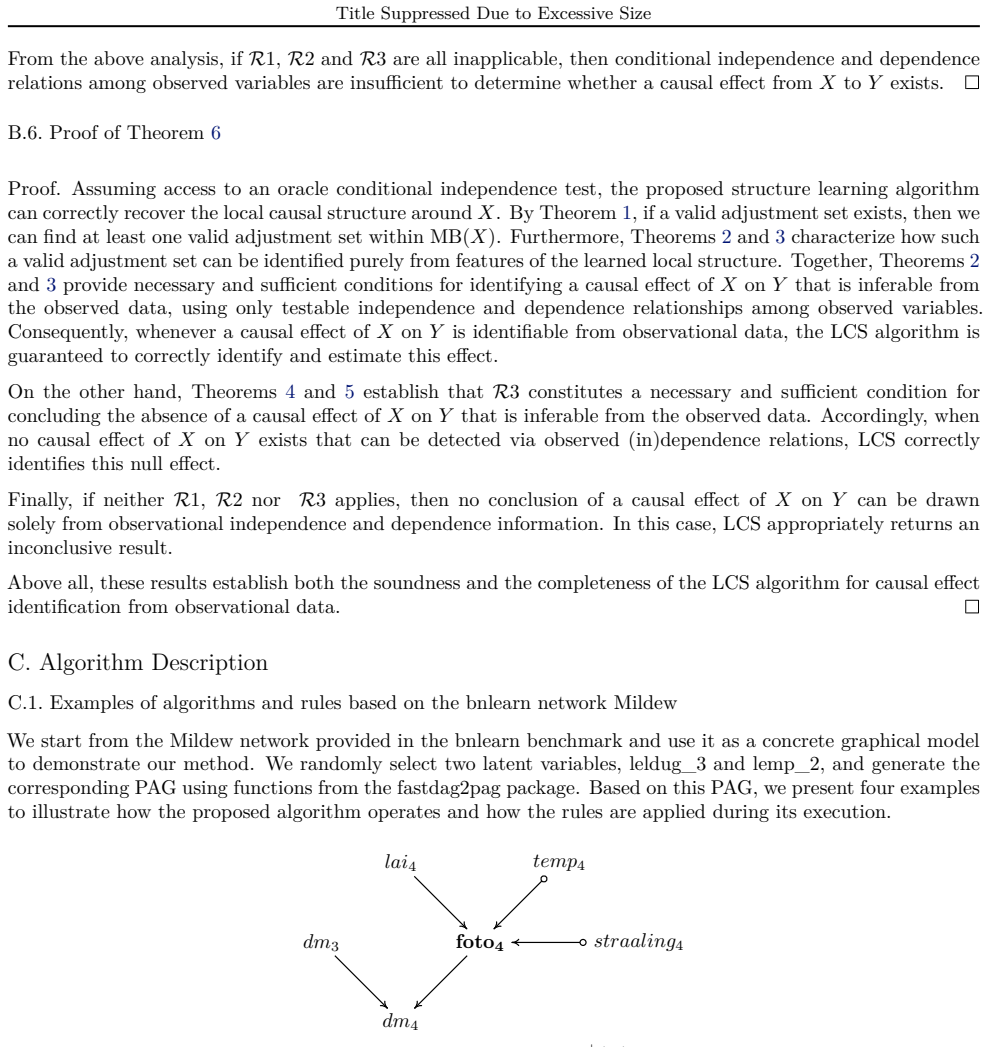
Local structure learning around X. MB (X) = {lai4, dm4, dm3, temp4, straaling4}, Pa ∗(X) = {lai4, temp4, straaling4}, Pa(X) = {lai4}, NCPa(X) = {temp4, straaling4}, Ch(X) = {dm4}. 19 Title Suppressed Due to Excessive Size
-
[6]
Rule application. Using R1, the variable S = temp4 satisfies the conditional independence tests: temp4 ̸ ⊥ ⊥udbytte | {lai4}, f oto 4 ⊥ ⊥udbytte | {lai4, temp4}. Therefore, the adjustment set is Z = {lai4}, and the procedure terminates with Θ ← θ. dm1 f oto2 dm2 dm3 f oto3 Figure 9. Induced subgraphs based on MB +(X) in Example 7. Example 7. Input: Target...
-
[7]
MB (X) = {dm1, f oto2, dm3, f oto3}, Pa ∗(X) = Pa( X) = {dm1, f oto2}, Ch(X) = {dm3}
Local structure learning around X. MB (X) = {dm1, f oto2, dm3, f oto3}, Pa ∗(X) = Pa( X) = {dm1, f oto2}, Ch(X) = {dm3}
-
[8]
R1 is not satisfied, so we proceed to R2
Rule application. R1 is not satisfied, so we proceed to R2. R2 holds since, in the local adjacency structure around X, the mark at the X-endpoint is always determined. Hence, the adjustment set is Z = {dm1, f oto2}. The causal effect is estimated and the procedure terminates with Θ ← θ. lai2 meldug2 mikro2 middel2 lai3 straaling3 meldug4 f oto3 lai4 temp3...
-
[9]
Local structure learning around X. MB (X) = {mikro2, lai2, meldug2, middel2, f oto3, meldug4, mikro3, straaling3, temp3, nedboer3, middel3, lai4}, Pa ∗(X) = {mikro2, lai2, meldug2, middel2}, Pa(X) = {mikro2, lai2, meldug2}, NCPa(X) = {middel2}, Ch(X) = {f oto3, meldug4, lai4, mikro3}. 20 Title Suppressed Due to Excessive Size
-
[10]
Using R3(i), we find that lai3 and straaling4 are independent
Rule application. Using R3(i), we find that lai3 and straaling4 are independent. Hence, the algorithm terminates with Θ ← 0. dm1 straaling2 lai2 nedboer2 dm2 foto2 milkro 2 Figure 11. Induced subgraphs based on MB +(X) in Example 9. Example 9. Input: Target variable pair (X, Y ) = ( f oto2, mikro2) and observed variable set O
-
[11]
Local structure learning around X. MB (X) = {lai2, dm2, dm1, mikro2, straaling2, nedboer2}, Pa ∗(X) = {lai2, straaling2, mikro2, nedboer2}, Pa(X) = {lai2}, NCPa(X) = {straaling2}, Ch(X) = {dm2}
-
[12]
Using R3(i), no conditioning set renders f oto2 and mikro2 independent
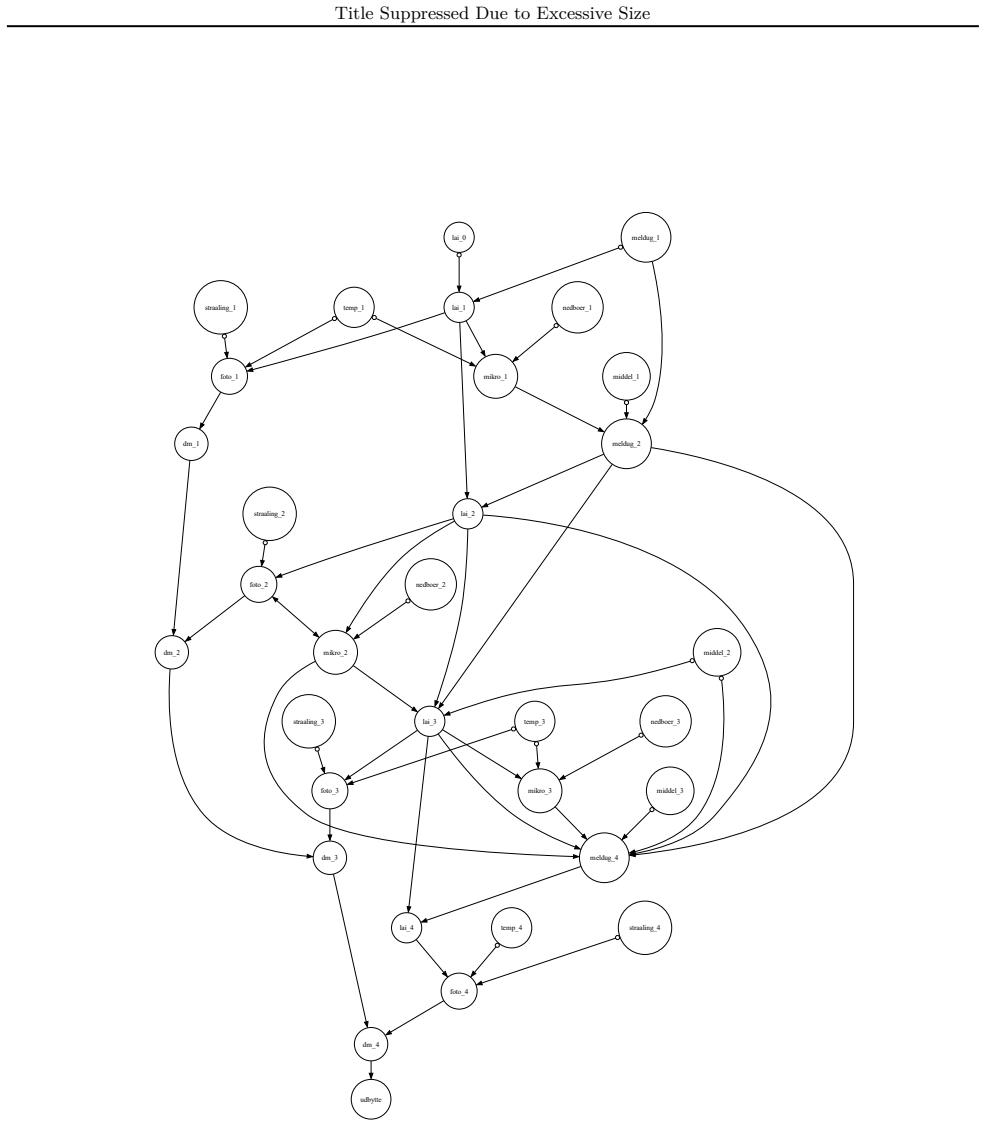
Rule application. Using R3(i), no conditioning set renders f oto2 and mikro2 independent. Applying R3(ii), we find that straaling2 ̸ ⊥ ⊥f oto2 but straaling2 ⊥ ⊥mikro2. The algorithm therefore terminates with Θ ← 0. 21 Title Suppressed Due to Excessive Size temp_1 foto_1 mikro_1 straaling_1 lai_0 lai_1 meldug_1 meldug_2 straaling_2 foto_2 middel_1 temp_3 ...
discussion (0)
Sign in with ORCID, Apple, or X to comment. Anyone can read and Pith papers without signing in.