Detecting Atypical Clients in Federated Learning via Representation-Level Divergence
Pith reviewed 2026-05-22 07:58 UTC · model grok-4.3
The pith
A geometric signal from activation partitions on a probe set identifies atypical clients in federated learning.
A machine-rendered reading of the paper's core claim, the machinery that carries it, and where it could break.
Core claim
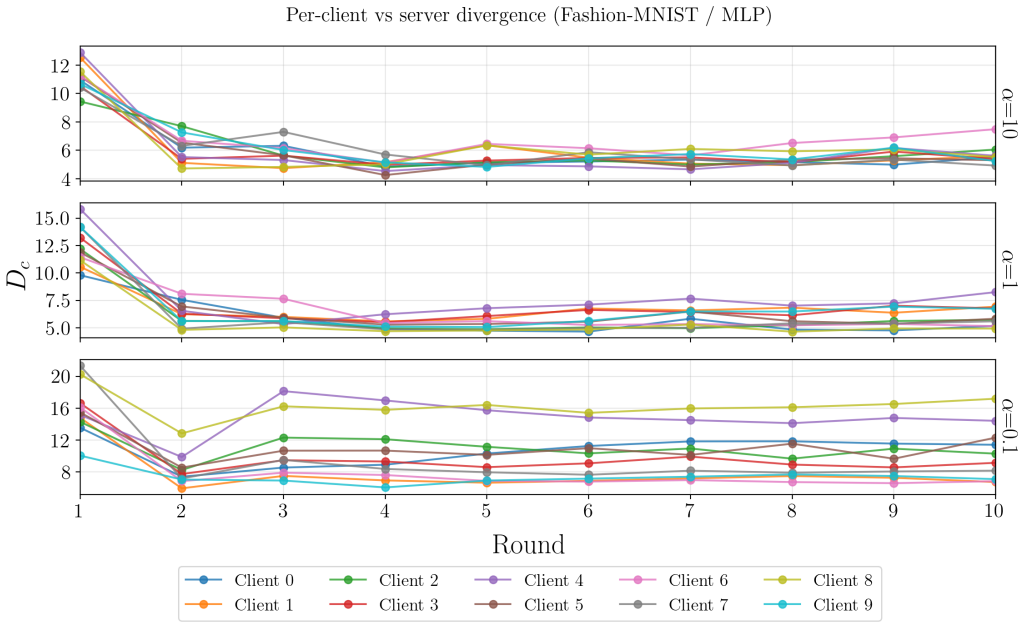
We propose a lightweight geometric signal to quantify the functional deviation of a client with respect to the global model by measuring how the local training of each client alters the activation-induced partition of the input space, evaluated on a shared probe set. This yields a permutation-invariant, interpretable metric of client-global divergence that captures differences in how data is processed by the model, effectively identifying clients that induce atypical functional changes.
What carries the argument
Activation-induced partition of the input space on a shared probe set as a geometric signal for functional deviation.
If this is right
- The metric distinguishes stable heterogeneous clients from those with significant divergence.
- It provides a tool for monitoring client behavior in federated learning systems.
- The approach enables risk-aware aggregation strategies.
- It addresses concerns about reliability in the aggregation process due to anomalous inputs or shifts.
Where Pith is reading between the lines
- Integrating this signal could lead to adaptive weighting of client contributions based on their divergence score.
- The method might be extended to detect specific types of attacks like data poisoning in federated setups.
- Similar representation-based checks could apply to other collaborative machine learning scenarios.
Load-bearing premise
That alterations in the activation-induced partition of the input space on a shared probe set provide a meaningful proxy for the functional deviation affecting global model aggregation.
What would settle it
Running the detection on a federated learning simulation where certain clients are engineered to have atypical updates and checking if the metric successfully flags them while ignoring normal heterogeneous clients.
Figures

read the original abstract
Federated learning enables collaborative training across distributed clients with heterogeneous data, but such heterogeneity often leads to unstable updates and degraded global performance. Moreover, in practical deployments, client updates may deviate from the expected behavior not only due to benign not i.i.d. distributions, but also due to distributional shifts or anomalous inputs, raising concerns about the reliability of the aggregation process. In this work, we propose a lightweight geometric signal to quantify the functional deviation of a client with respect to the global model. Instead of comparing model parameters or gradients, our approach measures how the local training of each client alters the activation-induced partition of the input space, evaluated on a shared probe set. This yields a permutation-invariant, interpretable metric of client--global divergence that captures differences in how data is processed by the model. We show that this signal effectively identifies clients that induce atypical functional changes, distinguishing stable yet heterogeneous clients from those whose updates significantly diverge from the global regime. As a result, the proposed metric provides a simple tool for monitoring client behavior and enabling risk-aware aggregation strategies in federated learning systems.
Editorial analysis
A structured set of objections, weighed in public.
Referee Report
Summary. The paper proposes a lightweight geometric signal for federated learning that quantifies a client's functional deviation from the global model by measuring alterations to the activation-induced partition of the input space, evaluated on a shared probe set. This yields a permutation-invariant metric claimed to identify atypical clients whose updates diverge significantly, distinguishing them from stable yet heterogeneous clients and supporting risk-aware aggregation strategies.
Significance. If the metric is shown to reliably flag clients whose updates produce atypical effects on the aggregated model, the approach could offer a practical, parameter-light monitoring tool for handling data heterogeneity, distributional shifts, and anomalies in federated systems without direct parameter or gradient comparisons.
major comments (2)
- Abstract: the central claim that the signal 'effectively identifies clients that induce atypical functional changes' and distinguishes them from stable heterogeneous clients lacks any supporting equations, validation experiments, or error analysis. This is load-bearing for the identification utility asserted in the abstract.
- Approach (activation-induced partition metric): the assumption that divergence in the activation-induced partition on a fixed probe set provides a meaningful and sufficient proxy for the functional deviations that affect global model aggregation is not demonstrated. The manuscript should include tests showing that high metric values causally correlate with larger post-aggregation shifts in global loss or decision boundaries, rather than being produced by benign heterogeneous clients.
minor comments (1)
- The abstract introduces 'activation-induced partition' without a concise definition or reference to the relevant section or equation; adding this would improve immediate clarity for readers.
Simulated Author's Rebuttal
We thank the referee for the insightful comments on our work. We provide detailed responses to each major comment and outline the revisions we will make to address the concerns raised.
read point-by-point responses
-
Referee: Abstract: the central claim that the signal 'effectively identifies clients that induce atypical functional changes' and distinguishes them from stable heterogeneous clients lacks any supporting equations, validation experiments, or error analysis. This is load-bearing for the identification utility asserted in the abstract.
Authors: While the abstract is a high-level summary, the manuscript provides supporting validation through experiments detailed in the results section. These experiments demonstrate the metric's effectiveness in identifying atypical clients by comparing divergence scores across different client types and showing correlation with model performance impacts. To strengthen the abstract, we will revise it to include a concise mention of the experimental evidence and the distinction from heterogeneous clients. We will also ensure that key equations defining the metric are referenced. revision: yes
-
Referee: Approach (activation-induced partition metric): the assumption that divergence in the activation-induced partition on a fixed probe set provides a meaningful and sufficient proxy for the functional deviations that affect global model aggregation is not demonstrated. The manuscript should include tests showing that high metric values causally correlate with larger post-aggregation shifts in global loss or decision boundaries, rather than being produced by benign heterogeneous clients.
Authors: We agree that demonstrating the link to aggregation effects is important. Our current results indicate that high metric values are associated with clients that cause notable shifts in the global model, unlike stable heterogeneous clients. To explicitly show the causal correlation, we will add new experiments measuring post-aggregation changes in global loss and decision boundaries as a function of the metric value. This will include comparisons to rule out benign heterogeneity and validate the probe set's role. These additions will be included in the revised manuscript. revision: yes
Circularity Check
No circularity: metric defined as direct observable on probe set
full rationale
The paper introduces a geometric signal that quantifies client-global divergence by measuring changes in activation-induced input-space partitions evaluated on a shared probe set. This definition is self-contained and does not rely on any fitted parameters, predictions that reduce to inputs by construction, or load-bearing self-citations. No derivation chain is presented that equates a claimed result to its own inputs; the metric is proposed as an independent, permutation-invariant observable for monitoring client behavior.
Axiom & Free-Parameter Ledger
Lean theorems connected to this paper
-
IndisputableMonolith/Cost/FunctionalEquation.leanwashburn_uniqueness_aczel unclear?
unclearRelation between the paper passage and the cited Recognition theorem.
we propose a lightweight geometric signal ... measures how the local training of each client alters the activation-induced partition of the input space, evaluated on a shared probe set ... K_θ_l(i,j) = 1 - (1/n_l) H(a_l(x_i;θ), a_l(x_j;θ)) ... D_hier(θ,θ') = d_1 + Σ (∏ λ_r) d_l
-
IndisputableMonolith/Foundation/AlexanderDuality.leanalexander_duality_circle_linking unclear?
unclearRelation between the paper passage and the cited Recognition theorem.
activation patterns ... define a partition of the input space into regions ... piecewise-affine decomposition
What do these tags mean?
- matches
- The paper's claim is directly supported by a theorem in the formal canon.
- supports
- The theorem supports part of the paper's argument, but the paper may add assumptions or extra steps.
- extends
- The paper goes beyond the formal theorem; the theorem is a base layer rather than the whole result.
- uses
- The paper appears to rely on the theorem as machinery.
- contradicts
- The paper's claim conflicts with a theorem or certificate in the canon.
- unclear
- Pith found a possible connection, but the passage is too broad, indirect, or ambiguous to say the theorem truly supports the claim.
Reference graph
Works this paper leans on
-
[1]
M. Chen, S. Mao, and Y . Liu, “Big data: A survey,”Mobile Networks and Applications, 2014
work page 2014
-
[2]
Advances and open problems in federated learning,
P. Kairouz and H. B. McMahan, “Advances and open problems in federated learning,”Foundations and Trends in Machine Learning, vol. 14, no. 1-2, pp. 1–210, 2021
work page 2021
-
[3]
Communication-efficient learning of deep networks from decentralized data,
B. McMahan, E. Moore, D. Ramage, S. Hampson, and B. A. y. Arcas, “Communication-efficient learning of deep networks from decentralized data,” inProceedings of the 20th International Conference on Artificial Intelligence and Statistics, 2017
work page 2017
-
[4]
Federated optimization in heterogeneous networks,
T. Li, A. K. Sahuet al., “Federated optimization in heterogeneous networks,” inProceedings of Machine Learning and Systems, 2020
work page 2020
-
[5]
Adaptive federated optimization,
S. J. Reddi, Z. Charles, M. Zaheer, Z. Garrett, K. Rush, J. Kone ˇcný, S. Kumar, and H. B. McMahan, “Adaptive federated optimization,” in International Conference on Learning Representations, 2021
work page 2021
-
[6]
Fedbn: Federated learning on non-iid features via local batch normalization,
X. Li, M. Jiang, X. Zhang, M. Kamp, and Q. Dou, “Fedbn: Federated learning on non-iid features via local batch normalization,” inInterna- tional Conference on Learning Representations, 2021
work page 2021
-
[7]
Exploiting shared representations for personalized federated learning,
L. Collins, H. Hassani, A. Mokhtari, and S. Shakkottai, “Exploiting shared representations for personalized federated learning,” inInterna- tional Conference on Machine Learning, 2021
work page 2021
-
[8]
Fedbabu: Toward enhanced representation for federated image classification,
J. Oh, S. Kim, and S.-Y . Yun, “Fedbabu: Toward enhanced representation for federated image classification,” inInternational Conference on Learning Representations, 2022
work page 2022
-
[9]
On the number of linear regions of deep neural networks,
G. Montúfar, R. Pascanu, K. Cho, and Y . Bengio, “On the number of linear regions of deep neural networks,” inAdvances in Neural Information Processing Systems, 2014
work page 2014
-
[10]
On the expressive power of deep neural networks,
M. Raghu, B. Poole, J. Kleinberg, S. Ganguli, and J. Sohl-Dickstein, “On the expressive power of deep neural networks,” inInternational Conference on Machine Learning, 2017
work page 2017
-
[11]
Convergence of deep relu networks,
Y . Xu and H. Zhang, “Convergence of deep relu networks,”Neurocom- puting, 2024
work page 2024
-
[12]
Studying the evolution of neural activation patterns during training of feed-forward relu networks,
D. Hartmann, D. Franzen, and S. Brodehl, “Studying the evolution of neural activation patterns during training of feed-forward relu networks,” Frontiers in Artificial Intelligence, 2021
work page 2021
-
[13]
Practical secure aggregation for privacy-preserving machine learning,
K. Bonawitz, V . Ivanov, B. Kreuter, A. Marcedone, H. B. McMahan, S. Patel, D. Ramage, A. Segal, and K. Seth, “Practical secure aggregation for privacy-preserving machine learning,” inACM CCS, 2017
work page 2017
-
[14]
Ma- chine learning with adversaries: Byzantine tolerant gradient descent,
P. Blanchard, E. M. El Mhamdi, R. Guerraoui, and J. Stainer, “Ma- chine learning with adversaries: Byzantine tolerant gradient descent,” in NeurIPS, 2017
work page 2017
-
[15]
Regime change hypothesis: Foun- dations for decoupled dynamics in neural network training,
C. Pérez-Corral, A. Fernández-Hernández, J. I. Mestre, M. F. Dolz, J. Duato, and E. S. Quintana-Orti, “Regime change hypothesis: Foun- dations for decoupled dynamics in neural network training,” 2026
work page 2026
discussion (0)
Sign in with ORCID, Apple, or X to comment. Anyone can read and Pith papers without signing in.