Enrichment of rhombohedral stacking by mechanical exfoliation of graphite
Pith reviewed 2026-05-22 05:05 UTC · model grok-4.3
The pith
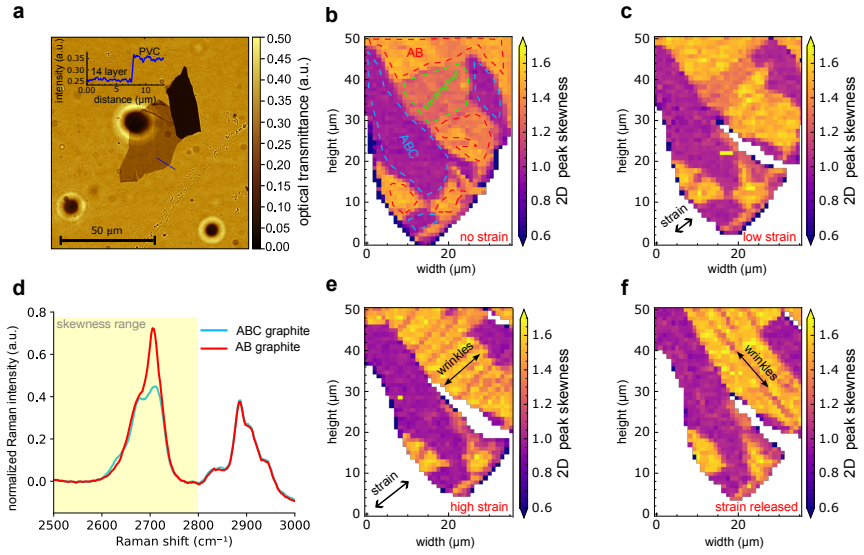
Mechanical exfoliation enriches rhombohedral ABC stacking in graphite from 3% to 26%
A machine-rendered reading of the paper's core claim, the machinery that carries it, and where it could break.
Core claim
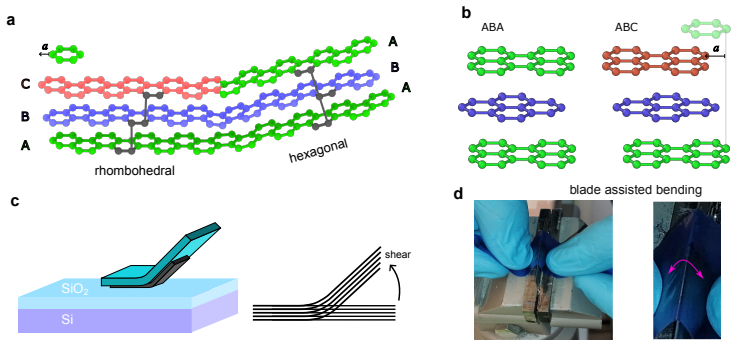
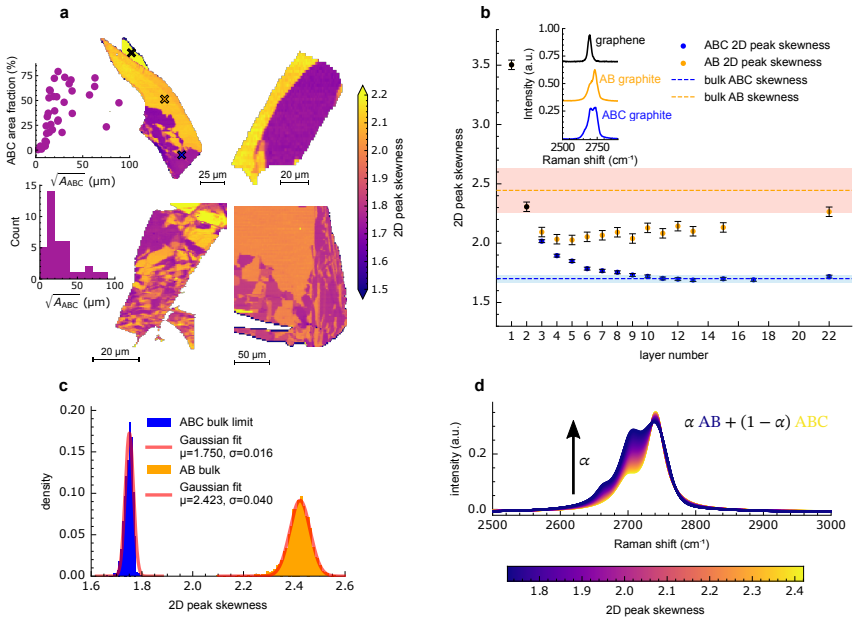
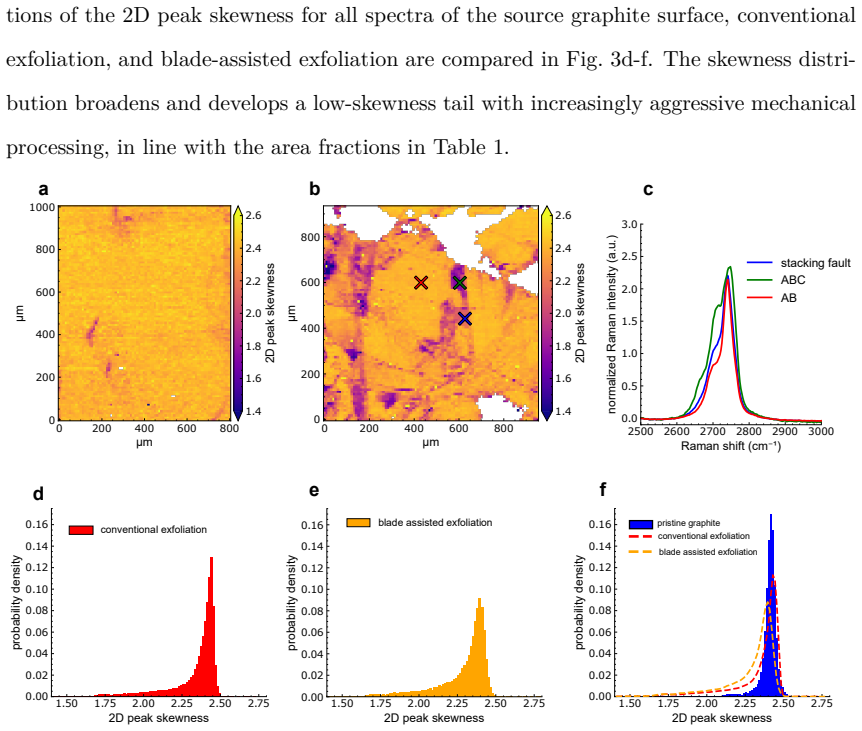
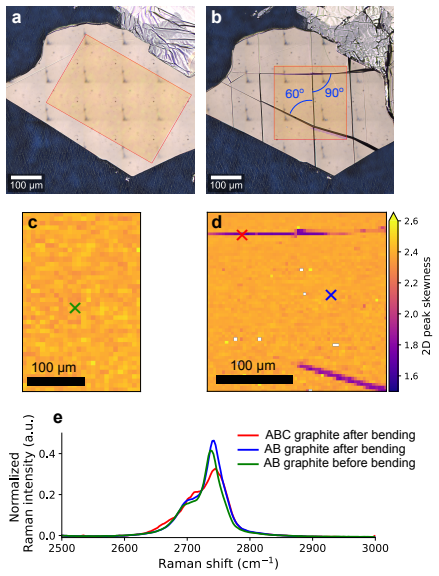
Routine mechanical exfoliation itself enriches the rhombohedral content of graphite flakes, and a simple blade-assisted exfoliation step that introduces additional shear amplifies the effect further. Large-area Raman 2D-band skewness mapping measures ABC content at area fractions of 3 percent in the pristine source crystal, 16 percent after conventional exfoliation, and 26 percent after blade-assisted exfoliation for thick flakes. In thin flakes under 20 layers the per-flake area fraction reaches 75 percent in the upper tail of the distribution. Tracking individual flakes shows wrinkles seed AB-ABC domain walls and uniaxial strain can move these walls, removing one bottleneck to preparing rh
What carries the argument
Shear from mechanical and blade-assisted exfoliation that seeds and shifts AB-ABC domain walls through wrinkles
If this is right
- Thin flakes below 20 layers reach per-flake ABC area fractions up to 75 percent.
- Wrinkles created during exfoliation seed AB-ABC domain walls.
- Uniaxial strain applied to flakes can move those domain walls.
- Blade-assisted exfoliation produces higher ABC fractions than conventional exfoliation alone.
- The method yields ABC-rich samples suitable for experiments on correlated and topological phases.
Where Pith is reading between the lines
- Controlling shear parameters more precisely during exfoliation could push ABC fractions even higher.
- Strain-based tuning of domain walls might enable devices that switch between AB and ABC regions.
- The same shear enrichment approach could be tested on other layered materials to engineer stacking order.
- Combining Raman mapping with in-situ strain application would allow real-time observation of wall motion.
Load-bearing premise
The Raman 2D-band skewness mapping reliably quantifies ABC versus AB area fractions without significant interference from strain, defects, or thickness variations.
What would settle it
A direct structural check such as electron diffraction or scanning tunneling microscopy on the identical regions previously mapped by Raman skewness would show matching ABC fractions if the quantification holds or clear mismatch if it does not.
Figures
read the original abstract
Rhombohedral (ABC) graphite hosts a surface-localized flat band that supports correlated and topological electronic phases, but its experimental study is limited by the scarcity of ABC stacking in natural graphite, which is dominated by Bernal (AB) stacking. Here we show that the routine mechanical exfoliation step itself enriches the rhombohedral content of graphite flakes, and that a simple blade-assisted exfoliation step, which introduces additional shear, amplifies the effect further. Using large-area Raman 2D-band skewness mapping we measure ABC content at area fractions of 3\% in the pristine source crystal, 16\% after conventional exfoliation, and 26\% after blade-assisted exfoliation for thick flakes. In thin flakes ($<20$ layers) the per-flake area fraction reaches 75\% in the upper tail of the distribution. Tracking individual flakes before and after blade-assisted exfoliation shows that wrinkles seed AB-ABC domain walls, and uniaxial strain can move these walls. Blade-assisted mechanical exfoliation therefore removes one of the bottlenecks to the preparation of ABC-rich graphite samples for studies of correlated and topological phases in rhombohedral graphite.
Editorial analysis
A structured set of objections, weighed in public.
Referee Report
Summary. The manuscript claims that routine mechanical exfoliation of graphite enriches rhombohedral (ABC) stacking relative to Bernal (AB) stacking, with the effect amplified by an additional blade-assisted shear step. Using large-area Raman 2D-band skewness mapping, the authors report ABC area fractions of 3% in the pristine source crystal, 16% after conventional exfoliation, and 26% after blade-assisted exfoliation for thick flakes; in thin flakes (<20 layers) the per-flake fraction reaches 75% in the upper tail. They further observe that wrinkles seed AB-ABC domain walls and that uniaxial strain can displace these walls.
Significance. If the Raman-based quantification holds, the work supplies a simple, low-cost route to ABC-enriched graphite flakes that removes a key preparation bottleneck for experiments on flat-band correlated and topological states. The direct before/after tracking of individual flakes and the reported strain-domain-wall coupling constitute useful experimental observations.
major comments (2)
- [Abstract and Raman-mapping results] Abstract and the Raman-mapping results section: the headline area fractions (3 %, 16 %, 26 %, and up to 75 % in thin flakes) are obtained by converting 2D-band skewness maps into ABC/AB area fractions. The manuscript itself states that uniaxial strain displaces AB-ABC domain walls and that wrinkles seed them; because the 2D lineshape is also known to broaden and shift under uniaxial strain and with layer number, the possibility that strain or thickness variations are mis-attributed to stacking order must be quantitatively ruled out before the enrichment factors can be accepted at face value.
- [Experimental-methods and data-analysis] Experimental-methods and data-analysis sections: no error analysis, calibration details, or raw skewness histograms are supplied in the provided text, nor is an independent cross-check (TEM, second-harmonic generation, or transport) described. Without these, it is impossible to assess whether post-selection of flakes or unaccounted strain gradients affect the reported percentages.
minor comments (2)
- [Figure captions] Figure captions should explicitly state the number of flakes and total mapped area underlying each percentage quoted.
- [Results on thin flakes] Clarify the precise definition of 'thin flakes (<20 layers)' and whether the 75 % upper-tail value is an average or a single-flake maximum.
Simulated Author's Rebuttal
We thank the referee for the careful and constructive review of our manuscript. The comments raise valid points about potential confounding factors in the Raman analysis and the need for greater methodological transparency. We address each major comment below and have revised the manuscript to incorporate additional discussion, data, and clarifications where possible.
read point-by-point responses
-
Referee: [Abstract and Raman-mapping results] Abstract and the Raman-mapping results section: the headline area fractions (3 %, 16 %, 26 %, and up to 75 % in thin flakes) are obtained by converting 2D-band skewness maps into ABC/AB area fractions. The manuscript itself states that uniaxial strain displaces AB-ABC domain walls and that wrinkles seed them; because the 2D lineshape is also known to broaden and shift under uniaxial strain and with layer number, the possibility that strain or thickness variations are mis-attributed to stacking order must be quantitatively ruled out before the enrichment factors can be accepted at face value.
Authors: We agree that strain and layer-number effects on the 2D band must be carefully considered, given our own observations on domain-wall motion. In the revised manuscript we have added a dedicated paragraph in the results section that quantifies these influences. Specifically, we include reference Raman maps acquired under controlled uniaxial strain (up to 0.5 %) on both AB- and ABC-rich flakes; these show that strain broadens the 2D band but shifts the skewness distribution by less than 10 % of the separation between the AB and ABC peaks used in our threshold. We also provide layer-number calibration curves obtained from AFM-counted flakes, confirming that the skewness contrast remains robust for thicknesses between 5 and 50 layers. Analysis regions were restricted to wrinkle-free areas identified by optical and AFM inspection. These additions allow the reported enrichment factors to be evaluated with the confounding effects explicitly bounded. revision: yes
-
Referee: [Experimental-methods and data-analysis] Experimental-methods and data-analysis sections: no error analysis, calibration details, or raw skewness histograms are supplied in the provided text, nor is an independent cross-check (TEM, second-harmonic generation, or transport) described. Without these, it is impossible to assess whether post-selection of flakes or unaccounted strain gradients affect the reported percentages.
Authors: We acknowledge that the original submission provided insufficient detail on statistical robustness and calibration. The revised methods section now contains a full description of the error analysis: uncertainties on area fractions are derived from the standard deviation across five independent large-area maps per sample type, combined with the uncertainty in the skewness threshold determined from reference flakes. Calibration is described using exfoliated flakes whose stacking order was cross-verified by AFM layer counting on the same regions. Raw skewness histograms for all mapped flakes are included in the new supplementary information. Regarding independent cross-checks, the Raman 2D skewness method is established in the literature for graphite stacking identification; however, we did not perform TEM, SHG, or transport measurements on the same flakes in this study. We have added an explicit limitations paragraph noting this and indicating that such verification would strengthen future work. revision: partial
- Independent cross-check of stacking order via TEM, second-harmonic generation, or transport measurements on the same flakes was not performed in the present study.
Circularity Check
No circularity: purely experimental measurements with no derivations or self-referential predictions
full rationale
The manuscript is an experimental observation paper reporting direct Raman 2D-band skewness mapping to quantify ABC stacking area fractions in graphite flakes before and after exfoliation. The headline percentages (3% pristine, 16% conventional, 26% blade-assisted; up to 75% in thin flakes) are obtained from spatial mapping of measured spectral skewness, not from any model, fit, or derivation that reduces to the input data by construction. No equations, predictions, ansatzes, or uniqueness theorems are invoked that could create self-definitional or fitted-input circularity. Self-citations, if present for prior Raman calibration, are not load-bearing for any claimed derivation chain. The work is self-contained as empirical results against external benchmarks (Raman literature on stacking), satisfying the criteria for a score of 0 with no circular steps.
Axiom & Free-Parameter Ledger
axioms (1)
- domain assumption Raman 2D-band skewness accurately distinguishes ABC from AB stacking over large areas
Reference graph
Works this paper leans on
-
[1]
Laves, F. & Baskin, Y. On the formation of the rhombohedral graphite modification. Z. Kristallogr.107, 337–356 (1956)
work page 1956
-
[2]
Roy, N.et al.Detecting the six polytypes of five-layer graphite.Adv. Mater.e09947 (2025)
work page 2025
-
[3]
Han, T.et al.Correlated insulator and chern insulators in pentalayer rhombohedral- stacked graphene.Nat. Nanotechnol.(2023)
work page 2023
-
[4]
Hagymási, I.et al.Observation of competing, correlated ground states in the flat band of rhombohedral graphite.Science Advances8, eabo6879 (2022)
work page 2022
-
[5]
Liu, K.et al.Spontaneous broken-symmetry insulator and metals in tetralayer rhom- bohedral graphene.Nat. Nanotechnol.(2023)
work page 2023
-
[6]
Zhou, H., Xie, T., Taniguchi, T., Watanabe, K. & Young, A. F. Superconductivity in rhombohedral trilayer graphene.Nature598, 434–438 (2021)
work page 2021
-
[7]
Yang, J.et al.Magnetic field-enhanced graphene superconductivity with record pauli- limit violation.arXiv(2025)
work page 2025
-
[8]
Pálinkás, A.et al.Identification of graphite with perfect rhombohedral stacking by electronic raman scattering.Carbon230, 119608 (2024)
work page 2024
-
[9]
Bouhafs, C.et al.Synthesis of large-area rhombohedral few-layer graphene by chem- ical vapor deposition on copper.Carbon177, 282–290 (2021)
work page 2021
-
[10]
Gao, Z.et al.Large-area epitaxial growth of curvature-stabilized ABC trilayer graphene.Nat. Commun.11, 546 (2020)
work page 2020
-
[11]
Nery, J. P., Calandra, M. & Mauri, F. Long-Range Rhombohedral-Stacked graphene through shear.Nano Lett.20, 5017–5023 (2020). 16
work page 2020
-
[12]
Dey, A., Azizimanesh, A., Wu, S. M. & Askari, H. Uniaxial strain-induced stacking order change in trilayer graphene.ACS Appl. Mater. Interfaces(2024)
work page 2024
-
[13]
Korhonen, T. & Koskinen, P. Peeling of multilayer graphene creates complex inter- layer sliding patterns.Phys. Rev. B92, 115427 (2015)
work page 2015
-
[14]
P.et al.Anomalous twin boundaries in two dimensional materials.Nat
Rooney, A. P.et al.Anomalous twin boundaries in two dimensional materials.Nat. Commun.9, 3597 (2018)
work page 2018
-
[15]
Holleis, L.et al.Cryogenic shock exfoliation for ultrahigh mobility rhombohedral graphite nanoelectronics.arXiv(2026)
work page 2026
-
[16]
Nery, J. P., Calandra, M. & Mauri, F. Ab-initio energetics of graphite and multilayer graphene: stability of bernal versus rhombohedral stacking.2D Mater.8, 035006 (2021)
work page 2021
-
[17]
Halbertal, D.et al.Moiré metrology of energy landscapes in van der waals het- erostructures.Nat. Commun.12, 242 (2021)
work page 2021
-
[18]
Nano Lett.19, 8526–8532 (2019)
Yang, Y.et al.Stacking order in graphite films controlled by van der waals technology. Nano Lett.19, 8526–8532 (2019)
work page 2019
-
[19]
McEllistrim, A., Garcia-Ruiz, A., Goodwin, Z. A. H. & Fal’ko, V. I. Spectroscopic signatures of tetralayer graphene polytypes.Phys. Rev. B107, 155147 (2023)
work page 2023
-
[20]
Klar, P.et al.Raman scattering efficiency of graphene.Phys. Rev. B: Condens. Matter Mater. Phys.87, 205435 (2013)
work page 2013
-
[21]
Feng, Z.et al.Rapid infrared imaging of rhombohedral graphene.Phys. Rev. Appl. 23, 034012 (2025)
work page 2025
-
[22]
Blakslee, O. L., Proctor, D. G., Seldin, E. J., Spence, G. B. & Weng, T. Elastic constants of compression-annealed pyrolytic graphite.J. Appl. Phys.41, 3373–3382 (1970). 17
work page 1970
-
[23]
Politano, A. & Chiarello, G. Probing the Young’s modulus and Poisson’s ratio in graphene/metal interfaces and graphite: a comparative study.Nano Res.8, 1847– 1856 (2015)
work page 2015
-
[24]
Faccinto, J. A., Lee, J. & Kim, K. J. Tensile modeling PVC gels for electrohydraulic actuators.Polymers17, 2641 (2025)
work page 2025
-
[25]
S.et al.Strain solitons and topological defects in bilayer graphene.Proc
Alden, J. S.et al.Strain solitons and topological defects in bilayer graphene.Proc. Natl. Acad. Sci. U. S. A.110, 11256–11260 (2013)
work page 2013
-
[26]
Yasuda, K.et al.Ultrafast high-endurance memory based on sliding ferroelectrics. Science385, 53–56 (2024)
work page 2024
-
[27]
zrbyte/ramantools: v0.3.1, DOI: 10.5281/zenodo.10143138 (2023)
Nemes-Incze, P. zrbyte/ramantools: v0.3.1, DOI: 10.5281/zenodo.10143138 (2023). 18
discussion (0)
Sign in with ORCID, Apple, or X to comment. Anyone can read and Pith papers without signing in.