Suicide Risk Assessment from AI-powered Video Surveillance: An Interpretable Framework for Prevention in Metro Stations
Pith reviewed 2026-05-25 05:52 UTC · model grok-4.3
The pith
Suicide risk in metro stations can be assessed from surveillance video by accumulating evidence from passenger behavior, platform geometry, and trajectories in an interpretable pipeline.
A machine-rendered reading of the paper's core claim, the machinery that carries it, and where it could break.
Core claim
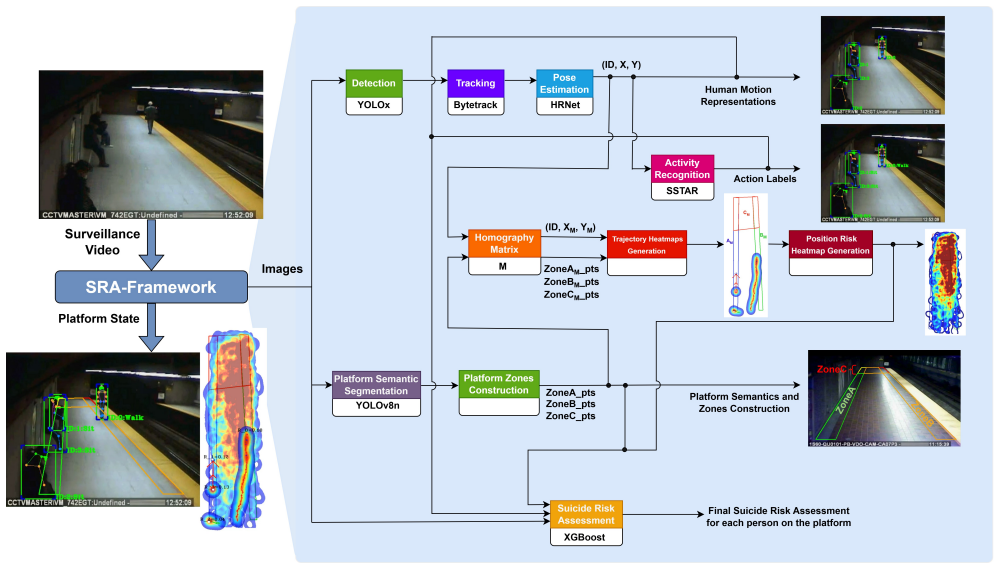
Suicide Risk Assessment is formalized as a distinct task in metro stations, and the first interpretable framework addresses it by incorporating person tracking, activity recognition, semantic segmentation of the platform, and trajectory-driven risk heatmap modeling, with a complete pipeline benchmarked at 83.2 percent ROC-AUC on real surveillance data.
What carries the argument
trajectory-driven risk heatmap modeling, which aggregates behavioral cues, motion, and platform context over time to produce an interpretable risk score.
If this is right
- High-risk situations become identifiable early enough for timely intervention using existing surveillance cameras.
- The task is shown to be more complex than isolated subtasks such as activity recognition alone.
- Research can now pursue other interpretable AI systems that build evidence from video for social-good applications.
- Risk assessment shifts from direct intent inference to aggregation of heterogeneous cues.
Where Pith is reading between the lines
- The same pipeline structure could be tested in other public spaces that already have overhead cameras, such as train platforms or airport terminals.
- Human operators could be studied to see whether the heatmaps and segmentations improve their ability to decide when to intervene compared with raw video.
- Future work could add a feedback loop where actual interventions update the risk model without requiring new labeled video.
Load-bearing premise
Observable video behaviors, trajectories, and platform context provide enough accumulated evidence to assess suicide risk reliably without direct psychological data or confirmed ground-truth labels.
What would settle it
Running the pipeline on incidents where independent psychological evaluations or confirmed intervention records exist, then checking whether the generated risk scores align with those external judgments.
Figures


read the original abstract
Understanding and monitoring human behavior in metro stations play an important role in supporting suicide prevention efforts, where early identification of high-risk situations can enable timely intervention. This requires assessing suicide risk from a surveillance video by jointly reasoning about the behavior of each passenger, his/her spatial context, and temporal dynamics. However, this assessment using videos captured by surveillance cameras is challenging, as it demands accurate perception of human motion, understanding of platform geometry, and aggregation of heterogeneous behavioral cues over time. In this work, we formalize the task of Suicide Risk Assessment (SRA) in metro stations and introduce the first interpretable framework that addresses this challenge. Unlike approaches that focus on isolated subtasks or attempt to infer intent directly, our formulation assesses suicide risk from accumulated evidence by incorporating person tracking, activity recognition, semantic segmentation of the platform, and trajectory-driven risk heatmap modeling. By formalizing SRA as a distinct task and benchmarking a complete operational pipeline achieving 83.2% ROC-AUC on real surveillance data, this work highlights the complexity of suicide risk assessment and opens new directions for research on interpretable AI systems for social good.
Editorial analysis
A structured set of objections, weighed in public.
Referee Report
Summary. The paper formalizes Suicide Risk Assessment (SRA) as a distinct task from metro station surveillance video, requiring joint reasoning over passenger behavior, spatial context, and temporal dynamics. It introduces an interpretable framework integrating person tracking, activity recognition, semantic segmentation of the platform, and trajectory-driven risk heatmap modeling. The central empirical claim is that a complete operational pipeline achieves 83.2% ROC-AUC on real surveillance data, thereby highlighting the complexity of the task and opening directions for interpretable AI systems for social good.
Significance. If the performance claim is substantiated with proper dataset and labeling documentation, the work would be significant for establishing SRA as a benchmarkable computer-vision task and for demonstrating an end-to-end, interpretable pipeline on real operational footage. Such a result could usefully direct future research toward behavior aggregation and context modeling in high-stakes public-safety settings.
major comments (1)
- [Abstract] Abstract: The claim that the pipeline achieves 83.2% ROC-AUC on real surveillance data is presented without any information on dataset size, collection period, labeling protocol (annotators, inter-annotator agreement, use of psychological records or follow-up confirmation), class balance, baselines, error analysis, or validation protocol (train/test split, cross-validation). This information is load-bearing for interpreting whether the metric constitutes evidence that observable video behaviors and trajectories suffice to assess suicide risk.
Simulated Author's Rebuttal
We thank the referee for the constructive feedback emphasizing the need for comprehensive dataset and evaluation documentation to support the performance claims. We agree these details are essential and will revise the manuscript to strengthen the presentation of the experimental setup. We respond to the major comment below.
read point-by-point responses
-
Referee: [Abstract] Abstract: The claim that the pipeline achieves 83.2% ROC-AUC on real surveillance data is presented without any information on dataset size, collection period, labeling protocol (annotators, inter-annotator agreement, use of psychological records or follow-up confirmation), class balance, baselines, error analysis, or validation protocol (train/test split, cross-validation). This information is load-bearing for interpreting whether the metric constitutes evidence that observable video behaviors and trajectories suffice to assess suicide risk.
Authors: We agree that the abstract lacks sufficient context on these elements and will revise it to include dataset size, collection period, class balance, and a high-level description of the validation protocol. Full details on labeling (performed by domain experts annotating observable high-risk behaviors such as edge proximity and trajectory patterns), inter-annotator agreement, baselines, error analysis, and train/test splits are already present in the Methods and Experiments sections; we will add explicit cross-references from the abstract. We will also clarify that the framework evaluates risk based on aggregated observable video evidence rather than direct intent inference. However, psychological records or follow-up confirmation are unavailable due to the anonymized nature of operational surveillance data. revision: partial
- Use of psychological records or follow-up confirmation for labeling, as the dataset consists solely of de-identified surveillance footage without linked individual health data.
Circularity Check
No circularity; empirical benchmark independent of inputs
full rationale
The paper formalizes Suicide Risk Assessment (SRA) as a distinct task and reports an empirical ROC-AUC of 83.2% from a complete pipeline (tracking, activity recognition, segmentation, risk heatmaps) evaluated on real surveillance data. No equations, parameter-fitting steps, or self-citations are described that would reduce the performance metric or framework definition to a tautology or fitted input by construction. The central result is an external benchmark rather than a derived quantity forced by the paper's own definitions or prior self-citations.
Axiom & Free-Parameter Ledger
axioms (1)
- domain assumption Suicide risk can be inferred from accumulated observable behaviors, trajectories, and spatial context in surveillance video
discussion (0)
Sign in with ORCID, Apple, or X to comment. Anyone can read and Pith papers without signing in.