HawkesLLM: Semantic Uncertainty Propagation in Agentic Text Simulation
Pith reviewed 2026-05-25 05:28 UTC · model grok-4.3
The pith
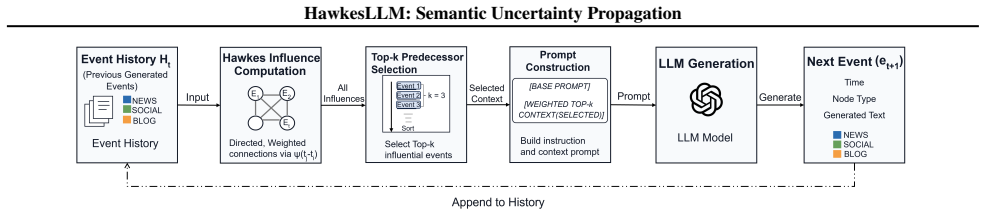
A multivariate Hawkes process models agent activations and influences to improve late-stage semantic alignment in text simulations under compact memory.
A machine-rendered reading of the paper's core claim, the machinery that carries it, and where it could break.
Core claim
The paper claims that representing a text-generating cascade as a network of agents, fitting a multivariate Hawkes process to their activation times and mutual influences, and feeding the resulting compact memory selections to a language model produces measurably higher late-stage semantic alignment with held-out GDELT references than baselines that lack this explicit temporal layer.
What carries the argument
multivariate Hawkes process that determines node activation times and selects which earlier agent outputs influence later prompts
If this is right
- Semantic alignment with reference events can be sustained further into the cascade while prompt memory remains compact.
- Local drift (deviation from nearby held-out references) can be measured separately from global drift (overall sequence divergence).
- Explicit modeling of influence structure among agents improves text-generation quality beyond what an LLM context window alone supplies.
- The framework extends in principle to any sequence of interdependent text generations where timing and cross-agent influence matter.
Where Pith is reading between the lines
- The same split between a temporal point-process layer and a content generator could reduce context-management costs in other long-horizon agentic tasks such as multi-turn dialogue or collaborative planning.
- If the Hawkes process recovers influence edges that generalize across cascades, it could serve as a lightweight alternative to ever-expanding context windows for maintaining coherence.
- Testing the approach on non-news domains would reveal whether the alignment gain is tied to event-cascade structure or holds more broadly for sequential text generation.
Load-bearing premise
The multivariate Hawkes process correctly captures the temporal activation patterns and influence structure among the text-generating agents in the simulation.
What would settle it
Applying HawkesLLM to the GDELT news-cascade data and finding no improvement, or a decline, in late-stage semantic alignment scores relative to a baseline using fixed or random memory selection would falsify the central performance claim.
Figures


read the original abstract
Agentic text-simulation systems write in sequence, with each item becoming possible context for later steps. That makes uncertainty path-dependent: an early ambiguity can affect later outputs. This paper studies this problem with HawkesLLM, a framework that separates temporal influence modeling from text generation. We represent the cascade as a network whose nodes are text-generating agents. A multivariate Hawkes process models how these nodes activate over time and which earlier node outputs should influence later prompts. A language model then writes each new event from the compact memory selected by this temporal model. We evaluate the framework on a held-out Global Database of Events, Language, and Tone (GDELT) news-cascade case study. The diagnostics track semantic alignment with local held-out references and separate local drift from global drift. In this setting, HawkesLLM improves late-stage semantic alignment under a compact prompt-memory budget.
Editorial analysis
A structured set of objections, weighed in public.
Referee Report
Summary. The paper introduces HawkesLLM, a framework for agentic text simulation that decouples temporal influence modeling (via a multivariate Hawkes process on a network of text-generating agents) from LLM-based text generation. The Hawkes component selects compact memory for prompts based on activation patterns and cross-influences; the LLM then generates each new event. On a held-out GDELT news-cascade case study, the authors claim improved late-stage semantic alignment (with diagnostics separating local from global drift) under a compact prompt-memory budget.
Significance. If the central claim holds, the work provides a principled mechanism for managing path-dependent uncertainty in sequential LLM simulations by explicitly modeling temporal dependencies and influence structure. The architectural separation of the Hawkes process from the generator is clean, and the use of held-out GDELT cascades with semantic-alignment metrics is a reasonable domain-appropriate evaluation. The approach could inform memory-efficient agentic systems, but its impact depends on whether the temporal model is verifiably accurate.
major comments (1)
- [Evaluation section (GDELT case study)] Evaluation / GDELT case study: The manuscript reports no goodness-of-fit diagnostics for the fitted multivariate Hawkes process on the GDELT cascades (e.g., residual analysis, compensator plots, or likelihood-ratio tests against homogeneous Poisson or self-exciting baselines). This is load-bearing for the headline claim, because any observed late-stage alignment gain could arise from the downstream memory-selection heuristic rather than from accurate recovery of activation intensities and cross-influence kernels.
Simulated Author's Rebuttal
We thank the referee for the constructive feedback on the evaluation. The concern about missing goodness-of-fit diagnostics for the multivariate Hawkes process is well-taken and directly relevant to interpreting the source of the reported alignment gains.
read point-by-point responses
-
Referee: The manuscript reports no goodness-of-fit diagnostics for the fitted multivariate Hawkes process on the GDELT cascades (e.g., residual analysis, compensator plots, or likelihood-ratio tests against homogeneous Poisson or self-exciting baselines). This is load-bearing for the headline claim, because any observed late-stage alignment gain could arise from the downstream memory-selection heuristic rather than from accurate recovery of activation intensities and cross-influence kernels.
Authors: We agree that the absence of explicit goodness-of-fit checks for the Hawkes component leaves open the possibility that gains derive primarily from the memory-selection rule rather than from recovered temporal structure. In the revised manuscript we will add (i) residual analysis and compensator plots for the fitted multivariate Hawkes process on the GDELT cascades and (ii) likelihood-ratio tests against both homogeneous Poisson and univariate self-exciting baselines. These diagnostics will be reported alongside the existing semantic-alignment metrics so that readers can assess whether the temporal model is verifiably recovering activation intensities and cross-influence kernels. revision: yes
Circularity Check
No circularity detected; framework separates components without self-referential reduction
full rationale
The abstract and description present HawkesLLM as a separation of a multivariate Hawkes process for temporal activation and influence modeling from an LLM for text generation, with evaluation on held-out GDELT cascades tracking semantic alignment. No equations, derivation steps, fitted parameters renamed as predictions, self-citations, or ansatzes are provided that would reduce any claimed result to its inputs by construction. The central empirical claim of improved late-stage alignment under compact memory is presented as an independent outcome of the combined system rather than a tautological restatement of the model fit itself.
Axiom & Free-Parameter Ledger
Lean theorems connected to this paper
-
IndisputableMonolith/Cost/FunctionalEquation.leanwashburn_uniqueness_aczel unclear?
unclearRelation between the paper passage and the cited Recognition theorem.
A multivariate Hawkes process models how these nodes activate over time and which earlier node outputs should influence later prompts.
-
IndisputableMonolith/Foundation/RealityFromDistinction.leanreality_from_one_distinction unclear?
unclearRelation between the paper passage and the cited Recognition theorem.
The event stream is modeled as lambda_i(s) = mu_i + sum ... phi_j,i(s - tau_m).
What do these tags mean?
- matches
- The paper's claim is directly supported by a theorem in the formal canon.
- supports
- The theorem supports part of the paper's argument, but the paper may add assumptions or extra steps.
- extends
- The paper goes beyond the formal theorem; the theorem is a base layer rather than the whole result.
- uses
- The paper appears to rely on the theorem as machinery.
- contradicts
- The paper's claim conflicts with a theorem or certificate in the canon.
- unclear
- Pith found a possible connection, but the passage is too broad, indirect, or ambiguous to say the theorem truly supports the claim.
Reference graph
Works this paper leans on
-
[1]
Spectra of Some Self-Exciting and Mutually Exciting Point Processes , author=. Biometrika , volume=
-
[2]
IEEE Transactions on Information Theory , volume=
On Lewis' Simulation Method for Point Processes , author=. IEEE Transactions on Information Theory , volume=
-
[3]
ISA Annual Convention , pages=
GDELT: Global Data on Events, Location, and Tone, 1979--2012 , author=. ISA Annual Convention , pages=
work page 1979
-
[4]
Qwen2.5: We're All Flying Together , author=. arXiv preprint arXiv:2412.15115 , year=
work page internal anchor Pith review Pith/arXiv arXiv
-
[5]
An Agent-Based Model of Reddit Interactions and Moderation , author=. Proceedings of the 2023 IEEE/ACM International Conference on Advances in Social Networks Analysis and Mining , pages=
work page 2023
-
[6]
arXiv preprint arXiv:2408.05123 , year=
Decoding Echo Chambers: LLM-Powered Simulations Revealing Polarization in Social Networks , author=. arXiv preprint arXiv:2408.05123 , year=
-
[7]
Proceedings of the 36th Annual ACM Symposium on User Interface Software and Technology , series=
Generative Agents: Interactive Simulacra of Human Behavior , author=. Proceedings of the 36th Annual ACM Symposium on User Interface Software and Technology , series=. 2023 , publisher=
work page 2023
-
[8]
Retrieval-Augmented Generation for Knowledge-Intensive
Lewis, Patrick and Perez, Ethan and Piktus, Aleksandra and Petroni, Fabio and Karpukhin, Vladimir and Goyal, Naman and Kuttler, Heinrich and Lewis, Mike and Yih, Wen-tau and Rocktaschel, Tim and Riedel, Sebastian and Kiela, Douwe , booktitle=. Retrieval-Augmented Generation for Knowledge-Intensive. 2020 , publisher=
work page 2020
-
[9]
arXiv preprint arXiv:2502.04567 , year=
Rhythm of Opinion: A Hawkes-Graph Framework for Dynamic Propagation Analysis , author=. arXiv preprint arXiv:2502.04567 , year=
-
[10]
arXiv preprint arXiv:2502.10867 , year=
TPP-LLM: Modeling Temporal Point Processes by Efficiently Fine-tuning Large Language Models , author=. arXiv preprint arXiv:2502.10867 , year=
-
[11]
LLM-AIDSim: LLM-Enhanced Agent-Based Influence Diffusion Simulation in Social Networks , author=. Systems , volume=
-
[12]
arXiv preprint arXiv:2502.17528 , year=
Advances in Temporal Point Processes: Bayesian, Neural, and LLM Approaches , author=. arXiv preprint arXiv:2502.17528 , year=
-
[13]
Zhao, Qiwei and Li, Dong and Liu, Yanchi and Cheng, Wei and Sun, Yiyou and Oishi, Mika and Osaki, Takao and Matsuda, Katsushi and Yao, Huaxiu and Zhao, Chen and Chen, Haifeng and Zhao, Xujiang , booktitle=. Uncertainty Propagation on. 2025 , publisher=
work page 2025
-
[14]
Findings of the Association for Computational Linguistics: ACL 2024 , pages=
Towards Uncertainty-Aware Language Agent , author=. Findings of the Association for Computational Linguistics: ACL 2024 , pages=. 2024 , publisher=
work page 2024
-
[15]
Findings of the Association for Computational Linguistics: EMNLP 2024 , pages=
Uncertainty Calibration for Tool-Using Language Agents , author=. Findings of the Association for Computational Linguistics: EMNLP 2024 , pages=. 2024 , publisher=
work page 2024
-
[16]
Detecting Hallucinations in Large Language Models Using Semantic Entropy , author=. Nature , volume=. 2024 , doi=
work page 2024
-
[17]
arXiv preprint arXiv:2305.19187 , year=
Generating with Confidence: Uncertainty Quantification for Black-box Large Language Models , author=. arXiv preprint arXiv:2305.19187 , year=
-
[18]
Know When To Stop: A Study of Semantic Drift in Text Generation , author=. Proceedings of the 2024 Conference of the North American Chapter of the Association for Computational Linguistics: Human Language Technologies (Volume 1: Long Papers) , pages=. 2024 , publisher=
work page 2024
-
[19]
Mohamed, Amr and Geng, Mingmeng and Vazirgiannis, Michalis and Shang, Guokan , booktitle=. 2025 , publisher=
work page 2025
-
[20]
Frontiers of Multimedia Research , pages=
A Tutorial on Hawkes Processes for Events in Social Media , author=. Frontiers of Multimedia Research , pages=. 2017 , publisher=
work page 2017
-
[21]
Advances in Neural Information Processing Systems , volume=
The Neural Hawkes Process: A Neurally Self-Modulating Multivariate Point Process , author=. Advances in Neural Information Processing Systems , volume=
-
[22]
Proceedings of the 37th International Conference on Machine Learning , series=
Transformer Hawkes Process , author=. Proceedings of the 37th International Conference on Machine Learning , series=. 2020 , publisher=
work page 2020
-
[23]
Transactions of the Association for Computational Linguistics , volume=
Lost in the Middle: How Language Models Use Long Contexts , author=. Transactions of the Association for Computational Linguistics , volume=. 2024 , doi=
work page 2024
-
[24]
Maximizing the Spread of Influence through a Social Network , author=. Theory of Computing , volume=
-
[25]
Algorithmic Game Theory , pages=
Cascading Behavior in Networks: Algorithmic and Economic Issues , author=. Algorithmic Game Theory , pages=
discussion (0)
Sign in with ORCID, Apple, or X to comment. Anyone can read and Pith papers without signing in.