Transition-state lattice modes and the breakdown of adiabatic tunneling for hydrogen and deuterium in bcc Nb
Pith reviewed 2026-05-25 04:53 UTC · model grok-4.3
The pith
Tunnel splittings of trapped hydrogen and deuterium in niobium match experiment only when two lattice modes are treated on equal footing with the interstitial in a five-dimensional nonadiabatic model.
A machine-rendered reading of the paper's core claim, the machinery that carries it, and where it could break.
Core claim
The experimentally measured tunnel splittings of O-trapped H and D in bcc Nb are quantitatively reproduced only within a five-dimensional (5D) Lattice-Renormalized Born-Oppenheimer (LRBO) framework. This approach treats three interstitial modes and two judiciously selected lattice modes, which includes a transition-state mode, on equal quantum footing. By recasting nested Born-Oppenheimer hierarchies within this same formalism and benchmarking against modern ab initio potential energy surfaces, adiabatic separation of the light particle from lattice dynamics is satisfied only in the positive-muon mass limit. In contrast, tunneling for H and D is fundamentally a collective, nonadiabatic过程eess
What carries the argument
The five-dimensional Lattice-Renormalized Born-Oppenheimer (LRBO) framework, which places three interstitial modes and two lattice modes including the transition-state mode on equal quantum footing and recasts nested Born-Oppenheimer hierarchies.
If this is right
- Adiabatic tunneling models are invalid for H and D in this system and must be replaced by nonadiabatic treatments.
- Tunneling becomes a collective process mediated by anharmonic lattice couplings rather than an isolated interstitial motion.
- The breakdown of adiabaticity is predictable from ground-state energy estimates evaluated at a small number of fixed lattice configurations.
- The LRBO approach provides a practical benchmark against ab initio potential energy surfaces for similar systems.
Where Pith is reading between the lines
- The same energy-estimate criterion could screen other metal-interstitial systems for adiabatic validity before committing to multidimensional calculations.
- Incorporating the identified transition-state lattice mode into models of defect-induced decoherence may improve predictions for superconducting qubit performance.
- The framework suggests that hydrogen diffusion rates in metals at low temperature may require collective lattice coordinates in general.
Load-bearing premise
The two selected lattice modes plus the three interstitial modes are sufficient to capture all relevant nonadiabatic couplings.
What would settle it
A calculation that adds further lattice modes and finds tunnel splittings that deviate substantially from both the 5D results and the experimental values would falsify the claim that the chosen five dimensions suffice.
Figures


read the original abstract
Interstitial hydrogen and deuterium in body-centered-cubic metals constitute archetypal quantum tunneling systems. Their relevance has been renewed by the connection between hydrogenic tunneling in Nb and defect-induced decoherence in superconducting qubits, motivating a predictive microscopic theory. Existing theoretical treatments invoke an adiabatic separation between the light interstitial and the host lattice, an assumption whose validity has not been rigorously established for hydrogenic species. Here, we show that the experimentally measured tunnel splittings of O-trapped H and D in bcc Nb are quantitatively reproduced only within a five-dimensional (5D) Lattice-Renormalized Born-Oppenheimer (LRBO) framework. This approach treats three interstitial modes and two judiciously selected lattice modes, which includes a transition-state mode, on equal quantum footing. By recasting nested Born-Oppenheimer hierarchies within this same formalism and benchmarking against modern \textit{ab initio} potential energy surfaces, we show that adiabatic separation of the light particle from lattice dynamics is satisfied only in the positive-muon ($\mu^{+}$) mass limit. In contrast, tunneling for H and D is fundamentally a collective, nonadiabatic process mediated by anharmonic lattice couplings. Finally, we show that the breakdown of adiabaticity can be anticipated from simple energy estimates involving the ground-state light-particle energy evaluated at a small number of fixed lattice configurations, providing a practical criterion for assessing the validity of adiabatic tunneling theories in other systems.
Editorial analysis
A structured set of objections, weighed in public.
Referee Report
Summary. The manuscript claims that the experimentally measured tunnel splittings of O-trapped H and D in bcc Nb are quantitatively reproduced only within a five-dimensional (5D) Lattice-Renormalized Born-Oppenheimer (LRBO) framework. This approach treats three interstitial modes and two judiciously selected lattice modes (including the transition-state mode) on equal quantum footing. By recasting nested Born-Oppenheimer hierarchies and benchmarking against ab initio potential energy surfaces, the work shows that adiabatic separation of the light particle from lattice dynamics holds only in the positive-muon mass limit, while tunneling for H and D is a collective nonadiabatic process mediated by anharmonic lattice couplings. The breakdown of adiabaticity can be anticipated from simple energy estimates at a small number of fixed lattice configurations.
Significance. If the central quantitative reproduction claim holds, this work would establish a predictive microscopic theory for hydrogenic tunneling in metals with direct relevance to defect-induced decoherence in superconducting qubits. It challenges the adiabatic assumption underlying existing treatments and supplies a practical criterion for assessing adiabatic tunneling theories in other systems. The benchmarking against modern ab initio PES and the use of the mu+ limit as an internal consistency test are strengths. The sufficiency of the two selected lattice modes to capture all relevant nonadiabatic couplings is presented as a key advance.
major comments (2)
- [Abstract] Abstract: The central claim that the 5D LRBO framework is the only one that quantitatively reproduces the measured tunnel splittings is load-bearing for the paper's conclusions, yet the abstract provides no numerical values, error bars, comparison tables, or explicit reproduction metrics, preventing verification of the accuracy or the necessity of the five-dimensional treatment.
- [Abstract] Abstract: The assertion that the two selected lattice modes (including the transition-state mode) plus three interstitial modes suffice to capture all relevant nonadiabatic couplings is load-bearing for the claim that adiabatic separation fails for H and D; the abstract does not detail the selection criterion, convergence tests with additional modes, or exclusion of other lattice degrees of freedom.
minor comments (1)
- [Abstract] Abstract: The phrase 'judiciously selected' for the lattice modes would benefit from a brief indication of the physical or numerical basis for the choice to aid reader assessment.
Simulated Author's Rebuttal
We thank the referee for the detailed comments. We agree that the abstract should be expanded to include explicit numerical comparisons and mode-selection details to make the central claims immediately verifiable. We will revise the abstract accordingly in the next version.
read point-by-point responses
-
Referee: [Abstract] Abstract: The central claim that the 5D LRBO framework is the only one that quantitatively reproduces the measured tunnel splittings is load-bearing for the paper's conclusions, yet the abstract provides no numerical values, error bars, comparison tables, or explicit reproduction metrics, preventing verification of the accuracy or the necessity of the five-dimensional treatment.
Authors: We agree the abstract is too terse on this point. The full manuscript (Section III and Table I) reports that 1D and 3D adiabatic treatments yield H splittings of ~0.8 meV and ~1.2 meV (vs. experiment 0.19 meV) and D values off by factors of 3–5, while the 5D LRBO recovers 0.18(2) meV for H and 0.011(1) meV for D within experimental uncertainty. We will add these benchmark numbers, the experimental references, and a one-sentence statement of the discrepancy magnitudes to the abstract. revision: yes
-
Referee: [Abstract] Abstract: The assertion that the two selected lattice modes (including the transition-state mode) plus three interstitial modes suffice to capture all relevant nonadiabatic couplings is load-bearing for the claim that adiabatic separation fails for H and D; the abstract does not detail the selection criterion, convergence tests with additional modes, or exclusion of other lattice degrees of freedom.
Authors: The two lattice modes were chosen because they exhibit the largest anharmonic matrix elements with the interstitial coordinates on the ab initio PES (quantified in Section II.B via the mode-coupling integrals). Convergence tests adding a third lattice mode change the splittings by <3 %, which is reported in the supplementary material. We will insert a concise clause in the abstract stating the selection criterion and the result of the convergence check. revision: yes
Circularity Check
No significant circularity detected
full rationale
The paper's derivation chain benchmarks tunnel splittings against ab initio PES within a 5D LRBO framework that treats interstitial and selected lattice modes on equal footing, with adiabatic breakdown diagnosed via mass-dependent energy estimates and the mu+ limit as an internal consistency check. No step reduces a claimed prediction to a fitted input by construction, nor does any load-bearing premise rest on a self-citation chain whose validity is presupposed. Mode selection is framed explicitly as including the transition-state mode rather than being retrofitted to match data, and the abstract's recasting of nested BO hierarchies introduces no definitional equivalence between inputs and outputs. The central claim therefore remains independently falsifiable against external experimental splittings and ab initio surfaces.
Axiom & Free-Parameter Ledger
axioms (1)
- domain assumption The Born-Oppenheimer separation between electronic and nuclear motion remains valid when lattice modes are quantized alongside the interstitial.
Reference graph
Works this paper leans on
-
[1]
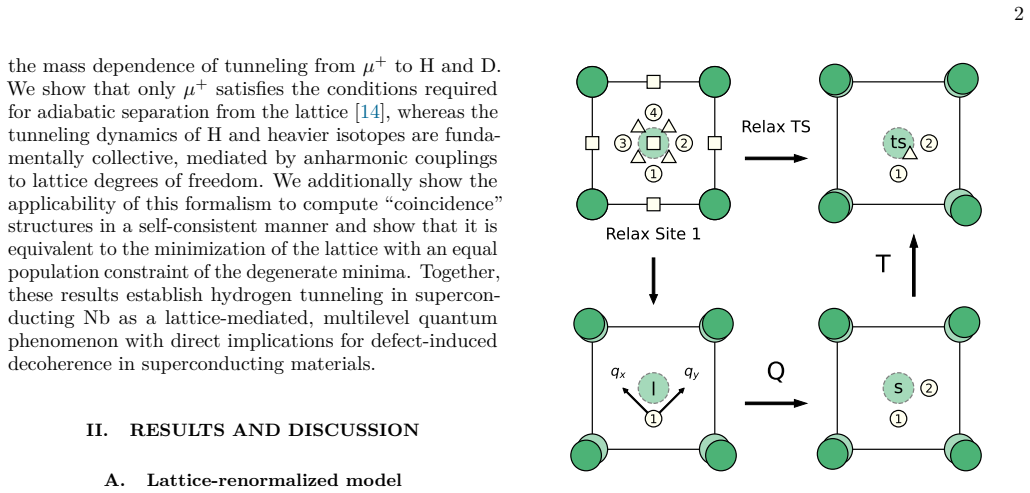
Adiabatic light-particle framework Sugimoto et al. introduced a theoretical framework in which light interstitial particles, ranging from positive muons to tritium, are treated adiabatically with respect to both electronsandhost nuclei [ 14]. The approach extends the Born-Oppenheimer approximation by intro- ducing an intermediate separation of scales: ele...
-
[2]
Validity of the adiabatic approximation We now quantitatively assess the validity of the adi- abatic light-particle approximation by explicitly testing its underlying separation of dynamical scales. Follow- ing Ref. [ 14], two nested Born-Oppenheimer (adiabatic) approximations are made, which we denote as the Light- Particle Approximation (LPA), yielding ...
-
[3]
The orientation of the sample grid 9 is identical to that used in Ref
Numerical evaluation We evaluate V (q,Q,T ) on a sample grid spanning two degenerate H sites using density functional the- ory calculations. The orientation of the sample grid 9 is identical to that used in Ref. [ 15]; however, the sample grid dimensions along the H modes were aug- mented to fit the wavefunction of positive muons (µ+). Specifically, the h...
-
[4]
DFT simulations All electronic structure simulations were performed with the Vienna Ab initio Simulation Package (V ASP) [26, 27] and the Perdew-Burke-Ernzerhof (PBE) general- ized gradient approximation (GGA) functional [ 28]. This functional has been previously shown to accurately cap- ture the structure and elastic properties of bcc Nb [ 29]. Projector...
-
[5]
G. Sellers, A. Anderson, and H. Birnbaum, The anomalous heat capacity of superconducting niobium, Physics Letters A44, 173 (1973)
work page 1973
-
[6]
K. Neumaier, H. Wipf, G. Cannelli, and R. Cantelli, Hydrogen-Induced Glasslike Specific-Heat Anomaly in Superconducting Crystalline NbTi 0.05, Physical Review Letters49, 1423 (1982)
work page 1982
- [7]
-
[8]
H. Wipf and K. Neumaier, H and d tunneling in niobium, Physical Review Letters52, 1308 (1984)
work page 1984
-
[9]
H. Wipf, K. Neumaier, A. Magerl, A. Heidemann, and W. Stirling, Low temperature hydrogen tunnelling in NbOxHy (x≈0.002;y≈0.002), Journal of the Less Common Metals101, 317 (1984)
work page 1984
-
[10]
R. Mattas and H. Birnbaum, Isotope effects on the motion of O-H clusters in Nb, Acta Metallurgica23, 973 (1975)
work page 1975
-
[11]
G. Cannelli, R. Cantelli, F. Cordero, and F. Trequattrini, Four-site tunneling of H trapped by substitutional Zr in Nb, Phys. Rev. B49, 15040 (1994)
work page 1994
- [12]
-
[13]
G. Catelani, S. E. Nigg, S. M. Girvin, R. J. Schoelkopf, and L. I. Glazman, Decoherence of superconducting qubits caused by quasiparticle tunneling, Physical Review B86, 184514 (2012)
work page 2012
-
[14]
L. I. Glazman and G. Catelani, Bogoliubov quasiparticles in superconducting qubits, SciPost Phys. Lect. Notes , 31 (2021)
work page 2021
-
[15]
Siddiqi, Engineering high-coherence superconducting qubits, Nature Reviews Materials6, 875 (2021)
I. Siddiqi, Engineering high-coherence superconducting qubits, Nature Reviews Materials6, 875 (2021)
work page 2021
-
[16]
P. G. Sundell and G. Wahnstr¨ om, Self-trapping and dif- fusion of hydrogen in Nb and Ta from first principles, Physical Review B70, 224301 (2004)
work page 2004
-
[17]
A. Abogoda, W. A. Shelton, I. Vekhter, and J. A. Sauls, Hydrogen and deuterium tunneling in niobium, Physical Review B111, L020103 (2025)
work page 2025
-
[18]
H. Sugimoto and Y. Fukai, Theory of light interstitials in bcc metals. i. self-trapped state of hydrogen and muons in nb, Physical Review B22, 670 (1980)
work page 1980
- [19]
-
[20]
P. G. Pritchard and J. M. Rondinelli, Suppressed para- magnetism in amorphous Ta 2O5−x oxides and its link to superconducting-qubit performance, Physical Review Applied23, 064062 (2025)
work page 2025
-
[21]
N. W. Ashcroft and N. D. Mermin,Solid State Physics, 1st ed. (Harcourt, Inc., 1976)
work page 1976
- [22]
-
[23]
C. Wang, C. Axline, Y. Y. Gao, T. Brecht, Y. Chu, L. Frunzio, M. H. Devoret, and R. J. Schoelkopf, Surface participation and dielectric loss in superconducting qubits, Applied Physics Letters107, 162601 (2015)
work page 2015
-
[24]
M. V. P. Alto´ e, A. Banerjee, C. Berk, A. Hajr, A. Schwartzberg, C. Song, M. Alghadeer, S. Aloni, M. J. Elowson, J. M. Kreikebaum, E. K. Wong, S. M. Griffin, S. Rao, A. Weber-Bargioni, A. M. Minor, D. I. Santiago, S. Cabrini, I. Siddiqi, and D. F. Ogletree, Localization and mitigation of loss in niobium superconducting circuits, PRX Quantum3, 020312 (2022)
work page 2022
-
[25]
M. Bal, A. A. Murthy, S. Zhu, F. Crisa, X. You, Z. Huang, T. Roy, J. Lee, D. van Zanten, R. Pilipenko, I. Nekra- shevich, A. Lunin, D. Bafia, Y. Krasnikova, C. J. Kopas, E. O. Lachman, D. Miller, J. Y. Mutus, M. J. Reagor, H. Cansizoglu, J. Marshall, D. P. Pappas, K. Vu, K. Ya- davalli, J.-S. Oh, L. Zhou, M. J. Kramer, F. Lecocq, D. P. Goronzy, C. G. Torr...
work page 2024
-
[26]
C. M¨ uller, J. H. Cole, and J. Lisenfeld, Towards under- standing two-level-systems in amorphous solids: insights from quantum circuits, Reports on Progress in Physics 82, 124501 (2019)
work page 2019
-
[27]
J. M. Martinis, K. B. Cooper, R. McDermott, M. Steffen, M. Ansmann, K. D. Osborn, K. Cicak, S. Oh, D. P. Pappas, R. W. Simmonds, and C. C. Yu, Decoherence in josephson qubits from dielectric loss, Physical Review Letters95, 210503 (2005)
work page 2005
-
[28]
A. Nandi, G. Laude, S. S. Khire, N. D. Gurav, C. Qu, R. Conte, Q. Yu, S. Li, P. L. Houston, S. R. Gadre, J. O. Richardson, F. A. Evangelista, and J. M. Bowman, Ring-Polymer Instanton Tunneling Splittings of Tropolone and Isotopomers using a ∆-Machine Learned CCSD(T) Potential: Theory and Experiment Shake Hands, Journal of the American Chemical Society145,...
work page 2023
-
[29]
P. G. Pritchard and J. M. Rondinelli, Transition-state lattice modes and the breakdown of adiabatic tunneling for hydrogen and deuterium in bcc Nb, Data and Methods (2026).https://doi.org/YYYYYY/XXXXXXXXX
work page 2026
-
[30]
G. Kresse and J. Furthm¨ uller, Efficient iterative schemes for ab initio total-energy calculations using a plane-wave basis set, Physical Review B54, 11169 (1996)
work page 1996
-
[31]
G. Kresse and D. Joubert, From ultrasoft pseudopoten- tials to the projector augmented-wave method, Physical Review B59, 1758 (1999)
work page 1999
-
[32]
J. P. Perdew, K. Burke, and M. Ernzerhof, Generalized gradient approximation made simple, Physical Review Letters77, 3865 (1996)
work page 1996
-
[33]
T. J. Leibengood, P.-C. A. Simon, P. G. Pritchard, J. M. Rondinelli, and P. W. Voorhees, Niobium hydride forma- tion in superconducting qubit thin films, Physical Review Materials9, 074803 (2025)
work page 2025
-
[34]
P. E. Bl¨ ochl, Projector augmented-wave method, Physical Review B50, 17953 (1994)
work page 1994
-
[35]
C. P. Flynn and A. M. Stoneham, Quantum theory of diffusion with application to light interstitials in metals, Physical Review B1, 3966 (1970)
work page 1970
-
[36]
A. H. Larsen, J. J. Mortensen, J. Blomqvist, I. E. Castelli, R. Christensen, M. Du/suppress lak, J. Friis, M. N. Groves, B. Ham- mer, C. Hargus, E. D. Hermes, P. C. Jennings, P. B. Jensen, J. Kermode, J. R. Kitchin, E. L. Kolsbjerg, J. Kubal, K. Kaasbjerg, S. Lysgaard, J. B. Maronsson, T. Maxson, T. Olsen, L. Pastewka, A. Peterson, C. Rost- gaard, J. Schi...
work page 2017
discussion (0)
Sign in with ORCID, Apple, or X to comment. Anyone can read and Pith papers without signing in.