Enhancing Blood Cells Classification using Hybrid Quantum Neural Networks
Pith reviewed 2026-05-25 05:07 UTC · model grok-4.3
The pith
Hybrid quantum neural networks improve blood cell classification over matched classical models on microscope images.
A machine-rendered reading of the paper's core claim, the machinery that carries it, and where it could break.
Core claim
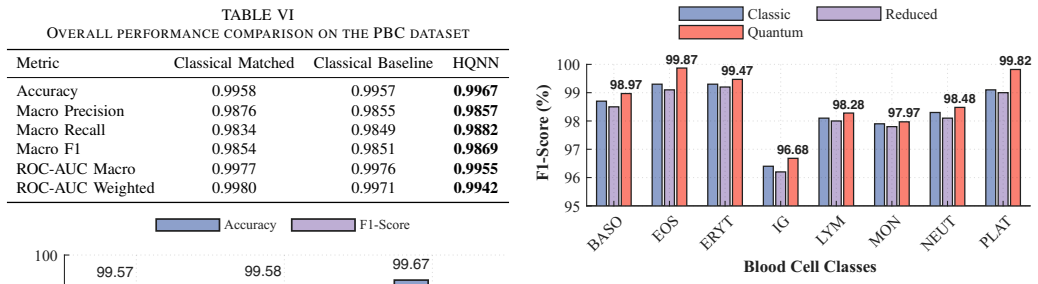
Combining a pre-trained ResNet-50 backbone with a low-dimensional latent bottleneck and a variational quantum circuit yields superior or more balanced performance across metrics on blood cell datasets compared with classical baselines of comparable capacity, with macro F1 improvements up to 3.7% and an F1 increase from 98.54% to 98.69% in the eight-class setting, plus only modest degradation when executed on IBM quantum hardware.
What carries the argument
Modular hybrid architecture that places a variational quantum circuit as the intermediate transformation after the classical backbone and bottleneck, enabling direct isolation of the quantum component against a capacity-matched classical nonlinear layer.
If this is right
- Quantum feature transformations can improve discriminative power especially in multi-class scenarios where classical performance is already near saturation.
- The hybrid models remain usable on current noisy quantum hardware without catastrophic loss of accuracy.
- The modular design allows the quantum stage to be swapped in or out while keeping the classical backbone fixed.
- Performance edges appear across two independent blood cell datasets, suggesting the pattern is not dataset-specific.
Where Pith is reading between the lines
- The same bottleneck-plus-quantum-circuit pattern could be tested on other medical imaging tasks that rely on subtle texture differences.
- As quantum hardware improves, scaling the circuit depth or qubit count might produce larger gains than the modest improvements seen here.
- The approach provides a practical template for adding quantum layers to existing CNN pipelines without full retraining of the backbone.
Load-bearing premise
Any measured gains are caused by the quantum circuit rather than by differences in total model capacity, training procedure, or other architectural details.
What would settle it
Re-train both the hybrid model and the classical matched model on the same datasets with identical hyperparameters and random seeds; if the quantum version no longer shows higher F1 scores, the claim that the quantum transformation is responsible collapses.
Figures




read the original abstract
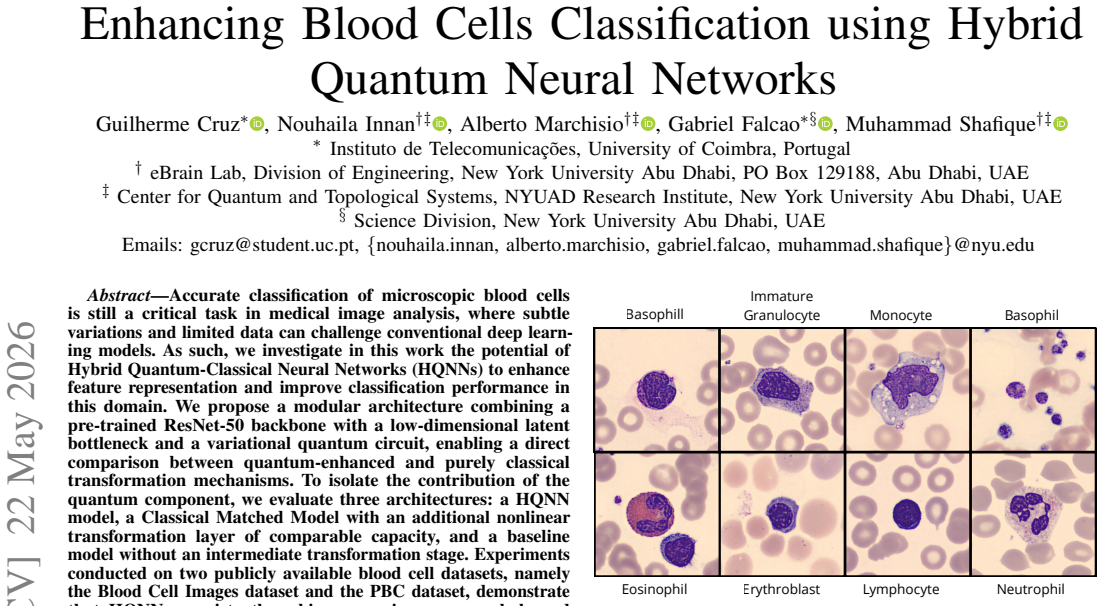
Accurate classification of microscopic blood cells is still a critical task in medical image analysis, where subtle variations and limited data can challenge conventional deep learning models. As such, we investigate in this work the potential of Hybrid Quantum-Classical Neural Networks (HQNNs) to enhance feature representation and improve classification performance in this domain. We propose a modular architecture combining a pre-trained ResNet-50 backbone with a low-dimensional latent bottleneck and a variational quantum circuit, enabling a direct comparison between quantum-enhanced and purely classical transformation mechanisms. To isolate the contribution of the quantum component, we evaluate three architectures: a HQNN model, a Classical Matched Model with an additional nonlinear transformation layer of comparable capacity, and a baseline model without an intermediate transformation stage. Experiments conducted on two publicly available blood cell datasets, namely the Blood Cell Images dataset and the PBC dataset, demonstrate that HQNNs consistently achieve superior or more balanced performance across evaluation metrics. In the Blood Cell Images Dataset, the proposed approach improves macro F1-score by up to 3.7% compared to classical baselines, while improving the F1-score from 98.54% to 98.69% in the more challenging 8-class scenario with near-saturated performance. Additional evaluation on IBM quantum hardware shows that the model remains robust under noise, with only a modest performance degradation relative to simulated results. These results indicate that quantum feature transformations can enhance discriminative representations, particularly in challenging classification scenarios, and highlight the practical potential of HQNN models for medical imaging tasks.
Editorial analysis
A structured set of objections, weighed in public.
Referee Report
Summary. The manuscript proposes a hybrid quantum-classical neural network (HQNN) architecture that augments a pre-trained ResNet-50 backbone with a low-dimensional latent bottleneck and variational quantum circuit. It evaluates three models (HQNN, classical matched model with nonlinear layer of comparable capacity, and baseline) on the Blood Cell Images and PBC datasets, reporting macro F1 improvements up to 3.7% and small gains (98.54% to 98.69%) in an 8-class setting, plus robustness under IBM quantum hardware noise.
Significance. If the performance differences are attributable to the quantum component after rigorous capacity matching and the experiments prove reproducible, the results would supply concrete evidence that variational quantum circuits can enhance feature representations in medical imaging tasks with subtle class variations or near-saturated performance regimes.
major comments (3)
- [Abstract] Abstract: the reported improvements (macro F1 up to 3.7%, F1 from 98.54% to 98.69%) are presented without any description of training protocols, data splits, statistical testing, error bars, or hyperparameter selection. This omission is load-bearing because the central claim rests on these empirical comparisons.
- [Abstract] Abstract: the Classical Matched Model is introduced as the key control 'with an additional nonlinear transformation layer of comparable capacity,' yet no quantification of capacity (parameter count, expressivity measure, or circuit-depth equivalent) is supplied. Given the small effect sizes, any mismatch could explain the gains rather than the quantum transformation.
- [Abstract] Abstract: the variational quantum circuit itself (qubit count, ansatz, measurement scheme) and the precise dimensionality of the latent bottleneck are not specified, preventing assessment of whether the hybrid design isolates a genuine quantum contribution.
minor comments (1)
- [Abstract] The hardware evaluation paragraph mentions 'modest performance degradation' but supplies no quantitative comparison table or noise-model details.
Simulated Author's Rebuttal
We thank the referee for the constructive comments. We address each major comment below and will revise the abstract accordingly to improve completeness while preserving its brevity.
read point-by-point responses
-
Referee: [Abstract] Abstract: the reported improvements (macro F1 up to 3.7%, F1 from 98.54% to 98.69%) are presented without any description of training protocols, data splits, statistical testing, error bars, or hyperparameter selection. This omission is load-bearing because the central claim rests on these empirical comparisons.
Authors: We agree that the abstract would be strengthened by briefly summarizing the evaluation methodology. We will revise the abstract to include a concise statement on the data splits, training protocol, cross-validation approach, and reporting of variability measures to better support the empirical claims. revision: yes
-
Referee: [Abstract] Abstract: the Classical Matched Model is introduced as the key control 'with an additional nonlinear transformation layer of comparable capacity,' yet no quantification of capacity (parameter count, expressivity measure, or circuit-depth equivalent) is supplied. Given the small effect sizes, any mismatch could explain the gains rather than the quantum transformation.
Authors: We acknowledge the need to quantify capacity matching explicitly. We will revise the abstract to state the basis for comparable capacity (parameter count equivalence between the classical nonlinear layer and the variational circuit) so that readers can assess the control. revision: yes
-
Referee: [Abstract] Abstract: the variational quantum circuit itself (qubit count, ansatz, measurement scheme) and the precise dimensionality of the latent bottleneck are not specified, preventing assessment of whether the hybrid design isolates a genuine quantum contribution.
Authors: The architectural specifications are provided in the methods section. We will revise the abstract to include a brief description of the qubit count, ansatz type, measurement scheme, and latent bottleneck dimension to allow direct evaluation of the hybrid design. revision: yes
Circularity Check
No circularity: empirical results on public datasets with explicit baselines
full rationale
The paper reports direct experimental comparisons of HQNN against a Classical Matched Model and baseline on two named public datasets (Blood Cell Images and PBC), measuring macro F1 and F1 scores. No equations, derivations, or predictions are presented that reduce reported gains to quantities defined by the paper's own fitted parameters or self-citations. The architecture description and hardware evaluation are likewise empirical measurements, not self-referential constructions. This matches the default case of a self-contained empirical study with no load-bearing circular steps.
Axiom & Free-Parameter Ledger
Reference graph
Works this paper leans on
-
[1]
Y . Xing, X. Liu, J. Dai, X. Ge, Q. Wang, Z. Hu, Z. Wu, X. Zeng, D. Xu, and C. Qu, “Artificial intelligence of digital morphology analyzers improves the efficiency of manual leukocyte differentiation of peripheral blood,”BMC Medical Informatics and Decision Making, 2023
work page 2023
-
[2]
B. E. Fan, B. S. J. Yong, R. Li, S. S. Y . Wang, M. Y . N. Aw, M. F. Chia, D. T. Y . Chen, Y . S. Neo, B. Occhipinti, R. R. Linget al., “From microscope to micropixels: A rapid review of artificial intelligence for the peripheral blood film,”Blood Reviews, 2024
work page 2024
-
[3]
Classification of white blood cells using machine and deep learning models: A systematic review,
R. Asghar, S. Kumar, P. Hynds, and A. Shaukat, “Classification of white blood cells using machine and deep learning models: A systematic review,” 2023
work page 2023
-
[4]
Classification of white blood cell using convolution neural network,
A. Girdhar, H. Kapur, and V . Kumar, “Classification of white blood cell using convolution neural network,”Biomedical Signal Processing and Control, 2022
work page 2022
-
[5]
White blood cell classification using multi-attention data augmentation and regularization,
N. Bayat, D. D. Davey, M. Coathup, and J.-H. Park, “White blood cell classification using multi-attention data augmentation and regularization,” Big Data and Cognitive Computing, 2022
work page 2022
-
[6]
An explainable ai-based blood cell classification using optimized convolutional neural network,
O. Islam, M. Assaduzzaman, and M. Z. Hasan, “An explainable ai-based blood cell classification using optimized convolutional neural network,” Journal of Pathology Informatics, 2024
work page 2024
-
[7]
S. Karaddi, H. Bitra, S. S. R. Bairaboina, and B. Gudibandi, “White blood cell classification using custom deep neural network and visualizing features of the images using heatmaps,”Scientific Reports, 2026
work page 2026
-
[8]
Recogni- tion of peripheral blood cell images using convolutional neural networks,
A. Acevedo, S. Alf ´erez, A. Merino, L. Puigv ´ı, and J. Rodellar, “Recogni- tion of peripheral blood cell images using convolutional neural networks,” Computer Methods and Programs in Biomedicine, 2019
work page 2019
-
[9]
Quantum machine learning in medical image analysis: A survey,
L. Wei, H. Liu, J. Xu, L. Shi, Z. Shan, B. Zhao, and Y . Gao, “Quantum machine learning in medical image analysis: A survey,”Neurocomputing, 2023
work page 2023
-
[10]
K. Mitarai, M. Negoro, M. Kitagawa, and K. Fujii, “Quantum circuit learning,”Phys. Rev. A, 2018
work page 2018
-
[11]
Circuit-centric quantum classifiers,
M. Schuld, A. Bocharov, K. M. Svore, and N. Wiebe, “Circuit-centric quantum classifiers,”Phys. Rev. A, 2020
work page 2020
-
[12]
Variational quantum algorithms,
M. V . S. Cerezo de la Roca, A. T. Arrasmith, R. Babbush, S. C. Benjamin, S. Endo, K. Fujii, J. R. McClean, K. Mitarai, X. Yuan, L. Cincioet al., “Variational quantum algorithms,”Nature Reviews Physics, 2021
work page 2021
-
[13]
Hybrid quantum-classical convolutional neural networks,
J. Liu, K. H. Lim, K. L. Wood, W. Huang, C. Guo, and H.-L. Huang, “Hybrid quantum-classical convolutional neural networks,”Science China Physics, Mechanics & Astronomy, 2021
work page 2021
-
[14]
Hybrid quantum-classical-quantum convolutional neural networks,
C. Long, M. Huang, X. Ye, Y . Futamura, and T. Sakurai, “Hybrid quantum-classical-quantum convolutional neural networks,”Scientific Reports, 2025
work page 2025
-
[15]
Fedqnn: Federated learning using quantum neural networks,
N. Innan, M. A.-Z. Khan, A. Marchisio, M. Shafique, and M. Bennai, “Fedqnn: Federated learning using quantum neural networks,”arXiv preprint arXiv:2403.10861, 2024
-
[16]
A. Bano and L. Liebovitch, “Analyzing images of blood cells with quantum machine learning methods: Equilibrium propagation and variational quantum circuits to detect acute myeloid leukemia,” 2026
work page 2026
-
[17]
Automated microscopic image analysis for leukocytes identification: A survey,
M. Saraswat and K. Arya, “Automated microscopic image analysis for leukocytes identification: A survey,”Micron, vol. 65, pp. 20–33, 2014
work page 2014
-
[18]
Automatic recognition of five types of white blood cells in peripheral blood,
S. H. Rezatofighi and H. Soltanian-Zadeh, “Automatic recognition of five types of white blood cells in peripheral blood,”Computerized Medical Imaging and Graphics, vol. 35, no. 4, pp. 333–343, 2011
work page 2011
-
[19]
The best texture features for leukocytes recognition,
O. Sarrafzadeh, A. M. Dehnavi, H. Y . Banaem, A. Talebi, and A. Gharibi, “The best texture features for leukocytes recognition,”Journal of Medical Signals & Sensors, vol. 7, no. 4, pp. 220–227, 2017
work page 2017
-
[20]
M. Habibzadeh, M. Jannesari, Z. Rezaei, H. Baharvand, and M. Totonchi, “Automatic white blood cell classification using pre-trained deep learning models: Resnet and inception,” inTenth international conference on machine vision (ICMV 2017), vol. 10696. SPIE, 2018, pp. 274–281
work page 2017
-
[21]
H. Chen, J. Liu, C. Hua, J. Feng, B. Pang, D. Cao, and C. Li, “Accurate classification of white blood cells by coupling pre-trained resnet and densenet with scam mechanism,”BMC bioinformatics, vol. 23, no. 1, p. 282, 2022
work page 2022
-
[22]
Z. M. Kouzehkanan, S. Saghari, S. Tavakoli, P. Rostami, M. Abaszadeh, F. Mirzadeh, E. S. Satlsar, M. Gheidishahran, F. Gorgi, S. Mohammadi et al., “A large dataset of white blood cells containing cell locations and types, along with segmented nuclei and cytoplasm,”Scientific reports, vol. 12, no. 1, p. 1123, 2022
work page 2022
-
[23]
Hybrid quantum-classical neural networks,
D. Arthur and P. Date, “Hybrid quantum-classical neural networks,” in2022 IEEE international conference on quantum computing and engineering (QCE). IEEE, 2022, pp. 49–55
work page 2022
-
[24]
Quantum machine learning for image classification,
A. Senokosov, A. Sedykh, A. Sagingalieva, B. Kyriacou, and A. Melnikov, “Quantum machine learning for image classification,”Machine Learning: Science and Technology, vol. 5, no. 1, p. 015040, 2024
work page 2024
-
[25]
A novel image classification framework based on variational quantum algorithms,
Y . Chen, “A novel image classification framework based on variational quantum algorithms,”Quantum Information Processing, 2024
work page 2024
-
[26]
Computational advantage in hybrid quantum neural networks: Myth or reality?
M. Kashif, A. Marchisio, and M. Shafique, “Computational advantage in hybrid quantum neural networks: Myth or reality?” in2025 62nd ACM/IEEE Design Automation Conference (DAC). IEEE, 2025, pp. 1–7
work page 2025
-
[27]
Bccd dataset: Blood cell count and detection,
Shenggan, “Bccd dataset: Blood cell count and detection,” https://github. com/Shenggan/BCCD Dataset, 2018
work page 2018
-
[28]
P. Mooney, “Blood cell images dataset,” https://www.kaggle.com/datasets/ paultimothymooney/blood-cells, 2018
work page 2018
-
[29]
Noisy intermediate- scale quantum algorithms,
K. Bharti, A. Cervera-Lierta, T. H. Kyaw, T. Haug, S. Alperin-Lea, A. Anand, M. Degroote, H. Heimonen, J. S. Kottmann, T. Menke, W.-K. Mok, S. Sim, L.-C. Kwek, and A. Aspuru-Guzik, “Noisy intermediate- scale quantum algorithms,”Rev. Mod. Phys., 2022
work page 2022
discussion (0)
Sign in with ORCID, Apple, or X to comment. Anyone can read and Pith papers without signing in.