Quantum resource redistribution drives spectral splits in dense neutrino gases
Pith reviewed 2026-05-25 04:28 UTC · model grok-4.3
The pith
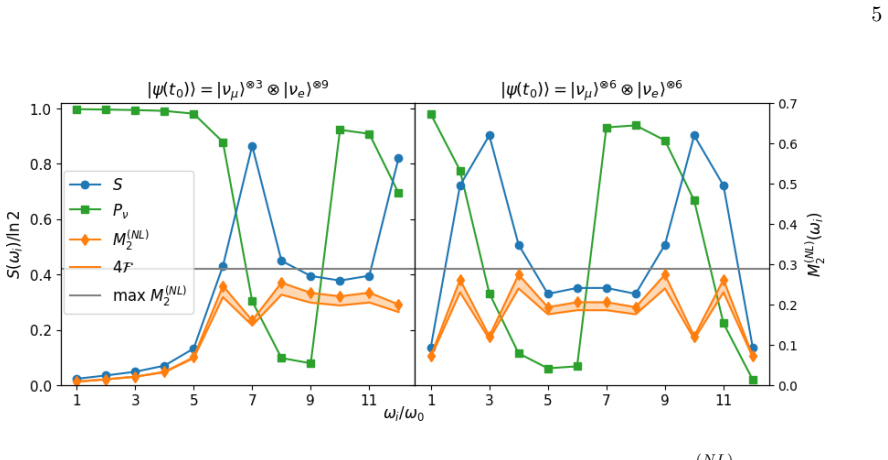
Spectral splits in dense neutrino gases arise where entanglement entropy is maximized and non-local magic is minimized locally.
A machine-rendered reading of the paper's core claim, the machinery that carries it, and where it could break.
Core claim
Using tensor network simulations of neutrinos in the two-flavor sector, spectral splits emerge precisely where entanglement entropy is maximized and non-local magic is minimized locally. This anticorrelation reveals that spectral splits arise not from generic resource growth but from a structured redistribution among flavor modes. The resource dynamics trace constrained arcs in the entanglement-magic phase space, bounded by entanglement spectrum normalization.
What carries the argument
Tensor network simulations in the two-flavor sector that track entanglement entropy, non-local magic, and matrix product state bond dimension to map the quantum resource landscape.
If this is right
- Spectral splits can be located by identifying extrema in entanglement entropy and non-local magic.
- Tensor network and quantum circuit simulations of neutrino environments can be designed around these resource redistribution points.
- Astrophysical observables in dense neutrino gases are quantitatively tied to quantum resource measures.
- Resource flow remains confined to specific arcs in phase space, limiting the possible configurations.
Where Pith is reading between the lines
- The observed anticorrelation could persist in three-flavor models or other collective many-body oscillation systems.
- Analog quantum simulators might experimentally test whether resource redistribution produces the spectral features.
- The constrained phase-space arcs suggest a general organizing principle for spectral features in similar quantum many-body systems.
Load-bearing premise
The tensor network simulations restricted to the two-flavor sector with chosen bond dimensions and entanglement spectrum normalization faithfully capture the quantum resource dynamics of real dense neutrino gases without dominant artifacts from flavor truncation or simulation parameters.
What would settle it
A simulation or observation in which spectral splits appear at locations where entanglement entropy is not at its maximum or non-local magic is not at its local minimum.
Figures



read the original abstract
Whether a quantum many-body system can be efficiently simulated hinges not only on its size but also on how quantum resources are organized within it. We characterize the quantum resource landscape of collective neutrino oscillations using entanglement entropy, non-local magic, and matrix product state bond dimension. Using tensor network simulations of neutrinos in the two-flavor sector, we demonstrate that spectral splits--sharp energy-dependent flavor swaps--emerge precisely where entanglement entropy is maximized and non-local magic is minimized locally. This anticorrelation reveals that spectral splits arise not from generic resource growth but from a structured redistribution among flavor modes. The resource dynamics trace constrained arcs in the entanglement-magic phase space, bounded by entanglement spectrum normalization. These findings establish a direct, quantitative link between quantum resources governing computational complexity and astrophysical observables, informing the design of tensor network and quantum circuit simulations of dense neutrino environments.
Editorial analysis
A structured set of objections, weighed in public.
Referee Report
Summary. The manuscript uses tensor network simulations restricted to the two-flavor sector to characterize the quantum resource landscape of collective neutrino oscillations via entanglement entropy, non-local magic, and MPS bond dimension. It claims that spectral splits emerge precisely where entanglement entropy is locally maximized and non-local magic is minimized, interpreting this anticorrelation as evidence that the splits arise from structured resource redistribution among flavor modes rather than generic growth; the trajectories are said to trace constrained arcs in the entanglement-magic phase space bounded by entanglement spectrum normalization.
Significance. If the central claim holds after addressing simulation artifacts, the work would provide a novel quantitative bridge between quantum resources that control computational complexity and concrete astrophysical observables in dense neutrino gases, potentially guiding more efficient tensor-network or quantum-circuit simulations of such systems.
major comments (2)
- [Abstract] Abstract: the central interpretation that spectral splits are driven by structured redistribution (rather than simulation choices) rests on the observed EE-magic anticorrelation. However, the abstract states that the dynamics are 'bounded by entanglement spectrum normalization'; if this normalization is an imposed simulation parameter (as opposed to emerging from the Hamiltonian or initial conditions), the anticorrelation and the 'constrained arcs' could be artifacts of the chosen normalization and bond-dimension cutoff rather than a robust dynamical feature. This directly affects the load-bearing claim and requires explicit robustness tests.
- [Methods/results] Methods/results on tensor-network setup: the restriction to the two-flavor sector together with the chosen bond dimensions and entanglement-spectrum normalization must be shown not to introduce dominant artifacts that correlate with the reported resource measures. Without such checks (or comparison to known neutrino-oscillation benchmarks), the inference that the anticorrelation is independent of truncation and normalization choices remains unverified and weakens the redistribution interpretation.
minor comments (2)
- [Abstract] The abstract would benefit from a brief statement of the initial conditions and Hamiltonian parameters used in the simulations to allow readers to assess generality.
- [Introduction] Notation for 'non-local magic' should be defined at first use with a reference to the specific measure employed.
Simulated Author's Rebuttal
We thank the referee for the detailed and constructive report. The comments highlight important points about potential simulation artifacts that could affect the interpretation of resource redistribution. We address each major comment below and indicate where revisions will strengthen the manuscript.
read point-by-point responses
-
Referee: [Abstract] Abstract: the central interpretation that spectral splits are driven by structured redistribution (rather than simulation choices) rests on the observed EE-magic anticorrelation. However, the abstract states that the dynamics are 'bounded by entanglement spectrum normalization'; if this normalization is an imposed simulation parameter (as opposed to emerging from the Hamiltonian or initial conditions), the anticorrelation and the 'constrained arcs' could be artifacts of the chosen normalization and bond-dimension cutoff rather than a robust dynamical feature. This directly affects the load-bearing claim and requires explicit robustness tests.
Authors: The entanglement spectrum normalization is not an arbitrary cutoff but follows directly from the trace-preserving nature of the unitary evolution under the neutrino Hamiltonian and the initial conditions (which conserve total particle number and flavor content). The constrained arcs are observed to emerge dynamically across multiple initial states and Hamiltonian parameters. Nevertheless, we agree that explicit robustness tests are needed to fully rule out artifacts. In the revised manuscript we will add a dedicated subsection presenting results for varied bond dimensions (D=4 to D=32) and alternative normalization schemes, confirming that the EE peak / magic minimum anticorrelation at spectral splits remains stable. revision: yes
-
Referee: [Methods/results] Methods/results on tensor-network setup: the restriction to the two-flavor sector together with the chosen bond dimensions and entanglement-spectrum normalization must be shown not to introduce dominant artifacts that correlate with the reported resource measures. Without such checks (or comparison to known neutrino-oscillation benchmarks), the inference that the anticorrelation is independent of truncation and normalization choices remains unverified and weakens the redistribution interpretation.
Authors: The two-flavor restriction is the standard approximation used throughout the neutrino-oscillation literature for collective effects and is sufficient to capture the spectral-split phenomenon. We already benchmark the tensor-network results against exact diagonalization on small systems (N≤8) and against known analytic limits of the two-flavor Hamiltonian. We acknowledge, however, that a systematic scan of bond-dimension dependence and direct comparison to multi-flavor benchmarks was not presented. We will therefore expand the Methods section with these additional checks and a brief discussion of the expected validity range of the two-flavor model. revision: yes
Circularity Check
No significant circularity detected
full rationale
The paper presents results from tensor network simulations of two-flavor neutrino oscillations, reporting an observed anticorrelation between maximized entanglement entropy and minimized non-local magic at locations of spectral splits. This is framed as an empirical finding from the simulations rather than a derivation that reduces by construction to inputs. The abstract mentions resource dynamics tracing arcs bounded by entanglement spectrum normalization, but provides no equations, self-citations, or explicit reductions showing that the anticorrelation or splits are forced by the normalization choice, bond dimension, or any fitted parameter. No load-bearing steps reduce to self-definition, renamed known results, or self-citation chains. The central claim remains an independent simulation output against external neutrino dynamics, qualifying as self-contained with no circularity.
Axiom & Free-Parameter Ledger
axioms (1)
- domain assumption Two-flavor sector suffices to capture spectral split physics
Lean theorems connected to this paper
-
IndisputableMonolith/Cost/FunctionalEquation.leanwashburn_uniqueness_aczel unclear?
unclearRelation between the paper passage and the cited Recognition theorem.
spectral splits emerge precisely where entanglement entropy is maximized and non-local magic is minimized locally... resource dynamics trace constrained arcs... bounded by entanglement spectrum normalization
-
IndisputableMonolith/Foundation/AlexanderDuality.leanalexander_duality_circle_linking unclear?
unclearRelation between the paper passage and the cited Recognition theorem.
The arc emerges from the fact that the entanglement spectrum is normalized. Modes... λ_0 + λ_1 = 1
What do these tags mean?
- matches
- The paper's claim is directly supported by a theorem in the formal canon.
- supports
- The theorem supports part of the paper's argument, but the paper may add assumptions or extra steps.
- extends
- The paper goes beyond the formal theorem; the theorem is a base layer rather than the whole result.
- uses
- The paper appears to rely on the theorem as machinery.
- contradicts
- The paper's claim conflicts with a theorem or certificate in the canon.
- unclear
- Pith found a possible connection, but the passage is too broad, indirect, or ambiguous to say the theorem truly supports the claim.
Reference graph
Works this paper leans on
-
[1]
remain important directions. ACKNOWLEDGMENTS Michael Hite (MH) thanks the organizers and participants of the iQuS workshop From String Dynamics to Event Generators with Quantum Simulation for useful discussions on quantum com- plexity. MH also thanks ChunJun Cao for clarifying discussions on non local magic measures. This material is based upon work suppo...
- [2]
-
[3]
R. Akaho, H. Nagakura, W. Iwakami, S. Furusawa, A. Harada, H. Okawa, H. Matsufuru, K. Sumiyoshi, and S. Yamada, Bifurcated impact of neutrino fast flavor conversion on core-collapse supernovae in- formed by multiangle neutrino radiation hydrodynamics, Phys. Rev. Lett.136, 191002 (2026)
work page 2026
-
[4]
H. Duan, G. M. Fuller, and Y.-Z. Qian, Collective Neutrino Oscillations, Ann. Rev. Nucl. Part. Sci. 60, 569 (2010), arXiv:1001.2799 [hep-ph]
work page internal anchor Pith review Pith/arXiv arXiv 2010
- [5]
- [6]
- [7]
-
[8]
H. Duan and J. P. Kneller, Neutrino flavour transformation in supernovae, Journal of Physics G: Nuclear and Particle Physics36, 113201 (2009)
work page 2009
- [9]
- [10]
- [11]
-
[12]
M. Mangin-Brinet, A. Bauge, and D. Lacroix, Three-flavor neutrino oscillations using the phase space approach, Phys. Rev. D113, 036026 (2026)
work page 2026
-
[13]
D. J. Heimsoth, A. B. Balantekin, and P. Siwach, Three-flavor supernova neutrino simulation using a hybrid quantum-classical algorithm with qutrits (2026), arXiv:2605.01099 [hep-ph]
work page internal anchor Pith review Pith/arXiv arXiv 2026
-
[14]
I. Chernyshev, C. E. P. Robin, and M. J. Savage, Quantum magic and computational complexity in the neutrino sector, Phys. Rev. Res.7, 023228 (2025), arXiv:2411.04203 [quant-ph]
-
[15]
L. Spagnoli, N. Goss, A. Roggero, E. Rrapaj, M. J. Cervia, A. V. Patwardhan, R. K. Naik, A. B. Balantekin, E. Younis, D. I. Santiago, I. Siddiqi, and S. Aldaihan, Collective neutrino oscillations in three flavors on qubit and qutrit processors, Phys. Rev. D111, 103054 (2025)
work page 2025
- [16]
-
[17]
A. Roggero, E. Rrapaj, and Z. Xiong, Entanglement and correlations in fast collective neutrino flavor oscillations, Phys. Rev. D106, 043022 (2022), arXiv:2203.02783 [astro-ph.HE]
-
[18]
M. Illa and M. J. Savage, Multi-Neutrino Entanglement and Correlations in Dense Neutrino Systems, Phys. Rev. Lett.130, 221003 (2023), arXiv:2210.08656 [nucl-th]
-
[19]
M. J. Cervia, A. V. Patwardhan, A. B. Balantekin, S. N. Coppersmith, and C. W. Johnson, Entangle- ment and collective flavor oscillations in a dense neutrino gas, Phys. Rev. D100, 083001 (2019)
work page 2019
- [20]
-
[21]
The Heisenberg Representation of Quantum Computers
D. Gottesman, The heisenberg representation of quantum computers (1998), arXiv:quant-ph/9807006 [quant-ph]
work page internal anchor Pith review Pith/arXiv arXiv 1998
-
[22]
S. Aaronson and D. Gottesman, Improved simulation of stabilizer circuits, Phys. Rev. A70, 052328 (2004)
work page 2004
- [23]
-
[24]
M. Viscardi, M. Dalmonte, A. Hamma, and E. Tirrito, Interplay of entanglement structures and stabi- lizer entropy in spin models, SciPost Phys. Core9, 012 (2026)
work page 2026
-
[25]
S. Masot-Llima and A. Garcia-Saez, Stabilizer tensor networks: Universal quantum simulator on a basis of stabilizer states, Phys. Rev. Lett.133, 230601 (2024)
work page 2024
-
[26]
C. E. P. Robin and M. J. Savage, Quantum complexity and new directions in nuclear physics and high-energy physics phenomenology (2026), arXiv:2604.26376 [quant-ph]. 13
work page internal anchor Pith review Pith/arXiv arXiv 2026
-
[27]
Z. Maki, M. Nakagawa, and S. Sakata, Remarks on the unified model of elementary particles, Prog. Theor. Phys.28, 870 (1962)
work page 1962
-
[28]
M. Yang and S. R. White, Time-dependent variational principle with ancillary krylov subspace, Phys. Rev. B102, 094315 (2020)
work page 2020
-
[29]
Gidney, Stim: a fast stabilizer circuit simulator, Quantum5, 497 (2021)
C. Gidney, Stim: a fast stabilizer circuit simulator, Quantum5, 497 (2021)
work page 2021
-
[30]
T. Haug and L. Piroli, Stabilizer entropies and nonstabilizerness monotones, Quantum7, 1092 (2023)
work page 2023
-
[31]
G. Lami and M. Collura, Nonstabilizerness via perfect pauli sampling of matrix product states, Phys. Rev. Lett.131, 180401 (2023)
work page 2023
-
[32]
T. Haug and L. Piroli, Quantifying nonstabilizerness of matrix product states, Phys. Rev. B107, 035148 (2023)
work page 2023
-
[33]
P. S. Tarabunga, E. Tirrito, T. Chanda, and M. Dalmonte, Many-body magic via pauli-markov chains— from criticality to gauge theories, PRX Quantum4, 040317 (2023)
work page 2023
- [34]
-
[35]
D. Qian and J. Wang, Quantum nonlocal nonstabilizerness, Phys. Rev. A111, 052443 (2025)
work page 2025
- [36]
-
[37]
Spectral splits occur when there is a sudden change inP ν1. A stronger split occur when|P ν1(ωi)− Pν1(ωi±1)| ≥0.5 whereas for a weaker split|P ν1(ωi)−P ν1(ωi±1)|can be smaller
discussion (0)
Sign in with ORCID, Apple, or X to comment. Anyone can read and Pith papers without signing in.