Order-Disorder Tricriticality in A_n B_n Star Polymer Melts
Pith reviewed 2026-05-25 02:49 UTC · model grok-4.3
The pith
In A_n B_n star polymer melts the arm number n itself tunes the lamellar order-disorder transition through a tricritical point at n_tc≈5.4475.
A machine-rendered reading of the paper's core claim, the machinery that carries it, and where it could break.
Core claim
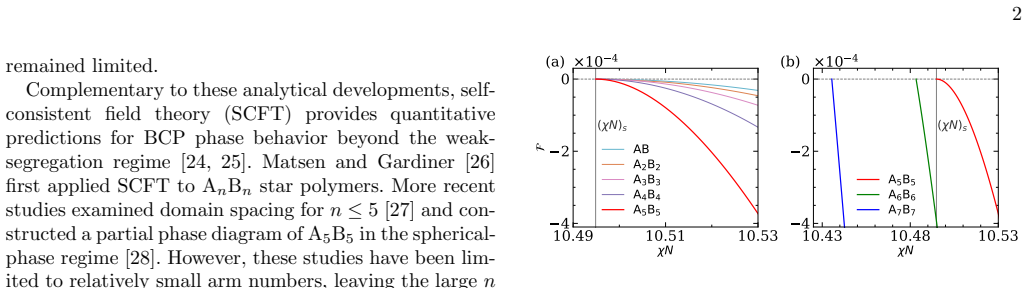
In symmetric A_n B_n star-polymer melts, the arm number n plays the role of an additional thermodynamic parameter that drives the order-disorder transition from second order to first order. Analytically, a tricritical arm number n_tc≈5.4475 is identified. For n<n_tc the lamellar ordering transition remains continuous at the spinodal (χN)_s≈10.495. For n>n_tc the transition becomes first order and (χN)_ODT shifts below (χN)_s with quadratic dependence near the tricritical point. SCFT calculations confirm the transition character and phase-boundary shift. The origin is inter-arm correlations from the common junction, and noninteger n_tc can be realized in binary mixtures.
What carries the argument
The sixth-order free-energy expansion within the random phase approximation, which locates the tricritical arm number by the vanishing of the fourth-order coefficient while the sixth-order coefficient remains positive.
If this is right
- For arm numbers below n_tc the lamellar transition is continuous and occurs exactly at the spinodal point (χN)_s≈10.495.
- For arm numbers above n_tc the transition is first-order and (χN)_ODT lies below the spinodal.
- Near the tricritical point the downward shift in (χN)_ODT scales quadratically with (n - n_tc).
- The non-integer tricritical arm number can be realized in binary mixtures of star polymers with different n.
Where Pith is reading between the lines
- The same junction-correlation mechanism could produce architecture-driven tricritical points in other branched polymer architectures such as H-polymers or comb polymers.
- Scattering experiments on stars with arm numbers just above and below 5.5 could directly test the predicted change in transition order and the location of the ODT relative to the spinodal.
- The analytic RPA expansion supplies a controlled starting point for adding fluctuation corrections or for extending the calculation to asymmetric arm lengths.
Load-bearing premise
The sixth-order truncation of the free-energy expansion within the random phase approximation is sufficient to locate the tricritical arm number and determine the order of the transition.
What would settle it
A direct SCFT or experimental observation that the transition order does not change at arm numbers near 5.4475, or that (χN)_ODT does not fall below the spinodal for larger n, would falsify the central claim.
Figures

read the original abstract
Tricriticality usually requires tuning an additional thermodynamic parameter. Here we show that, in symmetric $\mathrm{A}_n\mathrm{B}_n$ star-polymer melts, the arm number $n$ itself plays this role and drives the order--disorder transition (ODT) from second order to first order. By developing a sixth-order free-energy expansion within the random phase approximation and comparing it with self-consistent field theory (SCFT) calculations, we analytically identify a tricritical arm number, $n_{\mathrm{tc}}\approx 5.4475$. For $n<n_{\mathrm{tc}}$, the lamellar ordering transition remains continuous and occurs at the spinodal point, $(\chi N)_{\mathrm{s}}\approx 10.495$. For $n>n_{\mathrm{tc}}$, the transition becomes first order, and $(\chi N)_{\mathrm{ODT}}$ shifts below $(\chi N)_{\mathrm{s}}$ with a quadratic dependence near the tricritical point. SCFT calculations confirm the predicted transition character and phase-boundary shift. The origin of this behavior is traced to inter-arm correlations generated by the common junction. We further show that the noninteger tricritical arm number can be effectively realized in binary mixtures of star polymers. This provides a rare analytically tractable example of architecture-induced tricriticality in a microphase-separating polymer system.
Editorial analysis
A structured set of objections, weighed in public.
Referee Report
Summary. The manuscript claims that in symmetric A_n B_n star polymer melts the arm number n itself tunes the order-disorder transition (ODT) through a tricritical point. A sixth-order free-energy expansion within the random phase approximation (RPA) analytically locates the tricritical arm number n_tc ≈ 5.4475. For n < n_tc the lamellar transition remains continuous and occurs at the spinodal (χN)_s ≈ 10.495; for n > n_tc the transition becomes first-order with (χN)_ODT lying below the spinodal and exhibiting quadratic dependence near the tricritical point. Self-consistent field theory (SCFT) calculations are used to confirm the predicted transition character and phase-boundary shift. The effect is attributed to inter-arm correlations at the common junction, and binary mixtures of stars are proposed to realize the non-integer n_tc.
Significance. If the central result holds, the work supplies a rare analytically tractable example of architecture-induced tricriticality in a microphase-separating polymer melt, where an extra thermodynamic variable is normally required. The explicit RPA derivation that yields a concrete numerical n_tc together with SCFT confirmation constitutes a clear strength. The binary-mixture construction further increases experimental accessibility. The finding can influence theoretical and simulation studies of how molecular topology controls the order of microphase transitions.
major comments (2)
- [RPA expansion] RPA expansion (abstract and derivation section): the reported n_tc ≈ 5.4475 is obtained by setting the quartic coefficient to zero inside the sixth-order Landau expansion. The manuscript does not supply the explicit numerical value of the sixth-order coefficient at n_tc or a convergence check against eighth-order terms, leaving open the possibility that omitted higher-order contributions shift the location of the tricritical point or alter the sign of the effective quartic term.
- [SCFT calculations] SCFT confirmation (results section): while SCFT is stated to confirm the change in transition order, the manuscript should specify the diagnostic used (free-energy comparison, hysteresis, or order-parameter jump) and the chain discretization / box sizes employed, because these details are load-bearing for the claim that SCFT independently validates the RPA-predicted first-order character for n > n_tc.
minor comments (2)
- The abstract states (χN)_s ≈ 10.495 without indicating whether this value is strictly independent of n; an explicit statement or equation showing its n-independence would improve clarity.
- Notation for the Landau coefficients (e.g., a4(n), a6(n)) should be introduced with their explicit RPA expressions in the main text rather than only in supplementary material.
Simulated Author's Rebuttal
We thank the referee for the careful reading, positive assessment of the work, and constructive suggestions. We address each major comment below.
read point-by-point responses
-
Referee: [RPA expansion] RPA expansion (abstract and derivation section): the reported n_tc ≈ 5.4475 is obtained by setting the quartic coefficient to zero inside the sixth-order Landau expansion. The manuscript does not supply the explicit numerical value of the sixth-order coefficient at n_tc or a convergence check against eighth-order terms, leaving open the possibility that omitted higher-order contributions shift the location of the tricritical point or alter the sign of the effective quartic term.
Authors: We agree that reporting the explicit numerical value of the sixth-order coefficient at n_tc will make the analysis more transparent. In the revised manuscript we will include this value (which is positive at n_tc, as required for tricriticality). Extending the RPA expansion to eighth order entails substantially more involved diagrammatic algebra. We maintain that the sixth-order truncation is adequate near the tricritical point where the quartic coefficient vanishes, and that the independent SCFT results already corroborate the predicted change in transition order. We will add a short paragraph discussing this justification. revision: partial
-
Referee: [SCFT calculations] SCFT confirmation (results section): while SCFT is stated to confirm the change in transition order, the manuscript should specify the diagnostic used (free-energy comparison, hysteresis, or order-parameter jump) and the chain discretization / box sizes employed, because these details are load-bearing for the claim that SCFT independently validates the RPA-predicted first-order character for n > n_tc.
Authors: We accept this request for additional technical detail. The revised manuscript will explicitly state that the transition order was diagnosed by direct free-energy comparison between the disordered melt and the lamellar phase together with the observation of a discontinuous jump in the order parameter. We will also report the chain discretization (number of segments per arm) and the periodic box dimensions employed in the SCFT calculations. revision: yes
Circularity Check
No significant circularity; n_tc derived from explicit sixth-order RPA Landau expansion
full rationale
The derivation obtains n_tc by constructing a sixth-order free-energy expansion in the RPA, then setting the quartic coefficient to zero while requiring the sixth-order coefficient to remain positive. This is a direct algebraic procedure from the expansion coefficients and does not reduce to a fit, self-definition, or self-citation chain. SCFT is invoked only for numerical confirmation of the transition character, not as an input that forces the analytic result. No load-bearing self-citations, ansatz smuggling, or renaming of known results appear in the abstract or described chain. The truncation assumption is a modeling choice whose validity can be tested externally, but it does not create circularity within the reported derivation.
Axiom & Free-Parameter Ledger
axioms (2)
- domain assumption Random phase approximation remains valid through sixth order for the free-energy functional of star-polymer melts
- domain assumption The star polymers are perfectly symmetric A_n B_n with a single common junction
Reference graph
Works this paper leans on
-
[1]
R. B. Griffiths, Phys. Rev. Lett.24, 715 (1970)
work page 1970
- [2]
-
[3]
B. I. Halperin, T. C. Lubensky, and S.-k. Ma, Phys. Rev. Lett.32, 292 (1974)
work page 1974
-
[4]
S. Mo, J. Hove, and A. Sudbø, Phys. Rev. B65, 104501 (2002)
work page 2002
-
[5]
P. H. Keyes, H. T. Weston, and W. B. Daniels, Phys. Rev. Lett.31, 628 (1973)
work page 1973
- [6]
- [7]
- [8]
- [9]
-
[10]
J. D. Willis and M. W. Matsen, J. Chem. Phys.160, 024906 (2024)
work page 2024
- [11]
-
[12]
L. D. Landauet al., Zh. Eksp. Teor. Fiz.7, 926 (1937)
work page 1937
-
[13]
F. S. Bates and G. H. Fredrickson, Annu. Rev. Phys. Chem.41, 525 (1990)
work page 1990
-
[14]
M. W. Matsen, J. Phys.: Condens. Matter14, R21 (2002)
work page 2002
- [15]
-
[16]
M. Olvera de la Cruz and I. C. Sanchez, Macromolecules 19, 2501 (1986)
work page 1986
- [17]
-
[18]
A. M. Mayes and M. Olvera de la Cruz, J. Chem. Phys. 91, 7228 (1989)
work page 1989
-
[19]
A. V. Dobrynin and I. Y. Yerukhimovich, Polym. Sci. U.S.S.R.33, 1012 (1991)
work page 1991
-
[20]
A. V. Dobrynin and I. Y. Erukhimovich, Macromolecules 26, 276 (1993)
work page 1993
-
[21]
A. N. Morozov and J. G. E. M. Fraaije, J. Chem. Phys. 114, 2452 (2001)
work page 2001
-
[22]
M. A. Aliev and S. I. Kuchanov, J. Chem. Phys.131, 174111 (2009)
work page 2009
-
[23]
S. I. Kuchanov and S. V. Panyukov, J. Phys.: Condens. Matter18, L43 (2006)
work page 2006
-
[24]
M. W. Matsen and M. Schick, Phys. Rev. Lett.72, 2660 (1994)
work page 1994
- [25]
-
[26]
M. W. Matsen and J. M. Gardiner, J. Chem. Phys.113, 1673 (2000)
work page 2000
- [27]
- [28]
-
[29]
M. W. Matsen and T. M. Beardsley, Polymers13, 2437 (2021)
work page 2021
-
[30]
See Supplemental Material at [URL will be inserted by publisher] for details of the second-order RPA calcula- tion, SCFT formulation, mode truncation, density pro- files, analytic expression for the tricritical arm number ntc, derivation of the analytic expression for the phase- boundary shift, and comparison of the RPA prediction for the mixture system w...
- [31]
-
[32]
D. Yong, GitHub, Polymer Field Theory Simu- lations with Python,https://github.com/yongdd/ langevin-fts(2021), (accessed May 22, 2026)
work page 2021
- [33]
-
[34]
G. H. Fredrickson and E. Helfand, J. Chem. Phys.87, 697 (1987)
work page 1987
-
[35]
A. M. Mayes and M. O. de la Cruz, J. Chem. Phys.95, 4670 (1991)
work page 1991
-
[36]
M. W. Matsen, T. M. Beardsley, and J. D. Willis, Phys. Rev. Mater.7, 105605 (2023)
work page 2023
-
[37]
K. T. Delaney and G. H. Fredrickson, J. Phys. Chem. B 120, 7615 (2016)
work page 2016
discussion (0)
Sign in with ORCID, Apple, or X to comment. Anyone can read and Pith papers without signing in.