Classification of the eternal solutions and multiple coalescing shocks in the KPZ fixed point
Pith reviewed 2026-06-29 20:29 UTC · model grok-4.3
The pith
Eternal solutions of the KPZ fixed point are formed by patching together Busemann functions, creating shocks that coalesce forward in time.
A machine-rendered reading of the paper's core claim, the machinery that carries it, and where it could break.
Core claim
Every eternal solution of the KPZ fixed point is obtained exactly by a possibly infinite patching of Busemann functions, with shocks forming at each interface between patches. Forward in time the shocks coalesce; backward in time additional shocks can nucleate. The resulting shock tree admits a geometric description.
What carries the argument
Patching of Busemann functions along their boundaries to produce eternal solutions and the shocks that appear at those boundaries.
Load-bearing premise
Every eternal solution arises exactly as a patching of the known Busemann functions with no other solutions existing outside this construction.
What would settle it
An explicit eternal solution to the KPZ fixed point that cannot be expressed as any patching of Busemann functions would disprove the classification.
Figures
read the original abstract
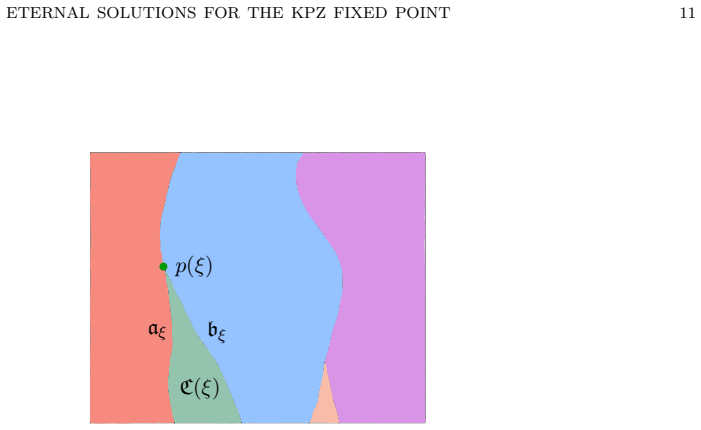
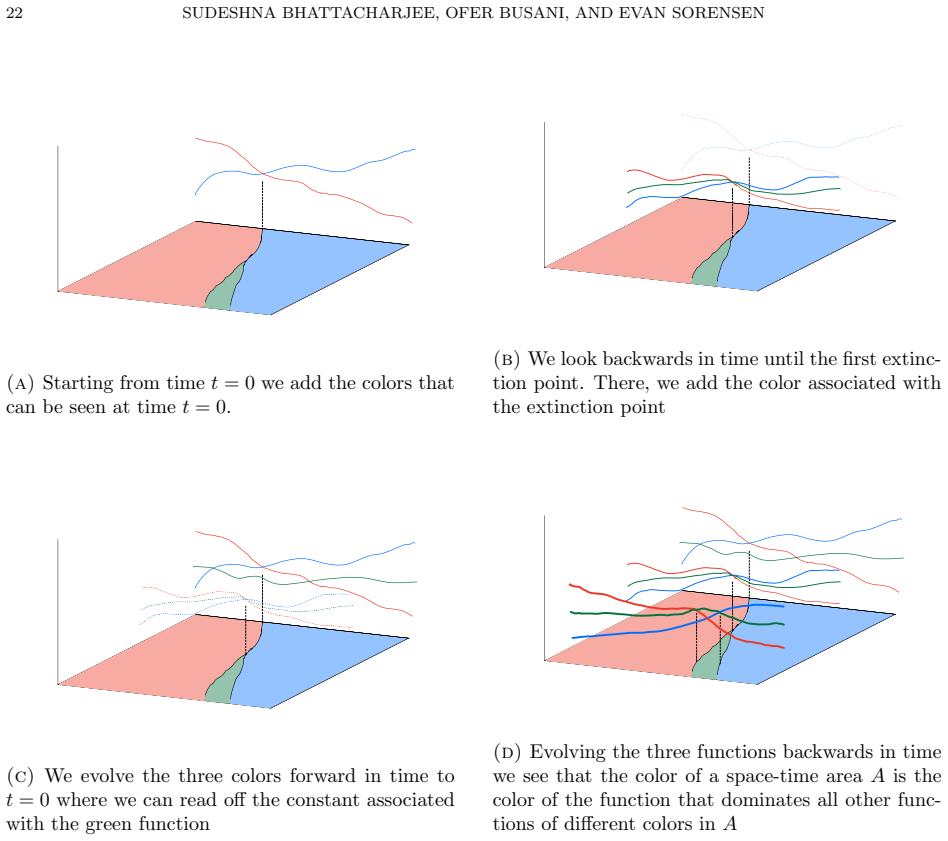
We give a complete classification of the eternal solutions for the KPZ fixed point. Each of these is a (possibly infinite) patching together of the known eternal solutions, called Busemann functions. The resulting evolution of the KPZ fixed point exhibits a shock at each of the boundaries between the different Busemann functions. Moving forward in time, the shocks coalesce, while moving backwards in time, additional shocks can form. We describe several geometric properties of this tree of shocks.
Editorial analysis
A structured set of objections, weighed in public.
Referee Report
Summary. The manuscript provides a complete classification of the eternal solutions for the KPZ fixed point. Each such solution is obtained as a (possibly infinite) patching of the known eternal solutions called Busemann functions. The resulting KPZ evolution exhibits shocks at the boundaries between these patches; these shocks coalesce when the solution evolves forward in time, while new shocks may form when evolving backward in time. The paper also describes several geometric properties of the resulting tree of shocks.
Significance. If the result holds, the classification is a significant contribution to the theory of the KPZ fixed point. It establishes that all eternal solutions arise exactly via patchings of Busemann functions, using the variational structure and the Hopf-Lax semigroup property to prove exhaustiveness. The description of the coalescing shock dynamics and the shock tree supplies new geometric information about the stationary solutions and their evolution. The rigorous argument for completeness, grounded in the characterization of Busemann functions as extremal stationary solutions, is a strength of the work.
Simulated Author's Rebuttal
We thank the referee for their positive assessment of the manuscript, the detailed summary of our results, and the recommendation to accept. No major comments were raised.
Circularity Check
No significant circularity; classification rests on independent variational characterization
full rationale
The paper constructs eternal solutions as (possibly infinite) patchings of known Busemann functions and proves that every eternal solution must arise this way, invoking the Hopf-Lax semigroup property and the extremal stationary characterization of Busemann functions. No step reduces a claimed result to a fitted parameter, self-definition, or unverified self-citation chain; the exhaustiveness argument is derived from the KPZ fixed point's variational structure rather than from the paper's own inputs by construction. Self-citations to prior Busemann work are normal and do not bear the central load in a circular manner.
Axiom & Free-Parameter Ledger
axioms (1)
- domain assumption The KPZ fixed point admits a family of eternal solutions known as Busemann functions that serve as the complete set of atomic pieces for all eternal solutions.
Reference graph
Works this paper leans on
-
[1]
Scaling limit of the colored ASEP and stochastic six-vertex models.Preprint:arXiv:2403.01341, 2024
Amol Aggarwal, Ivan Corwin, and Milind Hegde. Scaling limit of the colored ASEP and stochastic six-vertex models.Preprint:arXiv:2403.01341, 2024
-
[2]
On the distribution of the length of the longest increasing subse- quence of random permutations.J
Jinho Baik, Percy Deift, and Kurt Johansson. On the distribution of the length of the longest increasing subse- quence of random permutations.J. Amer. Math. Soc., 12(4):1119–1178, 1999
1999
-
[3]
The Burgers equation with Poisson random forcing.Ann
Yuri Bakhtin. The Burgers equation with Poisson random forcing.Ann. Probab., 41(4):2961–2989, 2013
2013
-
[4]
Space-time stationary solutions for the Burgers equation.J
Yuri Bakhtin, Eric Cator, and Konstantin Khanin. Space-time stationary solutions for the Burgers equation.J. Amer. Math. Soc., 27(1):193–238, 2014
2014
-
[5]
Thermodynamic limit for directed polymers and stationary solutions of the burgers equation.Communications on Pure and Applied Mathematics, 72(3):536–619, 2019
Yuri Bakhtin and Liying Li. Thermodynamic limit for directed polymers and stationary solutions of the burgers equation.Communications on Pure and Applied Mathematics, 72(3):536–619, 2019
2019
-
[6]
Duality in the Directed Landscape and Its Applications to Fractal Geometry.Int
Manan Bhatia. Duality in the Directed Landscape and Its Applications to Fractal Geometry.Int. Math. Res. Not. IMRN, 2024(12):9633–9662, 04 2024
2024
-
[7]
Exceptional force, uncountably many solutions in the KPZ fixed point.Preprint:arXiv:2505.09604, 2025
Sudeshna Bhattacharjee, Ofer Busani, and Evan Sorensen. Exceptional force, uncountably many solutions in the KPZ fixed point.Preprint:arXiv:2505.09604, 2025. 28 SUDESHNA BHATTACHARJEE, OFER BUSANI, AND EVAN SORENSEN
-
[8]
Borodin and Paavo Salminen.Handbook of Brownian motion—facts and formulae
Andrei N. Borodin and Paavo Salminen.Handbook of Brownian motion—facts and formulae. Probability and its Applications. Birkh¨ auser Verlag, Basel, second edition, 2002
2002
-
[9]
Non-existence of three non-coalescing infinite geodesics with the same direction in the directed landscape.Probab
Ofer Busani. Non-existence of three non-coalescing infinite geodesics with the same direction in the directed landscape.Probab. Theory Related Fields, 2025
2025
-
[10]
The stationary horizon and semi-infinite geodesics in the directed landscape.Ann
Ofer Busani, Timo Sepp¨ al¨ ainen, and Evan Sorensen. The stationary horizon and semi-infinite geodesics in the directed landscape.Ann. Probab., 52(1):1–66, 2024
2024
-
[11]
Brownian Gibbs property for Airy line ensembles.Invent
Ivan Corwin and Alan Hammond. Brownian Gibbs property for Airy line ensembles.Invent. Math., 195(2):441– 508, 2014
2014
-
[12]
The 27 geodesic networks in the directed landscape.Preprint: arXiv:2302.07802, 2023
Duncan Dauvergne. The 27 geodesic networks in the directed landscape.Preprint: arXiv:2302.07802, 2023
-
[13]
The 27 geodesic networks in the directed landscape.Inventiones mathematicae, 242:123–220, 2025
Duncan Dauvergne. The 27 geodesic networks in the directed landscape.Inventiones mathematicae, 242:123–220, 2025
2025
-
[14]
The directed landscape.Acta Math., 229(2):201–285, 2022
Duncan Dauvergne, Janosch Ortmann, and B´ alint Vir´ ag. The directed landscape.Acta Math., 229(2):201–285, 2022
2022
-
[15]
Three-halves variation of geodesics in the directed land- scape.Ann
Duncan Dauvergne, Sourav Sarkar, and B´ alint Vir´ ag. Three-halves variation of geodesics in the directed land- scape.Ann. Probab., 50(5):1947 – 1985, 2022
1947
-
[16]
The scaling limit of the longest increasing subsequence
Duncan Dauvergne and B´ alint Vir´ ag. The scaling limit of the longest increasing subsequence. Preprint:arXiv:2104.08210, 2021
-
[17]
Characterization of the directed landscape from the KPZ fixed point
Duncan Dauvergne and Lingfu Zhang. Characterization of the directed landscape from the KPZ fixed point. Preprint:arXiv:2412.13032, 2024
-
[18]
Viscous shock solutions to the stochastic Burgers equation.Arch
Alexander Dunlap and Lenya Ryzhik. Viscous shock solutions to the stochastic Burgers equation.Arch. Ration. Mech. Anal., 242(2):937–971, 2021
2021
-
[19]
Invariant measures and shocks in the KPZ fixed point
Alexander Dunlap and Evan Sorensen. Invariant measures and shocks in the KPZ fixed point. Preprint:arXiv:2508.15598, 2025
-
[20]
Viscous shock fluctuations in KPZ.Comm
Alexander Dunlap and Evan Sorensen. Viscous shock fluctuations in KPZ.Comm. Math. Phys., 407(4):Paper No. 63, 47, 2026
2026
-
[21]
Probability distribution functions for the random forced burgers equation.Phys
Weinan E, Konstantin Khanin, Alexandre Mazel, and Yakov Sinai. Probability distribution functions for the random forced burgers equation.Phys. Rev. Lett., 78:1904–1907, 1997
1904
-
[22]
P. A. Ferrari and L. R. G. Fontes. Current fluctuations for the asymmetric simple exclusion process.Ann. Probab., 22(2):820–832, 1994
1994
-
[23]
P. L. Ferrari, P. Ghosal, and P. Nejjar. Limit law of a second class particle in TASEP with non-random initial condition.Ann. Inst. Henri Poincar´ e Probab. Stat., 55(3):1203–1225, 2019
2019
-
[24]
Ferrari and Peter Nejjar
Patrik L. Ferrari and Peter Nejjar. Statistics of TASEP with three merging characteristics.J. Stat. Phys., 180(1- 6):398–413, 2020
2020
-
[25]
The directed landscape is a black noise.Preprint:arXiv:2404.16801, 2024
Zoe Himwich and Shalin Parekh. The directed landscape is a black noise.Preprint:arXiv:2404.16801, 2024. To appear in Ann. Inst. Henri Poincar´ e Probab. Stat
-
[26]
Iturriaga and K
R. Iturriaga and K. Khanin. Burgers turbulence and random Lagrangian systems.Comm. Math. Phys., 232(3):377–428, 2003
2003
-
[27]
Shape fluctuations and random matrices.Comm
Kurt Johansson. Shape fluctuations and random matrices.Comm. Math. Phys., 209(2):437–476, 2000
2000
-
[28]
The KPZ fixed point.Acta Math., 227(1):115–203, 2021
Konstantin Matetski, Jeremy Quastel, and Daniel Remenik. The KPZ fixed point.Acta Math., 227(1):115–203, 2021
2021
-
[29]
Mihai Nica, Jeremy Quastel, and Daniel Remenik. One-sided reflected Brownian motions and the KPZ fixed point.arXiv e-prints, page arXiv:2002.02922, 2020
-
[30]
Scale invariance of the PNG droplet and the Airy process.J
Michael Pr¨ ahofer and Herbert Spohn. Scale invariance of the PNG droplet and the Airy process.J. Statist. Phys., 108(5-6):1071–1106, 2002. Dedicated to David Ruelle and Yasha Sinai on the occasion of their 65th birthdays
2002
-
[31]
Infinite geodesics, competition interfaces and the second class particle in the scaling limit.Ann
Mustazee Rahman and Balint Virag. Infinite geodesics, competition interfaces and the second class particle in the scaling limit.Ann. Inst. Henri Poincar´ e Probab. Stat., 61(2):1075–1126, 2025
2025
-
[32]
Shocks, instability, and the twenty networks of infinite geodesics in the Directed Landscape
Firas Rassoul-Agha and Mikhail Sweeney. Shocks, instability, and the twenty networks of infinite geodesics in the Directed Landscape.Preprint:arXiv:2604.12963, 2026
work page internal anchor Pith review Pith/arXiv arXiv 2026
-
[33]
The Martin boundary of the Directed Landscape
Firas Rassoul-Agha and Mikhail Sweeney. The Martin boundary of the Directed Landscape.arXiv:2605.21366, 2026
work page internal anchor Pith review Pith/arXiv arXiv 2026
-
[34]
Ya. G. Sinai.Burgers system driven by a periodic stochastic flow, pages 347–353. Springer, Tokyo, 1996
1996
-
[35]
Ya. G. Sina˘ ı. Two results concerning asymptotic behavior of solutions of the Burgers equation with force.J. Statist. Phys., 64(1-2):1–12, 1991
1991
-
[36]
The KPZ equation and the directed landscape.Ann
Xuan Wu. The KPZ equation and the directed landscape.Ann. Probab., 54(3), 2026
2026
-
[37]
Convergence from the Log-Gamma Polymer to the Directed Landscape.Preprint:arXiv:2505.05685, 2025
Xinyi Zhang. Convergence from the Log-Gamma Polymer to the Directed Landscape.Preprint:arXiv:2505.05685, 2025. Sudeshna Bhattacharjee, School of Mathematics, University of Bristol, Fry Building, Woodland Road, BS8 1UG, Bristol, UK Email address:s.bhattacharjee@bristol.ac.uk URL:https://sites.google.com/view/sudeshnabhattacharjee/home ETERNAL SOLUTIONS FOR...
discussion (0)
Sign in with ORCID, Apple, or X to comment. Anyone can read and Pith papers without signing in.