CLEAR-NeRF: Collinearity and Local-region Enhanced Accurate 3D Reconstruction in Unbounded Scenes
Pith reviewed 2026-06-29 13:50 UTC · model grok-4.3
The pith
CLEAR-NeRF adapts NeRF with four targeted additions to deliver metric-accurate reconstruction across unbounded multi-ROI scenes.
A machine-rendered reading of the paper's core claim, the machinery that carries it, and where it could break.
Core claim
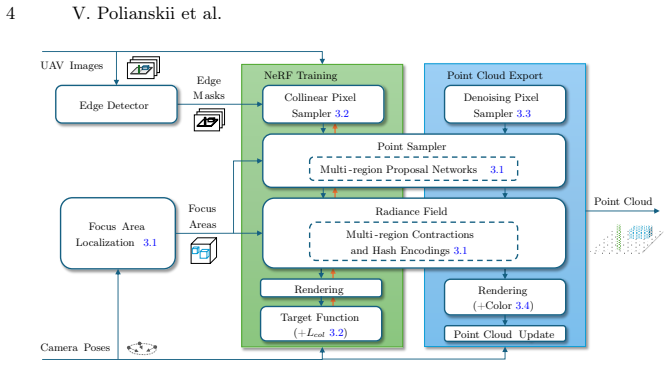
By combining automated local-region localization and reconstruction, collinearity-enforcing ray sampling, depth-localized neighborhood point extraction, and geometry-relevant color aggregation, the CLEAR-NeRF pipeline produces 3D reconstructions that are more robust to lighting and pose variation and more metrically accurate than baseline NeRF models or established SfM-MVS solutions in unbounded scenes containing multiple regions of interest.
What carries the argument
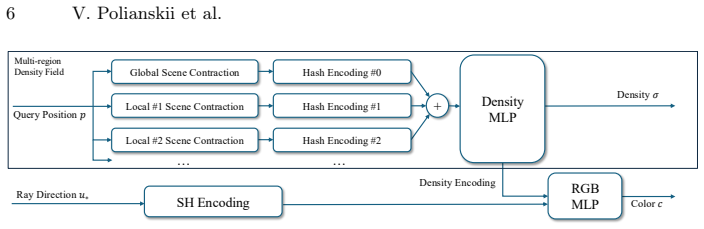
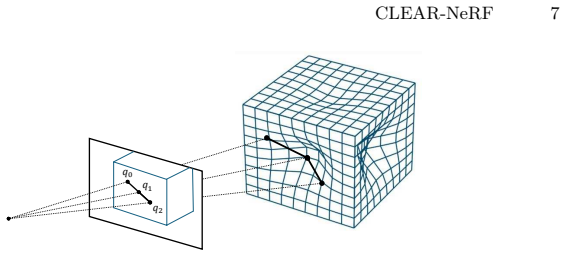
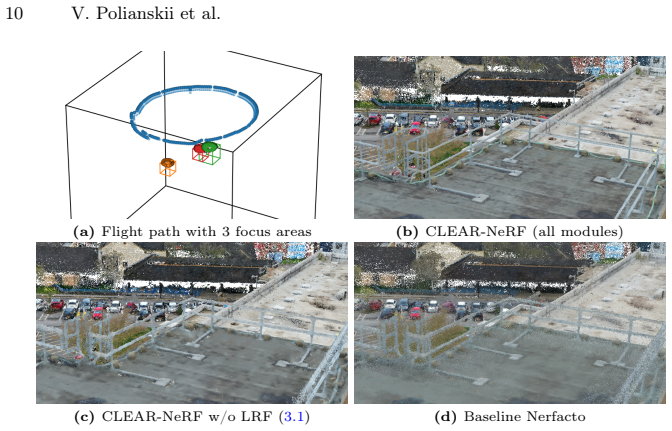
The four integrated techniques (automated local region localization/detection and reconstruction, collinearity-enforcing ray sampling, depth-localized neighborhood point extraction, geometry-relevant color aggregation) that together prioritize regions of interest, enforce surface smoothness, suppress artifacts, and reduce lighting/pose sensitivity.
If this is right
- Automated local-region handling allows the method to focus computation on areas of interest without manual intervention or extra modules.
- Collinear ray sampling produces smoother planar and curved surfaces than standard NeRF sampling.
- Depth-localized neighborhood extraction reduces surface artifacts that appear in conventional NeRF outputs.
- Geometry-relevant color aggregation reduces the impact of lighting and camera-pose variations on the final reconstruction.
- The combined pipeline reports better quantitative and qualitative results than both NeRF baselines and SfM-MVS on the target scene class.
Where Pith is reading between the lines
- The same four additions could be ported to other radiance-field or implicit-surface representations that currently struggle with large-scale scenes.
- Metric accuracy gains might reduce reliance on post-processing alignment steps when the output is used for measurement or simulation.
- If the local-region detector generalizes, the method could be applied to video streams where new regions of interest appear over time.
- Testing on scenes with extreme dynamic range or moving objects would reveal whether the color-aggregation step alone is sufficient.
Load-bearing premise
The four techniques can be combined inside one NeRF pipeline without adding many new submodules while still delivering both metric accuracy and robustness to lighting and pose changes.
What would settle it
A benchmark run on an unbounded multi-ROI scene with controlled lighting and pose variation where the full CLEAR-NeRF pipeline shows no improvement in either PSNR or metric reconstruction error over a plain NeRF baseline would falsify the performance claim.
Figures




read the original abstract
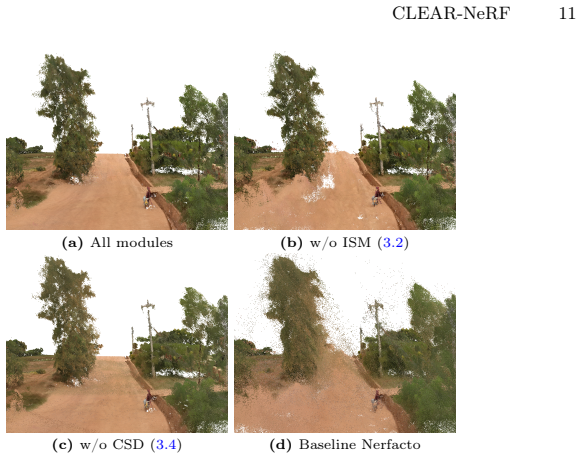
Many real-world 3D reconstruction applications demand photorealism and metric accuracy across unbounded, complex scenes with challenging lighting and imperfect captures that current Neural Radiance Field (NeRF) pipelines only partly satisfy. This study adapts NeRF-based 3D reconstruction to multi-region of interest unbounded scenes to improve robustness to lighting and pose variation while enforcing metric accuracy suitable for digital-twin applications. Our approach introduces (i) automated local region localization/detection and reconstruction to seamlessly prioritize areas of interest without proliferating submodules, (ii) collinearity-enforcing ray sampling to learn smooth planar and curved surfaces, (iii) depth-localized neighborhood point extraction to suppress surface artifacts, and (iv) geometry-relevant color aggregation to mitigate lighting- and pose-caused variations. Results indicate superior performance of the proposed pipeline over the baseline NeRF models and established Structure from Motion (SfM) - Multi-View Stereo (MVS) solutions.
Editorial analysis
A structured set of objections, weighed in public.
Referee Report
Summary. The manuscript introduces CLEAR-NeRF, a NeRF-based pipeline for photorealistic 3D reconstruction in unbounded multi-ROI scenes. It proposes four components—automated local-region localization/reconstruction, collinearity-enforcing ray sampling, depth-localized neighborhood point extraction, and geometry-relevant color aggregation—to improve robustness to lighting/pose variation, reduce artifacts, and enforce metric accuracy for digital-twin applications. The authors claim the integrated approach outperforms baseline NeRF models and SfM-MVS solutions without proliferating submodules.
Significance. If the quantitative results and metric-accuracy claims hold, the work could meaningfully advance practical NeRF deployment in complex real-world unbounded scenes by addressing local prioritization and appearance consistency. The collinearity and neighborhood mechanisms target common surface artifacts, which is a useful direction. However, significance is tempered by the need for explicit validation of scale recovery and ablation evidence.
major comments (2)
- [Abstract and §3] Abstract and §3 (method overview): the central claim that the four techniques 'enforce metric accuracy suitable for digital-twin applications' lacks support. None of the listed operations (local-region detection, collinearity ray sampling, depth-localized extraction, color aggregation) introduces an absolute scale anchor, known baseline, or alignment to a metric reference; standard NeRF formulations remain scale-ambiguous, so the pipeline can at best recover shape up to an arbitrary scale.
- [§4 and Abstract] §4 (experiments) and abstract: the assertion of 'superior performance' over baseline NeRF and SfM-MVS is stated without accompanying metrics, dataset specifications, ablation tables, or error analysis in the provided text. This prevents evaluation of whether the claimed improvements in smoothness, artifact reduction, and robustness are realized or statistically significant.
minor comments (2)
- [Abstract] Abstract: the phrasing 'without proliferating submodules' is imprecise; a brief clarification of the integration mechanism would help readers understand the architectural claim.
- [§3] Notation: ensure consistent use of symbols for depth, collinearity constraints, and neighborhood radii across equations and figures.
Simulated Author's Rebuttal
We thank the referee for the constructive comments. We address each major comment below and indicate where revisions will be made to the manuscript.
read point-by-point responses
-
Referee: [Abstract and §3] Abstract and §3 (method overview): the central claim that the four techniques 'enforce metric accuracy suitable for digital-twin applications' lacks support. None of the listed operations (local-region detection, collinearity ray sampling, depth-localized extraction, color aggregation) introduces an absolute scale anchor, known baseline, or alignment to a metric reference; standard NeRF formulations remain scale-ambiguous, so the pipeline can at best recover shape up to an arbitrary scale.
Authors: We agree with the referee that none of the four components introduces an absolute scale anchor or known baseline. The pipeline therefore recovers geometry up to an arbitrary scale, consistent with standard NeRF formulations. The phrasing in the abstract and §3 overstates the case by claiming enforcement of metric accuracy suitable for digital-twin applications. We will revise both locations to state that the method improves relative geometric consistency and reduces artifacts, which can support metric applications when an external scale reference is available. revision: yes
-
Referee: [§4 and Abstract] §4 (experiments) and abstract: the assertion of 'superior performance' over baseline NeRF and SfM-MVS is stated without accompanying metrics, dataset specifications, ablation tables, or error analysis in the provided text. This prevents evaluation of whether the claimed improvements in smoothness, artifact reduction, and robustness are realized or statistically significant.
Authors: Section 4 of the manuscript presents quantitative comparisons, but we acknowledge that the current presentation may not make the supporting metrics, dataset details, ablation tables, and error analysis sufficiently prominent or complete for evaluation. We will revise §4 to expand the reporting of all quantitative results, include explicit dataset specifications, add or clarify ablation tables, and provide statistical error analysis so that the performance claims can be directly assessed. revision: partial
Circularity Check
No circularity in derivation chain
full rationale
The paper presents four novel techniques (automated local region localization, collinearity-enforcing ray sampling, depth-localized neighborhood extraction, and geometry-relevant color aggregation) as additions to standard NeRF without any equations, fitted parameters renamed as predictions, or self-citations invoked to justify uniqueness or ansatz. The abstract and described approach contain no self-definitional reductions or load-bearing self-references; claims of metric accuracy and superior performance rest on empirical comparison to baselines rather than tautological construction from inputs. The derivation remains self-contained against external benchmarks.
Axiom & Free-Parameter Ledger
Reference graph
Works this paper leans on
-
[1]
In: Proceedings of the IEEE/CVF International Conference on Computer Vision
Barron, J.T., Mildenhall, B., Tancik, M., Hedman, P., Martin-Brualla, R., Srini- vasan, P.P.: Mip-nerf: A multiscale representation for anti-aliasing neural radiance fields. In: Proceedings of the IEEE/CVF International Conference on Computer Vision. pp. 5855–5864 (2021)
2021
-
[2]
In: Proceedings of the IEEE/CVF Conference on Computer Vision and Pattern Recognition
Barron, J.T., Mildenhall, B., Verbin, D., Srinivasan, P.P., Hedman, P.: Mip- nerf 360: Unbounded anti-aliased neural radiance fields. In: Proceedings of the IEEE/CVF Conference on Computer Vision and Pattern Recognition. pp. 5470– 5479 (2022)
2022
-
[3]
In: IEEE Latin American GRSS & ISPRS Remote Sensing Conference
Berra,E.,Peppa,M.:Advancesandchallengesofuavsfmmvsphotogrammetryand remote sensing: Short review. In: IEEE Latin American GRSS & ISPRS Remote Sensing Conference. pp. 533–538. IEEE (2020)
2020
-
[4]
IEEE Transactions on Pattern Analysis and Machine Intelligence8(6), 679–698 (1986)
Canny, J.: A computational approach to edge detection. IEEE Transactions on Pattern Analysis and Machine Intelligence8(6), 679–698 (1986)
1986
-
[5]
International Journal of Digital Earth18(1), 2542916 (2025)
Chen, Y., Chen, J.: Block-pspgof: High-quality mesh reconstruction of large scenes based on progressive self-planarized gaussian opacity fields. International Journal of Digital Earth18(1), 2542916 (2025)
2025
-
[6]
Automation in Construction165, 105517 (2024)
Cui, D., Wang, W., Hu, W., Peng, J., Zhao, Y., Zhang, Y., Wang, J.: 3d recon- struction of building structures incorporating neural radiation fields and geometric constraints. Automation in Construction165, 105517 (2024)
2024
-
[7]
DJI: Dji mavic 3 pro (2026),https://www.dji.com/mavic-3-pro, [Accessed: 03- 03-2026]
2026
-
[8]
In: Proceed- ings of the IEEE/CVF Conference on Computer Vision and Pattern Recognition
Fang, L., Zhu, H., Chen, L., Hu, F., Ye, L., Ma, Z.: Depth-guided bundle sam- pling for efficient generalizable neural radiance field reconstruction. In: Proceed- ings of the IEEE/CVF Conference on Computer Vision and Pattern Recognition. pp. 11217–11226 (2025)
2025
-
[9]
NeRF: Neural Radiance Field in 3D Vision: A Comprehensive Review (Updated Post-Gaussian Splatting)
Gao, K., Gao, Y., He, H., Lu, D., Xu, L., Li, J.: Nerf: Neural radiance field in 3d vision: A comprehensive review. arXiv preprint arXiv:2210.00379 (2022)
work page internal anchor Pith review Pith/arXiv arXiv 2022
-
[10]
Geomatics 6(1), 4 (2026)
Giaquinto, A., Ferraioli, G., Pizzo, S.D.: Evaluating neural radiance fields for image-based 3d reconstruction: A comparative study with sfm-mvs. Geomatics 6(1), 4 (2026)
2026
-
[11]
ACM Transactions on Graphics42(4), 139–1 (2023)
Kerbl, B., Kopanas, G., Leimkühler, T., Drettakis, G., et al.: 3d gaussian splatting for real-time radiance field rendering. ACM Transactions on Graphics42(4), 139–1 (2023)
2023
-
[12]
Leica Geosystems AG: Leica blk360 imaging laser scanner (2026), https://leica-geosystems.com/en-us/products/laser-scanners/scanners/ leica-blk360, [Accessed: 03-03-2026]
2026
-
[13]
Archiwum Fotogrametrii, Kartografii i Teledetekcji35(2023)
Lewandowski, B., Wilk, Ł., Zachar, P.: Application of neural network models in the mapping of telecommunications infrastructure objects. Archiwum Fotogrametrii, Kartografii i Teledetekcji35(2023)
2023
-
[14]
Interna- tional Journal of Remote Sensing pp
Li, F., Zhang, G., Zhang, R., Zhou, G.: Pgc-nerf: Probabilistic and geometric constraint-driven neural radiance fields for enhanced 3d reconstruction. Interna- tional Journal of Remote Sensing pp. 1–25 (2025)
2025
-
[15]
In: 7th Infor- mation Technology, Networking, Electronic and Automation Control Conference
Liao,L.,Chen,J.,Zhang,Z.,Huai,X.,Zhang,C.,Ren,X.,Zhang,B.:Improving3d reconstruction from limited samples: A depth-guided nerf approach. In: 7th Infor- mation Technology, Networking, Electronic and Automation Control Conference. vol. 7, pp. 879–883. IEEE (2024) CLEAR-NeRF 15
2024
-
[16]
ACM Computing Surveys58(2), 1–33 (2025)
Liao, Y., Di, Y., Zhou, H., Zhu, K., Lu, M., Duan, Q., Liu, J.: A survey on neural radiance fields. ACM Computing Surveys58(2), 1–33 (2025)
2025
-
[17]
In: 6th International Conference on Computer Vision, Image and Deep Learning
Liu, J., Xue, F.: Research on high-precision 3d modeling technology for campus real-scenes based on nerf. In: 6th International Conference on Computer Vision, Image and Deep Learning. pp. 1127–1132. IEEE (2025)
2025
-
[18]
Sensors25(18), 5748 (2025)
Liu, S., Yang, M., Xing, T., Yang, R.: A survey of 3d reconstruction: The evolution from multi-view geometry to nerf and 3dgs. Sensors25(18), 5748 (2025)
2025
-
[19]
In: Proceedings of the IEEE/CVF International Conference on Computer Vision Workshops
Llull, C., Baloian, N., Bustos, B., Kupczik, K., Sipiran, I., Baloian, A.: Evalua- tion of 3d reconstruction for cultural heritage applications. In: Proceedings of the IEEE/CVF International Conference on Computer Vision Workshops. pp. 1642– 1651 (2023)
2023
-
[20]
Remote Sensing17(14), 2535 (2025)
Maté-González, M.Á., Yali, R., Rodríguez-Hernández, J., González-González, E., AguirredeMata,J.:Comparisonofnerf-andsfm-basedmethodsforpointcloudre- construction for small-sized archaeological artifacts. Remote Sensing17(14), 2535 (2025)
2025
-
[21]
Journal of Open Source Software2(11), 205 (2017)
McInnes, L., Healy, J., Astels, S., et al.: hdbscan: Hierarchical density based clus- tering. Journal of Open Source Software2(11), 205 (2017)
2017
-
[22]
Commu- nications of the ACM65(1), 99–106 (2021)
Mildenhall, B., Srinivasan, P.P., Tancik, M., Barron, J.T., Ramamoorthi, R., Ng, R.: Nerf: Representing scenes as neural radiance fields for view synthesis. Commu- nications of the ACM65(1), 99–106 (2021)
2021
-
[23]
In: Proceedings of the IEEE/CVF International Conference on Computer Vision Workshops
Molaei, A., Aminimehr, A., Tavakoli, A., Kazerouni, A., Azad, B., Azad, R., Mer- hof, D.: Implicit neural representation in medical imaging: A comparative survey. In: Proceedings of the IEEE/CVF International Conference on Computer Vision Workshops. pp. 2381–2391 (2023)
2023
-
[24]
ACM Transactions on Graphics41(4), 1–15 (2022)
Müller, T., Evans, A., Schied, C., Keller, A.: Instant neural graphics primitives with a multiresolution hash encoding. ACM Transactions on Graphics41(4), 1–15 (2022)
2022
-
[25]
Inter- nationalArchives ofthePhotogrammetry, RemoteSensingand SpatialInformation Sciences48(1/W3-2023), 123–130 (2023)
Nex, F., Zhang, N., Remondino, F., Farella, E., Qin, R., Zhang, C.: Benchmarking the extraction of 3d geometry from uav images with deep learning methods. Inter- nationalArchives ofthePhotogrammetry, RemoteSensingand SpatialInformation Sciences48(1/W3-2023), 123–130 (2023)
2023
-
[26]
In: European Conference on Computer Vision (2024)
Pan, L., Barath, D., Pollefeys, M., Schönberger, J.L.: Global structure-from-motion revisited. In: European Conference on Computer Vision (2024)
2024
-
[27]
Applied Sciences12(24), 12886 (2022)
Pepe, M., Alfio, V.S., Costantino, D.: Uav platforms and the sfm-mvs approach in the 3d surveys and modelling: A review in the cultural heritage field. Applied Sciences12(24), 12886 (2022)
2022
-
[28]
Remote Sensing16(7), 1188 (2024)
Petrovska, I., Jutzi, B.: Vision through obstacles—3d geometric reconstruction and evaluation of neural radiance fields (nerfs). Remote Sensing16(7), 1188 (2024)
2024
-
[29]
In: Proceedings of the IEEE Conference on Computer Vision and Pattern Recognition (2016)
Schonberger, J.L., Frahm, J.M.: Structure-from-motion revisited. In: Proceedings of the IEEE Conference on Computer Vision and Pattern Recognition (2016)
2016
-
[30]
In: Proceedings of the European Conference on Computer Vision
Schönberger, J.L., Zheng, E., Frahm, J.M., Pollefeys, M.: Pixelwise view selection for unstructured multi-view stereo. In: Proceedings of the European Conference on Computer Vision. pp. 501–518 (2016)
2016
-
[31]
In: Proceedings of the IEEE Conference on Computer Vision and Pattern Recognition
Seitz, S.M., Curless, B., Diebel, J., Scharstein, D., Szeliski, R.: A comparison and evaluation of multi-view stereo reconstruction algorithms. In: Proceedings of the IEEE Conference on Computer Vision and Pattern Recognition. vol. 1, pp. 519–
-
[32]
In: Proceedings of the IEEE/CVF Conference on Computer Vision and Pattern Recognition
Tancik, M., Casser, V., Yan, X., Pradhan, S., Mildenhall, B., Srinivasan, P.P., Bar- ron, J.T., Kretzschmar, H.: Block-nerf: Scalable large scene neural view synthesis. In: Proceedings of the IEEE/CVF Conference on Computer Vision and Pattern Recognition. pp. 8248–8258 (2022)
2022
-
[33]
In: ACM SIGGRAPH Conference Proceedings
Tancik,M.,Weber,E.,Ng,E.,Li,R.,Yi,B.,Wang,T.,Kristoffersen,A.,Austin,J., Salahi, K., Ahuja, A., et al.: Nerfstudio: A modular framework for neural radiance field development. In: ACM SIGGRAPH Conference Proceedings. pp. 1–12 (2023) 16 V. Polianskii et al
2023
-
[34]
SICE Journal of Control, Measurement, and System Integration18(1), 2497600 (2025)
Tsukamoto, Y., Hayashi, A., Tokuda, K., Kochi, N.: Comparative verification of 3d reconstructed point cloud data: Comparison of ai estimation and multi-view stereo methods using nerfstudio and metashape. SICE Journal of Control, Measurement, and System Integration18(1), 2497600 (2025)
2025
-
[35]
In: Proceedings of the IEEE/CVF Con- ference on Computer Vision and Pattern Recognition
Turki, H., Ramanan, D., Satyanarayanan, M.: Mega-nerf: Scalable construction of large-scale nerfs for virtual fly-throughs. In: Proceedings of the IEEE/CVF Con- ference on Computer Vision and Pattern Recognition. pp. 12922–12931 (2022)
2022
-
[36]
In: Proceedings of the IEEE/CVF Conference on Computer Vision and Pattern Recognition
Turki, H., Zhang, J.Y., Ferroni, F., Ramanan, D.: Suds: Scalable urban dynamic scenes. In: Proceedings of the IEEE/CVF Conference on Computer Vision and Pattern Recognition. pp. 12375–12385 (2023)
2023
-
[37]
ISPRS International Journal of Geo-Information13(7), 243 (2024)
Wan, Q., Guan, Y., Zhao, Q., Wen, X., She, J.: Constraining the geometry of nerfs for accurate dsm generation from multi-view satellite images. ISPRS International Journal of Geo-Information13(7), 243 (2024)
2024
-
[38]
The International Journal of Robotics Research p
Wang, G., Pan, L., Peng, S., Liu, S., Xu, C., Miao, Y., Zhan, W., Tomizuka, M., Pollefeys, M., Wang, H.: Nerfs in robotics: A survey. The International Journal of Robotics Research p. 02783649251374246 (2024)
2024
-
[39]
Applied Computing and Geosciences 26, 100239 (2025)
Wang, X., Hua, W., Liu, X., Li, P., Li, G.: Gpe-dnerf: Neural radiance field method for surface geological bodies reconstruction. Applied Computing and Geosciences 26, 100239 (2025)
2025
-
[40]
In: European Conference on Computer Vision
Xiangli, Y., Xu, L., Pan, X., Zhao, N., Rao, A., Theobalt, C., Dai, B., Lin, D.: Bungeenerf: Progressive neural radiance field for extreme multi-scale scene render- ing. In: European Conference on Computer Vision. pp. 106–122. Springer (2022)
2022
-
[41]
arXiv preprint arXiv:2501.13104 (2025)
Xiao, W., Chierchia, R., Cruz, R.S., Li, X., Ahmedt-Aristizabal, D., Salvado, O., Fookes, C., Lebrat, L.: Neural radiance fields for the real world: A survey. arXiv preprint arXiv:2501.13104 (2025)
-
[42]
In: Proceedings of the IEEE/CVF Conference on Computer Vision and Pattern Recognition
Xu, L., Xiangli, Y., Peng, S., Pan, X., Zhao, N., Theobalt, C., Dai, B., Lin, D.: Grid-guided neural radiance fields for large urban scenes. In: Proceedings of the IEEE/CVF Conference on Computer Vision and Pattern Recognition. pp. 8296– 8306 (2023)
2023
-
[43]
The Photogrammetric Record39(188), 718–740 (2024)
Xu, N., Qin, R., Huang, D., Remondino, F.: Multi-tiling neural radiance field (nerf)—geometric assessment on large-scale aerial datasets. The Photogrammetric Record39(188), 718–740 (2024)
2024
-
[44]
Yang, C., Li, P., Zhou, Z., Yuan, S., Liu, B., Yang, X., Qiu, W., Shen, W.: Nerfvs: Neuralradiancefieldsforfreeviewsynthesisviageometryscaffolds.In:Proceedings of the IEEE/CVF Conference on Computer Vision and Pattern Recognition. pp. 16549–16558 (2023)
2023
-
[45]
Advances in Neural Information Processing Systems37, 21875–21911 (2024)
Yang, L., Kang, B., Huang, Z., Zhao, Z., Xu, X., Feng, J., Zhao, H.: Depth anything v2. Advances in Neural Information Processing Systems37, 21875–21911 (2024)
2024
-
[46]
arXiv preprint arXiv:2010.07492 (2020)
Zhang, K., Riegler, G., Snavely, N., Koltun, V.: Nerf++: Analyzing and improving neural radiance fields. arXiv preprint arXiv:2010.07492 (2020)
-
[47]
In: Proceedings of the 32nd ACM International Conference on Multimedia
Zhang, Q., Huang, C., Zhang, Q., Li, N., Feng, W.: Learning geometry consistent neural radiance fields from sparse and unposed views. In: Proceedings of the 32nd ACM International Conference on Multimedia. pp. 8508–8517 (2024)
2024
-
[48]
arXiv preprint arXiv:2405.06214 (2024)
Zhang, X., Qiu, Y., Sun, Z., Liu, Q.: Aerial-nerf: Adaptive spatial partitioning and sampling for large-scale aerial rendering. arXiv preprint arXiv:2405.06214 (2024)
-
[49]
arXiv preprint arXiv:2406.05649 (2024)
Zhuang, P., Han, S., Wang, C., Siarohin, A., Zou, J., Vasilkovsky, M., Shakhrai, V., Korolev, S., Tulyakov, S., Lee, H.Y.: Gtr: Improving large 3d reconstruction models through geometry and texture refinement. arXiv preprint arXiv:2406.05649 (2024)
discussion (0)
Sign in with ORCID, Apple, or X to comment. Anyone can read and Pith papers without signing in.