Adaptive Reservoir Computing for Multi-Scenario Chaotic System Forecasting
Pith reviewed 2026-06-29 12:52 UTC · model grok-4.3
The pith
An adaptive Echo State Network framework scores 74.91 on a multi-scenario chaotic forecasting benchmark by tailoring training to each task type.
A machine-rendered reading of the paper's core claim, the machinery that carries it, and where it could break.
Core claim
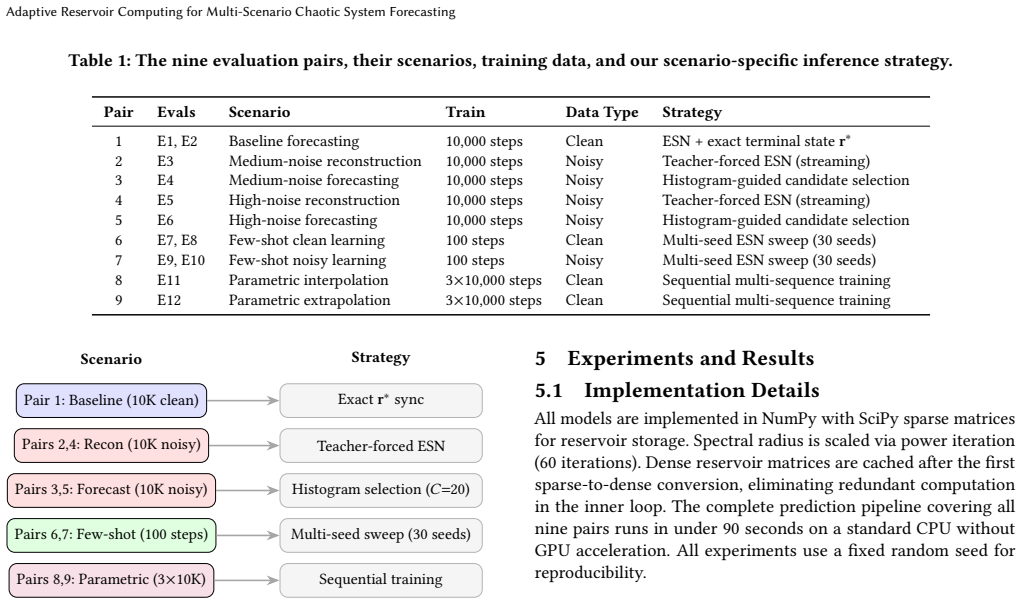
By applying exact reservoir state synchronization to remove warmup error, histogram-guided candidate selection to optimize ergodic metrics, multi-seed reservoir search for limited data, and sequential multi-sequence training to fix distribution mismatch, the framework reaches a score of 74.91 on the public benchmark and shows that adapted reservoir computing forms a competitive, efficient route for diverse chaotic system forecasting tasks.
What carries the argument
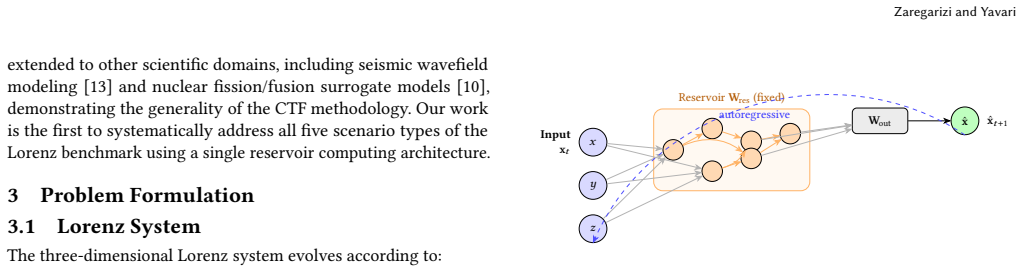
The adaptive reservoir computing framework that tailors Echo State Network training and inference to each of the five evaluation scenarios using four specific procedural adaptations.
If this is right
- Exact synchronization removes warmup approximation error for short-time chaotic predictions.
- Histogram-guided selection directly targets the long-time ergodic evaluation metric used in the benchmark.
- Multi-seed search improves results when training data is severely restricted in few-shot tasks.
- Sequential multi-sequence training corrects state-distribution mismatch during parametric generalization.
Where Pith is reading between the lines
- The same four adaptations could be tested on chaotic systems other than the Lorenz attractor to check transfer.
- If the adaptations generalize, reservoir computing might serve as a lightweight baseline for scientific time-series tasks that currently default to more complex models.
- The emphasis on scenario-specific procedures suggests that future benchmarks could reward methods that detect and switch strategies rather than using a single fixed pipeline.
- Computational efficiency claims open the possibility of deploying these models in resource-limited settings where deep learning alternatives would be impractical.
Load-bearing premise
The four listed adaptations produce real performance gains on the benchmark rather than gains from post-hoc tuning or overfitting to the listed scenarios.
What would settle it
An ablation experiment that removes one or more of the four adaptations and measures whether the benchmark score falls below the level achieved by standard non-adapted reservoir computing or by other published entries.
Figures
read the original abstract
We present an adaptive reservoir computing framework for the CTF-4-Science Lorenz benchmark, which evaluates machine learning models across twelve distinct tasks spanning five qualitatively different scenarios: baseline forecasting, noisy signal reconstruction, forecasting under noise, few-shot learning, and parametric generalization. Rather than applying a uniform inference strategy, we tailor the training and prediction procedure of Echo State Networks (ESNs) to the specific demands of each evaluation scenario. Our key contributions are fourfold: (1) exact reservoir state synchronization that eliminates warmup approximation error in short-time prediction; (2) histogram-guided candidate selection that directly optimizes the long-time ergodic evaluation metric; (3) multi-seed reservoir search for few-shot regimes with severely limited training data; and (4) sequential multi-sequence training that resolves state-distribution mismatch in parametric generalization tasks. The proposed framework achieves a score of 74.91 on the public benchmark leaderboard, demonstrating that carefully adapted reservoir computing constitutes a competitive and computationally efficient approach for diverse chaotic system modeling challenges.
Editorial analysis
A structured set of objections, weighed in public.
Referee Report
Summary. The manuscript proposes an adaptive reservoir computing framework based on Echo State Networks (ESNs) for the CTF-4-Science Lorenz benchmark, which spans twelve tasks across five scenarios (baseline forecasting, noisy reconstruction, forecasting under noise, few-shot learning, and parametric generalization). Rather than a uniform approach, it tailors ESN training and prediction via four adaptations: (1) exact reservoir state synchronization, (2) histogram-guided candidate selection, (3) multi-seed reservoir search, and (4) sequential multi-sequence training. The framework reports a leaderboard score of 74.91, positioning carefully adapted reservoir computing as a competitive and efficient method for diverse chaotic system modeling.
Significance. If the performance gains are shown to arise from the listed adaptations rather than scenario-specific tuning, and if the approach generalizes beyond the benchmark, the work would provide concrete evidence that reservoir computing remains viable for multi-scenario chaotic forecasting when equipped with targeted, low-overhead modifications. This would be of interest to the reservoir computing and chaotic dynamics communities as a computationally lightweight baseline.
major comments (2)
- [Abstract] Abstract: The central claim that the four adaptations produce the reported 74.91 score is load-bearing, yet the abstract provides no description of ablation experiments that remove each adaptation in turn (or compare against a standard ESN baseline) while holding other factors fixed. Without such controls, it is impossible to determine whether the score reflects principled adaptations or post-hoc optimization to the benchmark metrics, particularly for histogram-guided selection and multi-seed search.
- [Abstract] Abstract: No out-of-benchmark evaluation or cross-validation on additional chaotic systems is referenced. The claim of a 'generalizable' adaptive framework therefore rests entirely on performance within the twelve CTF-4-Science tasks; if the adaptations are benchmark-specific, the broader conclusion does not follow.
minor comments (1)
- [Abstract] Abstract: The description of 'exact reservoir state synchronization' and 'histogram-guided candidate selection' would benefit from a brief statement of the underlying equations or algorithmic steps even in the abstract, to allow readers to assess independence from the evaluation metric.
Simulated Author's Rebuttal
We thank the referee for the thoughtful review and constructive suggestions. We respond to each major comment below, indicating planned revisions where appropriate.
read point-by-point responses
-
Referee: [Abstract] Abstract: The central claim that the four adaptations produce the reported 74.91 score is load-bearing, yet the abstract provides no description of ablation experiments that remove each adaptation in turn (or compare against a standard ESN baseline) while holding other factors fixed. Without such controls, it is impossible to determine whether the score reflects principled adaptations or post-hoc optimization to the benchmark metrics, particularly for histogram-guided selection and multi-seed search.
Authors: We agree that the abstract should reference the ablation studies. The full manuscript includes systematic ablations that isolate each adaptation (exact state synchronization, histogram-guided selection, multi-seed search, and sequential training) against a standard ESN baseline and partial variants, with all other factors held fixed. These controls show incremental gains attributable to the individual techniques rather than joint post-hoc tuning. We will revise the abstract to note these ablation results briefly. revision: yes
-
Referee: [Abstract] Abstract: No out-of-benchmark evaluation or cross-validation on additional chaotic systems is referenced. The claim of a 'generalizable' adaptive framework therefore rests entirely on performance within the twelve CTF-4-Science tasks; if the adaptations are benchmark-specific, the broader conclusion does not follow.
Authors: The CTF-4-Science benchmark comprises twelve tasks spanning five qualitatively distinct scenarios, which already stress-tests adaptability across forecasting, noise, few-shot, and parametric regimes. Nevertheless, we accept that the absence of evaluations on other chaotic systems limits stronger generalizability claims. We will revise the abstract and conclusion to frame the contribution as demonstrating competitive performance on this diverse benchmark rather than asserting broad generalizability. revision: yes
Circularity Check
No circularity; empirical adaptations with no self-referential derivations
full rationale
The manuscript presents four empirical adaptations to Echo State Networks (exact synchronization, histogram-guided selection, multi-seed search, sequential training) tailored per scenario for the CTF-4-Science benchmark. No equations, first-principles derivations, or predictions are shown that reduce by construction to fitted inputs or self-citations. The 74.91 leaderboard score is an empirical outcome of these engineering choices rather than a mathematically forced result. The central claim remains independent of any load-bearing self-reference or renaming of known patterns.
Axiom & Free-Parameter Ledger
Reference graph
Works this paper leans on
-
[1]
CTF4Science Team. 2024. CTF4Science: Common Task Framework for Scien- tific Machine Learning. https://ctf-for-science.github.io/ctf4science/. Online; accessed 2026-05-26
2024
-
[2]
echo state
Herbert Jaeger. 2001. The “echo state” approach to analysing and training recurrent neural networks.GMD Technical Report148, 34 (2001), 13
2001
-
[3]
Herbert Jaeger and Harald Haas. 2004. Harnessing nonlinearity: Predicting chaotic systems and saving energy in wireless communication.Science304, 5667 (2004), 78–80
2004
-
[4]
Edward N Lorenz. 1963. Deterministic nonperiodic flow.Journal of the Atmo- spheric Sciences20, 2 (1963), 130–141
1963
-
[5]
Zhixin Lu, Jaideep Pathak, Brian Hunt, Michelle Girvan, Roger Brockett, and Edward Ott. 2018. Attractor reconstruction by machine learning.Chaos: An Interdisciplinary Journal of Nonlinear Science28, 6 (2018), 061104
2018
-
[6]
Wolfgang Maass, Thomas Natschläger, and Henry Markram. 2002. Real-time computing without stable states: A new framework for neural computation based on perturbations.Neural Computation14, 11 (2002), 2531–2560
2002
-
[7]
Jaideep Pathak, Brian Hunt, Michelle Girvan, Zhixin Lu, and Edward Ott. 2018. Model-free prediction of large spatiotemporally chaotic systems from data: A reservoir computing approach.Physical Review Letters120, 2 (2018), 024102
2018
-
[8]
Jaideep Pathak, Alexander Wikner, Rebeckah Fussell, Sarthak Chandra, Brian R Hunt, Michelle Girvan, and Edward Ott. 2017. Using machine learning to replicate chaotic attractors and calculate Lyapunov exponents from data.Chaos: An Interdisciplinary Journal of Nonlinear Science27, 12 (2017), 121102
2017
-
[9]
Maziar Raissi, Paris Perdikaris, and George E Karniadakis. 2019. Physics-informed neural networks: A deep learning framework for solving forward and inverse problems involving nonlinear partial differential equations.J. Comput. Phys.378 (2019), 686–707
2019
-
[10]
CTF4Nuclear: Common Task Framework for Nuclear Fission and Fusion Models
Stefano Riva, Carolina Introini, Antonio Cammi, Dean Price, Alexey Yermakov, Yue Zhao, Philippe M. Wyder, Judah Goldfeder, Jan Williams, Amy Sara Rude, Matteo Tomasetto, Joe Germany, Joseph Bakarji, Georg Maierhofer, Miles Cran- mer, and J. Nathan Kutz. 2026. CTF4Nuclear: Common Task Framework for Nuclear Fission and Fusion Models. arXiv:2605.15549 [cs.LG...
work page internal anchor Pith review Pith/arXiv arXiv 2026
-
[11]
Pantelis R Vlachas, Wonmin Byeon, Zhong Yi Wan, Themistoklis P Sapsis, and Petros Koumoutsakos. 2020. Backpropagation algorithms and reservoir comput- ing in recurrent neural networks for the forecasting of complex spatiotemporal dynamics.Neural Networks126 (2020), 191–217
2020
-
[12]
Philippe Wyder, Judah Goldfeder, Alexey Yermakov, Yue Zhao, Stefano Riva, Jan Williams, David Zoro, Amy Rude, Matteo Tomasetto, Joe Germany, Joseph Bakarji, Georg Maierhofer, Miles Cranmer, and Nathan Kutz. 2025. Common Task Framework For a Critical Evaluation of Scientific Machine Learning Algorithms. InAdvances in Neural Information Processing Systems 3...
2025
-
[13]
The Seismic Wavefield Common Task Framework
Alexey Yermakov, Yue Zhao, Marine Denolle, Yiyu Ni, Philippe M. Wyder, Judah Goldfeder, Stefano Riva, Jan Williams, David Zoro, Amy Sara Rude, Matteo Tomasetto, Joe Germany, Joseph Bakarji, Georg Maierhofer, Miles Cranmer, and J. Nathan Kutz. 2025. The Seismic Wavefield Common Task Framework. arXiv:2512.19927 [cs.LG] https://arxiv.org/abs/2512.19927
work page internal anchor Pith review Pith/arXiv arXiv 2025
discussion (0)
Sign in with ORCID, Apple, or X to comment. Anyone can read and Pith papers without signing in.