Dry Glass Reference Perturbation Theory: Development, Applications and Extensions
Pith reviewed 2026-06-29 09:53 UTC · model grok-4.3
The pith
Dry glass reference perturbation theory enables self-consistent sorption predictions from complex liquid mixtures into glassy polymers.
A machine-rendered reading of the paper's core claim, the machinery that carries it, and where it could break.
Core claim
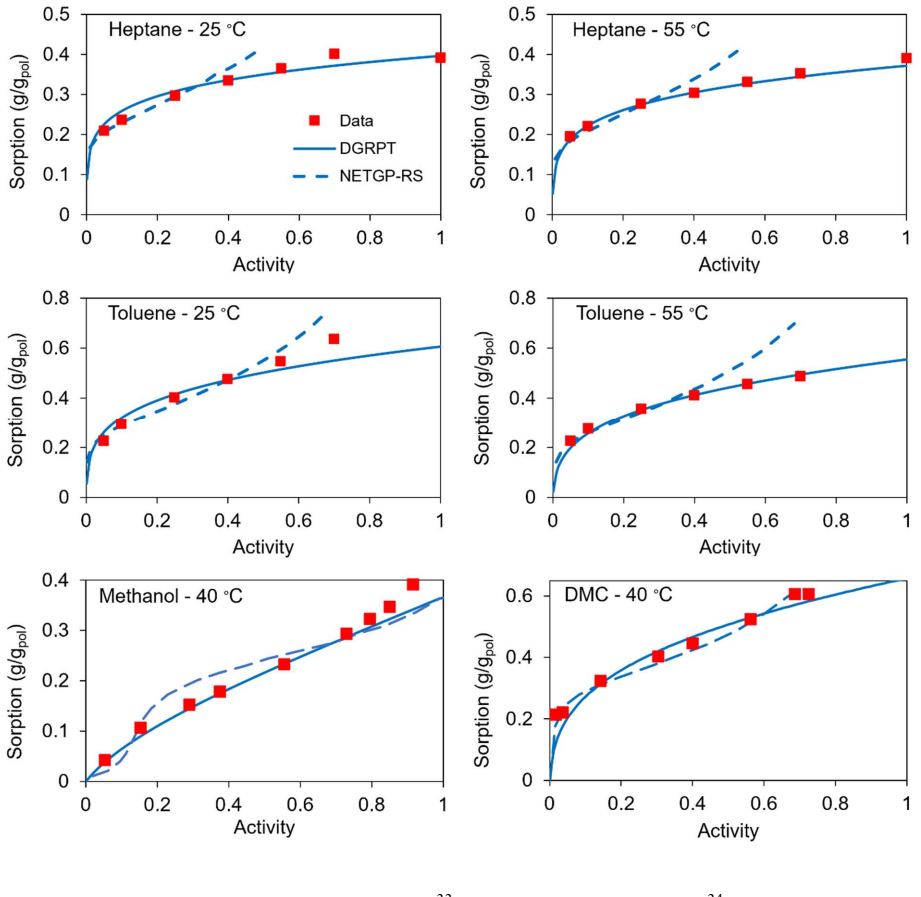
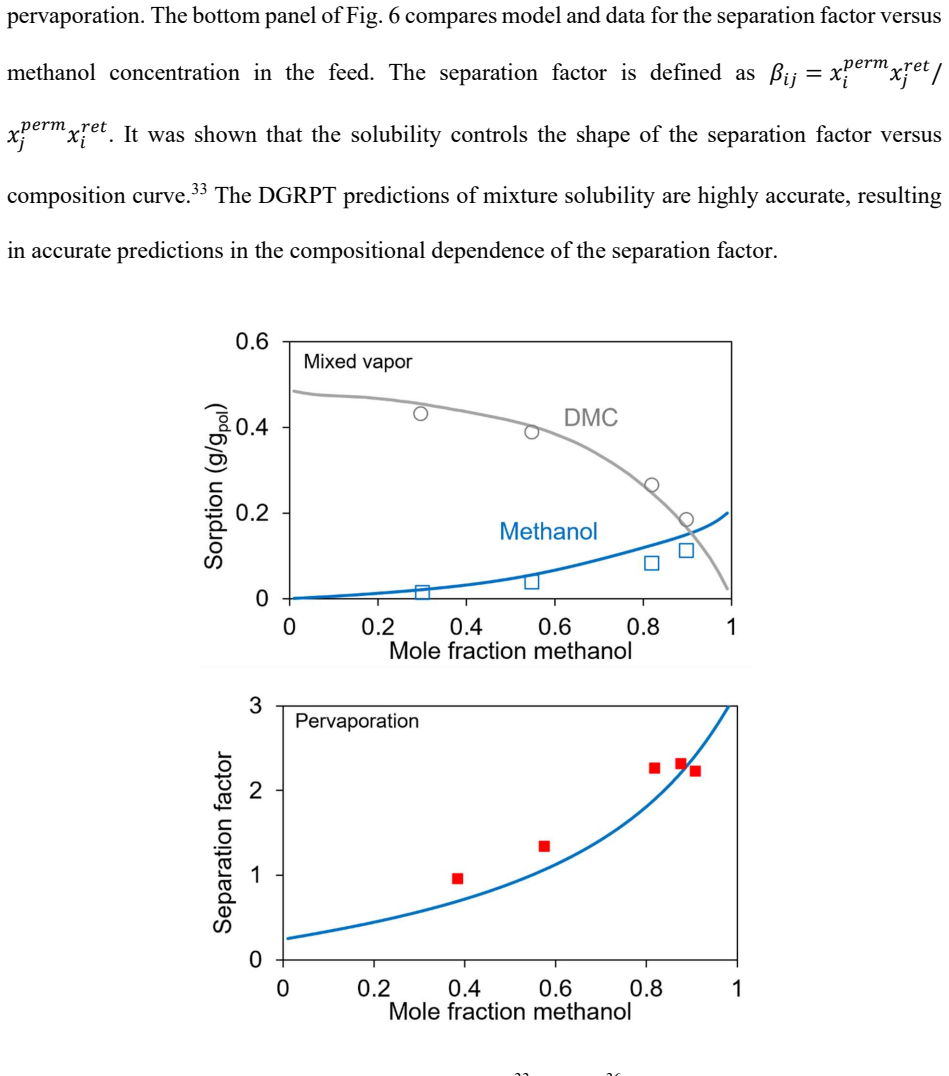
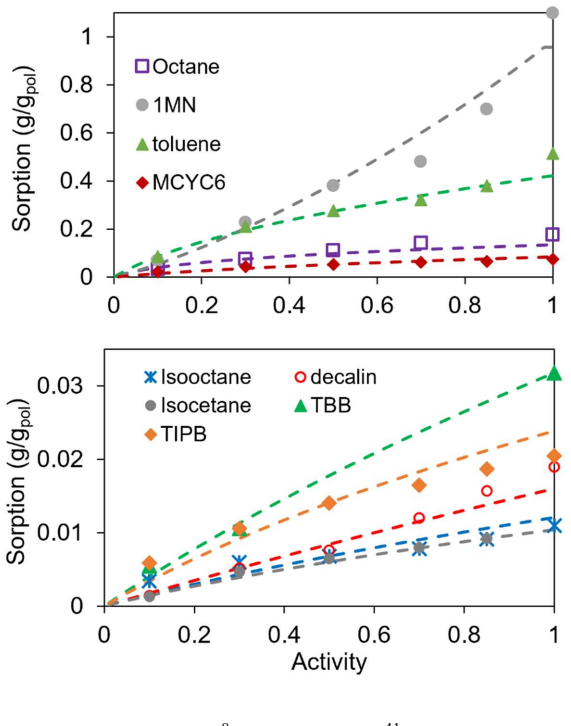
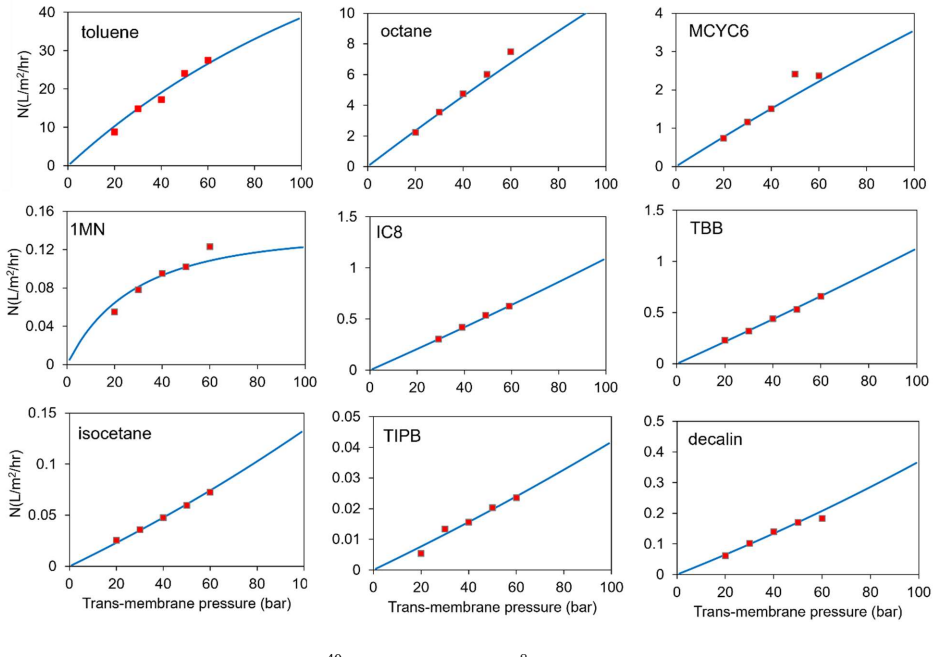
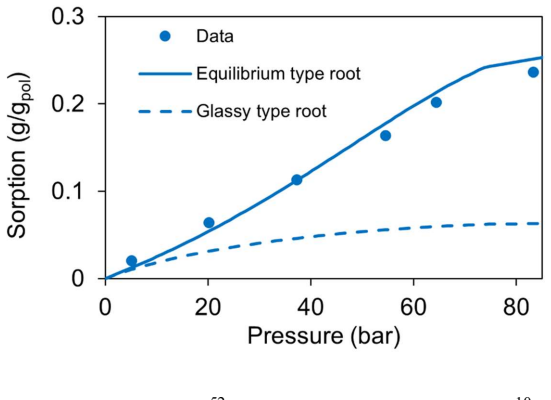
DGRPT was developed to allow for the self-consistent and accurate predictions of sorption from complex liquid mixtures into glassy polymers. DGRPT is applied in the context of diffusion theory to predict the membrane based separations of complex liquid mixtures with glassy polymer membranes. Several examples are given, including the membrane based fractionation of crude oil as well as the membrane based separation of highly non-ideal alcohol / hydrocarbon liquid mixtures. Extensions of the theory to higher order expansions are reviewed and evaluated.
What carries the argument
The DGRPT closure to the non-equilibrium thermodynamics of glassy polymers (NETGP), which supplies the sorption and diffusion relations needed for mixture predictions.
If this is right
- Membrane-based crude oil fractionation can be modeled directly from DGRPT sorption inputs and diffusion theory.
- Separation performance for highly non-ideal alcohol/hydrocarbon mixtures follows from the same DGRPT framework.
- Higher-order expansions of DGRPT can be evaluated for cases where the base closure is insufficient.
- Self-consistent calculations replace earlier inconsistent approximations for glassy-polymer sorption.
Where Pith is reading between the lines
- If DGRPT holds, membrane design for additional complex mixtures could proceed with fewer trial-and-error experiments.
- The reviewed extensions suggest a route to refine predictions for polymers or conditions outside the crude-oil and alcohol examples.
- Coupling DGRPT outputs to process-scale simulations could quantify energy savings in industrial separations.
Load-bearing premise
The DGRPT closure provides accurate and self-consistent sorption predictions when applied to the membrane separation examples described, such as crude oil fractionation and alcohol/hydrocarbon mixtures.
What would settle it
Direct comparison of DGRPT-predicted sorption isotherms for an alcohol/hydrocarbon mixture against laboratory measurements on a glassy polymer membrane; large systematic deviations would falsify the accuracy claim.
Figures

read the original abstract
This manuscript reviews the development, application and extensions of the dry glass reference perturbation theory (DGRPT) closure to the non-equilibrium thermodynamics of glassy polymers (NETGP). DGRPT was developed to allow for the self-consistent and accurate predictions of sorption from complex liquid mixtures into glassy polymers. DGRPT is applied in the context of diffusion theory to predict the membrane based separations of complex liquid mixtures with glassy polymer membranes. Several examples are given, including the membrane based fractionation of crude oil as well as the membrane based separation of highly non-ideal alcohol / hydrocarbon liquid mixtures. Extensions of the theory to higher order expansions are reviewed and evaluated.
Editorial analysis
A structured set of objections, weighed in public.
Referee Report
Summary. This manuscript is a review of the development, applications, and extensions of the dry glass reference perturbation theory (DGRPT) closure to the non-equilibrium thermodynamics of glassy polymers (NETGP). It claims that DGRPT was developed to enable self-consistent and accurate predictions of sorption from complex liquid mixtures into glassy polymers, applies this in diffusion theory to predict membrane-based separations (e.g., crude oil fractionation and alcohol/hydrocarbon mixtures), and reviews higher-order expansions.
Significance. If the central claims hold, the review consolidates the construction of DGRPT within NETGP and its cited applications to membrane separations, providing a reference resource for researchers working on glassy polymer sorption and complex mixture separations. The presentation of the theory's development and example applications is a strength for the field.
Simulated Author's Rebuttal
We thank the referee for their positive evaluation of the manuscript and for recommending acceptance. The review consolidates the DGRPT framework and its applications as intended.
Circularity Check
No significant circularity; review presents theory construction without self-referential reduction
full rationale
The manuscript is explicitly a review of DGRPT development within NETGP, its applications to sorption and membrane separations, and extensions. No derivation chain, equations, or load-bearing steps are exhibited in the provided abstract or summary. The central claim rests on the theory's construction and cited application examples rather than any internal prediction that reduces to a fitted input or self-citation by construction. No self-definitional, fitted-input, or uniqueness-imported patterns are identifiable from the given text. This is the expected outcome for a review-style paper whose internal logic is self-contained against external benchmarks.
Axiom & Free-Parameter Ledger
Reference graph
Works this paper leans on
-
[1]
(1) hold for the glassy polymer phase
The chemical equilibria relations in Eq. (1) hold for the glassy polymer phase
-
[2]
The density explicit equilibrium equation of state can be used calculate the chemical potentials 𝜇 ൫𝑇,𝜌,൛𝜌ൟ൯
-
[3]
dry glass density
The closure of Eq. (2) is replaced by imposing the polymer density ρp on the theory. The polymer density is no longer an output of the equation of state, but is an input. The closure relation in NET-GP is typically written as, ఘ ఘ = ଵ ଵା∑ ೞ,సభ (3) Where 𝜌 is the “dry glass density”, cs,i is an empirical swelling coefficient and fi is the fugac...
-
[4]
(1) holds true and the fluid species chemical potentials in the glassy polymer phase may be calculated using an equilibrium density explicit equation of state
As in traditional NETGP, Eq. (1) holds true and the fluid species chemical potentials in the glassy polymer phase may be calculated using an equilibrium density explicit equation of state
-
[5]
In addition to sorbed fluid species in the polymer, the polymer chemical potential µp may be evaluated with the same equilibrium density explicit equation of state as the fluid species
-
[6]
When fluid species sorb into glassy polymers which are deep glasses, these polymers will swell, but the underlying structure of the dry polymer remains imprinted on the swollen polymer
-
[7]
polar strength
As a result of 3), the polymer chemical potential can be expanded around a dry glass reference state to develop a self-consistent closure to NETGP Assumptions 3) and 4) will be most accurate for deep glassy polymers which retain their glassy structure as they swell, staying far away from glass transitions. On the other hand, assumptions 3) and 4) will be ...
-
[8]
F.; Jiang, Z.; Livingston, A
Kim, J.; Kim, J. F.; Jiang, Z.; Livingston, A. G., Advancing membrane technology in organic liquids towards a sustainable future. Nature Sustainability 2025, 8 (6), 594-605
2025
-
[9]
Journal of Membrane Science 2021, 620, 118882
Liu, C.; Dong, G.; Tsuru, T.; Matsuyama, H., Organic solvent reverse osmosis membranes for organic liquid mixture separation: A review. Journal of Membrane Science 2021, 620, 118882
2021
-
[10]
L.; Lively, R
Aristizábal, S. L.; Lively, R. P.; Nunes, S. P., Solvent and thermally stable polymeric membranes for liquid molecular separations: Recent advances, challenges, and perspectives. Journal of Membrane Science 2023, 685, 121972
2023
-
[11]
A.; Mathias, R.; Kim, D.; Kim, J.; Rangnekar, N.; Johnson, J.; Hoy, S
Thompson, K. A.; Mathias, R.; Kim, D.; Kim, J.; Rangnekar, N.; Johnson, J.; Hoy, S. J.; Bechis, I.; Tarzia, A.; Jelfs, K. E., N-Aryl–linked spirocyclic polymers for membrane separations of complex hydrocarbon mixtures. Science 2020, 369 (6501), 310-315
2020
-
[12]
C.; Lacombe, R
Sanchez, I. C.; Lacombe, R. H., An elementary molecular theory of classical fluids. Pure fluids. The Journal of Physical Chemistry 1976, 80 (21), 2352-2362. 40
1976
-
[13]
Industrial & engineering chemistry research 2001, 40 (4), 1244-1260
Gross, J.; Sadowski, G., Perturbed-chain SAFT: An equation of state based on a perturbation theory for chain molecules. Industrial & engineering chemistry research 2001, 40 (4), 1244-1260
2001
-
[14]
C.; Doghieri, F., Predictions of the solubility of gases in glassy polymers based on the NELF model
Sarti, G. C.; Doghieri, F., Predictions of the solubility of gases in glassy polymers based on the NELF model. Chemical Engineering Science 1998, 53 (19), 3435-3447
1998
-
[15]
P.; McCool, B
Marshall, B.; Mathias, R.; Lively, R. P.; McCool, B. A., Theoretically Self-Consistent Nonequilibrium Thermodynmaics of Glassy Polymer Theory for the Solubility of Vapors and Liquids in Glassy Polymers. Industrial & engineering chemistry research 2021, 60 (36), 13377
2021
-
[16]
C., Nonequilibrium lattice fluids: a predictive model for the solubility in glassy polymers
Doghieri, F.; Sarti, G. C., Nonequilibrium lattice fluids: a predictive model for the solubility in glassy polymers. Macromolecules 1996, 29 (24), 7885-7896
1996
-
[17]
G.; Sarti, G
De Angelis, M. G.; Sarti, G. C., Solubility of gases and liquids in glassy polymers. Annual review of chemical and biomolecular engineering 2011, 2, 97-120
2011
-
[18]
Polymer 2020, 188, 122140
Durďáková, T.-M.; Hrdlička, Z.; Dendisová, M.; Švecová, M.; Vopička, O., Swelling and plasticization of PDMS and PTMSP in methanol and dimethyl carbonate vapors and liquids: Volume, mechanical properties, Raman spectra. Polymer 2020, 188, 122140
2020
-
[19]
G., Solubility of Acetone-Methanol Mixtures in Matrimid Glassy Polymer: Experimental Data and Modelling through NET-GP and PC-SAFT
Merlonghi, L.; Doghieri, F.; Baschetti, M. G., Solubility of Acetone-Methanol Mixtures in Matrimid Glassy Polymer: Experimental Data and Modelling through NET-GP and PC-SAFT. Fluid Phase Equilibria 2025, 593, 114362
2025
-
[20]
Industrial & engineering chemistry research 2012, 51 (50), 16505-16516
Minelli, M.; Doghieri, F., A predictive model for vapor solubility and volume dilation in glassy polymers. Industrial & engineering chemistry research 2012, 51 (50), 16505-16516
2012
-
[21]
C., Modelling sorption induced volume dilation in glassy polymers within the NET-GP approach
Doghieri, F.; Parchi, R.; Sarti, G. C., Modelling sorption induced volume dilation in glassy polymers within the NET-GP approach. Fluid Phase Equilibria 2026, 114740
2026
-
[22]
Chapman, W. G. Cornell University, 1988
1988
-
[23]
L.; Kontogeorgis, G
von Solms, N.; Michelsen, M. L.; Kontogeorgis, G. M., Computational and physical performance of a modified PC-SAFT equation of state for highly asymmetric and associating mixtures. Industrial & engineering chemistry research 2003, 42 (5), 1098-1105
2003
-
[24]
Industrial & engineering chemistry research 2002, 41 (22), 5510-5515
Gross, J.; Sadowski, G., Application of the perturbed-chain SAFT equation of state to associating systems. Industrial & engineering chemistry research 2002, 41 (22), 5510-5515
2002
-
[25]
The Journal of chemical physics 1987, 87 (12), 7323-7331
Wertheim, M., Thermodynamic perturbation theory of polymerization. The Journal of chemical physics 1987, 87 (12), 7323-7331
1987
-
[26]
Wertheim, M., Fluids with highly directional attractive forces. IV. Equilibrium polymerization. Journal of statistical physics 1986, 42 (3), 477-492
1986
-
[27]
Wertheim, M., Fluids with highly directional attractive forces. III. Multiple attraction sites. Journal of statistical physics 1986, 42 (3), 459-476
1986
-
[28]
D., A PC-SAFT model for hydrocarbons IV: Water-hydrocarbon phase behavior including petroleum pseudo-components
Marshall, B. D., A PC-SAFT model for hydrocarbons IV: Water-hydrocarbon phase behavior including petroleum pseudo-components. Fluid Phase Equilibria 2019, 497, 79-86
2019
-
[29]
K.; Sauer, S
Jog, P. K.; Sauer, S. G.; Blaesing, J.; Chapman, W. G., Application of dipolar chain theory to the phase behavior of polar fluids and mixtures. Industrial & engineering chemistry research 2001, 40 (21), 4641-4648
2001
-
[30]
D.; Bokis, C
Marshall, B. D.; Bokis, C. P., A PC-SAFT model for hydrocarbons I: Mapping aromatic π-π interactions onto a dipolar free energy. Fluid Phase Equilibria 2019, 489, 83-89
2019
-
[31]
G.; Gubbins, K
Chapman, W. G.; Gubbins, K. E.; Jackson, G.; Radosz, M., New reference equation of state for associating liquids. Industrial & Engineering Chemistry Research 1990, 29 (8), 1709-1721
1990
-
[32]
W. V. Wilding, T. A. K., N. F. Giles, R. L. Rowley, DIPPR Data Compilation of Pure Chemical Properties, Design Institute for Physical Properties. AICHE: New York, New York, 2020
2020
-
[33]
G., Parameterisation of equations of state for polymers: From experimental approaches to machine learning
Ismaeel, H.; Ricci, E.; De Angelis, M. G., Parameterisation of equations of state for polymers: From experimental approaches to machine learning. Fluid Phase Equilibria 2026, 114754. 41
2026
-
[34]
European Polymer Journal 2016, 75, 243-250
Vopička, O.; Radotínský, D.; Friess, K., Sorption of vapour mixtures of methanol and dimethyl carbonate in PTMSP: Cooperative and competitive sorption in one system. European Polymer Journal 2016, 75, 243-250
2016
-
[35]
A.; Jin, J.; Stevens, G
Scholes, C. A.; Jin, J.; Stevens, G. W.; Kentish, S. E., Competitive permeation of gas and water vapour in high free volume polymeric membranes. Journal of Polymer Science Part B: Polymer Physics 2015, 53 (10), 719-728
2015
-
[36]
Journal of Polymer Science Part B: Polymer Physics 1997, 35 (14), 2245-2258
Doghieri, F.; Sarti, G., Solubility, diffusivity, and mobility of n-pentane and ethanol in poly (1- trimethylsilyl-1-propyne). Journal of Polymer Science Part B: Polymer Physics 1997, 35 (14), 2245-2258
1997
-
[37]
P.; Galizia, M., Fundamental origin of flux non-linearity in organic solvent nanofiltration: Formulation of a thermodynamic/diffusion framework
Bye, K. P.; Galizia, M., Fundamental origin of flux non-linearity in organic solvent nanofiltration: Formulation of a thermodynamic/diffusion framework. Journal of Membrane Science 2020, 603, 118020
2020
-
[38]
B.; Budd, P
McKeown, N. B.; Budd, P. M.; Msayib, K. J.; Ghanem, B. S.; Kingston, H. J.; Tattershall, C. E.; Makhseed, S.; Reynolds, K. J.; Fritsch, D., Polymers of intrinsic microporosity (PIMs): bridging the void between microporous and polymeric materials. Chemistry–A European Journal 2005, 11 (9), 2610-2620
2005
-
[39]
L.; Breedveld, V.; Lively, R
Jue, M. L.; Breedveld, V.; Lively, R. P., Defect-free PIM-1 hollow fiber membranes. Journal of Membrane Science 2017, 530, 33-41
2017
-
[40]
D.; Johnson, J., Dry glass reference perturbation theory predictions of the pervaporation separation of solvent mixtures using PIM-1 membranes
Marshall, B. D.; Johnson, J., Dry glass reference perturbation theory predictions of the pervaporation separation of solvent mixtures using PIM-1 membranes. Journal of Membrane Science 2023, 672, 121420
2023
-
[41]
Journal of Chemical & Engineering Data 2024, 69 (2), 538-559
Doghieri, F., pVT Data Analysis for the Prediction of Vapor Sorption in Glassy Polymers through the Nonequilibrium PC-SAFT Model. Journal of Chemical & Engineering Data 2024, 69 (2), 538-559
2024
-
[42]
Jue, M. L. PIM-1-derived carbon molecular sieve hollow fiber membranes for organic solvent reverse osmosis. Georgia Institute of Technology, 2017
2017
-
[43]
M.; Harrison, W.; Friess, K., Pervaporation and vapour permeation of methanol–dimethyl carbonate mixtures through PIM-1 membranes
Číhal, P.; Vopička, O.; Durďáková, T.-M.; Budd, P. M.; Harrison, W.; Friess, K., Pervaporation and vapour permeation of methanol–dimethyl carbonate mixtures through PIM-1 membranes. Separation and Purification Technology 2019, 217, 206-214
2019
-
[44]
John Wiley & Sons: 1993; Vol
Taylor, R.; Krishna, R., Multicomponent mass transfer. John Wiley & Sons: 1993; Vol. 2
1993
-
[45]
A.; Mathias, R.; Kim, D.; Kim, J.; Rangnekar, N.; Johnson, J
Thompson, K. A.; Mathias, R.; Kim, D.; Kim, J.; Rangnekar, N.; Johnson, J. R.; Hoy, S. J.; Bechis, I.; Tarzia, A.; Jelfs, K. E.; McCool, B. A.; Livingston, A. G.; Lively, R. P.; Finn, M. G., N-Aryl–linked spirocyclic polymers for membrane separations of complex hydrocarbon mixtures. Science 2020, 369 (6501), 310-315
2020
-
[46]
D.; Li, W.; Lively, R
Marshall, B. D.; Li, W.; Lively, R. P., Dry Glass Reference Perturbation Theory Predictions of the Temperature and Pressure Dependent Separations of Complex Liquid Mixtures Using SBAD-1 Glassy Polymer Membranes. Membranes 2022, 12 (7), 705
2022
-
[47]
D.; Allen, J
Marshall, B. D.; Allen, J. W.; Lively, R. P., A model for the separation of complex liquid mixtures with glassy polymer membranes: A thermodynamic perspective. Journal of Membrane Science 2022, 647, 120316
2022
-
[48]
J.; Thompson, K
Mathias, R.; Weber, D. J.; Thompson, K. A.; Marshall, B.; Finn, M. G.; Scott, J. K.; Lively, R. P., A Framework for Predicting the Fractionation of Complex Liquid Feeds via Polymer Membranes. Journal of Membrane Science 2021, 640, 11976
2021
-
[49]
J.; Jaffe, S
Quann, R. J.; Jaffe, S. B., Structure-oriented lumping: describing the chemistry of complex hydrocarbon mixtures. Industrial & engineering chemistry research 1992, 31 (11), 2483-2497
1992
-
[50]
B.; Freund, H.; Olmstead, W
Jaffe, S. B.; Freund, H.; Olmstead, W. N., Extension of structure-oriented lumping to vacuum residua. Industrial & engineering chemistry research 2005, 44 (26), 9840-9852
2005
-
[51]
D.; Bokis, C
Marshall, B. D.; Bokis, C. P., A PC-SAFT model for hydrocarbons II: General model development. Fluid Phase Equilibria 2018, 478, 34-41
2018
-
[52]
J.; Jang, H
Lee, Y. J.; Jang, H. Y.; Marshall, B. D.; Abutaqiya, M. I. L.; Rangnekar, N.; Bruno, N. C.; Finn, M. G.; Lively, R. P., Fractionation of complex aromatic hydrocarbon mixtures using membrane cascades hybridized with distillation. Chemical Engineering Journal 2025, 503, 158170. 42
2025
-
[53]
D.; Johnson, J
Marshall, B. D.; Johnson, J. R.; Lee, Y. J.; Moser, D.; Lively, R. P., Organic solvent reverse osmosis separations of hydrocarbon-alcohol mixtures using matrimid membranes. Journal of Membrane Science 2024, 689, 122168
2024
-
[54]
D.; Bokis, C
Marshall, B. D.; Bokis, C. P., Revisiting the treatment of cross-association interactions in oxygenate mixtures with the polar PC-SAFT equation of state. Fluid Phase Equilibria 2021, 529, 112867
2021
-
[55]
J.; Lively, R
Lee, Y. J.; Lively, R. P., Hydrocarbon sorption data on Matrimid. 2023
2023
-
[56]
P.; Maier, A
Stanford, J. P.; Maier, A. L.; McDonald, L. A.; Pfromm, P. H.; Rezac, M. E., Kinetic and equilibrium sorption of organic liquids and vapors in Matrimid. Journal of Membrane Science 2016, 512, 29-37
2016
-
[57]
Journal of Polymer Science: Polymer Physics Edition 1980, 18 (5), 981-992
Koros, W., Model for sorption of mixed gases in glassy polymers. Journal of Polymer Science: Polymer Physics Edition 1980, 18 (5), 981-992
1980
-
[58]
D.; Ricci, E.; De Angelis, M
Ismaeel, H.; Marshall, B. D.; Ricci, E.; De Angelis, M. G., A second-order Dry Glass Reference Perturbation Theory for modeling sorption in glassy polymers: applications to systems containing light gases, alcohols, and water vapor. Fluid Phase Equilibria 2025, 595, 114410
2025
-
[59]
D., Modified Dry Glass Reference Perturbation Theory for Linear Sorption in Dense Glassy Polymers
Marshall, B. D., Modified Dry Glass Reference Perturbation Theory for Linear Sorption in Dense Glassy Polymers. Industrial & Engineering Chemistry Research 2023, 62 (46), 20029-20036
2023
-
[60]
Separation and Purification Technology 2025, 367, 132839
Baldanza, A.; Brondi, C.; Correa, A.; Musto, P.; Mensitieri, G.; Scherillo, G., Modelling sorption thermodynamics of gases, vapors and gas mixtures in glassy polymers using a non-equilibrium version of PC-SAFT accounting for specific interactions and volume change. Separation and Purification Technology 2025, 367, 132839
2025
discussion (0)
Sign in with ORCID, Apple, or X to comment. Anyone can read and Pith papers without signing in.