Symmetry-Selective Topological Magnon Engineering by Phonon Angular Momentum
Pith reviewed 2026-06-29 11:05 UTC · model grok-4.3
The pith
Circular and elliptical phonons carrying finite angular momentum open tunable gaps at magnon Dirac points in monolayer CrI3 and reverse topological phases, while linearly polarized phonons leave the spectrum unchanged.
A machine-rendered reading of the paper's core claim, the machinery that carries it, and where it could break.
Core claim
Using ab initio spin-lattice coupling and Floquet theory applied to monolayer CrI3, we show that phonon angular momentum induces chiral magnon interactions in a symmetry-selective manner. Linearly polarized phonons leave the magnon spectrum unchanged, whereas circular and elliptical phonons carrying finite phonon angular momentum open and tune gaps at Dirac points, thereby generating and reversing topological magnon phases whose gap magnitudes and Chern numbers are governed by the phonon angular momentum.
What carries the argument
Phonon angular momentum carried by circular or elliptical lattice vibrations, which generates effective chiral spin interactions in the Floquet-driven magnon system.
If this is right
- The gap size at the Dirac points scales directly with the magnitude of the phonon angular momentum.
- Reversing the handedness of the phonon polarization reverses the sign of the magnon Chern numbers.
- Linear polarization produces no effective interaction and therefore no topological change.
- Driven lattice dynamics via phonons provides a general route to Floquet engineering of topological bosonic excitations.
Where Pith is reading between the lines
- The same phonon-angular-momentum mechanism could be tested in other van der Waals magnets to produce on-demand topological magnon bands.
- Time-resolved probes of magnon spectra under circularly polarized mid-infrared pulses that excite specific phonon modes would directly test the predicted gap opening.
- The approach may allow ultrafast, all-optical switching between topologically distinct magnon phases without external magnetic fields.
Load-bearing premise
The ab initio spin-lattice coupling combined with Floquet theory accurately captures the induced chiral interactions and symmetry selectivity in monolayer CrI3 without significant higher-order or anharmonic effects altering the outcome.
What would settle it
A measurement showing either gap opening under linearly polarized phonon drive or no gap opening under circularly polarized drive in monolayer CrI3 would falsify the claimed symmetry selectivity and PAM dependence.
Figures
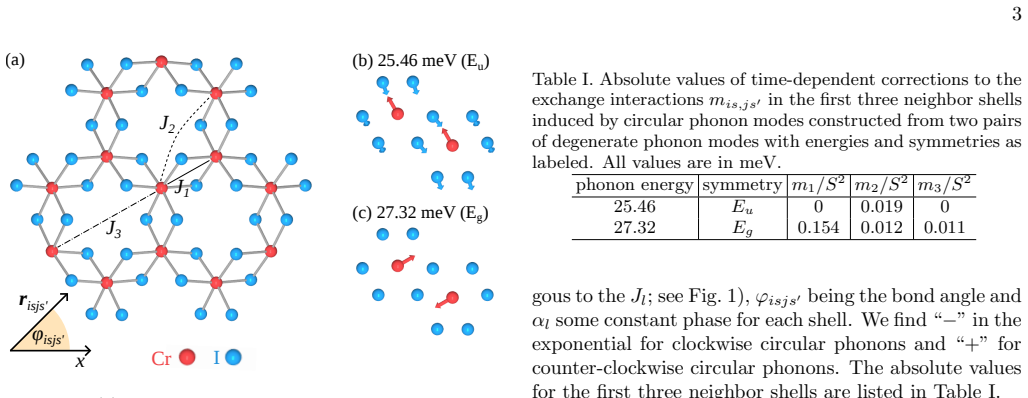
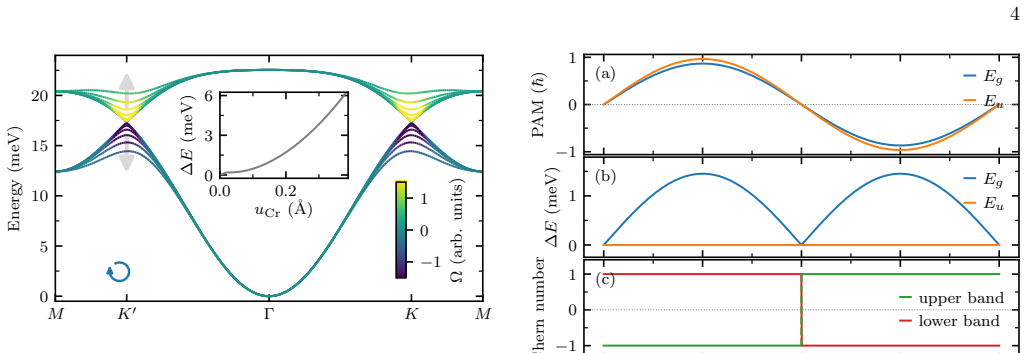
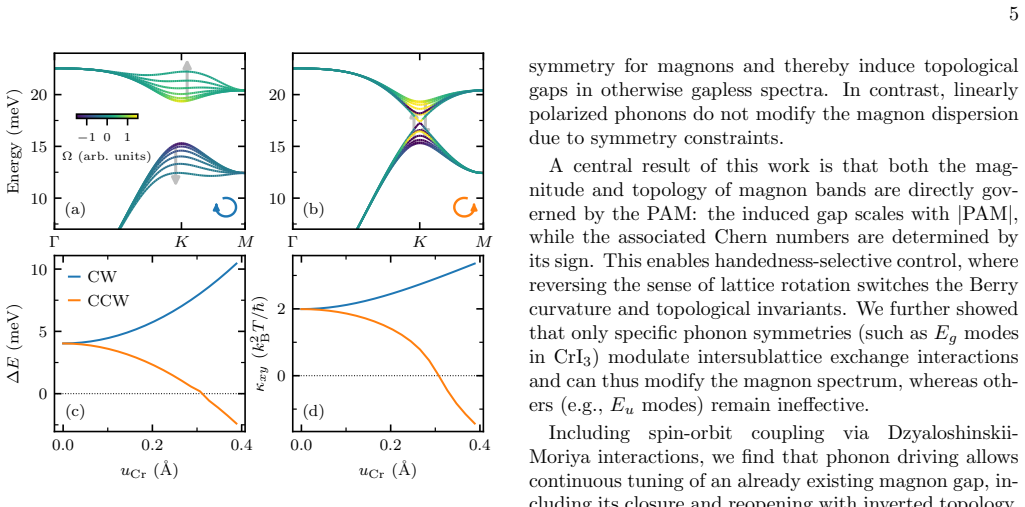
read the original abstract
Dynamical control of Berry curvature remains an outstanding challenge in the engineering of topological phases. Here, we demonstrate control of magnon band structures via coherently driven phonons, based on \textit{ab initio} spin-lattice coupling and Floquet theory. We show that this control is symmetry selective: linearly polarized phonons leave the spectrum unchanged, whereas circular and elliptical phonons carrying finite phonon angular momentum (PAM) induce chiral interactions that open and tune gaps at Dirac points, generating and reversing topological magnon phases. The gap magnitude and Chern numbers are directly governed by the PAM, enabling handedness-selective topology control. Applied to monolayer CrI$_3$, and supported by symmetry analysis, our results establish driven lattice dynamics as a general route to engineering topological bosonic excitations and a versatile platform for Floquet control of magnetism.
Editorial analysis
A structured set of objections, weighed in public.
Referee Report
Summary. The paper claims that coherently driven phonons in monolayer CrI3, treated via ab initio spin-lattice coupling and Floquet theory, exhibit symmetry-selective control of magnon topology: linearly polarized phonons leave the spectrum invariant, while circular/elliptical phonons with finite phonon angular momentum (PAM) generate chiral magnon interactions that open and tune gaps at Dirac points, enabling generation and reversal of topological phases with gap size and Chern numbers set directly by PAM. Symmetry analysis supports the selectivity, positioning driven lattice dynamics as a route to Floquet control of bosonic topology.
Significance. If validated, the result establishes a PAM-based, handedness-selective mechanism for dynamical engineering of topological magnon bands in 2D magnets, extending Floquet methods beyond electronic systems. The combination of ab initio-derived parameters with symmetry arguments provides a concrete, material-specific demonstration that could generalize to other bosonic excitations.
major comments (2)
- [§4] The central claim that only finite-PAM phonons induce chiral interactions (while linear polarization leaves the spectrum unchanged) and that gap/Chern numbers are directly governed by PAM rests on the sufficiency of the first-order Floquet expansion of the ab initio spin-lattice Hamiltonian. §4 (Floquet derivation) and the numerical results for CrI3 should explicitly bound or rule out second-order magnon-phonon or phonon-phonon anharmonic corrections at the drive amplitudes considered, as these could introduce non-chiral, symmetry-breaking contributions that close or invert gaps independently of PAM.
- [Table 2, Fig. 3] Table 2 (Chern numbers vs. PAM) and Fig. 3 (gap size vs. ellipticity): the reported linear scaling of gap with PAM assumes the microscopic parameters from DFT remain valid under drive; the manuscript should test sensitivity to small variations in the spin-lattice coupling constants to confirm the selectivity is not an artifact of the specific ab initio fit.
minor comments (2)
- [Abstract] The abstract states the gap magnitude is 'directly governed by the PAM' but the main text should clarify whether this holds exactly or only to leading order in the drive amplitude.
- [§2] Notation for phonon angular momentum (PAM) is introduced without an explicit definition equation; add a short definition in §2 to aid readers unfamiliar with the concept.
Simulated Author's Rebuttal
We are grateful to the referee for the positive assessment of our work and the detailed comments, which help improve the manuscript. Below we provide point-by-point responses to the major comments.
read point-by-point responses
-
Referee: [§4] The central claim that only finite-PAM phonons induce chiral interactions (while linear polarization leaves the spectrum unchanged) and that gap/Chern numbers are directly governed by PAM rests on the sufficiency of the first-order Floquet expansion of the ab initio spin-lattice Hamiltonian. §4 (Floquet derivation) and the numerical results for CrI3 should explicitly bound or rule out second-order magnon-phonon or phonon-phonon anharmonic corrections at the drive amplitudes considered, as these could introduce non-chiral, symmetry-breaking contributions that close or invert gaps independently of PAM.
Authors: We thank the referee for pointing this out. Our Floquet treatment is performed to first order in the phonon drive amplitude, which is appropriate for the coherent driving regime where the phonon amplitude is small compared to the lattice spacing. The symmetry analysis in the manuscript demonstrates that the chiral interaction term arises specifically from the finite PAM component and is absent for linear polarization, independent of higher-order terms. To strengthen the manuscript, we will include in the revised version an order-of-magnitude estimate showing that second-order corrections are smaller by a factor of the drive amplitude (typically <<1) and do not alter the PAM dependence or close the gaps for the parameters used. We will also discuss the regime of validity of the first-order approximation. revision: yes
-
Referee: [Table 2, Fig. 3] Table 2 (Chern numbers vs. PAM) and Fig. 3 (gap size vs. ellipticity): the reported linear scaling of gap with PAM assumes the microscopic parameters from DFT remain valid under drive; the manuscript should test sensitivity to small variations in the spin-lattice coupling constants to confirm the selectivity is not an artifact of the specific ab initio fit.
Authors: The linear scaling with PAM follows directly from the first-order Floquet term being proportional to the phonon amplitude (and thus to PAM). The symmetry selectivity is a consequence of the transformation properties under the crystal symmetries and is robust against small changes in the coupling strengths, as long as the form of the spin-lattice interaction is preserved. However, to address the concern, we will add a supplementary analysis in the revision where we vary the spin-lattice coupling constants by ±10% (within typical DFT accuracy) and show that the gap opening and Chern number reversal remain intact, with only quantitative changes in the gap size. revision: yes
Circularity Check
No significant circularity in derivation chain
full rationale
The paper's central derivation proceeds from ab initio spin-lattice coupling parameters (obtained via DFT) into a Floquet-expanded effective magnon Hamiltonian, followed by symmetry analysis and explicit band-structure/Chern-number calculations on monolayer CrI3. None of the load-bearing steps reduce by construction to the target observables; the PAM selectivity and gap tuning emerge from the microscopic model and Floquet driving terms rather than from self-definition, fitted inputs renamed as predictions, or self-citation chains. The result is self-contained against external benchmarks (DFT, Floquet theory) and does not rely on uniqueness theorems or ansatzes imported from the authors' prior work.
Axiom & Free-Parameter Ledger
Reference graph
Works this paper leans on
-
[1]
Xiao, M.-C
D. Xiao, M.-C. Chang, and Q. Niu, Berry phase effects on 6 electronic properties, Rev. Mod. Phys.82, 1959 (2010)
1959
-
[2]
Nagaosa, J
N. Nagaosa, J. Sinova, S. Onoda, A. H. MacDonald, and N. P. Ong, Anomalous Hall effect, Rev. Mod. Phys.82, 1539 (2010)
2010
-
[3]
M. Z. Hasan and C. L. Kane, Colloquium: Topological insulators, Rev. Mod. Phys.82, 3045 (2010)
2010
-
[4]
Qi and S.-C
X.-L. Qi and S.-C. Zhang, Topological insulators and su- perconductors, Rev. Mod. Phys.83, 1057 (2011)
2011
-
[5]
Matsumoto and S
R. Matsumoto and S. Murakami, Theoretical Prediction of a Rotating Magnon Wave Packet in Ferromagnets, Phys. Rev. Lett.106, 197202 (2011)
2011
-
[6]
Matsumoto, R
R. Matsumoto, R. Shindou, and S. Murakami, Thermal Hall effect of magnons in magnets with dipolar interac- tion, Phys. Rev. B89, 054420 (2014)
2014
-
[7]
Onose, T
Y. Onose, T. Ideue, H. Katsura, Y. Shiomi, N. Nagaosa, and Y. Tokura, Observation of the Magnon Hall Effect, Science329, 297 (2010)
2010
-
[8]
A. Mook, J. Henk, and I. Mertig, Magnon Hall effect and topology in kagome lattices: A theoretical investigation, Phys. Rev. B89, 134409 (2014)
2014
-
[9]
A. Mook, J. Henk, and I. Mertig, Edge states in topolog- ical magnon insulators, Phys. Rev. B90, 024412 (2014)
2014
-
[10]
S. A. Owerre, A first theoretical realization of honeycomb topological magnon insulator, Journal of Physics: Con- densed Matter28, 386001 (2016)
2016
-
[11]
P. A. McClarty, Topological Magnons: A Review, Annual Review of Condensed Matter Physics13, 171 (2022)
2022
-
[12]
Zhang and Q
L. Zhang and Q. Niu, Chiral Phonons at High-Symmetry Points in Monolayer Hexagonal Lattices, Phys. Rev. Lett. 115, 115502 (2015)
2015
-
[13]
H. Zhu, J. Yi, M.-Y. Li, J. Xiao, L. Zhang, C.-W. Yang, R. A. Kaindl, L.-J. Li, Y. Wang, and X. Zhang, Obser- vation of chiral phonons, Science359, 579 (2018)
2018
-
[14]
Zhang and Q
L. Zhang and Q. Niu, Angular Momentum of Phonons and the Einstein–de Haas Effect, Phys. Rev. Lett.112, 085503 (2014)
2014
-
[15]
J. Luo, T. Lin, J. Zhang, X. Chen, E. R. Blackert, R. Xu, B. I. Yakobson, and H. Zhu, Large effective magnetic fields from chiral phonons in rare-earth halides, Science 382, 698 (2023)
2023
-
[16]
Basini, M
M. Basini, M. Pancaldi, B. Wehinger, M. Udina, V. Unikandanunni, T. Tadano, M. C. Hoffmann, A. V. Balatsky, and S. Bonetti, Terahertz electric-field-driven dynamical multiferroicity in SrTiO 3, Nature628, 534 (2024)
2024
-
[17]
C. S. Davies, F. G. N. Fennema, A. Tsukamoto, I. Raz- dolski, A. V. Kimel, and A. Kirilyuk, Phononic switching of magnetization by the ultrafast Barnett effect, Nature 628, 540 (2024)
2024
-
[18]
Dornes, Y
C. Dornes, Y. Acremann, M. Savoini, M. Kubli, M. J. Neugebauer, E. Abreu, L. Huber, G. Lantz, C. A. F. Vaz, H. Lemke, E. M. Bothschafter, M. Porer, V. Es- posito, L. Rettig, M. Buzzi, A. Alberca, Y. W. Windsor, P. Beaud, U. Staub, D. Zhu, S. Song, J. M. Glownia, and S. L. Johnson, The ultrafast Einstein–de Haas effect, Na- ture565, 209 (2019)
2019
-
[19]
S. R. Tauchert, M. Volkov, D. Ehberger, D. Kazenwadel, M. Evers, H. Lange, A. Donges, A. Book, W. Kreuz- paintner, U. Nowak, and P. Baum, Polarized phonons carry angular momentum in ultrafast demagnetization, Nature602, 73 (2022)
2022
-
[20]
M. S. Mrudul, M. Weißenhofer, and P. M. Oppeneer, Generation of phonons with angular momentum during ultrafast demagnetization, Phys. Rev. B112, L180407 (2025)
2025
-
[21]
D. M. Jurascheket al., Chiral phonons, Nature Phys.21, 1532 (2025)
2025
-
[22]
Hellsvik, D
J. Hellsvik, D. Thonig, K. Modin, D. Iu¸ san, A. Bergman, O. Eriksson, L. Bergqvist, and A. Delin, General method for atomistic spin-lattice dynamics with first-principles accuracy, Phys. Rev. B99, 104302 (2019)
2019
-
[23]
Mankovsky, S
S. Mankovsky, S. Polesya, H. Lange, M. Weißenhofer, U. Nowak, and H. Ebert, Angular Momentum Transfer via Relativistic Spin-Lattice Coupling from First Princi- ples, Phys. Rev. Lett.129, 067202 (2022)
2022
-
[24]
J. H. Shirley, Solution of the Schr¨ odinger Equation with a Hamiltonian Periodic in Time, Phys. Rev.138, B979 (1965)
1965
-
[25]
Bukov, L
M. Bukov, L. D’Alessio, and A. Polkovnikov, Universal high-frequency behavior of periodically driven systems: from dynamical stabilization to Floquet engineering, Ad- vances in Physics64, 139 (2015)
2015
-
[26]
Eckardt, Colloquium: Atomic quantum gases in pe- riodically driven optical lattices, Rev
A. Eckardt, Colloquium: Atomic quantum gases in pe- riodically driven optical lattices, Rev. Mod. Phys.89, 011004 (2017)
2017
-
[27]
Oka and S
T. Oka and S. Kitamura, Floquet Engineering of Quan- tum Materials, Annual Review of Condensed Matter Physics10, 387 (2019)
2019
-
[28]
Yarmohammadi, M
M. Yarmohammadi, M. Berritta, M. Bukov, L. ˇSmejkal, J. Linder, and P. M. Oppeneer, Spin polarization en- gineering ind-wave altermagnets, Phys. Rev. B113, L060403 (2026)
2026
-
[29]
Erikssonet al.,Atomistic Spin Dynamics(Oxford University Press, 2017)
O. Erikssonet al.,Atomistic Spin Dynamics(Oxford University Press, 2017)
2017
-
[30]
Mankovsky, H
S. Mankovsky, H. Lange, S. Polesya, and H. Ebert, Spin-lattice interaction parameters from first principles: Theory and implementation, Phys. Rev. B107, 144428 (2023)
2023
-
[31]
I. P. Miranda, M. Pankratova, M. Weißenhofer, A. B. Klautau, D. Thonig, M. Pereiro, E. Sj¨ oqvist, A. Delin, M. I. Katsnelson, O. Eriksson, and A. Bergman, Spin- lattice couplings in 3dferromagnets: Analysis from first principles, Phys. Rev. Mater.9, 024409 (2025)
2025
-
[32]
(6), (ii) the deriva- tion of Eq
See Supplemental Material at [URL will be inserted by publisher] for (i) the derivation of Eq. (6), (ii) the deriva- tion of Eq. (7), (iii) a summary of Colpa’s method, (iv) a proof that phonon-induced intrasublattice exchange can- not modify the magnon gap, and (v) the computational details for the exchange and spin-lattice coupling param- eters
-
[33]
Yambe and S
R. Yambe and S. Hayami, Symmetry analysis of light- induced magnetic interactions via Floquet engineering, Phys. Rev. B108, 064420 (2023)
2023
-
[34]
Holstein and H
T. Holstein and H. Primakoff, Field Dependence of the Intrinsic Domain Magnetization of a Ferromagnet, Phys. Rev.58, 1098 (1940)
1940
-
[35]
Huang, G
B. Huang, G. Clark, E. Navarro-Moratalla, D. R. Klein, R. Cheng, K. L. Seyler, D. Zhong, E. Schmidgall, M. A. McGuire, D. H. Cobden, W. Yao, D. Xiao, P. Jarillo- Herrero, and X. Xu, Layer-dependent ferromagnetism in a van der waals crystal down to the monolayer limit, Nature546, 270 (2017)
2017
-
[36]
Chen, J.-H
L. Chen, J.-H. Chung, B. Gao, T. Chen, M. B. Stone, A. I. Kolesnikov, Q. Huang, and P. Dai, Topological Spin Excitations in Honeycomb Ferromagnet CrI3, Phys. Rev. X8, 041028 (2018)
2018
-
[37]
A. I. Liechtenstein, M. I. Katsnelson, V. P. Antropov, and V. A. Gubanov, Local spin density functional approach 7 to the theory of exchange interactions in ferromagnetic metals and alloys, Journal of Magnetism and Magnetic Materials67, 65 (1987)
1987
-
[38]
Ebert and S
H. Ebert and S. Mankovsky, Anisotropic exchange cou- pling in diluted magnetic semiconductors: Ab initio spin-density functional theory, Phys. Rev. B79, 045209 (2009)
2009
-
[39]
Ebert, D
H. Ebert, D. K¨ odderitzsch, and J. Min´ ar, Calculat- ing condensed matter properties using the KKR-Green’s function method—recent developments and applications, Reports on Progress in Physics74, 096501 (2011)
2011
-
[40]
Kresse and J
G. Kresse and J. Furthm¨ uller, Efficiency of ab-initio total energy calculations for metals and semiconductors using a plane-wave basis set, Computational Materials Science 6, 15 (1996)
1996
-
[41]
Kresse and J
G. Kresse and J. Furthm¨ uller, Efficient iterative schemes for ab initio total-energy calculations using a plane-wave basis set, Phys. Rev. B54, 11169 (1996)
1996
-
[42]
A. Togo, L. Chaput, T. Tadano, and I. Tanaka, Imple- mentation strategies in phonopy and phono3py, Journal of Physics: Condensed Matter35, 353001 (2023)
2023
-
[43]
Colpa, Diagonalization of the quadratic boson hamil- tonian, Physica A: Statistical Mechanics and its Appli- cations93, 327 (1978)
J. Colpa, Diagonalization of the quadratic boson hamil- tonian, Physica A: Statistical Mechanics and its Appli- cations93, 327 (1978)
1978
-
[44]
Weißenhofer, P
M. Weißenhofer, P. Rieger, M. S. Mrudul, L. Mikadze, U. Nowak, and P. M. Oppeneer, Chiral Phonons Aris- ing from Chirality-Selective Magnon-Phonon Coupling, Phys. Rev. Lett.135, 216701 (2025)
2025
-
[45]
A. Mook, J. Henk, and I. Mertig, Thermal Hall effect in noncollinear coplanar insulating antiferromagnets, Phys. Rev. B99, 014427 (2019)
2019
-
[46]
We defineσ 0 = ( 1 0 0 1 ),σ 1 = ( 0 1 1 0 ),σ 2 = 0−i i0 , and σ3 = 1 0 0−1
-
[47]
Weißenhofer, M
M. Weißenhofer, M. S. Mrudul, S. Mankovsky, and P. M. Oppeneer, Magnon orbital nernst effect in altermagnets, npj Quantum Materials11, 25 (2026)
2026
-
[48]
I. Lee, F. G. Utermohlen, D. Weber, K. Hwang, C. Zhang, J. van Tol, J. E. Goldberger, N. Trivedi, and P. C. Hammel, Fundamental Spin Interactions Underly- ing the Magnetic Anisotropy in the Kitaev Ferromagnet CrI3 , Phys. Rev. Lett.124, 017201 (2020)
2020
-
[49]
C. Xu, J. Feng, H. Xiang, and L. Bellaiche, Interplay between Kitaev interaction and single ion anisotropy in ferromagnetic CrI3 and CrGeTe3 monolayers, npj Com- putational Materials4, 57 (2018)
2018
-
[50]
Kartsev, M
A. Kartsev, M. Augustin, R. F. L. Evans, K. S. Novoselov, and E. J. G. Santos, Biquadratic exchange interactions in two-dimensional magnets, npj Computa- tional Materials6, 150 (2020)
2020
-
[51]
Chen, J.-H
L. Chen, J.-H. Chung, M. B. Stone, A. I. Kolesnikov, B. Winn, V. O. Garlea, D. L. Abernathy, B. Gao, M. Au- gustin, E. J. G. Santos, and P. Dai, Magnetic Field Effect on Topological Spin Excitations in CrI3, Phys. Rev. X11, 031047 (2021)
2021
-
[52]
Zhang, Berry curvature and various thermal Hall ef- fects, New J
L. Zhang, Berry curvature and various thermal Hall ef- fects, New J. Phys.18, 103039 (2016)
2016
-
[53]
Murakami and A
S. Murakami and A. Okamoto, Thermal Hall effect of magnons, J. Phys. Soc. Jpn.86, 011010 (2017)
2017
-
[54]
J. N. Kløgetvedt and A. Qaiumzadeh, Tunable topologi- cal magnon-polaron states and intrinsic anomalous Hall phenomena in two-dimensional ferromagnetic insulators, Phys. Rev. B108, 224424 (2023)
2023
-
[55]
Ghazaryan, M
D. Ghazaryan, M. T. Greenaway, Z. Wang, V. H. Guarochico-Moreira, I. J. Vera-Marun, J. Yin, Y. Liao, S. V. Morozov, O. Kristanovski, A. I. Lichtenstein, M. I. Katsnelson, F. Withers, A. Mishchenko, L. Eaves, A. K. Geim, K. S. Novoselov, and A. Misra, Magnon-assisted tunnelling in van der Waals heterostructures based on CrBr3, Nature Electronics1, 344 (2018)
2018
-
[56]
D. R. Klein, D. MacNeill, Q. Song, D. T. Larson, S. Fang, M. Xu, R. A. Ribeiro, P. C. Canfield, E. Kaxiras, R. Comin, and P. Jarillo-Herrero, Enhancement of inter- layer exchange in an ultrathin two-dimensional magnet, Nature Physics15, 1255 (2019)
2019
-
[57]
Z. Fei, B. Huang, P. Malinowski, W. Wang, T. Song, J. Sanchez, W. Yao, D. Xiao, X. Zhu, A. F. May, W. Wu, D. H. Cobden, J.-H. Chu, and X. Xu, Two-dimensional itinerant ferromagnetism in atomically thin Fe 3GeTe2, Nature Materials17, 778 (2018)
2018
discussion (0)
Sign in with ORCID, Apple, or X to comment. Anyone can read and Pith papers without signing in.