REVIEW 3 minor 118 references
Perturbative dynamics and relativistic effects of a dyonic Kalb-Ramond black hole
T0 review · 0 major / 3 minor · reviewed 2026-06-29 · grok-4.3
Pith's one-line read The Lorentz-violating parameter dominates corrections to quasinormal modes and relativistic effects in a dyonic Kalb-Ramond black hole, while dyonic charges produce milder shifts.
desk verdict Routine WKB spectra on a fixed Lorentz-violating dyonic metric with the usual observables attached; nothing structurally new but the numbers are concrete. read the letter →
The pith
A machine-rendered reading of the paper's core claim, the machinery that carries it, and where it could break.
The reading
What carries the argument
The effective combination P_ℓ² = Q²/(1-ℓ)² + p²/(1-2ℓ) that enters the metric and controls all derived potentials and observables.
What would settle it
Direct numerical evaluation of the sixth-order WKB quasinormal frequencies for independent variations of ℓ versus Q and p that fails to show larger frequency and damping shifts from ℓ would refute the claimed dominance.
Extended reading notes
Core claim
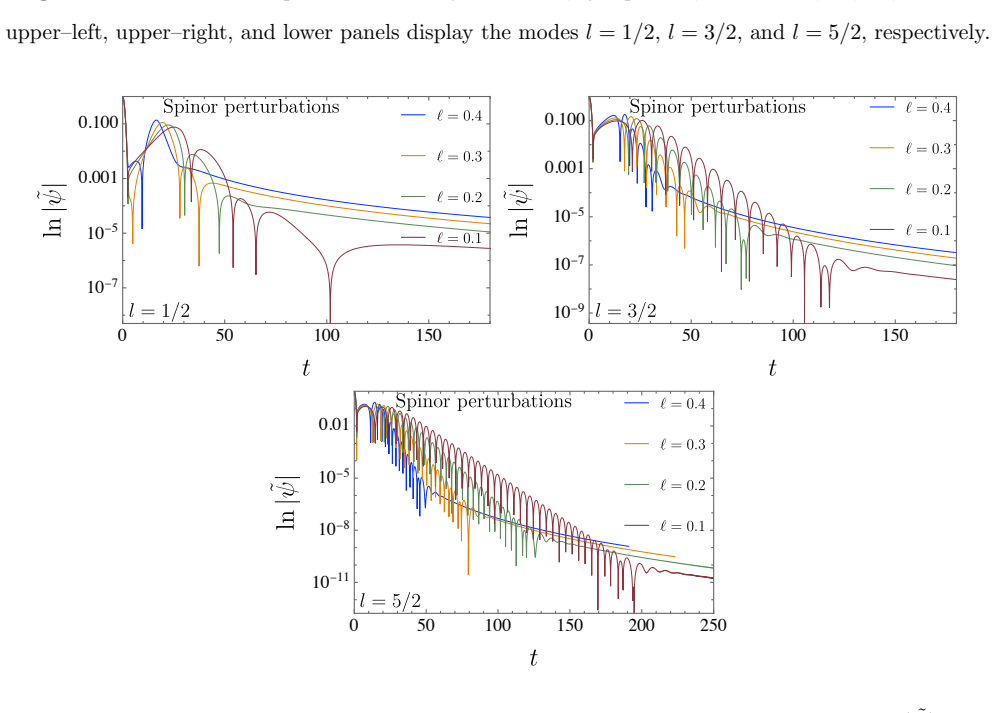
The geometry is controlled by the mass M, the electric charge Q, the magnetic charge p, and the Lorentz-violating parameter ℓ, with the dyonic sector entering through the effective combination P_ℓ² = Q²/(1-ℓ)² + p²/(1-2ℓ). The Lorentz-violating parameter gives the dominant correction, increasing the oscillation frequencies and modifying the damping rates, while the dyonic charges produce milder shifts. These conclusions follow from explicit computation of the effective potentials, the WKB spectra, and the time-domain profiles that exhibit damped ringing followed by power-law tails.
Load-bearing premise
The spacetime geometry is fully determined by the mass, the two charges, and the single Lorentz-violating parameter through their combination in the effective P_ℓ² term.
Editorial extensions
If this is right
- Dyonic charges shift the frequency ratio of radial signals toward unity and thereby weaken the gravitational redshift.
- Tidal forces reverse their usual stretching and compression patterns at characteristic radii determined by the effective charges.
- Electric and magnetic sectors both reduce the gravitational time delay along null trajectories relative to the reference case.
- The Lorentz-violating parameter raises the real parts of the quasinormal frequencies and changes the imaginary parts more strongly than the dyonic charges.
- Time-domain evolution shows the standard sequence of damped quasinormal ringing followed by late-time power-law tails.
Reading between the lines
- If the dominance of ℓ persists in rotating or higher-dimensional extensions, gravitational-wave ringdown signals could carry distinguishable signatures of Lorentz violation.
- The same effective combination might appear in other antisymmetric-tensor models and allow cross-checks between black-hole spectroscopy and particle-physics bounds.
- Late-time tail exponents could be recomputed analytically to test whether the power-law indices remain universal once ℓ is nonzero.
Editorial analysis
A structured set of objections, weighed in public.
Referee Report
Summary. The manuscript investigates perturbative dynamics, tidal effects, and relativistic frequency shifts for a dyonic Kalb-Ramond black hole in a Lorentz-violating background. The static spherically symmetric geometry is parameterized by mass M, electric charge Q, magnetic charge p, and Lorentz-violating parameter ℓ, with the dyonic contributions entering via the effective combination P_ℓ² = Q²/(1-ℓ)² + p²/(1-2ℓ). The authors compute the gravitational Doppler shift for radial signals, radial and angular tidal forces in a freely falling frame, and gravitational time delay for null geodesics. They then derive effective potentials for scalar, vector, tensor, and spinor perturbations and extract quasinormal frequencies via sixth-order WKB, reporting that ℓ dominates the corrections (increasing frequencies and altering damping) while dyonic charges induce milder shifts; time-domain evolution confirms damped ringing followed by power-law tails.
Significance. If the derivations and numerics hold, the work supplies concrete quantitative results on how a Lorentz-violating parameter modifies both relativistic observables and black-hole ringdown spectra in a dyonic setting. The combination of analytic tidal/Doppler calculations with sixth-order WKB spectra and time-domain confirmation is a positive methodological feature. The reported dominance of ℓ over the dyonic charges is a falsifiable numerical outcome that follows directly once the metric and potentials are fixed.
minor comments (3)
- [Abstract / Geometry section] The abstract states that the geometry is 'controlled by' the combination P_ℓ² but does not indicate whether this form is derived from the underlying action or posited as an ansatz; a brief derivation or reference in the geometry section would clarify the status of the effective charge.
- [Perturbative sector] Explicit expressions for the effective potentials of the scalar, vector, tensor, and spinor fields are not reproduced in the abstract; including them (or at least their leading ℓ and P_ℓ corrections) would allow readers to verify the WKB input without consulting external references.
- [Numerical results] The numerical spectra are said to show ℓ dominance, but the abstract does not specify the parameter ranges, grid resolution, or error estimates employed in the sixth-order WKB runs; adding a short table or statement on these choices would strengthen reproducibility.
Simulated Author's Rebuttal
We thank the referee for the careful and accurate summary of our manuscript, as well as for the positive assessment of its significance and methodological approach. The recommendation for minor revision is noted. As the report lists no major comments, we have no specific points requiring point-by-point response or revision at this stage.
Circularity Check
No significant circularity detected
full rationale
The paper takes the static spherically symmetric geometry (with effective dyonic combination P_ℓ²) as an explicit input and performs standard derivations of effective potentials followed by sixth-order WKB extraction of quasinormal frequencies; these steps are direct consequences of the given metric and do not reduce to self-definitions, fitted parameters renamed as predictions, or load-bearing self-citations. The reported dominance of ℓ is a numerical outcome from the fixed potentials rather than a constructed equivalence. The derivation chain is therefore self-contained against external benchmarks in black-hole perturbation theory.
Assumptions & free parameters
free parameters (3)
- ℓ
- Q
- p
assumptions (1)
- domain assumption The effective combination P_ℓ² = Q²/(1-ℓ)² + p²/(1-2ℓ) fully controls the dyonic contribution to the geometry.
Cite this review
Pith. "Pith review of Perturbative dynamics and relativistic effects of a dyonic Kalb-Ramond black hole." pith.science (2026). https://pith.science/paper/GWLF7YOL
@misc{pith2026260528580,
  author       = {Pith},
  title        = {Pith review of: Perturbative dynamics and relativistic effects of a dyonic Kalb-Ramond black hole},
  year         = {2026},
  howpublished = {\url{https://pith.science/paper/GWLF7YOL}},
  note         = {Machine review of arXiv:2605.28580}
}
abstract
We investigate perturbative dynamics, tidal effects, and relativistic frequency shifts in a dyonic Kalb-Ramond black hole generated by a Lorentz-violating antisymmetric tensor background. The geometry is controlled by the mass $M$, the electric charge $Q$, the magnetic charge $p$, and the Lorentz-violating parameter $\ell$, with the dyonic sector entering through the effective combination $P_{\ell}^{2}=Q^{2}/(1-\ell)^{2}+p^{2}/(1-2\ell)$. First, we analyze the gravitational Doppler effect for radial signal exchange between freely falling and static observers, showing how the dyonic charges weaken the redshift by shifting the frequency ratio toward unity. We then compute the radial and angular tidal forces in a freely falling frame and determine the characteristic radii at which the usual stretching and compression patterns are reversed. The gravitational time delay is also evaluated for null trajectories, showing that the electric and magnetic sectors reduce the delay relative to the reference configuration. In the perturbative sector, we derive the scalar, vector, tensor, and spinor effective potentials and compute the corresponding quasinormal frequencies through the sixth-order WKB method. The numerical spectra indicate that the Lorentz-violating parameter gives the dominant correction, increasing the oscillation frequencies and modifying the damping rates, while the dyonic charges produce milder shifts. Finally, the time-domain profiles confirm the presence of damped quasinormal ringing followed by late-time power-law tails.
Figures


Figures from the paper (24 more)




Reference graph
Works this paper leans on
-
[1]
Constraints on lorentz violation from clock-comparison experi- ments,
V. A. Kosteleck` y and C. D. Lane, “Constraints on lorentz violation from clock-comparison experi- ments,”Physical Review D, vol. 60, no. 11, p. 116010, 1999
1999
-
[2]
Cpt violation and the standard model,
D. Colladay and V. A. Kosteleck` y, “Cpt violation and the standard model,”Physical Review D, vol. 55, no. 11, p. 6760, 1997
1997
-
[3]
Gravity, lorentz violation, and the standard model,
V. A. Kosteleck` y, “Gravity, lorentz violation, and the standard model,”Physical Review D, vol. 69, no. 10, p. 105009, 2004
2004
-
[4]
Spontaneous breaking of lorentz symmetry in string theory,
V. A. Kosteleck` y and S. Samuel, “Spontaneous breaking of lorentz symmetry in string theory,” Physical Review D, vol. 39, no. 2, p. 683, 1989
1989
-
[5]
Data tables for lorentz and cpt violation,
V. A. Kosteleck` y and N. Russell, “Data tables for lorentz and cpt violation,”Reviews of Modern Physics, vol. 83, no. 1, pp. 11–31, 2011
2011
-
[6]
Spontaneous lorentz and diffeomorphism violation, massive modes, and gravity,
R. Bluhm, S.-H. Fung, and V. A. Kosteleck` y, “Spontaneous lorentz and diffeomorphism violation, massive modes, and gravity,”Physical Review D—Particles, Fields, Gravitation, and Cosmology, vol. 77, no. 6, p. 065020, 2008
2008
-
[7]
Spontaneous lorentz violation, nambu-goldstone modes, and grav- ity,
R. Bluhm and V. A. Kosteleck` y, “Spontaneous lorentz violation, nambu-goldstone modes, and grav- ity,”Physical Review D—Particles, Fields, Gravitation, and Cosmology, vol. 71, no. 6, p. 065008, 2005. 51
2005
-
[8]
Spontaneous and Explicit Spacetime Symmetry Breaking in Einstein–Cartan Theory with Background Fields,
R. Bluhm and Y. Zhi, “Spontaneous and Explicit Spacetime Symmetry Breaking in Einstein–Cartan Theory with Background Fields,”Symmetry, vol. 16, no. 1, p. 25, 2024
2024
Show all 118 references
-
[9]
Matter-gravity scattering in the presence of spontaneous Lorentz violation,
R. V. Maluf, V. Santos, W. T. Cruz, and C. A. S. Almeida, “Matter-gravity scattering in the presence of spontaneous Lorentz violation,”Phys. Rev. D, vol. 88, no. 2, p. 025005, 2013
2013
-
[10]
Einstein-Hilbert graviton modes modified by the Lorentz-violating bumblebee Field,
R. V. Maluf, C. A. S. Almeida, R. Casana, and M. M. Ferreira, Jr., “Einstein-Hilbert graviton modes modified by the Lorentz-violating bumblebee Field,”Phys. Rev. D, vol. 90, no. 2, p. 025007, 2014
2014
-
[11]
Gravity with explicit spacetime symmetry breaking and the Standard-Model Extension,
R. Bluhm, H. Bossi, and Y. Wen, “Gravity with explicit spacetime symmetry breaking and the Standard-Model Extension,”Phys. Rev. D, vol. 100, no. 8, p. 084022, 2019
2019
-
[12]
Photon and graviton masses in string theories,
V. A. Kosteleck` y and S. Samuel, “Photon and graviton masses in string theories,”Physical Review Letters, vol. 66, no. 14, p. 1811, 1991
1991
-
[13]
Einstein-aether waves,
T. Jacobson and D. Mattingly, “Einstein-aether waves,”Physical Review D, vol. 70, no. 2, p. 024003, 2004
2004
-
[14]
The Flight of the bumblebee: Vacuum solutions of a gravity model with vector-induced spontaneous Lorentz symmetry breaking,
O. Bertolami and J. Paramos, “The Flight of the bumblebee: Vacuum solutions of a gravity model with vector-induced spontaneous Lorentz symmetry breaking,”Phys. Rev. D, vol. 72, p. 044001, 2005
2005
-
[15]
Exact Schwarzschild-like solution in a bumblebee gravity model,
R. Casana, A. Cavalcante, F. P. Poulis, and E. B. Santos, “Exact Schwarzschild-like solution in a bumblebee gravity model,”Phys. Rev. D, vol. 97, no. 10, p. 104001, 2018
2018
-
[16]
Lorentz violation alleviates gravitationally induced entanglement degradation,
W. Liu, C. Wen, and J. Wang, “Lorentz violation alleviates gravitationally induced entanglement degradation,”JHEP, vol. 01, p. 184, 2025
2025
-
[17]
How does non-metricity affect particle creation and evaporation in bumblebee gravity?,
A. A. Ara´ ujo Filho, “How does non-metricity affect particle creation and evaporation in bumblebee gravity?,”JCAP, vol. 06, p. 026, 2025
2025
-
[18]
Polarizations of gravitational waves in the bumblebee gravity model,
D. Liang, R. Xu, X. Lu, and L. Shao, “Polarizations of gravitational waves in the bumblebee gravity model,”Phys. Rev. D, vol. 106, no. 12, p. 124019, 2022
2022
-
[19]
Quasinormal frequencies for a black hole in a bumblebee gravity,
R. Oliveira, D. M. Dantas, and C. A. S. Almeida, “Quasinormal frequencies for a black hole in a bumblebee gravity,”EPL, vol. 135, no. 1, p. 10003, 2021
2021
-
[20]
Gravitational-Bumblebee perturbations: Exact decoupling and isospectrality,
H.-F. Liu, W. Liu, Y.-X. Liu, Q. Su, and D.-f. Zeng, “Gravitational-Bumblebee perturbations: Exact decoupling and isospectrality,” 5 2026
2026
-
[21]
Schwarzschild-like black hole with a topological defect in bumblebee gravity,
I. G¨ ull¨ u and A.¨Ovg¨ un, “Schwarzschild-like black hole with a topological defect in bumblebee gravity,” Annals Phys., vol. 436, p. 168721, 2022
2022
-
[22]
Bumblebee gravity and particle motion in Snyder noncommutative spacetime structures,
S. Kumar Jha, H. Barman, and A. Rahaman, “Bumblebee gravity and particle motion in Snyder noncommutative spacetime structures,”JCAP, vol. 04, p. 036, 2021
2021
-
[23]
The Flight of the Bumblebee in a Non-Commutative Geometry: A New Black Hole Solution,
A. A. Ara´ ujo Filho, N. Heidari, I. P. Lobo, Y. Shi, and F. S. N. Lobo, “The Flight of the Bumblebee in a Non-Commutative Geometry: A New Black Hole Solution,” 9 2025
2025
-
[24]
Black holes with a cosmological constant in bumblebee gravity,
R. V. Maluf and J. C. S. Neves, “Black holes with a cosmological constant in bumblebee gravity,” Phys. Rev. D, vol. 103, no. 4, p. 044002, 2021. 52
2021
-
[25]
Cosmological implications of Bumble- bee theory on an FLRW background,
M. Gonzalez-Espinoza, G. Panotopoulos, and F. Tello-Ortiz, “Cosmological implications of Bumble- bee theory on an FLRW background,” 12 2025
2025
-
[26]
When Bumblebee Meets NLED: Lorentz-Violating Black Holes and Regular Spacetimes,
Z.-C. Li and H. Lu, “When Bumblebee Meets NLED: Lorentz-Violating Black Holes and Regular Spacetimes,” 5 2026
2026
-
[27]
Exact Kerr-like solution and its shadow in a gravity model with spontaneous Lorentz symmetry breaking,
C. Ding, C. Liu, R. Casana, and A. Cavalcante, “Exact Kerr-like solution and its shadow in a gravity model with spontaneous Lorentz symmetry breaking,”Eur. Phys. J. C, vol. 80, no. 3, p. 178, 2020
2020
-
[28]
Thin accretion disk around a rotating Kerr-like black hole in Einstein- bumblebee gravity model,
C. Liu, C. Ding, and J. Jing, “Thin accretion disk around a rotating Kerr-like black hole in Einstein- bumblebee gravity model,” 10 2019
2019
-
[29]
Gravitational lensing under the effect of Weyl and bumblebee gravities: Applications of Gauss–Bonnet theorem,
A. Ovg¨ un, K. Jusufi, and I. Sakalli, “Gravitational lensing under the effect of Weyl and bumblebee gravities: Applications of Gauss–Bonnet theorem,”Annals Phys., vol. 399, pp. 193–203, 2018
2018
-
[30]
Circular Orbit of a Particle and Weak Gravitational Lensing,
Z. Li, G. Zhang, and A. ¨Ovg¨ un, “Circular Orbit of a Particle and Weak Gravitational Lensing,” Phys. Rev. D, vol. 101, no. 12, p. 124058, 2020
2020
-
[31]
Quasinormal Modes of Massive Scalar Per- turbations in Slow-Rotation Bumblebee Black Holes with Traceless Conformal Electrodynamics,
Y. Sekhmani, W. Liu, W. Deng, and K. Boshkayev, “Quasinormal Modes of Massive Scalar Per- turbations in Slow-Rotation Bumblebee Black Holes with Traceless Conformal Electrodynamics,” 10 2025
2025
-
[32]
Quasinormal Modes of a Massive Scalar Field in Slowly Rotating Einstein-Bumblebee Black Holes,
W. Deng, W. Liu, F. Long, K. Xiao, and J. Jing, “Quasinormal Modes of a Massive Scalar Field in Slowly Rotating Einstein-Bumblebee Black Holes,” 7 2025
2025
-
[33]
Constraining Lorentz symmetry breaking in bumblebee gravity with extreme mass-ratio inspirals,
S. Long, Z.-w. Xia, H. Gong, Z. Cao, Q. Pan, and J. Jing, “Constraining Lorentz symmetry breaking in bumblebee gravity with extreme mass-ratio inspirals,” 5 2026
2026
-
[34]
Classical direct interstring action,
M. Kalb and P. Ramond, “Classical direct interstring action,”Phys. Rev. D, vol. 9, p. 2273, 1974
1974
-
[35]
Antisymmetric tensor propagator with spontaneous lorentz violation,
R. V. Maluf, A. A. Ara´ ujo Filho, W. Cruz, and C. Almeida, “Antisymmetric tensor propagator with spontaneous lorentz violation,”Europhysics Letters, vol. 124, p. 61001, 2019
2019
-
[36]
Lorentz violation with an antisymmetric tensor,
B. Altschul, Q. Bailey, and V. Kostelecky, “Lorentz violation with an antisymmetric tensor,”Phys. Rev. D, vol. 81, p. 065028, 2010
2010
-
[37]
Static and spherically symmetric black holes in gravity with a background Kalb-Ramond field,
K. Yang, Y.-Z. Chen, Z.-Q. Duan, and J.-Y. Zhao, “Static and spherically symmetric black holes in gravity with a background Kalb-Ramond field,”Phys. Rev. D, vol. 108, no. 12, p. 124004, 2023
2023
-
[38]
Particle dynamics and gravita- tional weak lensing around black hole in the kalb-ramond gravity,
F. Atamurotov, D. Ortiqboev, A. Abdujabbarov, and G. Mustafa, “Particle dynamics and gravita- tional weak lensing around black hole in the kalb-ramond gravity,”Eur. Phys. J. C, vol. 82, p. 659, 2022
2022
-
[39]
Exploring antisymmetric tensor effects on black hole shadows and quasinormal frequencies,
A. A. A. Filho, J. A. A. S. Reis, and H. Hassanabadi, “Exploring antisymmetric tensor effects on black hole shadows and quasinormal frequencies,”JCAP, vol. 05, p. 029, 2024
2024
-
[40]
Quasinormal modes and greybody factor of a Lorentz-violating black hole,
W.-D. Guo, Q. Tan, and Y.-X. Liu, “Quasinormal modes and greybody factor of a Lorentz-violating black hole,”Journal of Cosmology and Astroparticle Physics,, vol. 07, p. 008, 2024
2024
-
[41]
Gravitational lensing of a schwarzschild-like black hole in kalb-ramond 53 gravity,
E. L. B. Junior, J. T. S. S. Junior, F. S. N. Lobo, M. E. Rodrigues, D. Rubiera-Garcia, L. F. D. da Silva, and H. A. Vieira, “Gravitational lensing of a schwarzschild-like black hole in kalb-ramond 53 gravity,”Physical Review D, vol. 110, no. 2, p. 024077, 2024
2024
-
[42]
Spontaneous Lorentz symmetry-breaking constraints in Kalb–Ramond gravity,
E. L. B. Junior, J. T. S. S. Junior, F. S. N. Lobo, M. E. Rodrigues, D. Rubiera-Garcia, L. F. D. da Silva, and H. A. Vieira, “Spontaneous Lorentz symmetry-breaking constraints in Kalb–Ramond gravity,”Eur. Phys. J. C, vol. 84, no. 12, p. 1257, 2024
2024
-
[43]
Periodical orbits and waveforms with spontaneous Lorentz symmetry- breaking in Kalb–Ramond gravity,
E. L. B. Junior, J. T. S. S. Junior, F. S. N. Lobo, M. E. Rodrigues, D. Rubiera-Garcia, L. F. D. da Silva, and H. A. Vieira, “Periodical orbits and waveforms with spontaneous Lorentz symmetry- breaking in Kalb–Ramond gravity,”Eur. Phys. J. C, vol. 85, no. 5, p. 557, 2025
2025
-
[44]
Cir- cular motion and qpos near black holes in kalb–ramond gravity,
S. Jumaniyozov, S. U. Khan, J. Rayimbaev, A. Abdujabbarov, S. Urinbaev, and S. Murodov, “Cir- cular motion and qpos near black holes in kalb–ramond gravity,”The European Physical Journal C, vol. 84, no. 9, p. 964, 2024
2024
-
[45]
Accretion of vlasov gas onto a black hole in the kalb–ramond field,
Y.-H. Jiang and X. Zhang, “Accretion of vlasov gas onto a black hole in the kalb–ramond field,” Chinese Physics C, 2024
2024
-
[46]
Particle creation and evaporation in Kalb-Ramond gravity,
A. A. Ara´ ujo Filho, “Particle creation and evaporation in Kalb-Ramond gravity,”JCAP, vol. 04, p. 076, 2025
2025
-
[47]
Neutrino oscillations in a Kalb-Ramond black hole background,
Y. Shi, A. A. Ara´ ujo Filho, K. E. L. de Farias, V. B. Bezerra, and A. R. Queiroz, “Neutrino oscillations in a Kalb-Ramond black hole background,” 12 2025
2025
-
[48]
Influence of a Kalb-Ramond black hole on neutrino behavior,
Y. Shi and A. A. Ara´ ujo Filho, “Influence of a Kalb-Ramond black hole on neutrino behavior,” JHEP, vol. 08, p. 028, 2025
2025
-
[49]
Electrically charged black holes in gravity with a background Kalb–Ramond field,
Z.-Q. Duan, J.-Y. Zhao, and K. Yang, “Electrically charged black holes in gravity with a background Kalb–Ramond field,”Eur. Phys. J. C, vol. 84, no. 8, p. 798, 2024
2024
-
[50]
Geodesics structure and deflection angle of electrically charged black holes in gravity with a background Kalb–Ramond field,
A. al Badawi, S. Shaymatov, and I. Sakallı, “Geodesics structure and deflection angle of electrically charged black holes in gravity with a background Kalb–Ramond field,”Eur. Phys. J. C, vol. 84, no. 8, p. 825, 2024
2024
-
[51]
Electric Penrose, circular orbits and collisions of charged particles near charged black holes in Kalb–Ramond gravity,
M. Zahid, J. Rayimbaev, N. Kurbonov, S. Ahmedov, C. Shen, and A. Abdujabbarov, “Electric Penrose, circular orbits and collisions of charged particles near charged black holes in Kalb–Ramond gravity,”Eur. Phys. J. C, vol. 84, no. 7, p. 706, 2024
2024
-
[52]
Antisymmetric tensor influence on charged black hole lensing phenomena and time delay,
A. A. Ara´ ujo Filho, “Antisymmetric tensor influence on charged black hole lensing phenomena and time delay,”Journal of High Energy Astrophysics, p. 100401, 2025
2025
-
[53]
The impact of an antisymmet- ric tensor on charged black holes: evaporation process, geodesics, deflection angle, scattering effects and quasinormal modes,
A. A. Ara´ ujo Filho, N. Heidari, J. A. A. S. Reis, and H. Hassanabadi, “The impact of an antisymmet- ric tensor on charged black holes: evaporation process, geodesics, deflection angle, scattering effects and quasinormal modes,”Classical and Quantum Gravity, vol. 42, no. 6, p...
2025
-
[54]
Energy extraction from rotating charged black holes in kalb-ramond gravity,
J.-T. Yao, K.-J. He, Z.-C. Lin, and H. Yu, “Energy extraction from rotating charged black holes in kalb-ramond gravity,”Physics Letters B, p. 140562, 2026
2026
-
[55]
Thermal, topological, and scattering effects of an AdS charged black hole with an antisymmetric tensor background,
H. Chen, M. Y. Zhang, A. A. A. Filho, F. Hosseinifar, and H. Hassanabadi, “Thermal, topological, and scattering effects of an AdS charged black hole with an antisymmetric tensor background,” 54 Commun. Theor. Phys., vol. 78, no. 2, p. 025404, 2026
2026
-
[56]
A non-commutative Kalb-Ramond black hole,
A. A. Ara´ ujo Filho, N. Heidari, and I. P. Lobo, “A non-commutative Kalb-Ramond black hole,” JCAP, vol. 09, p. 076, 2025
2025
-
[57]
Black hole solutions surrounded by an anisotropic fluid in a Kalb–Ramond two–form background,
Y. Sekhmani, A. Al-Badawi, M. Fathi, A. Vachher, and S. G. Ghosh, “Black hole solutions surrounded by an anisotropic fluid in a Kalb–Ramond two–form background,” 3 2026
2026
-
[58]
Lorentz- violating ModMax black holes in phantom-enhanced Kalb–Ramond gravity: Thermodynamics and topological charges,
Y. Sekhmani, S. K. Maurya, J. Rayimbaev, M. Altanji, I. Ibragimov, and S. Muminov, “Lorentz- violating ModMax black holes in phantom-enhanced Kalb–Ramond gravity: Thermodynamics and topological charges,”Phys. Dark Univ., vol. 50, p. 102079, 2025
2025
-
[59]
Kalb-Ramond black holes sourced by ModMax electrodynamics: Some perturbative properties in the phantom sector,
Y. Sekhmani, A. Baruah, S. K. Maurya, J. Rayimbaev, M. Altanji, I. Ibragimov, and S. Muminov, “Kalb-Ramond black holes sourced by ModMax electrodynamics: Some perturbative properties in the phantom sector,”Phys. Dark Univ., vol. 50, p. 102157, 2025
2025
-
[60]
Constraining Kalb-Ramond gravity with cloud of strings using EHT shadow observations and X-ray binary QPO data,
F. Ahmed, A. Al-Badawi, and I. Sakallı, “Constraining Kalb-Ramond gravity with cloud of strings using EHT shadow observations and X-ray binary QPO data,”Phys. Dark Univ., vol. 52, p. 102315, 2026
2026
-
[61]
Charged Black Holes in KR-gravity Surrounded by Perfect Fluid Dark Matter,
F. Ahmed, M. Fathi, and E. O. Silva, “Charged Black Holes in KR-gravity Surrounded by Perfect Fluid Dark Matter,” 4 2026
2026
-
[62]
Dyonic ModMax Black Holes in Kalb-Ramond gravity with a Cloud of Strings as Source,
F. Ahmed and E. O. Silva, “Dyonic ModMax Black Holes in Kalb-Ramond gravity with a Cloud of Strings as Source,” 3 2026
2026
-
[63]
Self-consistency of compact objects in Lorentz-violating gravity theories,
L. A. Lessa, R. B. Magalh˜ aes, and M. M. Ferreira Junior, “Self-consistency of compact objects in Lorentz-violating gravity theories,”Phys. Rev. D, vol. 112, no. 6, p. 064031, 2025
2025
-
[64]
Static neutral black holes in Kalb-Ramond gravity,
W. Liu, D. Wu, and J. Wang, “Static neutral black holes in Kalb-Ramond gravity,”JCAP, vol. 09, p. 017, 2024
2024
-
[65]
Shadow of slowly rotating Kalb-Ramond black holes,
W. Liu, D. Wu, and J. Wang, “Shadow of slowly rotating Kalb-Ramond black holes,”JCAP, vol. 05, p. 017, 2025
2025
-
[66]
Quasinormal modes of scalar, electromagnetic, and gravi- tational perturbations in slowly rotating Kalb–Ramond black holes,
W. Deng, W. Liu, K. Xiao, and J. Jing, “Quasinormal modes of scalar, electromagnetic, and gravi- tational perturbations in slowly rotating Kalb–Ramond black holes,”Eur. Phys. J. C, vol. 86, no. 3, p. 232, 2026
2026
-
[67]
Global monopole in a Ricci-coupled Kalb–Ramond bumblebee gravity,
F. M. Belchior, R. V. Maluf, A. Y. Petrov, and P. J. Porf´ ırio, “Global monopole in a Ricci-coupled Kalb–Ramond bumblebee gravity,”Eur. Phys. J. C, vol. 85, no. 6, p. 658, 2025
2025
-
[68]
Dyonic Black Holes in Lorentz-Violating Gravity with a Back- ground Kalb–Ramond Field,
Y.-X. Lin, J.-Z. Liu, and Y.-X. Liu, “Dyonic Black Holes in Lorentz-Violating Gravity with a Back- ground Kalb–Ramond Field,” 5 2026
2026
-
[69]
Observation of Gravitational Waves from a Binary Black Hole Merger,
B. P. Abbottet al., “Observation of Gravitational Waves from a Binary Black Hole Merger,”Phys. Rev. Lett., vol. 116, no. 6, p. 061102, 2016
2016
-
[70]
First sagittarius a ∗ event horizon telescope results. i. the shadow of the 55 supermassive black hole in the center of the milky way,
K. Akiyama, A. Alberdi, W. Alef, J. C. Algaba, R. Anantua, K. Asada, R. Azulay, U. Bach, A.-K. Baczko, D. Ball,et al., “First sagittarius a ∗ event horizon telescope results. i. the shadow of the 55 supermassive black hole in the center of the milky way,”The Astrophysical Jour...
2022
-
[71]
First M87 ∗ event horizon telescope results. i. the shadow of the super- massive black hole,
T. E. H. T. Collaboration, “First M87 ∗ event horizon telescope results. i. the shadow of the super- massive black hole,”The Astrophysical Journal Letters, vol. 875, no. 1, p. L1, 2019
2019
-
[72]
Quasinormal modes of black holes: From astrophysics to string theory,
R. A. Konoplya and A. Zhidenko, “Quasinormal modes of black holes: From astrophysics to string theory,”Reviews of Modern Physics, vol. 83, no. 3, pp. 793–836, 2011
2011
-
[73]
Massive charged scalar field in the Kerr-Newman background I: quasinormal modes, late-time tails and stability,
R. A. Konoplya and A. Zhidenko, “Massive charged scalar field in the Kerr-Newman background I: quasinormal modes, late-time tails and stability,”Physical Review D, vol. 88, p. 024054, 2013
2013
-
[74]
Quasinormal modes and thermodynamic properties of gup-corrected schwarzschild black hole surrounded by quintessence,
R. Karmakar, D. J. Gogoi, and U. D. Goswami, “Quasinormal modes and thermodynamic properties of gup-corrected schwarzschild black hole surrounded by quintessence,”International Journal of Modern Physics A, vol. 37, no. 28n29, p. 2250180, 2022
2022
-
[75]
Higher order WKB formula for quasinormal modes and grey-body factors: recipes for quick and accurate calculations,
R. A. Konoplya, A. Zhidenko, and A. F. Zinhailo, “Higher order WKB formula for quasinormal modes and grey-body factors: recipes for quick and accurate calculations,”Class. Quant. Grav., vol. 36, p. 155002, 2019
2019
-
[76]
Quasinormal modes, thermodynamics and shadow of black holes in Hu–Sawickif(R) gravity theory,
R. Karmakar and U. D. Goswami, “Quasinormal modes, thermodynamics and shadow of black holes in Hu–Sawickif(R) gravity theory,”The European Physical Journal C, vol. 84, no. 9, p. 969, 2024
2024
-
[77]
Decay of a charged scalar and Dirac fields in the Kerr-Newman-de Sitter background,
R. A. Konoplya and A. Zhidenko, “Decay of a charged scalar and Dirac fields in the Kerr-Newman-de Sitter background,”Physical Review D, vol. 76, no. 8, p. 084018, 2007. [Erratum: Phys.Rev.D 90, 029901 (2014)]
2007
-
[78]
Quasinormal modes, scattering and Hawking radiation of Kerr-Newman black holes in a magnetic field,
K. D. Kokkotas, R. A. Konoplya, and A. Zhidenko, “Quasinormal modes, scattering and Hawking radiation of Kerr-Newman black holes in a magnetic field,”Physical Review D, vol. 83, p. 024031, 2011
2011
-
[79]
Connection Between the Shadow Radius and Quasinormal Modes in Rotating Space- times,
K. Jusufi, “Connection Between the Shadow Radius and Quasinormal Modes in Rotating Space- times,”Physical Review D, vol. 101, no. 12, p. 124063, 2020
2020
-
[80]
Correspondence between grey-body factors and quasinormal modes,
R. A. Konoplya and A. Zhidenko, “Correspondence between grey-body factors and quasinormal modes,”Journal of Cosmology and Astroparticle Physics,, vol. 09, p. 068, 2024
2024
-
[81]
Correspondence between grey-body factors and quasinormal fre- quencies for rotating black holes,
R. Konoplya and A. Zhidenko, “Correspondence between grey-body factors and quasinormal fre- quencies for rotating black holes,”Physics Letters B, vol. 861, p. 139288, 2025
2025
-
[82]
Franchini and S
N. Franchini and S. H. V¨ olkel,Testing general relativity with black hole quasi-normal modes, pp. 361–
-
[83]
Free-falling test particles in a charged Kalb-Ramond black hole: Gravitational Doppler effect and tidal forces,
D. S. J. Cordeiro, E. L. B. Junior, J. T. S. S. Junior, F. S. N. Lobo, M. E. Rodrigues, D. Rubiera- Garcia, L. F. D. da Silva, and H. A. Vieira, “Free-falling test particles in a charged Kalb-Ramond black hole: Gravitational Doppler effect and tidal forces,”Phys. Rev. D, vol. ...
2025
-
[84]
Generalized observers and velocity measurements in general relativity,
P. Crawford and I. Tereno, “Generalized observers and velocity measurements in general relativity,” 56 General Relativity and Gravitation, vol. 34, pp. 2075–2088, 2002
-
[85]
The doppler shift in a schwarzschild spacetime,
A. Radosz, A. T. Augousti, and K. Ostasiewicz, “The doppler shift in a schwarzschild spacetime,” Physics Letters A, vol. 373, pp. 801–803, 2009
2009
-
[86]
On the speed of a test particle inside the schwarzschild event horizon and other kinds of black holes,
A. T. Augousti, P. Gusin, B. Ku´ smierz, J. Masajada, and A. Radosz, “On the speed of a test particle inside the schwarzschild event horizon and other kinds of black holes,”General Relativity and Gravitation, vol. 50, p. 131, 2018
2018
-
[87]
Inside spherically symmetric black holes or how a uniformly accelerated particle may slow down,
A. Radosz, P. Gusin, A. T. Augousti, and F. Formalik, “Inside spherically symmetric black holes or how a uniformly accelerated particle may slow down,”European Physical Journal C, vol. 79, p. 876, 2019
2019
-
[88]
Free-falling test particles in a charged kalb–ramond black hole: Gravitational doppler effect and tidal forces,
D. S. J. Cordeiro, E. L. B. Junior, J. T. S. S. Junior, F. S. N. Lobo, M. E. Rodrigues, D. Rubiera- Garcia, L. F. Dias da Silva, and H. A. Vieira, “Free-falling test particles in a charged kalb–ramond black hole: Gravitational doppler effect and tidal forces,”Physical Review D...
2025
-
[89]
C. W. Misner, K. S. Thorne, and J. A. Wheeler,Gravitation. San Francisco: W. H. Freeman, 1973
1973
-
[90]
Chandrasekhar,The Mathematical Theory of Black Holes
S. Chandrasekhar,The Mathematical Theory of Black Holes. Oxford: Clarendon Press, 1983
1983
-
[91]
R. M. Wald,General Relativity. Chicago: University of Chicago Press, 1984
1984
-
[92]
Poisson,A Relativist’s Toolkit: The Mathematics of Black-Hole Mechanics
E. Poisson,A Relativist’s Toolkit: The Mathematics of Black-Hole Mechanics. Cambridge: Cam- bridge University Press, 2004
2004
-
[93]
Tidal forces in reissner–nordstr¨ om spacetimes,
L. C. B. Crispino, A. Higuchi, L. A. Oliveira, and E. S. de Oliveira, “Tidal forces in reissner–nordstr¨ om spacetimes,”Eur. Phys. J. C, vol. 76, no. 3, p. 168, 2016
2016
-
[94]
Time delay of light in the gravitational lensing of supermassive black holes in dark matter halos,
C.-K. Qiao and P. Su, “Time delay of light in the gravitational lensing of supermassive black holes in dark matter halos,”Eur. Phys. J. C, vol. 84, no. 10, p. 1032, 2024
2024
-
[95]
Absorption, scattering, geodesics, shadows and lensing phenomena of black holes in effective quantum gravity,
N. Heidari, A. A. Ara´ ujo Filho, R. C. Pantig, and A. ¨Ovg¨ un, “Absorption, scattering, geodesics, shadows and lensing phenomena of black holes in effective quantum gravity,”Phys. Dark Univ., vol. 47, p. 101815, 2025
2025
-
[96]
Analysis of a nonlinear electromagnetic generalization of the Reiss- ner–Nordstr¨ om black hole,
A. A. Ara´ ujo Filho, “Analysis of a nonlinear electromagnetic generalization of the Reiss- ner–Nordstr¨ om black hole,”Eur. Phys. J. C, vol. 85, no. 4, p. 454, 2025
2025
-
[97]
Remarks on a nonlinear electromagnetic extension in AdS Reissner-Nordstr¨ om spacetime,
A. A. Ara´ ujo Filho, “Remarks on a nonlinear electromagnetic extension in AdS Reissner-Nordstr¨ om spacetime,”JCAP, vol. 01, p. 072, 2025
2025
-
[98]
Gravitational aspects of a new bumblebee black hole,
A. A. Ara´ ujo Filho, N. Heidari, I. P. Lobo, and V. B. Bezerra, “Gravitational aspects of a new bumblebee black hole,”Annals Phys., vol. 489, p. 170469, 2026
2026
-
[99]
Quasinormal modes, greybody factors, and Hawking radiation sparsity of black holes influenced by a global monopole charge in Kalb-Ramond gravity,
A. Baruah, Y. Sekhmani, S. K. Maurya, A. Deshamukhya, and M. K. Jasim, “Quasinormal modes, greybody factors, and Hawking radiation sparsity of black holes influenced by a global monopole charge in Kalb-Ramond gravity,”JCAP, vol. 08, p. 023, 2025
2025
-
[100]
Dark matter signatures of black holes 57 with Yukawa potential,
A. A. A. Filho, K. Jusufi, B. Cuadros-Melgar, and G. Leon, “Dark matter signatures of black holes 57 with Yukawa potential,”Phys. Dark Univ., vol. 44, p. 101500, 2024
2024
-
[101]
Charged black holes with Yukawa potential,
A. A. A. Filho, K. Jusufi, B. Cuadros-Melgar, G. Leon, A. Jawad, and C. E. Pellicer, “Charged black holes with Yukawa potential,”Phys. Dark Univ., vol. 46, p. 101711, 2024
2024
-
[102]
Spin effects on particle creation and evaporation inf(R, T) gravity,
A. A. Ara´ ujo Filho, N. Heidari, and F. S. N. Lobo, “Spin effects on particle creation and evaporation inf(R, T) gravity,” 10 2025
2025
-
[103]
Gravitational signatures of a nonlinear electrodynamics in f(R,T) gravity,
A. A. Ara´ ujo Filho, N. Heidari, I. P. Lobo, and V. B. Bezerra, “Gravitational signatures of a nonlinear electrodynamics in f(R,T) gravity,”JCAP, vol. 09, p. 015, 2025
2025
-
[104]
Black Hole Gravitational Phenomena in Higher- Order Curvature-Scalar Gravity,
A. A. Ara´ ujo Filho, N. Heidari, and I. P. Lobo, “Black Hole Gravitational Phenomena in Higher- Order Curvature-Scalar Gravity,” 9 2025
2025
-
[105]
Gravitational perturbations of nonsingular black holes in conformal grav- ity,
C.-Y. Chen and P. Chen, “Gravitational perturbations of nonsingular black holes in conformal grav- ity,”Phys. Rev. D, vol. 99, no. 10, p. 104003, 2019
2019
-
[106]
A consistent model of non-singular Schwarzschild black hole in loop quantum gravity and its quasinormal modes,
M. Bouhmadi-L´ opez, S. Brahma, C.-Y. Chen, P. Chen, and D.-h. Yeom, “A consistent model of non-singular Schwarzschild black hole in loop quantum gravity and its quasinormal modes,”JCAP, vol. 07, p. 066, 2020
2020
-
[107]
Massless dirac perturbations in a consistent model of loop quantum gravity black hole: quasinormal modes and particle emission rates,
S. Albuquerque, I. P. Lobo, and V. B. Bezerra, “Massless dirac perturbations in a consistent model of loop quantum gravity black hole: quasinormal modes and particle emission rates,”Classical and Quantum Gravity, vol. 40, no. 17, p. 174001, 2023
2023
-
[108]
Massless dirac perturbations of black holes in f (q) gravity: quasinormal modes and a weak deflection angle,
A. Al-Badawi and S. K. Jha, “Massless dirac perturbations of black holes in f (q) gravity: quasinormal modes and a weak deflection angle,”Communications in Theoretical Physics, vol. 76, no. 9, p. 095403, 2024
2024
-
[109]
Hawking radiation by spherically- symmetric static black holes for all spins: Teukolsky equations and potentials,
A. Arbey, J. Auffinger, M. Geiller, E. R. Livine, and F. Sartini, “Hawking radiation by spherically- symmetric static black holes for all spins: Teukolsky equations and potentials,”Physical Review D, vol. 103, no. 10, p. 104010, 2021
2021
-
[110]
S. Devi, R. Roy, and S. Chakrabarti, “Quasinormal modes and greybody factors of the novel four dimensional gauss–bonnet black holes in asymptotically de sitter space time: scalar, electromagnetic and dirac perturbations,”The European Physical Journal C, vol. 80, no. 8, p. 760, 2020
2020
-
[111]
Late time behavior of stellar collapse and explosions: 1. Linearized perturbations,
C. Gundlach, R. H. Price, and J. Pullin, “Late time behavior of stellar collapse and explosions: 1. Linearized perturbations,”Physical Review D, vol. 49, pp. 883–889, 1994
1994
-
[112]
Ringing of extreme regular black holes,
M. Skvortsova, “Ringing of extreme regular black holes,”Gravitation and Cosmology, vol. 30, no. 3, pp. 279–288, 2024
2024
-
[113]
Echoes of massless scalar field induced from hairy schwarzschild black hole,
Z.-H. Yang, C. Xu, X.-M. Kuang, B. Wang, and R.-H. Yue, “Echoes of massless scalar field induced from hairy schwarzschild black hole,”Physics Letters B, vol. 853, p. 138688, 2024
2024
-
[114]
Late time decay of scalar and Dirac fields around an asymptotically de Sitter black hole in the Euler–Heisenberg electrodynamics,
S. V. Bolokhov, “Late time decay of scalar and Dirac fields around an asymptotically de Sitter black hole in the Euler–Heisenberg electrodynamics,”The European Physical Journal C, vol. 84, no. 6, p. 634, 2024. 58
2024
-
[115]
Quasinormal modes and bounding greybody factors of GUP-corrected black holes in Kalb–Ramond gravity,
A. Baruah, A. ¨Ovg¨ un, and A. Deshamukhya, “Quasinormal modes and bounding greybody factors of GUP-corrected black holes in Kalb–Ramond gravity,”Annals of Physics, vol. 455, p. 169393, 2023
2023
-
[116]
Scalar fields around a loop quantum gravity black hole in de Sitter spacetime: Quasinormal modes, late-time tails and strong cosmic censorship,
C.-Y. Shao, C. Zhang, W. Zhang, and C.-G. Shao, “Scalar fields around a loop quantum gravity black hole in de Sitter spacetime: Quasinormal modes, late-time tails and strong cosmic censorship,” Physical Review D, vol. 109, no. 6, p. 064012, 2024
2024
-
[117]
Echoes and quasinormal modes of asymmetric black bounces,
A. C. L. Santos, L. A. Lessa, R. V. Maluf, and G. J. Olmo, “Echoes and quasinormal modes of asymmetric black bounces,”JCAP, vol. 04, p. 010, 2026
2026
-
[118]
Long-lived quasinormal modes, grey-body factors and absorption cross-section of the black hole immersed in the Hernquist galactic halo,
B. C. L¨ utf¨ uo˘ glu, “Long-lived quasinormal modes, grey-body factors and absorption cross-section of the black hole immersed in the Hernquist galactic halo,” 10 2025. 59
2025
Reviewed June 29, 2026 · model on record in the stance chip above.
Discussion (0). Continue with ORCID to comment.