MIC: Maximizing Informational Capacity in Adaptive Representations via Isotropic Subspace Alignment
Pith reviewed 2026-06-29 08:21 UTC · model grok-4.3
The pith
MIC aligns nested subspaces isotropically to preserve information in compressed multi-scale embeddings.
A machine-rendered reading of the paper's core claim, the machinery that carries it, and where it could break.
Core claim
MIC optimizes the geometric landscape of multi-granular embeddings through isotropic subspace alignment. It employs Soft Collapse Regularization (SCR) to mitigate redundancy between prefix and residual subspaces via cross-correlation penalties, alongside Spectral Isotropy Regularization (SIR) to ensure hyper-spherical uniformity in low-dimensional prefixes. By unifying these strategies through a self-distillation objective, MIC generates semantically dense representations that maintain high discriminative power.
What carries the argument
Isotropic subspace alignment, implemented by unifying Soft Collapse Regularization (SCR) via cross-correlation penalties and Spectral Isotropy Regularization (SIR) via self-distillation to enforce uniformity in nested subspaces.
If this is right
- Representations retain higher informational capacity in high-compression scenarios compared with standard baselines.
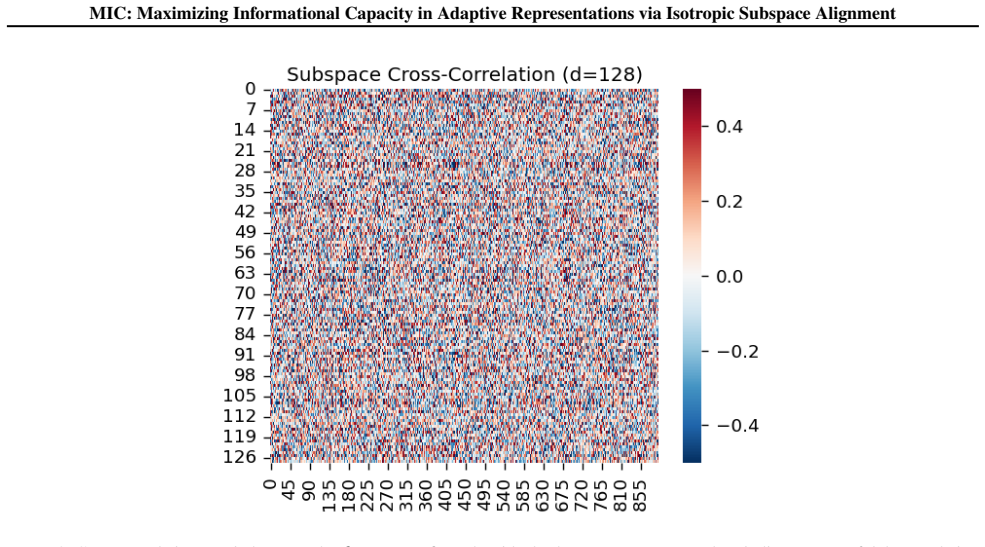
- Prefix and residual subspaces exhibit reduced redundancy when cross-correlation penalties are applied.
- Low-dimensional prefixes achieve greater hyper-spherical uniformity under the self-distillation objective.
- Overall discriminative power remains high while semantic density increases.
Where Pith is reading between the lines
- The same regularization pair could be tested on non-nested embedding hierarchies such as hierarchical VAEs.
- If the isotropy constraint scales to very high dimensions, it might reduce the need for explicit dimensionality reduction steps in production pipelines.
- Combining MIC with contrastive objectives could further strengthen the link between geometric uniformity and downstream transfer performance.
Load-bearing premise
Cross-correlation penalties and hyper-spherical uniformity constraints will reliably prevent dimensional redundancy and spectral collapse in nested subspaces without degrading performance or needing extensive hyperparameter tuning.
What would settle it
Training the same multi-scale model with and without MIC on a high-compression task and finding no measurable gain in downstream accuracy or mutual information between input and embedding would falsify the central claim.
Figures
read the original abstract
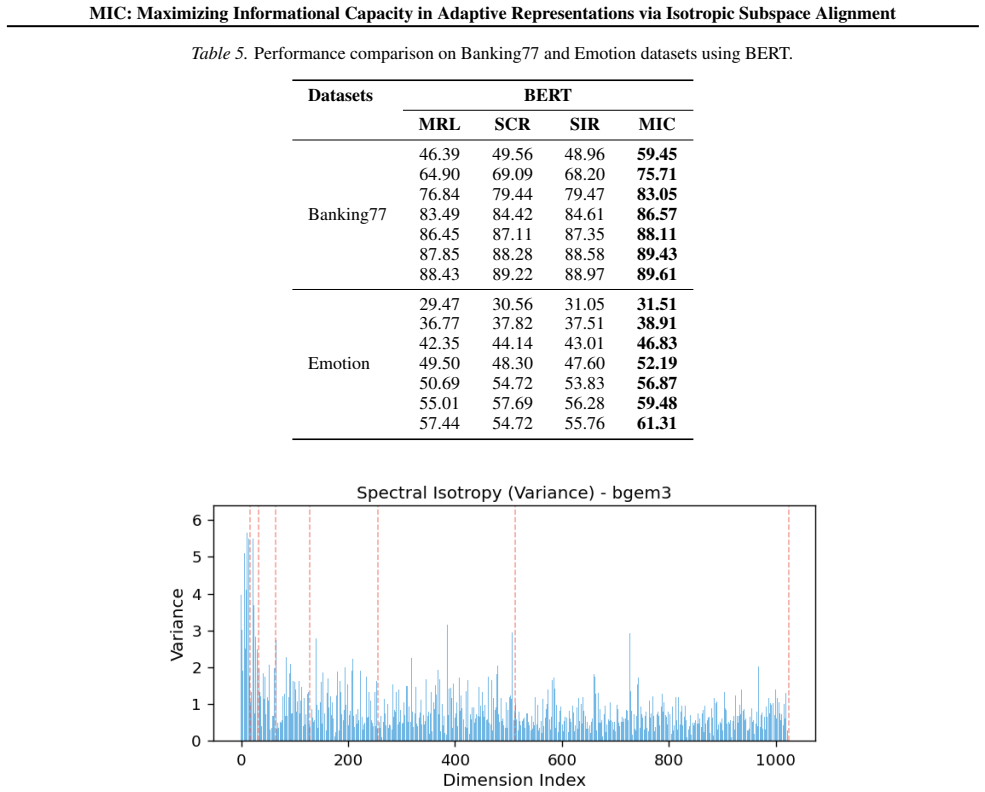
Although multi-scales representation learning enables elastic-dimension embeddings, nested subspaces often suffer from dimensional redundancy and spectral collapse. To address this, we introduce MIC, a framework that optimizes the geometric landscape of multi-granular embeddings through isotropic subspace alignment. MIC employs Soft Collapse Regularization (SCR) to mitigate redundancy between prefix and residual subspaces via cross-correlation penalties, alongside Spectral Isotropy Regularization (SIR) to ensure hyper-spherical uniformity in low-dimensional prefixes. By unifying these strategies through a self-distillation objective, MIC generates semantically dense representations that maintain high discriminative power. Our experiments demonstrate that MIC significantly outperforms standard baselines, particularly in high-compression scenarios where maintaining informational capacity is most critical.
Editorial analysis
A structured set of objections, weighed in public.
Referee Report
Summary. The paper proposes MIC, a framework for multi-scale representation learning that addresses dimensional redundancy and spectral collapse in nested subspaces. It introduces Soft Collapse Regularization (SCR) via cross-correlation penalties between prefix and residual subspaces, and Spectral Isotropy Regularization (SIR) via self-distillation to enforce hyper-spherical uniformity in low-dimensional prefixes. These are combined in a self-distillation objective to produce semantically dense representations with maintained discriminative power. The abstract asserts significant outperformance over baselines, especially under high compression.
Significance. The regularization approach follows established patterns in representation learning and could be relevant for adaptive embeddings if the claimed gains are substantiated. However, with no derivations, implementation details, baselines, or results provided beyond the abstract, the significance cannot be assessed; the contribution rests entirely on unverified empirical claims.
major comments (2)
- Abstract: the central claim that MIC 'significantly outperforms standard baselines, particularly in high-compression scenarios' is unsupported, as the manuscript supplies no experimental setup, datasets, baselines, metrics, statistical tests, or results tables, rendering the outperformance assertion unverifiable and load-bearing for the paper's contribution.
- No methods or results sections: the manuscript contains no equations, algorithmic details, or implementation descriptions for SCR (cross-correlation penalties) or SIR (self-distillation objective), preventing evaluation of whether the combined objective preserves discriminative power without degradation or excessive hyperparameter sensitivity.
Simulated Author's Rebuttal
We thank the referee for their careful reading and constructive feedback. We agree that the submitted manuscript is incomplete, containing only the abstract without methods, equations, implementation details, or experimental results. We will submit a major revision that fully addresses these gaps while preserving the core contributions of MIC.
read point-by-point responses
-
Referee: Abstract: the central claim that MIC 'significantly outperforms standard baselines, particularly in high-compression scenarios' is unsupported, as the manuscript supplies no experimental setup, datasets, baselines, metrics, statistical tests, or results tables, rendering the outperformance assertion unverifiable and load-bearing for the paper's contribution.
Authors: We accept this criticism. The abstract claim will be supported in the revision by adding a complete experimental section that specifies all datasets, baselines (including standard representation learning methods), evaluation metrics, statistical tests (e.g., significance testing across multiple runs), and result tables demonstrating gains under high compression. The revision will ensure the claim is empirically grounded rather than asserted. revision: yes
-
Referee: No methods or results sections: the manuscript contains no equations, algorithmic details, or implementation descriptions for SCR (cross-correlation penalties) or SIR (self-distillation objective), preventing evaluation of whether the combined objective preserves discriminative power without degradation or excessive hyperparameter sensitivity.
Authors: We agree the current version lacks these elements. The revised manuscript will include: (1) full mathematical definitions and derivations for Soft Collapse Regularization (cross-correlation penalties between prefix and residual subspaces) and Spectral Isotropy Regularization (self-distillation for hyper-spherical uniformity); (2) the unified self-distillation objective; (3) algorithmic pseudocode; (4) implementation details (e.g., architectures, training procedures); and (5) analysis of discriminative power preservation and hyperparameter sensitivity (including ablation studies). revision: yes
Circularity Check
No significant circularity; derivation is self-contained
full rationale
The manuscript introduces MIC via SCR (cross-correlation penalties on prefix/residual subspaces) and SIR (self-distillation for hyperspherical uniformity), unified in a composite objective. No equations, fitted parameters, or self-citations are shown that reduce any claimed prediction or uniqueness result to the inputs by construction. The approach follows standard multi-objective regularization patterns in representation learning without self-definitional loops or load-bearing self-citations. The central claim of preserved discriminative power under compression rests on empirical reporting rather than tautological redefinition.
Axiom & Free-Parameter Ledger
Reference graph
Works this paper leans on
-
[1]
URL https://aclanthology.org/2020. findings-emnlp.148/. BehnamGhader, P., Adlakha, V ., Mosbach, M., Bahdanau, D., Chapados, N., and Reddy, S. LLM2Vec: Large lan- guage models are secretly powerful text encoders. InFirst Conference on Language Modeling, 2024. URL https: //openreview.net/forum?id=IW1PR7vEBf. Cai, M., Yang, J., Gao, J., and Lee, Y . J. Matr...
-
[2]
Distributed Representations of Words and Phrases and their Compositionality
URL https://openreview.net/forum? id=plgLA2YBLH. Marelli, M., Bentivogli, L., Baroni, M., Bernardi, R., Menini, S., and Zamparelli, R. SemEval-2014 task 1: Evaluation of compositional distributional seman- tic models on full sentences through semantic related- ness and textual entailment. In Nakov, P. and Zesch, T. (eds.),Proceedings of the 8th Internatio...
work page internal anchor Pith review Pith/arXiv arXiv doi:10.3115/v1/s14-2001 2014
-
[3]
Sentence-BERT: Sentence Embeddings using Siamese BERT-Networks
URL https://aclanthology.org/2022. naacl-main.284/. Pennington, J., Socher, R., and Manning, C. GloVe: Global vectors for word representation. In Moschitti, A., Pang, B., and Daelemans, W. (eds.),Proceedings 5 MIC: Maximizing Informational Capacity in Adaptive Representations via Isotropic Subspace Alignment of the 2014 Conference on Empirical Methods in ...
work page internal anchor Pith review Pith/arXiv arXiv doi:10.3115/v1/d14-1162 2022
-
[4]
arXiv preprint arXiv:2002.10957 (2020)
URL https://proceedings.mlr.press/ v119/wang20k.html. Wang, W., Wei, F., Dong, L., Bao, H., Yang, N., and Zhou, M. Minilm: Deep self-attention distillation for task- agnostic compression of pre-trained transformers, 2020. URLhttps://arxiv.org/abs/2002.10957. Zbontar, J., Jing, L., Misra, I., LeCun, Y ., and Deny, S. Barlow twins: Self-supervised learning ...
-
[5]
To further refine the geometry of these spaces, contrastive frameworks such as SimCSE (Gao et al., 2022) and EASE (Nishikawa et al.,
pioneered the use of Siamese architectures to derive semantically meaningful sentence-level pools. To further refine the geometry of these spaces, contrastive frameworks such as SimCSE (Gao et al., 2022) and EASE (Nishikawa et al.,
2022
-
[6]
utilized dropout-based augmentation to enforce better feature distribution. Most recently, the field has pivoted toward leveraging the latent knowledge of Large Language Models (LLMs) to generate high-fidelity embeddings through instruction tuning and architectural adaptations (BehnamGhader et al., 2024; He et al., 2025). Despite these qualitative gains, ...
2024
discussion (0)
Sign in with ORCID, Apple, or X to comment. Anyone can read and Pith papers without signing in.