A Boolean-Lattice Perspective for All-Loop Two-Site Cosmological Wavefunction
Pith reviewed 2026-06-28 21:50 UTC · model grok-4.3
The pith
The shifted-tree decomposition and tubing representation of all-loop two-site cosmological wavefunctions are two expressions of one Boolean-lattice identity.
A machine-rendered reading of the paper's core claim, the machinery that carries it, and where it could break.
Core claim
The nontrivial central part of the shifted-tree decomposition reduces to an alternating subset sum over shifted diagonal divisors organized by the Boolean lattice associated with the internal energies. This subset sum equals a product of commuting finite-difference operators acting on a seed divisor. The finite-difference form produces a vertex expansion on the Boolean lattice and an equivalent maximal-chain expansion over complete filtrations. The maximal-chain formula is proved algebraically by a telescoping relation for products of shifted divisors and geometrically by representing the finite-difference expression as a cubical integral whose simplex decomposition yields the chains. Restor
What carries the argument
The Boolean lattice of internal energies, which organizes the alternating subset sum, the finite-difference operators, and the maximal-chain expansions that equate the shifted-tree and tubing constructions.
If this is right
- The loop-level two-site wavefunction coefficients admit an explicit maximal-chain expansion indexed by complete filtrations of the internal energies.
- Products of finite-difference operators generate the vertex expansion of the coefficient on the Boolean lattice.
- The cubical-integral representation of the finite-difference expression admits a simplex decomposition that reproduces the maximal chains.
- The shifted-tree and tubing constructions coincide for the entire bubble-like family at any loop order.
Where Pith is reading between the lines
- The same lattice organization may supply a uniform description for wavefunction coefficients involving more than two sites once the appropriate internal-energy sets are identified.
- The telescoping identity for products of shifted divisors could be used to derive recursion relations that accelerate numerical evaluation of higher-loop integrals.
- The geometric cubical-integral picture may connect the wavefunction coefficients to combinatorial counts of paths or chains that appear in other perturbative expansions.
Load-bearing premise
The central nontrivial part of the shifted-tree decomposition equals an alternating subset sum over shifted diagonal divisors organized by the Boolean lattice of internal energies.
What would settle it
An explicit three-loop calculation of a two-site bubble diagram in which the maximal-chain expansion, after multiplication by the two-site prefactor, fails to match the known tubing representation of the coefficient.
Figures
read the original abstract
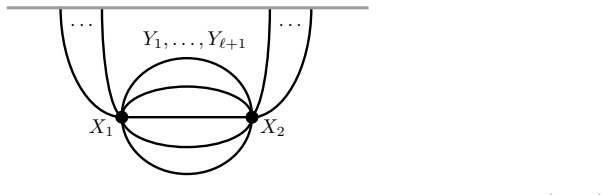
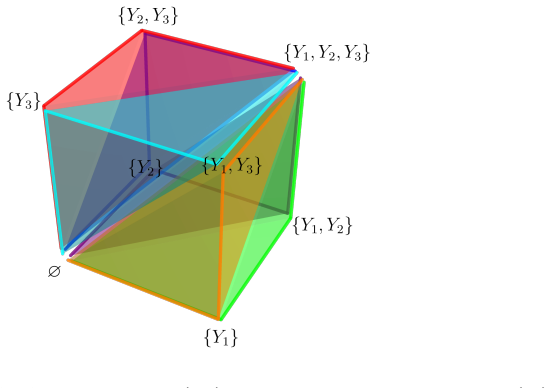
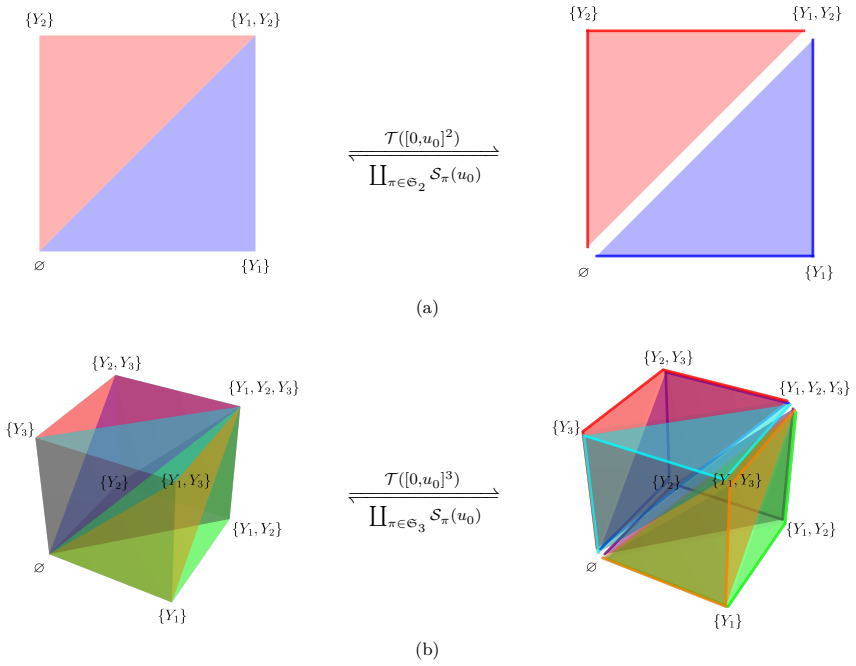
We revisit the shifted-tree decomposition formula proposed in our previous work arXiv:2410.17192 for two-site cosmological wavefunction coefficients. For the two-site bubble-like family at arbitrary loop order, we show that the nontrivial central part of the decomposition reduces to an alternating subset sum over shifted diagonal divisors. This subset sum is naturally organized by the Boolean lattice associated with the internal energies, and can be rewritten as a product of commuting finite-difference operators acting on a seed divisor. The finite-difference form first gives a vertex expansion on the Boolean lattice and then leads to an equivalent maximal-chain expansion over complete filtrations from the empty subset to the full set of internal energies. We prove this maximal-chain formula in two complementary ways. Algebraically, the identity follows from a telescoping relation for products of shifted divisors. Geometrically, the finite-difference expression is represented by a cubical integral over the Boolean cube, while the maximal-chain expansion gives its simplex decomposition. After restoring the common two-site prefactor, this maximal-chain expansion reproduces the tubing representation of the loop-level wavefunction coefficient. Thus the shifted-tree decomposition and the tubing construction are two realizations of the same Boolean-lattice identity, providing a concrete geometric interpretation of the all-loop two-site formula.
Editorial analysis
A structured set of objections, weighed in public.
Referee Report
Summary. The paper revisits the shifted-tree decomposition from arXiv:2410.17192 for two-site cosmological wavefunction coefficients. For the two-site bubble-like family at arbitrary loop order, it claims the nontrivial central part reduces to an alternating subset sum over shifted diagonal divisors organized by the Boolean lattice of internal energies. This is rewritten as a product of commuting finite-difference operators on a seed divisor, yielding a vertex expansion and then an equivalent maximal-chain expansion over complete filtrations. The maximal-chain formula is proved algebraically via a telescoping relation for products of shifted divisors and geometrically via a cubical integral over the Boolean cube with its simplex decomposition. After restoring the common two-site prefactor, the expansion reproduces the tubing representation, establishing that the shifted-tree decomposition and tubing construction are two realizations of the same Boolean-lattice identity.
Significance. If the central reduction and dual proofs hold, the work supplies a concrete combinatorial and geometric unification of two distinct all-loop representations for two-site wavefunction coefficients. The algebraic telescoping identity and the cubical-to-simplex geometric argument are explicit strengths, as is the all-loop validity for the bubble family. This perspective may facilitate further combinatorial analyses of cosmological correlators and offers a falsifiable link between previously separate constructions.
major comments (2)
- [Abstract, §2] Abstract and §2 (reduction step): The central claim that the nontrivial part of the shifted-tree decomposition reduces exactly to the alternating subset sum over shifted diagonal divisors is load-bearing. Because this step invokes the shifted-tree formula defined in arXiv:2410.17192, the manuscript must demonstrate that the reduction is derived from the Boolean-lattice organization rather than presupposing the tubing result it later recovers; an explicit low-loop verification (e.g., one- and two-loop cases) would confirm independence.
- [§4] §4 (maximal-chain expansion): The reproduction of the tubing representation after restoring the prefactor is asserted to follow directly from the maximal-chain formula. The manuscript should state the precise prefactor and show that no additional combinatorial factors arise when matching the two realizations, to ensure the claimed equivalence is not an artifact of normalization choices.
minor comments (2)
- [§1] Notation for the Boolean lattice and internal energies should be introduced with a small diagram or table in §1 to make the subset-sum organization immediately visible to readers unfamiliar with the prior work.
- [§3] The geometric argument in §3 refers to a 'cubical integral over the Boolean cube'; an explicit coordinate chart or change-of-variables formula would clarify how the finite-difference operators map to the simplex decomposition.
Simulated Author's Rebuttal
We thank the referee for the careful reading and constructive suggestions. We address each major comment below and will incorporate clarifications in a revised manuscript.
read point-by-point responses
-
Referee: [Abstract, §2] Abstract and §2 (reduction step): The central claim that the nontrivial part of the shifted-tree decomposition reduces exactly to the alternating subset sum over shifted diagonal divisors is load-bearing. Because this step invokes the shifted-tree formula defined in arXiv:2410.17192, the manuscript must demonstrate that the reduction is derived from the Boolean-lattice organization rather than presupposing the tubing result it later recovers; an explicit low-loop verification (e.g., one- and two-loop cases) would confirm independence.
Authors: We agree that explicit low-loop checks will strengthen the logical independence of the reduction. In the revised manuscript we will add a dedicated subsection in §2 that computes the one-loop and two-loop bubble coefficients directly from the shifted-tree formula of arXiv:2410.17192. These calculations will organize the resulting terms by the Boolean lattice of internal energies and arrive at the alternating subset sum without any reference to the tubing construction, thereby confirming that the reduction step is self-contained. revision: yes
-
Referee: [§4] §4 (maximal-chain expansion): The reproduction of the tubing representation after restoring the prefactor is asserted to follow directly from the maximal-chain formula. The manuscript should state the precise prefactor and show that no additional combinatorial factors arise when matching the two realizations, to ensure the claimed equivalence is not an artifact of normalization choices.
Authors: We will revise §4 to state the common two-site prefactor explicitly and to include a term-by-term coefficient comparison between the maximal-chain expansion (multiplied by this prefactor) and the tubing representation. The comparison will demonstrate that the two expressions agree exactly, with no residual combinatorial factors, for the bubble family at arbitrary loop order. revision: yes
Circularity Check
No significant circularity identified
full rationale
The paper cites its prior work (arXiv:2410.17192) solely as the source of the shifted-tree decomposition formula, which serves as the explicit starting input. It then derives—via explicit algebraic telescoping and geometric cubical-to-simplex arguments—the reduction of that formula's central part to an alternating subset sum on the Boolean lattice, the finite-difference rewriting, the maximal-chain expansion, and the final reproduction of the tubing representation after restoring the common prefactor. These steps are presented as independent proofs rather than tautological redefinitions or fitted renamings. No load-bearing self-citation chain, self-definitional loop, or 'prediction' that reduces by construction to the input is exhibited; the Boolean-lattice identity is established through verifiable algebraic and geometric identities that stand on their own.
Axiom & Free-Parameter Ledger
axioms (2)
- standard math Finite-difference operators on shifted divisors satisfy the stated telescoping product identity
- standard math The cubical integral over the Boolean cube admits the simplex decomposition corresponding to maximal chains
Reference graph
Works this paper leans on
-
[1]
A note on kinematic flow and differential equations for two-site one-loop graph in FR W spacetime,
Y. Hang and C. Shen, “A note on kinematic flow and differential equations for two-site one-loop graph in FR W spacetime,” JHEP 09 (2025) 209 , arXiv:2410.17192 [hep-th]
arXiv 2025
-
[2]
Cosmological Polytopes and the Wavefunction of the Universe,
N. Arkani-Hamed, P. Benincasa, and A. Postnikov, “Cosmological Polytopes and the Wavefunction of the Universe,” arXiv:1709.02813 [hep-th]
-
[3]
N. Arkani-Hamed and P. Benincasa, “On the Emergence of Lorentz Invariance and Unitarity from the Scattering Facet of Cosmological Polytopes,” arXiv:1811.01125 [hep-th]
-
[4]
Kinematic Flow and the Emergence of Time,
N. Arkani-Hamed, D. Baumann, A. Hillman, A. Joyce, H. Lee, and G. L. Pimentel, “Kinematic Flow and the Emergence of Time,” Phys. Rev. Lett. 135 no. 3, (2025) 031602 , arXiv:2312.05300 [hep-th]
arXiv 2025
-
[5]
Differential Equations for Cosmological Correlators,
N. Arkani-Hamed, D. Baumann, A. Hillman, A. Joyce, H. Lee, and G. L. Pimentel, “Differential Equations for Cosmological Correlators,” arXiv:2312.05303 [hep-th]
-
[6]
On one-loop corrections to the Bunch-Davies wavefunction of the universe,
P. Benincasa, G. Brunello, M. K. Mandal, P. Mastrolia, and F. Vazão, “On one-loop corrections to the Bunch-Davies wavefunction of the universe,” arXiv:2408.16386 [hep-th]
-
[7]
N. Arkani-Hamed, C. Figueiredo, and F. Vazão, “Cosmohedra,” JHEP 11 (2025) 029 , arXiv:2412.19881 [hep-th]
arXiv 2025
-
[8]
Cosmological correlators at the loop level,
Z. Qin, “Cosmological correlators at the loop level,” JHEP 03 (2025) 051 , arXiv:2411.13636 [hep-th]
arXiv 2025
-
[9]
Strongly coupled sectors in inflation: gapless theories and unparticles,
G. L. Pimentel and C. Yang, “Strongly coupled sectors in inflation: gapless theories and unparticles,” JHEP 04 (2026) 146 , arXiv:2503.17840 [hep-th]
Pith/arXiv arXiv 2026
-
[10]
Dimensional regularization of bubble diagrams in de Sitter spacetime,
H. Zhang, “Dimensional regularization of bubble diagrams in de Sitter spacetime,” JHEP 02 (2026) 119 , arXiv:2507.19318 [hep-th]
arXiv 2026
-
[11]
On the simplicity of de Sitter correlators,
C. Chowdhury, S. He, Y.-X. Su, and D. Yang, “On the simplicity of de Sitter correlators,” arXiv:2604.26421 [hep-th]
-
[12]
The massive flat space limit of cosmological correlators,
S. Cespedes and S. Jazayeri, “The massive flat space limit of cosmological correlators,” JHEP 07 (2025) 032 , arXiv:2501.02119 [hep-th]
arXiv 2025
-
[13]
R. Glew, “Correlators from Amplitubes,” arXiv:2507.07199 [hep-th]
-
[14]
Correlators from graphical amplitudes,
R. Glew, “Correlators from graphical amplitudes,” Phys. Rev. D 112 no. 6, (2025) L061302
2025
-
[15]
Wavefunction coefficients from amplitubes,
R. Glew, “Wavefunction coefficients from amplitubes,” JHEP 07 (2025) 064 , arXiv:2503.13596 [hep-th] . 18
arXiv 2025
-
[16]
C. Chowdhury, A. Lipstein, J. Marshall, J. Mei, and I. Sachs, “Cosmological dressing rules,” JHEP 03 (2026) 076 , arXiv:2503.10598 [hep-th]
arXiv 2026
-
[17]
Cosmology meets cluster algebra,
M. Capuano, L. Ferro, T. Lukowski, and A. Palazio, “Cosmology meets cluster algebra,” arXiv:2512.14859 [hep-th]
-
[18]
Cluster algebras for cosmological correlators,
P. Mazloumi and X. Xu, “Cluster algebras for cosmological correlators,” JHEP 03 (2026) 256 , arXiv:2512.14854 [hep-th]
arXiv 2026
-
[19]
Generalised Cluster Adjacency for Cosmology,
M. Capuano, L. Ferro, T. Lukowski, A. Palazio, and Y.-Q. Zhang, “Generalised Cluster Adjacency for Cosmology,” arXiv:2603.09965 [hep-th]
-
[20]
A physical basis for cosmological correlators from cuts,
S. De and A. Pokraka, “A physical basis for cosmological correlators from cuts,” JHEP 03 (2025) 040 , arXiv:2411.09695 [hep-th]
arXiv 2025
-
[21]
Euler Discriminant of Complements of Hyperplanes,
C. Fevola and S.-J. Matsubara-Heo, “Euler Discriminant of Complements of Hyperplanes,” arXiv:2411.19696 [math.AG]
-
[22]
Differential equations for tree-level cosmological correlators with massive states,
F. Gasparotto, P. Mazloumi, and X. Xu, “Differential equations for tree-level cosmological correlators with massive states,” JHEP 09 (2025) 043 , arXiv:2411.05632 [hep-th]
arXiv 2025
-
[23]
Canonical Differential Equations for Cosmology from Positive Geometries,
M. Capuano, L. Ferro, T. Lukowski, and A. Palazio, “Canonical Differential Equations for Cosmology from Positive Geometries,” arXiv:2505.14609 [hep-th]
-
[24]
Differential Equations for Massive Correlators,
D. Baumann, A. Joyce, H. Lee, and K. Salehi Vaziri, “Differential Equations for Massive Correlators,” arXiv:2604.08658 [hep-th]
-
[25]
J. Chen, B. Feng, Z. Qin, and Y.-X. Tao, “Loop integrals in de Sitter spacetime: The parity-split IBP system and d log-form differential equations,” arXiv:2604.14549 [hep-th]
-
[26]
Notes on Diagrammatic Coaction for Cosmological Wavefunction Coefficients: A Two-Site Prelude,
Y. Fu and J. Liu, “Notes on Diagrammatic Coaction for Cosmological Wavefunction Coefficients: A Two-Site Prelude,” arXiv:2603.25698 [hep-th]
-
[27]
Kinematic flow for cosmological loop integrands,
D. Baumann, H. Goodhew, and H. Lee, “Kinematic flow for cosmological loop integrands,” JHEP 07 (2025) 131 , arXiv:2410.17994 [hep-th]
arXiv 2025
-
[28]
D. Baumann, H. Goodhew, A. Joyce, H. Lee, G. L. Pimentel, and T. Westerdijk, “Geometry of kinematic flow,” JHEP 05 (2026) 211 , arXiv:2504.14890 [hep-th]
arXiv 2026
-
[29]
Kinematic flow from the flow of cuts,
R. Glew and A. Pokraka, “Kinematic flow from the flow of cuts,” arXiv:2508.11568 [hep-th]
-
[30]
An Alternative Viewpoint on Kinematic Flow from Tubing Splitting,
J.-Y. Ke and P. He, “An Alternative Viewpoint on Kinematic Flow from Tubing Splitting,” arXiv:2605.17751 [hep-th] . 19
-
[31]
Quantum Field Theory in de Sitter Space: Renormalization by Point Splitting,
T. S. Bunch and P. C. W. Davies, “Quantum Field Theory in de Sitter Space: Renormalization by Point Splitting,” Proc. Roy. Soc. Lond. A 360 (1978) 117–134
1978
-
[32]
Permutohedra, associahedra, and beyond,
A. Postnikov, “Permutohedra, associahedra, and beyond,” International Mathematics Research Notices 2009 no. 6, (2009) 1026–1106, arXiv:math/0507163 [math.CO]
Pith/arXiv arXiv 2009
-
[33]
Coxeter complexes and graph-associahedra,
M. Carr and S. L. Devadoss, “Coxeter complexes and graph-associahedra,” Topology and its Applications 153 no. 12, (2006) 2155–2168, arXiv:math/0407229 [math.QA]
Pith/arXiv arXiv 2006
-
[34]
M. Carr, S. L. Devadoss, and S. Forcey, “Pseudograph associahedra,” Journal of Combinatorial Theory, Series A 118 no. 7, (2011) 2035–2055 , arXiv:1005.2551 [math.CO]
Pith/arXiv arXiv 2011
-
[35]
The lean 4 theorem prover and programming language,
L. d. Moura and S. Ullrich, “The lean 4 theorem prover and programming language,” in International Conference on Automated Deduction , pp. 625–635, Springer. 2021
2021
-
[36]
formal-physics-lean
Y. Hang, “formal-physics-lean. ” https://github.com/yf-hang/formal-physics-lean
-
[37]
Nakahara, Geometry, topology and physics
M. Nakahara, Geometry, topology and physics . CRC press, 2018. 20
2018
discussion (0)
Sign in with ORCID, Apple, or X to comment. Anyone can read and Pith papers without signing in.