Clustering in atom probe tomography data: coordination number metric, percolation-based parameter scaling, and size effects
Pith reviewed 2026-06-28 22:01 UTC · model grok-4.3
The pith
A composition-based coordination number metric combined with percolation scaling improves clustering of nanoscale features in atom probe tomography data and compensates for reconstruction artifacts better than solute-density approaches.
A machine-rendered reading of the paper's core claim, the machinery that carries it, and where it could break.
Core claim
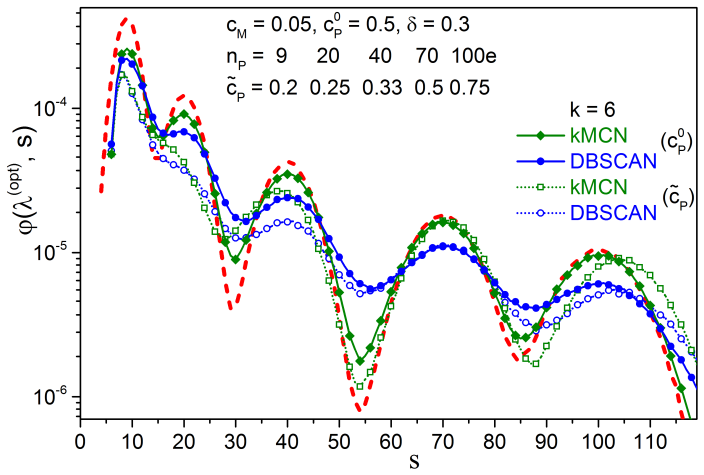
The central claim is that a coordination-number metric based on composition, when combined with scaling of clustering properties to the corresponding percolation thresholds, defines a self-similar variable that is nearly invariant with respect to the choice of metric, clustering parameters, and structural disorder; this variable enables formal transfer of optimal parameters between methods and, in simulations that include finite spatial resolution, detection efficiency, and reconstruction artifacts, the coordination-number approach compensates for heterogeneous dilations and outperforms solute-density-based methods in all tested scenarios.
What carries the argument
The coordination-number metric based on local composition, which incorporates solvent atoms and is scaled to percolation thresholds to yield an invariant self-similar clustering variable.
If this is right
- Optimal clustering parameters identified with one metric can be transferred to another metric via the self-similar variable.
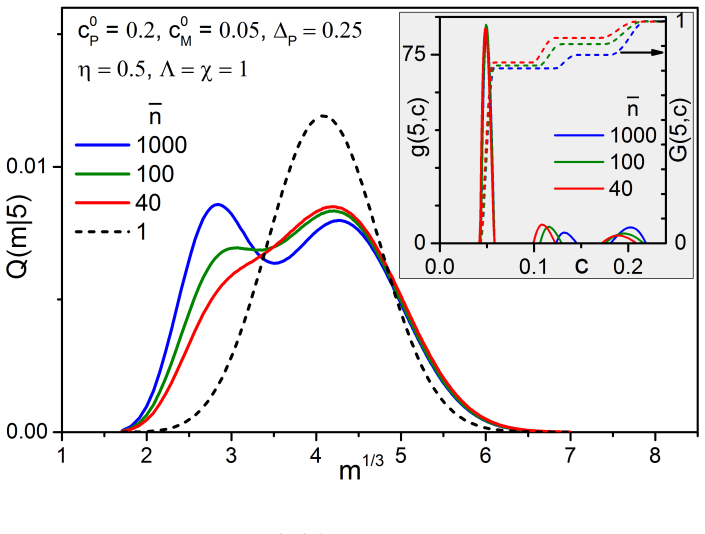
- Small precipitates exhibit broadened clustering curves because the precipitate-matrix interface alters the local composition spectrum.
- The method remains effective when typical APT artifacts such as limited detection efficiency and spatial resolution are present.
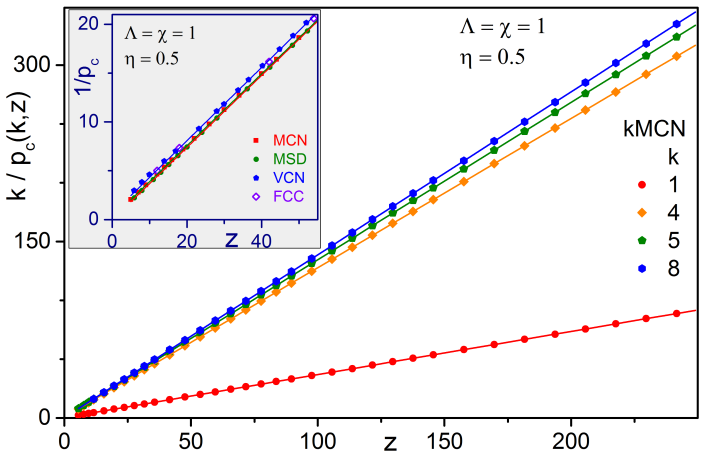
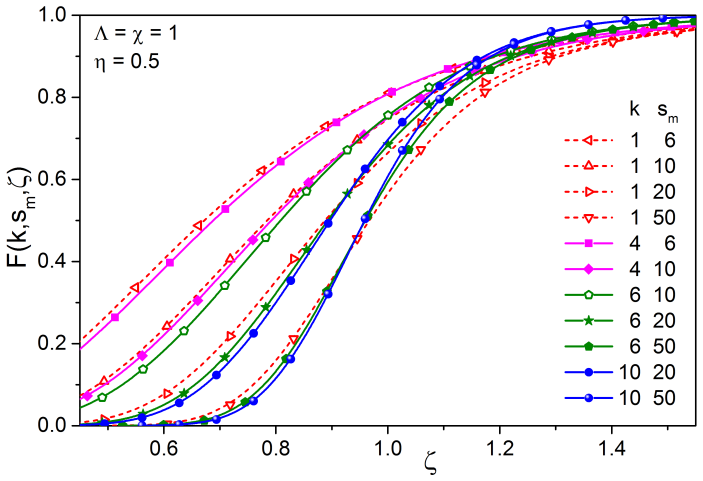
- Clustering descriptions become largely independent of the specific distance or density metric once scaled to the percolation threshold.
Where Pith is reading between the lines
- The same percolation-scaling step might reduce sensitivity to reconstruction algorithm choices across different atom probe instruments.
- The approach could be tested on experimental datasets where precipitate sizes are independently verified by another microscopy technique to check consistency of the invariant variable.
- Extending the coordination definition to include higher-order neighbor shells might further stabilize the scaled variable in very dilute alloys.
Load-bearing premise
Percolation thresholds can be reliably identified and used for scaling in mixed solvent-solute APT structures, and the composition-based coordination definition captures relevant spatial information without new biases from detection efficiency or reconstruction artifacts.
What would settle it
A direct comparison on simulated APT datasets with known precipitate locations and controlled heterogeneous dilation artifacts in which the coordination-number method shows no improvement or produces a scaled variable that varies strongly with metric choice.
Figures
read the original abstract
The ability to identify nanometer-scale nuclei of new phases in atom probe tomography (APT) is often limited by the sensitivity of clustering algorithms to user-defined control parameters. Conventional approaches typically rely on the Euclidean distance metric and consider only solute atoms, thereby discarding the solvent atoms that contain most of the spatial information. Here, we introduce a coordination-number metric based on the composition and apply it to higher-order clustering. Using various metrics, we investigate percolation in typical APT structures. By scaling clustering properties to the corresponding percolation thresholds, we define a self-similar variable that is almost invariant with respect to metrics, clustering parameters, and structural disorder. This variable provides a relevant description of clustering and enables the formal transfer of optimal parameters between clustering methods. We also study the characteristic clustering behavior in small precipitates and quantify how the precipitate-matrix interface alters the composition spectrum and broadens the clustering curve. Finally, using simulations that incorporate finite spatial resolution, detection efficiency, and other APT reconstruction artifacts, we show that the approach based on coordination numbers effectively compensates for heterogeneous dilations and outperforms solute-density-based methods in all tested scenarios.
Editorial analysis
A structured set of objections, weighed in public.
Referee Report
Summary. The manuscript introduces a coordination-number metric derived from local composition for clustering in atom probe tomography (APT) data. It applies this metric within a higher-order clustering framework, identifies percolation thresholds in typical APT structures (solvent + solute), and scales clustering properties to those thresholds to obtain a self-similar variable claimed to be nearly invariant to metric choice, clustering parameters, and structural disorder. The work further examines characteristic clustering in small precipitates, the effect of the precipitate-matrix interface on the composition spectrum, and demonstrates via simulations that incorporate finite spatial resolution, detection efficiency, and reconstruction artifacts that the coordination-number approach compensates for heterogeneous dilations and outperforms conventional solute-density methods in all tested cases.
Significance. If the central claims hold, the self-similar variable and associated parameter-transfer procedure would constitute a useful methodological advance for reducing user-parameter sensitivity in APT clustering analysis. The explicit inclusion of detection efficiency and reconstruction artifacts in the validation simulations is a strength; reproducible demonstration that the percolation threshold remains extractable under realistic atom-loss conditions would strengthen the result.
major comments (2)
- [Simulations section (detection-efficiency results)] The central claim that the coordination-number metric “effectively compensates for heterogeneous dilations” in the presence of detection efficiency (20–60 % atom removal) rests on the untested premise that percolation thresholds remain identifiable and stable on the resulting incomplete graphs. The abstract states that simulations include detection efficiency, but without explicit quantification of threshold shift or loss of percolation signature near interfaces and in dilute regions, the invariance of the self-similar variable cannot be verified.
- [Percolation-threshold definition and self-similar variable] The self-similar variable is defined by scaling to percolation thresholds measured on the same data set to which the coordination metric is applied. If the threshold extraction itself depends on the metric and on the same incomplete point set, the claimed parameter-free invariance may be partly by construction; an independent validation (e.g., against known synthetic precipitates or cross-validation with an external length scale) is needed to establish that the scaling is not circular.
minor comments (2)
- [Abstract] The abstract is information-dense; splitting the final sentence or adding a short clause on the range of detection efficiencies tested would improve readability.
- [Methods / metric definition] Notation for the coordination number (e.g., whether it is a local average or a graph degree) should be defined at first use with an explicit equation.
Simulated Author's Rebuttal
We thank the referee for the detailed and constructive review. The two major comments raise important points about the robustness of the percolation analysis under detection efficiency and the potential circularity in the self-similar variable. We address each below and will revise the manuscript accordingly.
read point-by-point responses
-
Referee: The central claim that the coordination-number metric “effectively compensates for heterogeneous dilations” in the presence of detection efficiency (20–60 % atom removal) rests on the untested premise that percolation thresholds remain identifiable and stable on the resulting incomplete graphs. The abstract states that simulations include detection efficiency, but without explicit quantification of threshold shift or loss of percolation signature near interfaces and in dilute regions, the invariance of the self-similar variable cannot be verified.
Authors: We agree that explicit quantification of percolation threshold stability under atom removal would strengthen the claims. While the simulations section already incorporates detection efficiencies of 20–60 % and shows the coordination-number metric outperforming density-based methods, we did not provide a dedicated quantification of threshold shifts or signature loss near interfaces. In the revised manuscript we will add a new panel or supplementary figure reporting the percolation threshold as a function of detection efficiency, including separate curves for interface and dilute regions, to directly verify that the signature remains identifiable and the self-similar variable remains stable. revision: yes
-
Referee: The self-similar variable is defined by scaling to percolation thresholds measured on the same data set to which the coordination metric is applied. If the threshold extraction itself depends on the metric and on the same incomplete point set, the claimed parameter-free invariance may be partly by construction; an independent validation (e.g., against known synthetic precipitates or cross-validation with an external length scale) is needed to establish that the scaling is not circular.
Authors: We acknowledge the referee’s concern that scaling to a threshold extracted from the same incomplete point set could introduce some degree of circularity. The current manuscript demonstrates invariance across metrics and parameters on the same data, which supports transferability, but does not include an external check against known ground-truth structures. In the revision we will add a validation subsection using synthetic precipitates of known size and composition; we will show that the scaled variable recovers the expected clustering behavior when compared against these independent length scales, thereby confirming that the invariance is not solely an artifact of the threshold definition. revision: yes
Circularity Check
No significant circularity; scaling to measured percolation thresholds is a standard data-collapse technique validated empirically.
full rationale
The abstract describes defining a self-similar variable by scaling clustering properties to percolation thresholds identified on the same APT structures. This is a conventional normalization step in percolation analysis to test invariance across parameters, not a reduction by construction. No equations or self-citations are provided that would make the claimed invariance tautological; the paper instead reports empirical checks in simulations that include detection efficiency and reconstruction artifacts. The derivation chain remains independent of its inputs and does not match any enumerated circularity pattern.
Axiom & Free-Parameter Ledger
Reference graph
Works this paper leans on
-
[1]
Pre- viously, we used marginal metrics based on backward (M B ij = min(m ij, mji) and forward (M F ij = max(m ij, mji) symmetrizations [10]
Distributions of local neighbor numbers We chose the arithmetic mean (M A) of the coordination numbers (2) as the metric in this study; one could otherwise use the geometric (M G) or harmonic (M H) mean. Pre- viously, we used marginal metrics based on backward (M B ij = min(m ij, mji) and forward (M F ij = max(m ij, mji) symmetrizations [10]. It was demon...
-
[2]
To this end, we consider the same fragment of 2D atomic arrangement shown in Fig
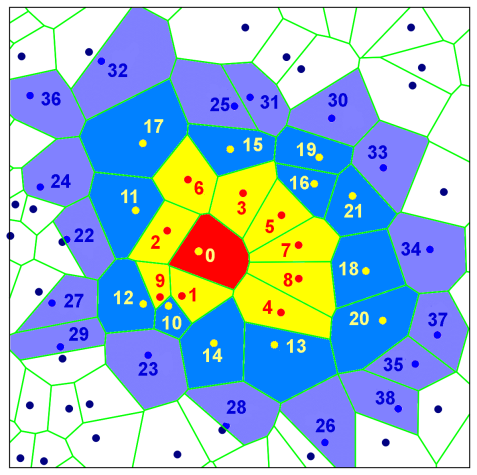
Maps of links To gain a visual understanding of metric properties, it is helpful to compare the maps of links that form in a highly disordered system. To this end, we consider the same fragment of 2D atomic arrangement shown in Fig. 1 as a reference system. Figure A.3 demonstrates the maps obtained by three methods with the control parameterz 0 = 6, equal...
-
[3]
Gault, A
B. Gault, A. Chiaramonti, O. Cojocaru-Miredin, P. Stender, R. Dubosq, C. Freysoldt, S. K. Makineni, T. Li, M. Moody, and J. M. Cairney, Atom probe tomography, Nature Reviews 37 Methods Primers51, 2662 (2021)
2021
-
[4]
M. K. Miller,Atom-Probe Tomography: Analysis at the Atomic Level(Springer, New York, NY, 2000)
2000
-
[5]
Lefebvre, F
W. Lefebvre, F. Vurpillot, and X. Sauvage,Atom probe tomography: put theory into practice (Academic Press, 2016)
2016
-
[6]
J. M. Hyde and C. A. English, An analysis of the structure of irradiation induced Cu-enriched clusters in low and high nickel welds, MRS Online Proceedings Library (OPL)650, R6 (2000)
2000
-
[7]
Ester, H.-P
M. Ester, H.-P. Kriegel, J. Sander, and X. Xu, A density-based algorithm for discovering clusters in large spatial databases with noise, inKDD-96 Proceedings(AAAI Press, 1996) pp. 226–231
1996
-
[8]
L. T. Stephenson, M. P. Moody, P. V. Liddicoat, and S. P. Ringer, New techniques for the analysis of fine-scaled clustering phenomena within atom probe tomography (APT) data, Microscopy and Microanalysis13, 448 (2007)
2007
-
[9]
Lefebvre, T
W. Lefebvre, T. Philippe, and F. Vurpillot, Application of Delaunay tessellation for the charac- terization of solute-rich clusters in atom probe tomography, Ultramicroscopy111, 200 (2011)
2011
-
[10]
Felfer, A
P. Felfer, A. Ceguerra, S. Ringer, and J. Cairney, Detecting and extracting clusters in atom probe data: A simple, automated method using Voronoi cells, Ultramicroscopy150, 30 (2015)
2015
-
[11]
E. A. Marquis and J. M. Hyde, Applications of atom-probe tomography to the characterisation of solute behaviours, Materials Science and Engineering: R: Reports69, 37 (2010)
2010
-
[12]
Lazarev and J
M. Lazarev and J. Banhart, A concept of local coordination number for the characterization of solute clusters within atom probe tomography data, Microscopy and Microanalysis30, 793 (2024)
2024
-
[13]
T. T. Tsong, J. McLane, S. B., M. Ahmad, and C. S. Wu, Field evaporation events as Markov chains: A time-of-flight atom-probe study of iridium, Pt-Rh alloys, and metallic glasses, Jour- nal of Applied Physics53, 4180 (1982)
1982
-
[14]
R. P. Kolli and D. N. Seidman, Comparison of compositional and morphological atom-probe tomography analyses for a multicomponent Fe-Cu steel, Microscopy and Microanalysis13, 272 (2007)
2007
-
[15]
J. Hyde, E. Marquis, K. Wilford, and T. Williams, A sensitivity analysis of the maximum separation method for the characterisation of solute clusters, Ultramicroscopy111, 440 (2011)
2011
-
[16]
A. V. Ceguerra, M. P. Moody, L. T. Stephenson, R. K. Marceau, and S. P. Ringer, A three- 38 dimensional Markov field approach for the analysis of atomic clustering in atom probe data, Philosophical Magazine90, 1657 (2010)
2010
-
[17]
Cover and P
T. Cover and P. Hart, Nearest neighbor pattern classification, IEEE Transactions on Infor- mation Theory13, 21 (1967)
1967
-
[18]
P. M. Ossi,Disordered materials: an introduction(Springer, 2006)
2006
-
[19]
Waseda,The Structure of Non-Crystalline Materials: Liquids and Amorphous Solids (McGraw-Hill, New York, 1980)
Y. Waseda,The Structure of Non-Crystalline Materials: Liquids and Amorphous Solids (McGraw-Hill, New York, 1980)
1980
-
[20]
Mathieson and P
L. Mathieson and P. Moscato, An introduction to proximity graphs, inBusiness and Consumer Analytics: New Ideas(Springer, 2019) pp. 213–233
2019
-
[21]
L. T. Stephenson, M. P. Moody, and S. P. Ringer, Theory of solute clustering in materials for atom probe, Philosophical Magazine91, 2200 (2011)
2011
-
[22]
De Geuser, B
F. De Geuser, B. Gault, A. Bostel, and F. Vurpillot, Correlated field evaporation as seen by atom probe tomography, Surface Science601, 536 (2007)
2007
-
[23]
L. T. Stephenson, M. P. Moody, B. Gault, and S. P. Ringer, Nearest neighbour diagnostic statistics on the accuracy of apt solute cluster characterisation, Philosophical Magazine93, 975 (2013)
2013
-
[24]
M. K. Miller and M. G. Hetherington, Local magnification effects in the atom probe, Surface Science246, 442 (1991)
1991
-
[25]
J. M. Hyde, G. Da Costa, C. Hatzoglou, H. Weekes, B. Radiguet, P. D. Styman, F. Vurpillot, C. Pareige, A. Etienne, G. Bonny, N. Castin, L. Malerba, and P. Pareige, Comparison of cluster analysis methods for the analysis of atom probe data, Microscopy and Microanalysis 23, 366 (2017)
2017
-
[26]
L. A. Steen and J. A. Seebach,Counterexamples in Topology(Springer, 1978)
1978
-
[27]
V. M. Worlitzer, G. Ariel, and E. A. Lazar, Pair correlation function based on Voronoi topol- ogy, Physical Review E108(2023)
2023
-
[28]
J. Lu, E. A. Lazar, and C. H. Rycroft, An extension to Voro++ for multithreaded computation of Voronoi cells, Computer Physics Communications291, 108832 (2023)
2023
-
[29]
R. K. W. Marceau, Atomic-scale analysis of light alloys using atom probe tomography, Mate- rials Science and Technology32, 209 (2016)
2016
-
[30]
M. H. DeGroot and M. J. Schervish,Probability and Statistics, 4th ed. (Addison-Wesley, 2012)
2012
-
[31]
Wanderka, N
N. Wanderka, N. Lazarev, C. S. T. Chang, and J. Banhart, Analysis of clustering in Al–Mg–Si 39 alloy by density spectrum analysis of atom probe data, Ultramicroscopy111, 701 (2011)
2011
-
[32]
Chandrasekhar, Stochastic problems in physics and astronomy, Reviews of Modern Physics 15, 1 (1943)
S. Chandrasekhar, Stochastic problems in physics and astronomy, Reviews of Modern Physics 15, 1 (1943)
1943
-
[33]
Philippe, F
T. Philippe, F. De Geuser, S. Duguay, W. Lefebvre, O. Cojocaru-Mir´ edin, and D. Blavette, Clustering and nearest neighbour distances in atom-probe tomography, Ultramicroscopy109, 1304 (2009)
2009
-
[34]
Bhattacharjee, Nth-nearest-neighbor distribution functions of an interacting fluid, Physical Review E67(2003)
B. Bhattacharjee, Nth-nearest-neighbor distribution functions of an interacting fluid, Physical Review E67(2003)
2003
-
[35]
Timpel, N
M. Timpel, N. Wanderka, R. Schlesiger, T. Yamamoto, N. Lazarev, D. Isheim, G. Schmitz, S. Matsumura, and J. Banhart, The role of strontium in modifying aluminium–silicon alloys, Acta Materialia60, 3920 (2012)
2012
-
[36]
A. V. Morozov,Methods for Solving Incorrectly Posed Problems(Springer, 1984)
1984
-
[37]
Roths, M
T. Roths, M. Martha, J. Weese, and J. Honerkamp, A generalized regularization method for nonlinear ill-posed problems, Computer Physics Communications139, 279 (2001)
2001
-
[38]
Stauffer and A
D. Stauffer and A. Aharony,Introduction to Percolation Theory(Taylor & Francis, 1994) p. 192
1994
-
[39]
Sahimi and A
M. Sahimi and A. G. Hunt, eds.,Complex Media and Percolation Theory(Springer, 2021)
2021
-
[40]
M. E. J. Newman and R. M. Ziff, Fast Monte Carlo algorithm for site or bond percolation, Physical Review E64(2001)
2001
-
[41]
Z. Xun, D. Hao, and R. M. Ziff, Site and bond percolation thresholds on regular lattices, Physical Review E105(2022)
2022
-
[42]
Li, R.-R
M. Li, R.-R. Liu, L. L¨ u, M.-B. Hu, S. Xu, and Y.-C. Zhang, Percolation on complex networks: Theory and application, Physics Reports907, 1 (2021)
2021
-
[43]
C. P. Winsor, The Gompertz curve as a growth curve, Proceedings of the National Academy of Sciences18, 1 (1932)
1932
-
[44]
E. H. Dill,Continuum mechanics: elasticity, plasticity, viscoelasticity(CRC press, 2006)
2006
-
[45]
Ankerst, M
M. Ankerst, M. M. Breunig, H.-P. Kriegel, and J. Sander, OPTICS: Ordering points to identify the clustering structure, ACM SIGMOD Record28, 49 (1999)
1999
-
[46]
J. Wang, D. K. Schreiber, N. Bailey, P. Hosemann, and M. B. Toloczko, The application of the OPTICS algorithm to cluster analysis in atom probe tomography data, Microscopy and Microanalysis25, 338 (2019). 40
2019
-
[47]
Ghamarian and E
I. Ghamarian and E. A. Marquis, Hierarchical density-based cluster analysis framework for atom probe tomography data, Ultramicroscopy200, 28 (2019)
2019
-
[48]
Schrauth and J
M. Schrauth and J. S. E. Portela, Fast algorithm for topologically disordered lattices with constant coordination number, Physical Review Research1, 033061 (2019)
2019
-
[49]
Mertens, I
S. Mertens, I. Jensen, and R. M. Ziff, Universal features of cluster numbers in percolation, Physical Review E96, 052119 (2017)
2017
-
[50]
Deng and H
Y. Deng and H. W. J. Bl¨ ote, Monte Carlo study of the site-percolation model in two and three dimensions, Physical Review E72, 016126 (2005)
2005
-
[51]
C. D. Lorenz and R. M. Ziff, Precise determination of the bond percolation thresholds and finite-size scaling corrections for the sc, fcc, and bcc lattices, Physical Review E57, 230 (1998). 41
1998
discussion (0)
Sign in with ORCID, Apple, or X to comment. Anyone can read and Pith papers without signing in.