Functional methods for quantum thermodynamics
Pith reviewed 2026-06-28 20:02 UTC · model grok-4.3
The pith
A Hubbard-Stratonovich derivation supplies the contact subtraction term required for FRG-DFT to recover exact Bose-Hubbard thermodynamics.
A machine-rendered reading of the paper's core claim, the machinery that carries it, and where it could break.
Core claim
Deriving the FRG-DFT flow equations from a Hubbard-Stratonovich transformation on the coherent-state path integral of the single-site Bose-Hubbard model identifies the equal-time contact subtraction that eliminates spurious self-interactions, allowing appropriate closures of the resulting hierarchy to reproduce the model's exact free energy, chemical potential, and connected density correlators over wide ranges of density, temperature, and interaction strength.
What carries the argument
The FRG-DFT flow equation for the free energy, with the self-interaction correction term supplied by Hubbard-Stratonovich decoupling of the coherent-state path integral.
If this is right
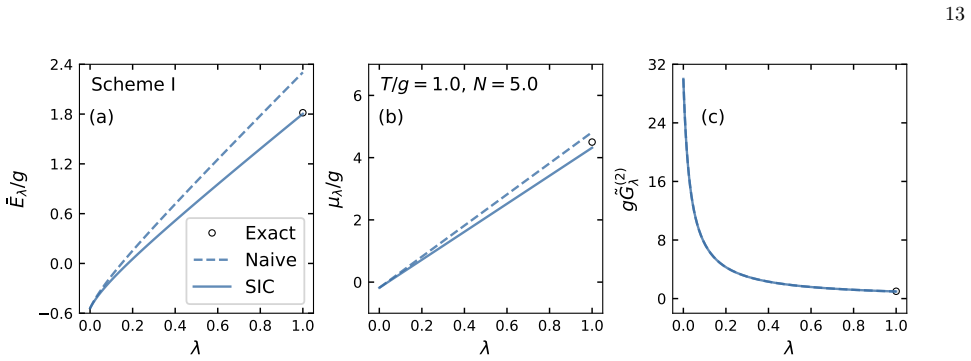
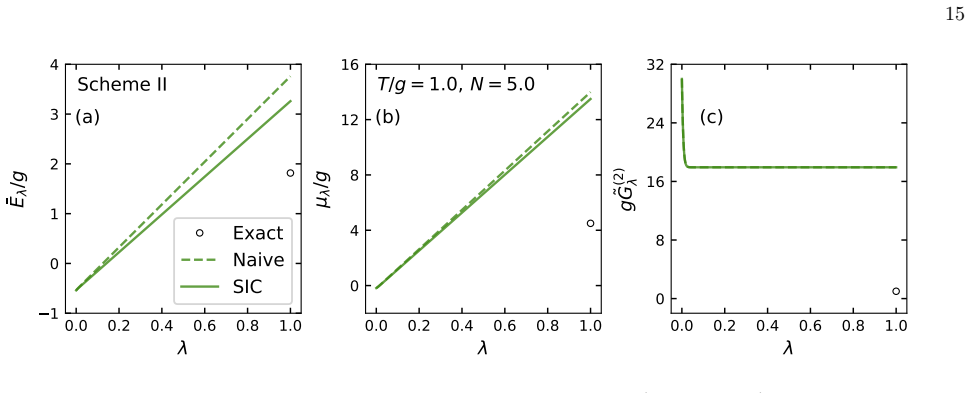
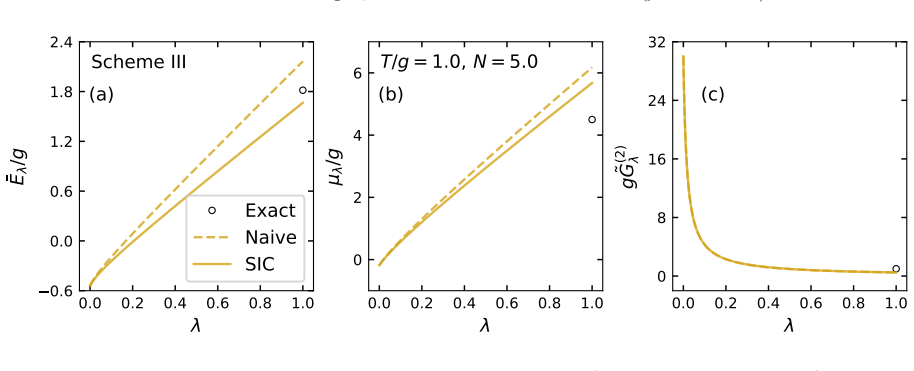
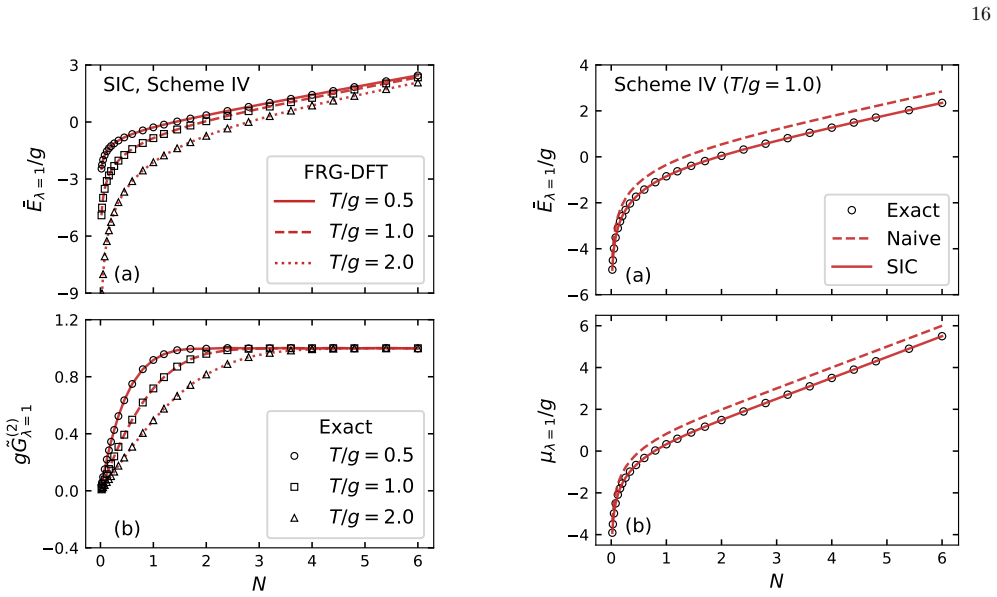
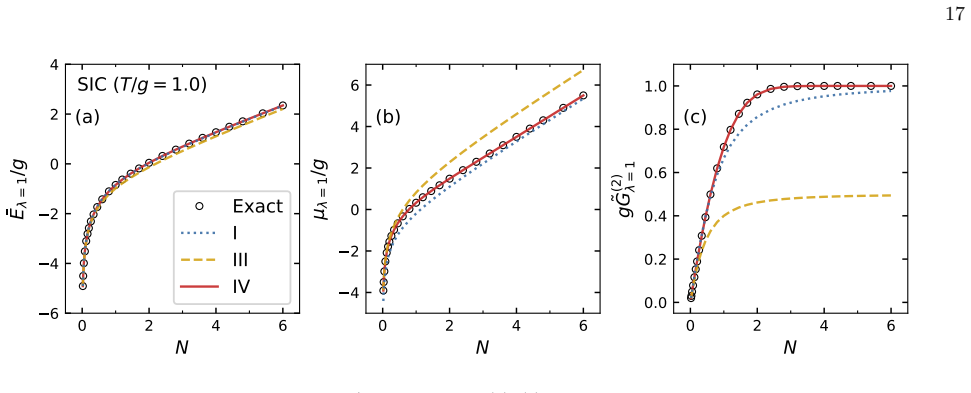
- The free energy obtained from the flow remains comparatively accurate across different hierarchy closures.
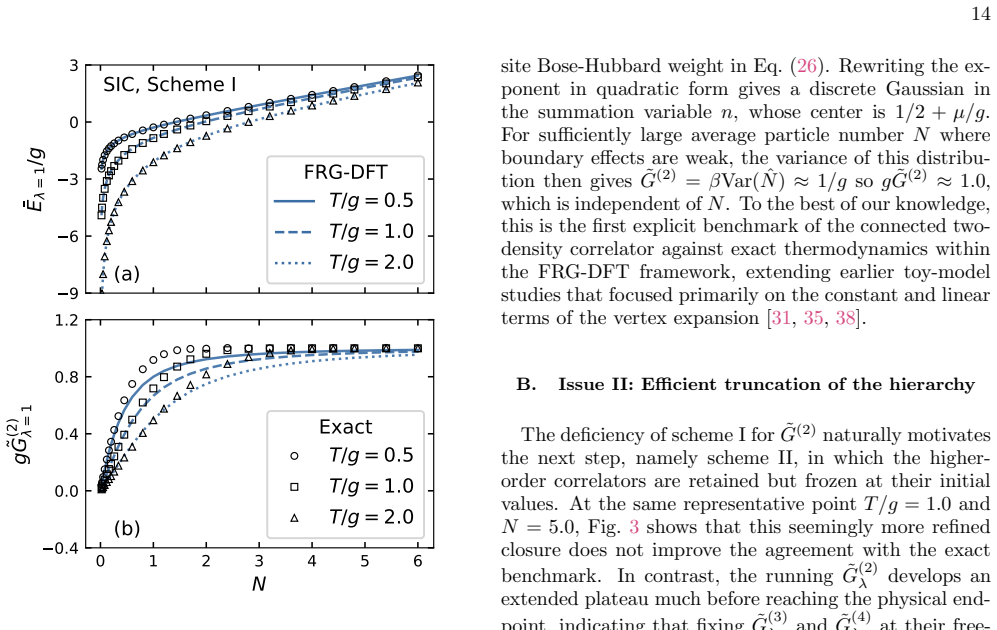
- Chemical potential and fluctuation observables distinguish the quality of closures more sharply than the free energy does.
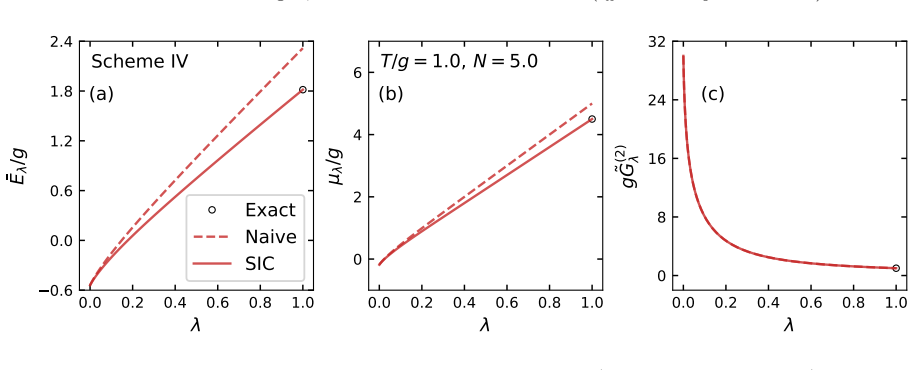
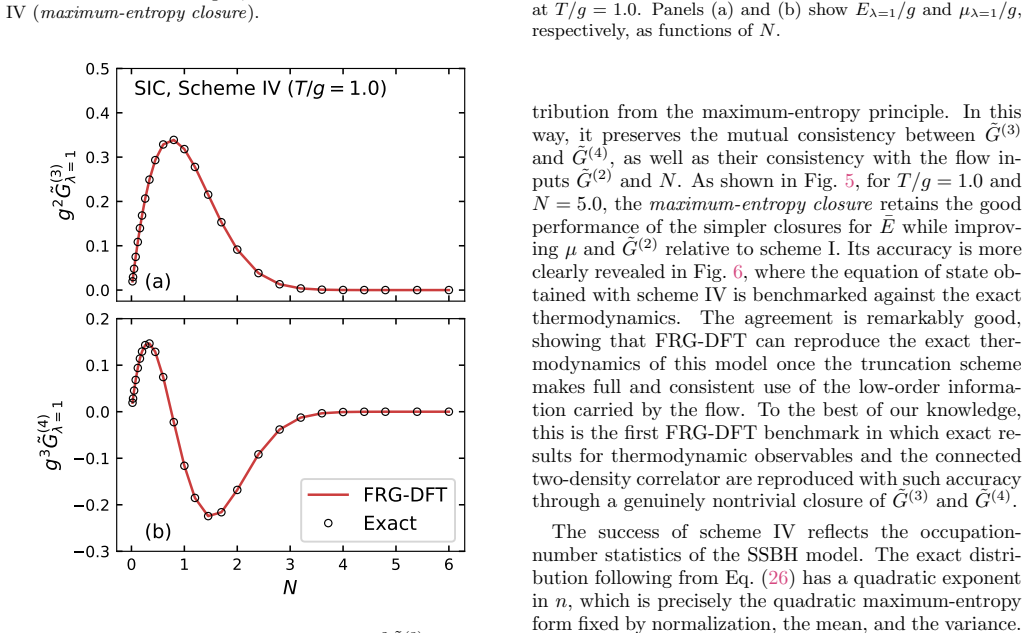
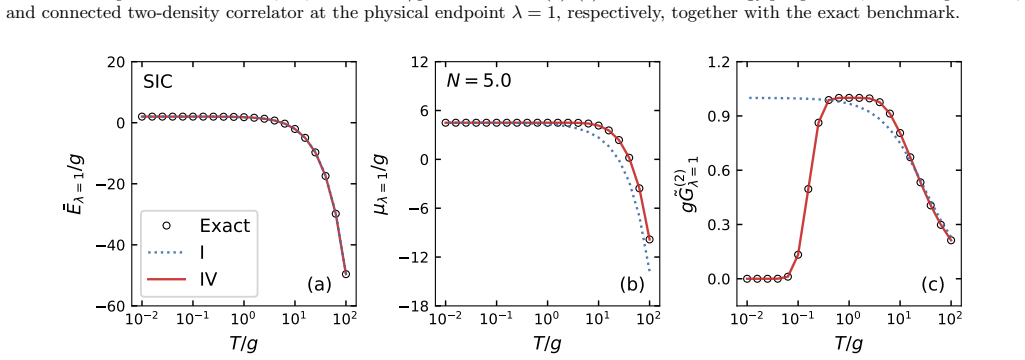
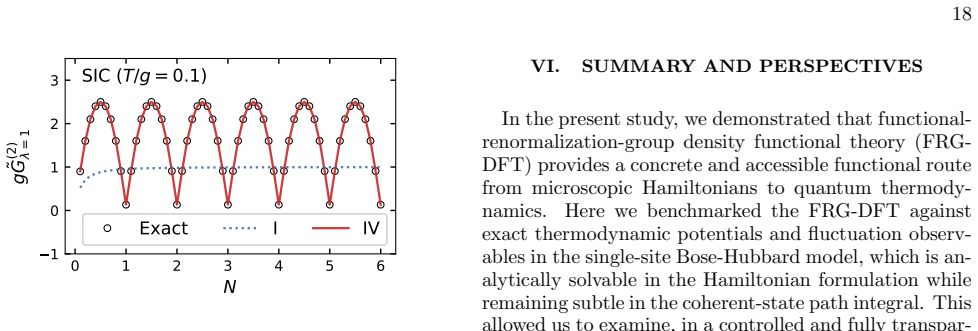
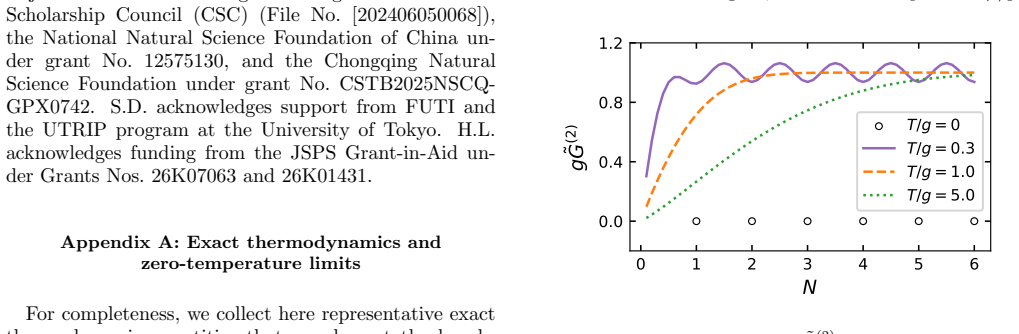
- A maximum-entropy closure reproduces even the low-temperature oscillatory structure of the connected two-density correlator.
- Any functional approach to quantum thermodynamics must retain the contact subtraction in the flow equation and enforce statistical consistency in the closure.
Where Pith is reading between the lines
- The same contact subtraction may prove necessary when extending FRG-DFT to other models with on-site interactions.
- Measurements of density fluctuations in cold-atom realizations of the Bose-Hubbard model could directly test the performance of different closures.
- The benchmark supplies a controlled testbed for deriving density functionals that could later be applied to higher-dimensional or fermionic systems.
Load-bearing premise
The hierarchy of flow equations can be closed while preserving the statistical consistency of the connected density correlators.
What would settle it
A calculation demonstrating that the FRG-DFT flow without the identified equal-time contact subtraction deviates from the exact partition function or thermodynamics of the single-site Bose-Hubbard model at finite interaction strength would show the correction is required.
Figures
read the original abstract
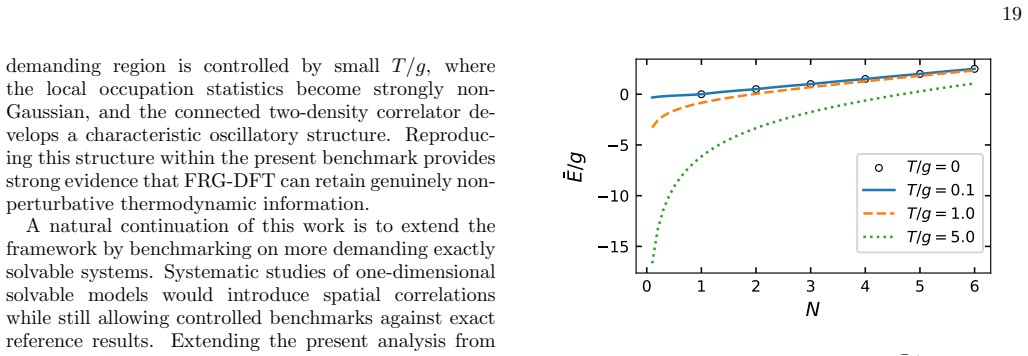
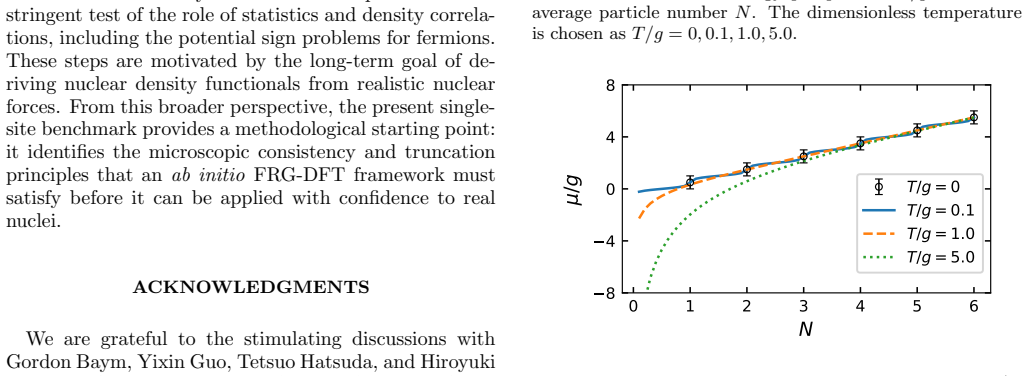
The functional renormalization group provides a nonperturbative and systematically improvable route to constructing density functionals for quantum many-body systems from microscopic Hamiltonians. Here we advance this program by benchmarking functional-renormalization-group density functional theory (FRG-DFT) against the exact thermodynamics of the single-site Bose-Hubbard model. This model provides an ideal testing ground because it is analytically solvable, yet remains subtle in the imaginary-time coherent-state path integral, where a naive continuum treatment generates a spurious self-interaction. We show that a careful Hubbard-Stratonovich derivation identifies the self-interaction correction term that must be included in the FRG-DFT flow to recover the exact thermodynamics. We then systematically compare several closures of the resulting hierarchy of flow equations for the free energy, chemical potential, and connected density correlators over broad ranges of density, temperature, and interaction strength. The benchmark shows that the free energy is comparatively robust, whereas the chemical potential and fluctuation observables provide much sharper diagnostics of the hierarchy closure. A maximum-entropy closure gives the most accurate overall description and reproduces even the low-temperature oscillatory structure of the connected two-density correlator. These results identify two general requirements for functional approaches to quantum thermodynamics: the renormalization group flow equation must retain the equal-time contact subtraction to avoid spurious self-interactions, and any closure of the hierarchy must preserve the statistical consistency of density correlators. This work provides a controlled foundation for deriving ab initio density functionals for quantum many-body systems across condensed-matter, ultracold-atom, and nuclear physics, as well as quantum chemistry.
Editorial analysis
A structured set of objections, weighed in public.
Referee Report
Summary. The paper benchmarks functional-renormalization-group density functional theory (FRG-DFT) on the exactly solvable single-site Bose-Hubbard model. A Hubbard-Stratonovich derivation supplies an equal-time contact subtraction that must be retained in the flow equation to eliminate spurious self-interaction. Systematic comparison of hierarchy closures shows that a maximum-entropy closure recovers the exact free energy, chemical potential, and the low-temperature oscillatory structure of the connected two-density correlator, while other closures are less accurate. The work concludes that functional approaches to quantum thermodynamics require both the contact subtraction and statistical consistency of the closure.
Significance. The manuscript supplies a controlled, parameter-free benchmark against an independent analytic solution together with reproducible comparisons of multiple closures. If the derivations and numerical implementation hold, the results establish two concrete technical requirements (retention of the equal-time subtraction and preservation of correlator consistency) that any functional method must satisfy. This strengthens the foundation for deriving ab initio density functionals from microscopic Hamiltonians in ultracold atoms, condensed matter, and nuclear physics.
minor comments (3)
- [§3] §3 (flow-equation derivation): the precise placement of the contact subtraction term relative to the regulator is stated only in words; an explicit equation showing its insertion into the Wetterich equation would remove ambiguity.
- [Figure 4] Figure 4 (connected correlator): the low-temperature oscillatory structure is visually convincing, but the caption should state the exact temperature and interaction values used for each curve to allow direct reproduction.
- [Table 1] Table 1 (closure comparison): the reported deviations for chemical potential are given only at selected points; adding a column for the maximum relative error across the full scanned range would strengthen the claim that maximum-entropy is uniformly superior.
Simulated Author's Rebuttal
We thank the referee for the careful reading and positive evaluation of the manuscript. The recommendation for minor revision is appreciated, and we note that the report highlights the controlled benchmark and the two technical requirements identified. No specific major comments were raised.
Circularity Check
No significant circularity; derivation validated externally
full rationale
The paper performs a Hubbard-Stratonovich transformation on the imaginary-time path integral of the Bose-Hubbard model to identify the equal-time contact subtraction, then closes the FRG-DFT hierarchy and benchmarks all observables (free energy, chemical potential, connected correlators) directly against the model's independent exact analytic solution. This external benchmark is independent of any fitted parameters or self-citations, satisfying the criteria for a self-contained derivation. No load-bearing step reduces to a self-definition, fitted prediction, or author-only uniqueness theorem.
Axiom & Free-Parameter Ledger
axioms (2)
- domain assumption The functional renormalization group provides a nonperturbative and systematically improvable route to constructing density functionals from microscopic Hamiltonians.
- domain assumption The single-site Bose-Hubbard model is analytically solvable and therefore supplies an exact benchmark.
Reference graph
Works this paper leans on
-
[1]
Kohn, Rev
W. Kohn, Rev. Mod. Phys.71, 1253 (1999)
1999
-
[2]
Bender, P.-H
M. Bender, P.-H. Heenen, and P.-G. Reinhard, Rev. Mod. Phys.75, 121 (2003)
2003
-
[3]
P. N. Ma, S. Pilati, M. Troyer, and X. Dai, Nat. Phys.8, 601 (2012)
2012
-
[4]
P. J. Hasnip, K. Refson, M. I. J. Probert, J. R. Yates, S. J. Clark, and C. J. Pickard, Philos. Trans. R. Soc. A 372, 20130270 (2014)
2014
-
[5]
Pribram-Jones, D
A. Pribram-Jones, D. A. Gross, and K. Burke, Annu. Rev. Phys. Chem.66, 283 (2015)
2015
-
[6]
Dick and M
S. Dick and M. Fernandez-Serra, Nat. Commun.11, 3509 (2020)
2020
-
[7]
Kirkpatrick, B
J. Kirkpatrick, B. McMorrow, D. H. Turban, A. L. Gaunt, J. S. Spencer, A. G. Matthews, A. Obika, L. Thiry, M. Fortunato, D. Pfau,et al., Science374, 1385 (2021)
2021
-
[8]
X. Wu, Z. Ren, and P. Zhao, Commun. Phys.8, 316 (2025)
2025
-
[9]
Hohenberg and W
P. Hohenberg and W. Kohn, Phys. Rev.136, B864 (1964)
1964
-
[10]
J. E. Drut, R. J. Furnstahl, and L. Platter, Prog. Part. Nucl. Phys.64, 120 (2010)
2010
-
[11]
E. H. Lieb, Int. J. Quantum Chem.24, 243 (1983)
1983
-
[12]
Fukuda, T
R. Fukuda, T. Kotani, Y. Suzuki, and S. Yokojima, Prog. Theor. Phys.92, 833 (1994)
1994
-
[13]
Fukuda, M
R. Fukuda, M. Komachiya, S. Yokojima, Y. Suzuki, K. Okumura, and T. Inagaki, Prog. Theor. Phys. Suppl. 121, 1 (1995)
1995
-
[14]
Yokota, H
T. Yokota, H. Kasuya, K. Yoshida, and T. Kunihiro, PTEP2021, 013A03 (2021)
2021
-
[15]
Puglia, A
S. Puglia, A. Bhattacharyya, and R. Furnstahl, Nucl. Phys. A723, 145 (2003). 24
2003
-
[16]
Bhattacharyya and R
A. Bhattacharyya and R. Furnstahl, Nucl. Phys. A747, 268 (2005)
2005
-
[17]
Bhattacharyya and R
A. Bhattacharyya and R. Furnstahl, Phys. Lett. B607, 259 (2005)
2005
-
[18]
G. W. Fernando, inMetallic Multilayers and their Ap- plications, Handbook of Metal Physics, Vol. 4, edited by G. W. Fernando (Elsevier, 2008) pp. 131–156
2008
- [19]
-
[20]
Gell-Mann and F
M. Gell-Mann and F. E. Low, Phys. Rev.95, 1300 (1954)
1954
-
[21]
C. G. Callan, Phys. Rev. D2, 1541 (1970)
1970
-
[22]
Symanzik, Commun
K. Symanzik, Commun. Math. Phys.18, 227 (1970)
1970
-
[23]
K. G. Wilson, Phys. Rev. B4, 3174 (1971)
1971
-
[24]
K. G. Wilson and M. E. Fisher, Phys. Rev. Lett.28, 240 (1972)
1972
-
[25]
K. G. Wilson and J. Kogut, Phys. Rep.12, 75 (1974)
1974
-
[26]
Kopietz, L
P. Kopietz, L. Bartosch, and F. Sch¨ utz,Introduction to the functional renormalization group, Vol. 798 (Springer Science & Business Media, 2010)
2010
-
[27]
Metzner, M
W. Metzner, M. Salmhofer, C. Honerkamp, V. Meden, and K. Sch¨ onhammer, Rev. Mod. Phys.84, 299 (2012)
2012
-
[28]
Dupuis, L
N. Dupuis, L. Canet, A. Eichhorn, W. Metzner, J. M. Pawlowski, M. Tissier, and N. Wschebor, Phys. Rep. 910, 1 (2021)
2021
- [29]
-
[30]
Polonyi and K
J. Polonyi and K. Sailer, Phys. Rev. B66, 155113 (2002)
2002
-
[31]
Kemler and J
S. Kemler and J. Braun, J. Phys. G: Nucl. Part. Phys. 40, 085105 (2013)
2013
-
[32]
Wetterich, Phys
C. Wetterich, Phys. Lett. B301, 90 (1993)
1993
-
[33]
Berges, N
J. Berges, N. Tetradis, and C. Wetterich, Phys. Rep.363, 223 (2002)
2002
-
[34]
J. M. Cornwall, R. Jackiw, and E. Tomboulis, Phys. Rev. D10, 2428 (1974)
1974
-
[35]
J. F. Rentrop, S. G. Jakobs, and V. Meden, J. Phys. A: Math. Theor.48, 145002 (2015)
2015
-
[36]
Kemler, M
S. Kemler, M. Pospiech, and J. Braun, J. Phys. G: Nucl. Part. Phys.44, 015101 (2016)
2016
-
[37]
Yokota, K
T. Yokota, K. Yoshida, and T. Kunihiro, Phys. Rev. C 99, 024302 (2019)
2019
-
[38]
Liang, Y
H. Liang, Y. Niu, and T. Hatsuda, Phys. Lett. B779, 436 (2018)
2018
-
[39]
Yokota and T
T. Yokota and T. Naito, Phys. Rev. B99, 115106 (2019)
2019
-
[40]
Yokota and T
T. Yokota and T. Naito, Phys. Rev. Research3, L012015 (2021)
2021
-
[41]
Yokota and T
T. Yokota and T. Naito, Phys. Rev. B105, 035105 (2022)
2022
-
[42]
Coleman,Introduction to Many-Body Physics(Cam- bridge University Press, 2015)
P. Coleman,Introduction to Many-Body Physics(Cam- bridge University Press, 2015)
2015
-
[43]
J. W. Negele,Quantum many-particle systems(CRC Press, 2018)
2018
-
[44]
Altland and B
A. Altland and B. Simons,Condensed Matter Field The- ory, 3rd ed. (Cambridge University Press, 2023)
2023
-
[45]
J. H. Wilson and V. Galitski, Phys. Rev. Lett.106, 110401 (2011)
2011
-
[46]
Rigorous construction of coherent state path integrals through dualization
F. Bruckmann and J. D. Urbina, (2018), arXiv:1807.10462
work page internal anchor Pith review Pith/arXiv arXiv 2018
-
[47]
Salasnich and C
L. Salasnich and C. Vianello, SciPost Phys. Lect. Notes , 117 (2026)
2026
-
[48]
N. D. Mermin, Phys. Rev.137, A1441 (1965)
1965
-
[49]
Pittalis, C
S. Pittalis, C. R. Proetto, A. Floris, A. Sanna, C. Bersier, K. Burke, and E. K. U. Gross, Phys. Rev. Lett.107, 163001 (2011)
2011
-
[50]
V. V. Karasiev, L. Calder´ ın, and S. B. Trickey, Phys. Rev. E93, 063207 (2016)
2016
-
[51]
Ran¸ con, J
A. Ran¸ con, J. Phys. A: Math. Theor.53, 105302 (2020)
2020
-
[52]
M. P. A. Fisher, P. B. Weichman, G. Grinstein, and D. S. Fisher, Phys. Rev. B40, 546 (1989)
1989
-
[53]
Dagotto, Rev
E. Dagotto, Rev. Mod. Phys.66, 763 (1994)
1994
-
[54]
D. P. Arovas, E. Berg, S. A. Kivelson, and S. Raghu, Annu. Rev. Condens. Matter Phys.13, 239 (2022)
2022
-
[55]
Jaksch, C
D. Jaksch, C. Bruder, J. I. Cirac, C. W. Gardiner, and P. Zoller, Phys. Rev. Lett.81, 3108 (1998)
1998
-
[56]
Bloch, J
I. Bloch, J. Dalibard, and W. Zwerger, Rev. Mod. Phys. 80, 885 (2008)
2008
-
[57]
Esslinger, Annu
T. Esslinger, Annu. Rev. Condens. Matter Phys.1, 129 (2010)
2010
-
[58]
Bloch, J
I. Bloch, J. Dalibard, and S. Nascimb` ene, Nat. Phys.8, 267 (2012)
2012
-
[59]
Lagoin, C
C. Lagoin, C. Morin, K. Baldwin, L. Pfeiffer, and F. Du- bin, Nat. Phys.22, 566 (2026)
2026
- [60]
-
[61]
R. L. Stratonovich, Dokl. Akad. Nauk SSSR115, 1097 (1957)
1957
-
[62]
Hubbard, Phys
J. Hubbard, Phys. Rev. Lett.3, 77 (1959)
1959
-
[63]
Øksendal, inStochastic differential equations: an in- troduction with applications(Springer, 2003) pp
B. Øksendal, inStochastic differential equations: an in- troduction with applications(Springer, 2003) pp. 38–50
2003
-
[64]
Evans and D
T. Evans and D. A. Steer, Nucl. Phys. B474, 481 (1996)
1996
-
[65]
A. M. Tsvelik,Quantum Field Theory in Condensed Mat- ter Physics, 2nd ed. (Cambridge University Press, Cam- bridge, 2007)
2007
-
[66]
A. L. Fetter and J. D. Walecka,Quantum Theory of Many-Particle Systems(McGraw-Hill, New York, 1971)
1971
-
[67]
E. T. Jaynes, Phys. Rev.106, 620 (1957)
1957
-
[68]
E. T. Jaynes, Phys. Rev.108, 171 (1957)
1957
-
[69]
Jarrell and J
M. Jarrell and J. E. Gubernatis, Phys. Rep.269, 133 (1996)
1996
-
[70]
J. R. Dormand and P. J. Prince, J. Comput. Appl. Math. 6, 19 (1980)
1980
discussion (0)
Sign in with ORCID, Apple, or X to comment. Anyone can read and Pith papers without signing in.