REVIEW 3 minor 51 references
Valley-polarized Orbital and Spin Magnetism Induced by Femtosecond Optical Pulses in Two-Dimensional Semiconductors
T0 review · 0 major / 3 minor · reviewed 2026-06-28 · grok-4.3
Pith's one-line read Circularly polarized femtosecond pulses generate controllable valley-polarized spin and orbital magnetic moments in two-dimensional semiconductors.
desk verdict The paper separates orbital (direct, Rabi-like, dephasing-sensitive) from spin (SOC-mediated, gradual) magnetic responses in a minimal 2D Dirac model under circular pulses. read the letter →
The pith
A machine-rendered reading of the paper's core claim, the machinery that carries it, and where it could break.
The reading
What carries the argument
Valley-selective optical selection rules arising from the valley-contrasting magnetic texture of the band structure, which allow circularly polarized light to generate distinct orbital and spin responses.
What would settle it
Time-resolved measurements that show identical temporal profiles and identical sensitivity to dephasing for the induced spin and orbital moments under circularly polarized excitation.
Extended reading notes
Core claim
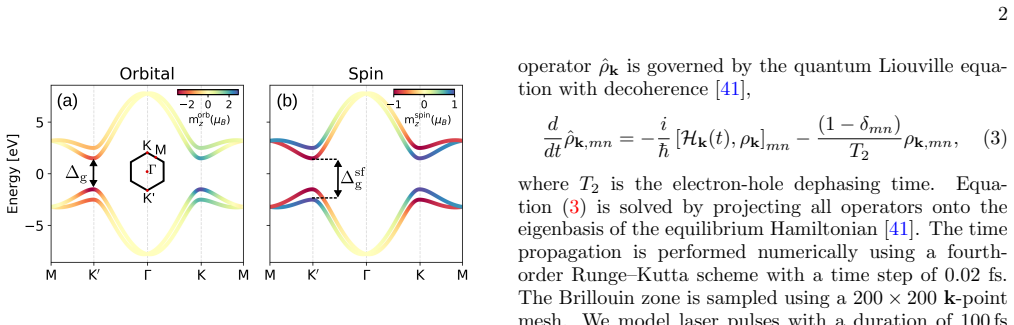
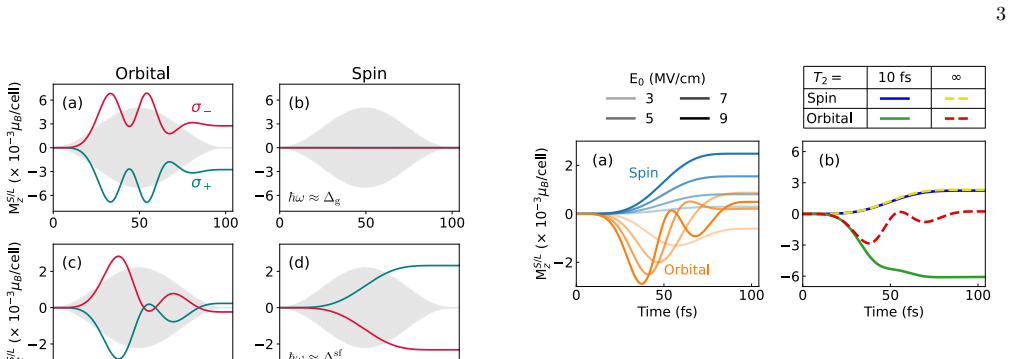
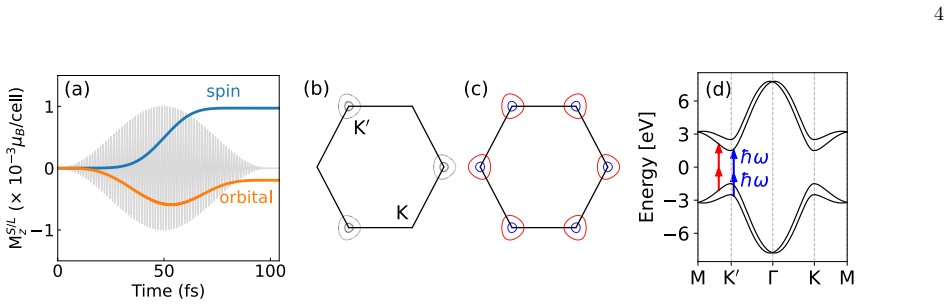
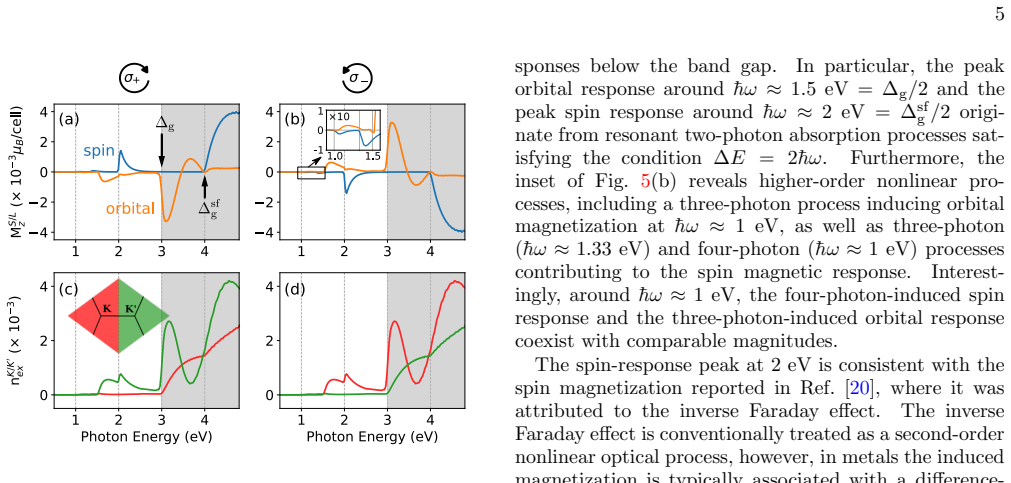
Using a time-dependent density-matrix formalism on a representative 2D gapped Dirac system with spin-orbit coupling, the authors demonstrate that circularly polarized laser pulses produce valley-polarized nonequilibrium spin and orbital magnetism. The induced moments can be tuned separately through photon energy and field polarization. Orbital magnetism arises from direct electric-field coupling and therefore exhibits faster dynamics and Rabi oscillations, while spin magnetism develops gradually via spin-orbit coupling; consequently the orbital signal decays more readily under dephasing.
Load-bearing premise
The time-dependent density-matrix treatment of a 2D gapped Dirac model with spin-orbit coupling faithfully represents the actual light-matter interaction and dephasing processes in real materials.
Editorial extensions
If this is right
- Photon energy and light polarization provide independent knobs for adjusting the relative sizes of the induced spin and orbital moments.
- Orbital magnetism develops on a faster timescale and displays pronounced Rabi-like oscillations because it couples directly to the external electric field.
- Spin magnetism builds more slowly because it requires spin-orbit coupling to transfer angular momentum from the orbital sector.
- Orbital dynamics is significantly more sensitive to electron-hole dephasing than the spin response.
- Technologies that rely on femtosecond optical control of magnetism must include orbital contributions to predict the net magnetization correctly.
Reading between the lines
- Device designs could exploit the faster orbital channel for sub-picosecond switching while using the slower spin channel for longer-lived storage.
- The same separation of timescales might appear in other valleytronic materials whose band structure contains analogous magnetic texture.
- Time-resolved magneto-optical measurements that isolate orbital versus spin signals would provide a direct test of the predicted difference in dephasing sensitivity.
- Tuning across resonant and multiphoton regimes could enable selective suppression of one contribution relative to the other.
Editorial analysis
A structured set of objections, weighed in public.
Referee Report
Summary. The manuscript uses a time-dependent density-matrix formalism on a minimal gapped Dirac Hamiltonian with spin-orbit coupling to demonstrate that circularly polarized femtosecond pulses induce valley-polarized nonequilibrium orbital and spin magnetic moments in 2D semiconductors. It reports that orbital moments arise from direct electric-field coupling (yielding fast Rabi-like oscillations) while spin moments build gradually via SOC, with distinct sensitivities to photon energy, polarization, and electron-hole dephasing under both resonant and multiphoton conditions.
Significance. If the model-level results hold, the work is significant for separating orbital versus spin contributions to ultrafast valley magnetism in systems such as TMDs. The use of a standard density-matrix approach without ad-hoc parameters or circular reductions, together with explicit exploration of dephasing rates, provides a clean demonstration of qualitatively different temporal behaviors. This strengthens the case for including orbital magnetism in interpretations of light-induced magnetic effects.
minor comments (3)
- The mapping from the gapped Dirac model to specific materials (e.g., which TMD parameters are used for the gap and SOC strength) should be stated explicitly, ideally with a table of numerical values employed in the simulations.
- Figure captions and axis labels should clarify whether the plotted moments are valley-resolved or total, and whether they are normalized to the pulse fluence or to a reference value.
- A brief comparison of the computed dephasing dependence against existing experimental reports on TMD coherence times would help anchor the phenomenological rates.
Simulated Author's Rebuttal
We thank the referee for the positive assessment of our manuscript, including the summary of the time-dependent density-matrix results on valley-polarized orbital and spin magnetism, the significance for separating orbital versus spin contributions, and the recommendation for minor revision. No specific major comments were raised in the report.
Circularity Check
No significant circularity detected
full rationale
The paper applies the standard time-dependent density-matrix formalism to the gapped Dirac Hamiltonian with SOC, a minimal model representative of TMDs. Orbital magnetism is obtained from the direct coupling of interband coherence to the vector potential, while spin magnetism enters only through the SOC term; the resulting Rabi-like orbital oscillations versus gradual spin buildup are direct consequences of solving the Liouville-von Neumann equation under these couplings. Dephasing rates are introduced as explicit phenomenological parameters whose variation is explored, not fitted to any output. No self-definitional relations, fitted inputs renamed as predictions, or load-bearing self-citations appear in the derivation chain. The central results are therefore independent demonstrations within the chosen model rather than reductions to the inputs by construction.
Assumptions & free parameters
Cite this review
Pith. "Pith review of Valley-polarized Orbital and Spin Magnetism Induced by Femtosecond Optical Pulses in Two-Dimensional Semiconductors." pith.science (2026). https://pith.science/paper/4DGSVL6X
@misc{pith2026260531263,
  author       = {Pith},
  title        = {Pith review of: Valley-polarized Orbital and Spin Magnetism Induced by Femtosecond Optical Pulses in Two-Dimensional Semiconductors},
  year         = {2026},
  howpublished = {\url{https://pith.science/paper/4DGSVL6X}},
  note         = {Machine review of arXiv:2605.31263}
}
read the original abstract
We theoretically investigate the ultrafast generation of spin and orbital magnetism in a two-dimensional gapped Dirac system with spin-orbit coupling. This system is representative of two-dimensional hexagonal semiconductors, such as transition-metal dichalcogenides that exhibit valley-selective optical selection rules arising from the valley-contrasting magnetic texture of their band structure. Using a time-dependent density-matrix formalism, we demonstrate that circularly polarized laser pulses generate nonequilibrium magnetization under both resonant and multiphoton resonant conditions. We show that the induced spin and orbital magnetic moments can be distinctly controlled via the photon energy and polarization of the driving field. Furthermore, spin and orbital dynamics originate from fundamentally different light-matter coupling mechanisms, leading to qualitatively dissimilar temporal behaviors. The orbital magnetic moment couples directly to the external electric field, resulting in faster dynamics and pronounced Rabi-like oscillations, whereas the spin response develops gradually through spin-orbit coupling. Consequently, orbital dynamics is significantly more sensitive to electron-hole dephasing than the spin response. Our results highlight the importance of properly accounting for orbital contributions in future technologies that utilize femtosecond control of magnetism.
Figures
Figures from the paper (1 more)
Reference graph
Works this paper leans on
-
[1]
A. V. Kimel, A. Kirilyuk, P. A. Usachev, R. V. Pisarev, A. M. Balbashov, and T. Rasing, Ultrafast non-thermal control of magnetization by instantaneous photomagnetic pulses, Nature435, 655 (2005)
2005
-
[2]
Hansteen, A
F. Hansteen, A. Kimel, A. Kirilyuk, and T. Rasing, Non- thermal ultrafast optical control of the magnetization in garnet films, Physical Review B73, 014421 (2006)
2006
-
[3]
C. D. Stanciu, F. Hansteen, A. V. Kimel, A. Kirilyuk, A. Tsukamoto, A. Itoh, and T. Rasing, All-optical mag- netic recording with circularly polarized light, Physical Review Letters99, 047601 (2007)
2007
-
[4]
Vahaplar, A
K. Vahaplar, A. M. Kalashnikova, A. V. Kimel, D. Hinzke, U. Nowak, R. Chantrell, A. Tsukamoto, A. Itoh, A. Kirilyuk, and T. Rasing, Ultrafast path for optical magnetization reversal via a strongly nonequilib- rium state, Physical Review Letters103, 117201 (2009)
2009
-
[5]
Satoh, S.-J
T. Satoh, S.-J. Cho, R. Iida, T. Shimura, K. Kuroda, H. Ueda, Y. Ueda, B. A. Ivanov, F. Nori, and M. Fiebig, Spin oscillations in antiferromagnetic NiO triggered by circularly polarized light, Physical Review Letters105, 077402 (2010)
2010
-
[6]
Kirilyuk, A
A. Kirilyuk, A. V. Kimel, and T. Rasing, Ultrafast opti- 7 cal manipulation of magnetic order, Reviews of Modern Physics82, 2731 (2010)
2010
-
[7]
Vahaplar, A
K. Vahaplar, A. M. Kalashnikova, A. V. Kimel, S. Ger- lach, D. Hinzke, U. Nowak, R. Chantrell, A. Tsukamoto, A. Itoh, A. Kirilyuk,et al., All-optical magnetization re- versal by circularly polarized laser pulses: Experiment and multiscale modeling, Physical Review B85, 104402 (2012)
2012
-
[8]
J. P. Van der Ziel, P. S. Pershan, and L. D. Malmstrom, Optically-induced magnetization resulting from the in- verse Faraday effect, Physical Review Letters15, 190 (1965)
1965
Show all 51 references
-
[9]
P. S. Pershan, J. P. Van der Ziel, and L. D. Malmstrom, Theoretical discussion of the inverse Faraday effect, Ra- man scattering, and related phenomena, Physical review 143, 574 (1966)
1966
-
[10]
Hertel, Theory of the inverse Faraday effect in metals, Journal of magnetism and magnetic materials303, L1 (2006)
R. Hertel, Theory of the inverse Faraday effect in metals, Journal of magnetism and magnetic materials303, L1 (2006)
2006
-
[11]
Popova, A
D. Popova, A. Bringer, and S. Bl¨ ugel, Theory of the in- verse Faraday effect in view of ultrafast magnetization experiments, Physical Review B84, 214421 (2011)
2011
-
[12]
Popova, A
D. Popova, A. Bringer, and S. Bl¨ ugel, Theoretical in- vestigation of the inverse Faraday effect via a stimulated Raman scattering process, Physical Review B85, 094419 (2012)
2012
-
[13]
Battiato, G
M. Battiato, G. Barbalinardo, and P. M. Oppeneer, Quantum theory of the inverse Faraday effect, Physical review B89, 014413 (2014)
2014
-
[14]
Berritta, R
M. Berritta, R. Mondal, K. Carva, and P. M. Oppeneer, Ab initio theory of coherent laser-induced magnetization in metals, Physical Review Letters117, 137203 (2016)
2016
-
[15]
Adamantopoulos, D
T. Adamantopoulos, D. Go, P. M. Oppeneer, and Y. Mokrousov, Light-induced orbital and spin magnetism in 3d, 4d, and 5d transition metals, npj Spintronics3, 27 (2025)
2025
-
[16]
Goulielmakis, V
E. Goulielmakis, V. S. Yakovlev, A. L. Cavalieri, M. Uiberacker, V. Pervak, A. Apolonski, R. Kienberger, U. Kleineberg, and F. Krausz, Attosecond control and measurement: lightwave electronics, Science317, 769 (2007)
2007
-
[17]
Ghimire, G
S. Ghimire, G. Ndabashimiye, A. D. DiChiara, E. Sistrunk, M. I. Stockman, P. Agostini, L. F. DiMauro, and D. A. Reis, Strong-field and attosecond physics in solids, Journal of Physics B: Atomic, Molecular and Op- tical Physics47, 204030 (2014)
2014
-
[18]
S. Y. Kruchinin, F. Krausz, and V. S. Yakovlev, Collo- quium: Strong-field phenomena in periodic systems, Re- views of Modern Physics90, 021002 (2018)
2018
-
[19]
Ghimire and D
S. Ghimire and D. A. Reis, High-harmonic generation from solids, Nature physics15, 10 (2019)
2019
-
[20]
M. S. Okyay, A. H. Kulahlioglu, D. Kochan, and N. Park, Resonant amplification of the inverse Faraday effect mag- netization dynamics of time reversal symmetric insula- tors, Physical Review B102, 104304 (2020)
2020
-
[21]
Neufeld, N
O. Neufeld, N. Tancogne-Dejean, U. De Giovannini, H. H¨ ubener, and A. Rubio, Attosecond magnetization dynamics in non-magnetic materials driven by intense femtosecond lasers, Npj Computational Materials9, 39 (2023)
2023
-
[22]
Neufeld, Linearly polarized few-cycle pulses drive carrier-envelope phase-sensitive coherent magnetization injection, Physical Review Letters135, 206902 (2025)
O. Neufeld, Linearly polarized few-cycle pulses drive carrier-envelope phase-sensitive coherent magnetization injection, Physical Review Letters135, 206902 (2025)
2025
-
[23]
Kittel,Solid state physics, Vol
C. Kittel,Solid state physics, Vol. 3 (Shell Development Company Emeryville, 1955)
1955
-
[24]
D. Go, D. Jo, C. Kim, and H.-W. Lee, Intrinsic spin and orbital Hall effects from orbital texture, Physical review letters121, 086602 (2018)
2018
-
[25]
D. Go, D. Jo, H.-W. Lee, M. Kl¨ aui, and Y. Mokrousov, Orbitronics: Orbital currents in solids, Europhysics Let- ters135, 37001 (2021)
2021
-
[26]
Salemi and P
L. Salemi and P. M. Oppeneer, First-principles theory of intrinsic spin and orbital Hall and Nernst effects in metallic monoatomic crystals, Physical Review Materials 6, 095001 (2022)
2022
-
[27]
K. F. Mak, C. Lee, J. Hone, J. Shan, and T. F. Heinz, Atomically thin MoS2: a new direct-gap semiconductor, Physical review letters105, 136805 (2010)
2010
-
[28]
K. F. Mak and J. Shan, Photonics and optoelectronics of 2D semiconductor transition metal dichalcogenides, Na- ture Photonics10, 216 (2016)
2016
-
[29]
Manzeli, D
S. Manzeli, D. Ovchinnikov, D. Pasquier, O. V. Yazyev, and A. Kis, 2D transition metal dichalcogenides, Nature Reviews Materials2, 17033 (2017)
2017
-
[30]
Langer, C
F. Langer, C. P. Schmid, S. Schlauderer, M. Gmitra, J. Fabian, P. Nagler, C. Sch¨ uller, T. Korn, P. G. Hawkins, J. T. Steiner, U. Huttner, S. W. Koch, M. Kira, and R. Huber, Lightwave valleytronics in a monolayer of tung- sten diselenide, Nature557, 76 (2018)
2018
-
[31]
Jim´ enez-Gal´ an, R
A. Jim´ enez-Gal´ an, R. E. F. Silva, O. Smirnova, and M. Ivanov, Lightwave control of topological properties in 2D materials for sub-cycle and non-resonant valley ma- nipulation, Nature Photonics14, 728 (2020)
2020
-
[32]
M. S. Mrudul, ´A. Jim´ enez-Gal´ an, M. Ivanov, and G. Dixit, Light-induced valleytronics in pristine graphene, Optica8, 422 (2021)
2021
-
[33]
Rana and G
N. Rana and G. Dixit, All-optical ultrafast valley switch- ing in two-dimensional materials, Physical Review Ap- plied19, 034056 (2023)
2023
-
[34]
Mitra, ´A
S. Mitra, ´A. Jim´ enez-Gal´ an, M. Aulich, M. Neuhaus, R. E. F. Silva, V. Pervak, M. F. Kling, and S. Biswas, Light-wave-controlled Haldane model in monolayer hexagonal boron nitride, Nature628, 752 (2024)
2024
-
[35]
Tyulnev, ´A
I. Tyulnev, ´A. Jim´ enez-Gal´ an, J. Poborska, L. Vamos, P. S. J. Russell, F. Tani, O. Smirnova, M. Ivanov, R. E. F. Silva, and J. Biegert, Valleytronics in bulk MoS2 with a topologic optical field, Nature628, 746 (2024)
2024
-
[36]
Gucci, E
F. Gucci, E. B. Molinero, M. Russo, P. San-Jose, F. V. A. Camargo, M. Maiuri, M. Ivanov, ´A. Jim´ enez-Gal´ an, R. E. F. Silva, S. Dal Conte, and G. Cerullo, Encoding and manipulating ultrafast coherent valleytronic infor- mation with lightwaves, Nature Photonics20, 266 (2026)
2026
-
[37]
W. Yao, D. Xiao, and Q. Niu, Valley-dependent opto- electronics from inversion symmetry breaking, Physical Review B77, 235406 (2008)
2008
-
[38]
Xiao, G.-B
D. Xiao, G.-B. Liu, W. Feng, X. Xu, and W. Yao, Cou- pled spin and valley physics in monolayers of MoS2 and other group-VI dichalcogenides, Physical Review Letters 108, 196802 (2012)
2012
-
[39]
Chang and Q
M.-C. Chang and Q. Niu, Berry phase, hyperorbits, and the Hofstadter spectrum: Semiclassical dynamics in mag- netic Bloch bands, Physical Review B53, 7010 (1996)
1996
-
[40]
P. M. Oppeneer, Magneto-optical spectroscopy in the valence-band energy regime: relationship to the magne- tocrystalline anisotropy, Journal of magnetism and mag- netic materials188, 275 (1998)
1998
-
[41]
M. S. Mrudul, Dependence of high-harmonic genera- 8 tion in twisted bilayer graphene on laser pulse ellipticity, Physical Review B110, 115415 (2024)
2024
-
[42]
Bhowal and G
S. Bhowal and G. Vignale, Orbital Hall effect as an alter- native to valley Hall effect in gapped graphene, Physical Review B103, 195309 (2021)
2021
-
[43]
A. Pezo, D. Garc´ ıa Ovalle, and A. Manchon, Orbital Hall effect in crystals: Interatomic versus intra-atomic contri- butions, Physical Review B106, 104414 (2022)
2022
-
[44]
Pozo Oca˜ na and I
´O. Pozo Oca˜ na and I. Souza, Multipole theory of opti- cal spatial dispersion in crystals, SciPost Physics14, 118 (2023)
2023
-
[45]
Thonhauser, D
T. Thonhauser, D. Ceresoli, D. Vanderbilt, and R. Resta, Orbital magnetization in periodic insulators, Physical Review Letters95, 137205 (2005)
2005
-
[46]
D. Xiao, J. Shi, and Q. Niu, Berry phase correction to electron density of states in solids, Physical Review Let- ters95, 137204 (2005)
2005
-
[47]
J. Shi, G. Vignale, D. Xiao, and Q. Niu, Quantum the- ory of orbital magnetization and its generalization to in- teracting systems, Physical Review Letters99, 197202 (2007)
2007
-
[48]
Kuneˇ s and P
J. Kuneˇ s and P. M. Oppeneer, Exact many-body sum rule for the magneto-optical spectrum of solids, Phys. Rev. B 61, 15774 (2000)
2000
-
[49]
Souza and D
I. Souza and D. Vanderbilt, Dichroic f-sum rule and the orbital magnetization of crystals, Physical Review B77, 054438 (2008)
2008
-
[50]
C. C. Gerry and P. L. Knight,Introductory quantum op- tics(Cambridge university press, 2023)
2023
-
[51]
M. S. Mrudul and P. M. Oppeneer, Ab initio investi- gation of laser-induced ultrafast demagnetization ofL1 0 FePt: Intensity dependence and importance of electron coherence, Physical Review B109, 144418 (2024)
2024
Reviewed June 28, 2026 · model on record in the stance chip above.
Discussion (0). Continue with ORCID to comment.